" height="26.80529977783203px" id="tymKb8bqC" width="128.00300311279295px"/><path d="M 0 2.417 L 0 0 L 12.909 0 L 12.909 2.417 Z" fill="rgb(126, 78, 253)" height="2.417099999999998px" id="aYr4em6zK" transform="translate(128.341 22.325)" width="12.908999999999992px"/></svg>)

"/><stop offset="1" stop-color="rgb(118, 37, 250)"/></linearGradient></defs><g d="M 19.242 21.22 L 19.362 6.204 L 19.272 6.204 L 13.757 21.22 L 10.161 21.22 L 4.796 6.204 L 4.706 6.204 L 4.825 21.22 L 0 21.22 L 0 0 L 7.283 0 L 12.109 13.607 L 12.229 13.607 L 16.844 0 L 24.247 0 L 24.247 21.22 Z M 26.421 26.113 L 26.421 23.445 L 41.407 23.445 L 41.407 26.113 Z" fill="transparent" height="26.112508199679183px" id="DvfaAIHYn" width="41.40731898311435px"><path d="M 19.242 21.22 L 19.362 6.204 L 19.272 6.204 L 13.757 21.22 L 10.161 21.22 L 4.796 6.204 L 4.706 6.204 L 4.825 21.22 L 0 21.22 L 0 0 L 7.283 0 L 12.109 13.607 L 12.229 13.607 L 16.844 0 L 24.247 0 L 24.247 21.22 Z" fill="rgb(46, 46, 46)" height="21.220180016149442px" id="pLsxRCobd" width="24.247352589074694px"/><path d="M 0 2.668 L 0 0 L 14.986 0 L 14.986 2.668 Z" fill="url(%23yD9d4I5GR-3279285344-linear-gradient)" height="2.6675085048549647px" id="yD9d4I5GR" transform="translate(26.421 23.445)" width="14.986002836263765px"/></g></svg>)

Naïlé Titah
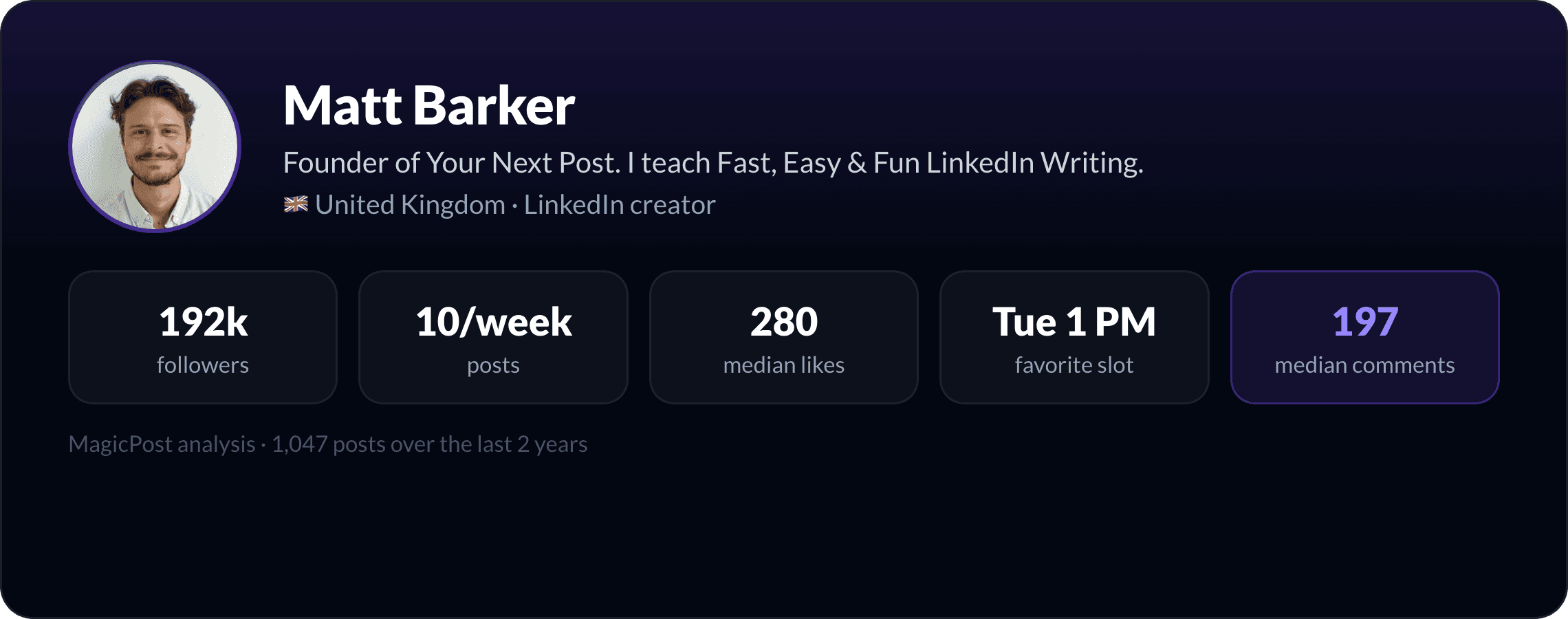
Of the 196 creators in our catalog, Matt Barker is one of the most-studied, a hook writer whose method has spread across the platform despite a following many names dwarf. At MagicPost we analyzed 1,047 of his LinkedIn posts (back to 2022): what he writes, when, for whom, and what makes his style worth studying.
There is a twist that makes this the most fitting page in the cluster. He once wrote a hook so good that, in his own words, "the whole of LinkedIn copied it INCLUDING Ali Abdaal's ghostwriter." When the whole platform borrows your hook, that is proof your method works.
This is who he is, by the best possible source: his own posts, measured.
His story, in his own posts
Barker tells his origin story constantly, and our data shows which chapters he treats as load-bearing.
The leap. "12 months ago I left a £35,000/year job in London with nothing lined up," he wrote in an early post. He and his girlfriend moved to Cyprus "with: No job, No LinkedIn presence, 1 months salary each leftover." An old boss reached out for copywriting, and a hungover New Year's resolution did the rest: "I want to do something for myself... She said 'just do your copywriting'. So I did."
The grind nobody saw. "In Jan 22, I started posting on LinkedIn every day... I posted at 7:55am GMT. No skipping... Every day. Like a lunatic," he recalls. The early numbers were brutal, and he reprints them often: "My 1st LinkedIn post got 22 likes. My 2nd LinkedIn post got 6 likes. My 3rd LinkedIn post got 2 likes."
The business. Three years on, the picture inverts. "I no longer have to write to make money. Instead I teach LinkedIn Writing & Growth to CEOs, Founders and Leaders. I've made around $1M in business revenue," he wrote, adding that he had become "an Investor & Advisor for MagicPost." A monthly breakdown showed the engine: "My business goal: hit $300k in 2025. I'm at $292k... I have no co-founders, team or payroll."
The values. What ties it together is a deliberately anti-guru stance. His most-liked post of all time, at 6,604 likes, is a confession of everything he does "wrong" by guru standards: "I like a drink. I don't meditate. I hate coffee chats... According to the rules of 99% of productivity/lifestyle/digital nomad based content, I am an absolute f**k up. Yet I live a content, financially free life." He would rather "just do the work instead of looking busy" than perform success.
One thing our data surfaces that a normal bio never would: his origin story is not a post, it is a format he re-runs. The "I left a £35,000/year job" account from 2022 reappears almost verbatim in a 2025 version with the ending updated, and the "3 years ago I was single, 28lbs overweight" timeline (6,016 likes) comes back as a "6 years ago" reboot. When a story works for Barker, he does not retire it, he reformats it.



What he actually talks about
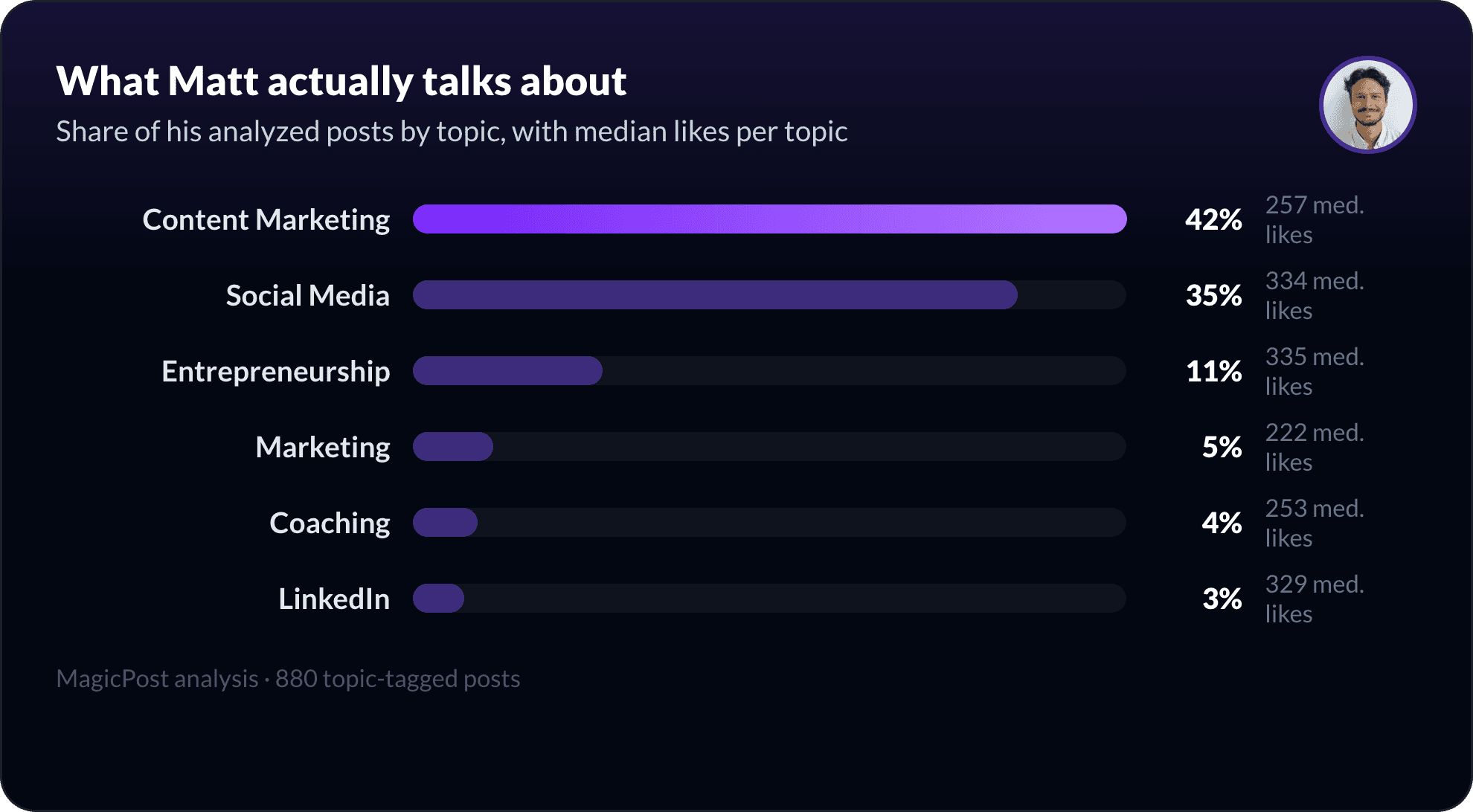
His feed is narrower than most, on purpose. Content Marketing and Social Media together account for the large majority of his analyzed posts, with entrepreneurship, marketing and coaching filling the rest. He calls it strategy, not a rut: "I write about the same topics... You'll never see me hopping from one trend to the next, like others."
Two details beat the ranking:
The "softer" topics out-earn the core one. Social Media (about 334 median likes) and Entrepreneurship (about 335) beat his bread-and-butter Content Marketing (about 257). His audience rewards him most when he zooms out from craft to the life around it.
By register, his biggest mode is selling through value (about 200 posts), with punchy standalone advice close behind (about 189). But a striking share, the personal updates, baby news, marriage timelines, lentil-soup mornings, is pure life. That mix is the whole brand: teach, sell, be a human.
Who he writes for
His reader is explicit: the beginner posting into silence, and the person who suspects there is another way out of the 9-to-5. He addresses them directly: "Shout out to everyone posting on LinkedIn with less than 500 followers and no engagement. I know the feeling." His offer matches: a free Social Copywriting book, a writing club, and the promise in his headline, to make LinkedIn writing "Fast, Easy & Fun."
His best posts of 2026
His biggest posts of 2026 so far, from our data:
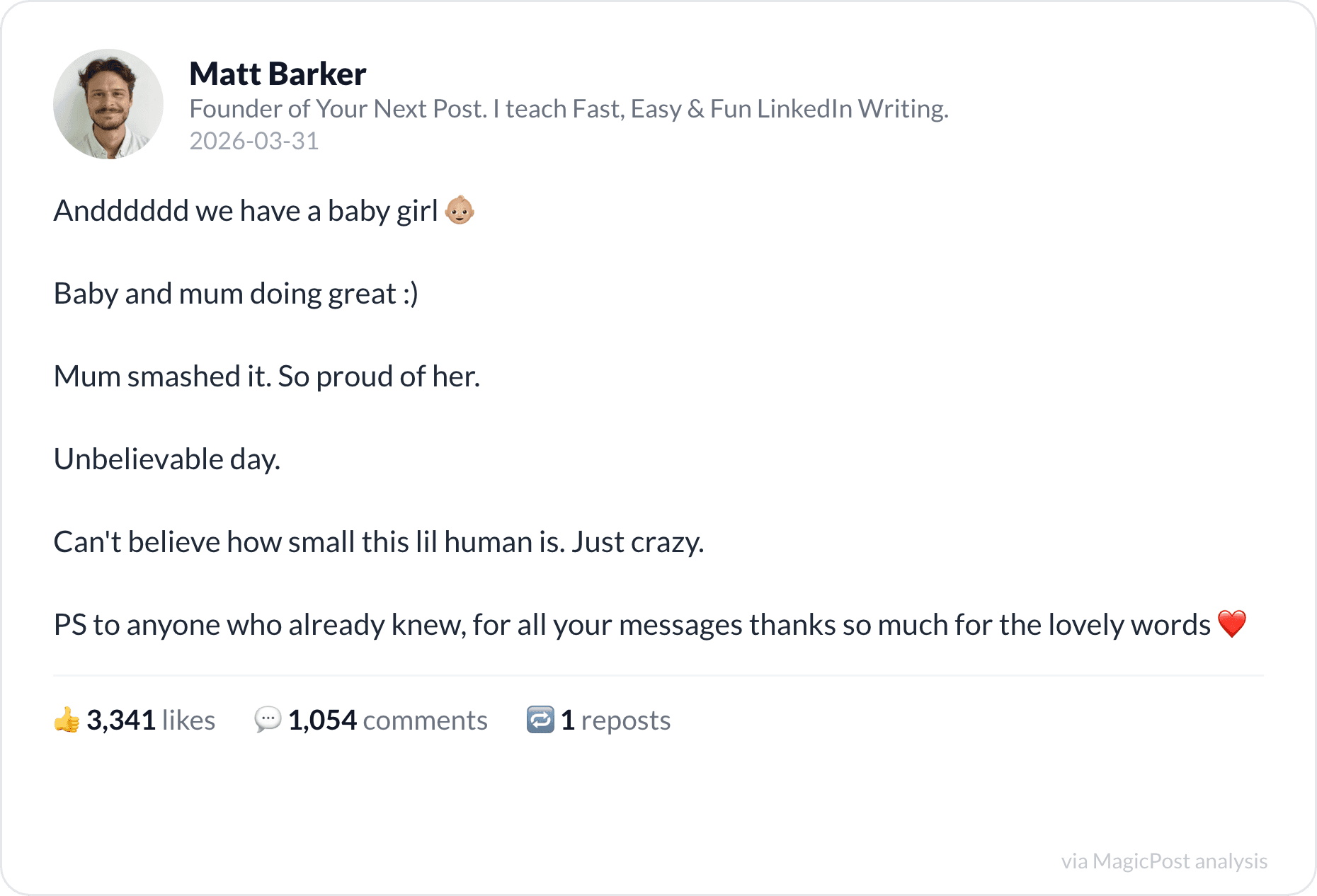
3,341 likes. "Andddddd we have a baby girl." His most-liked 2026 post is not about LinkedIn at all. The rawest possible personal news, six short lines, zero strategy, and it dwarfed everything else he published.
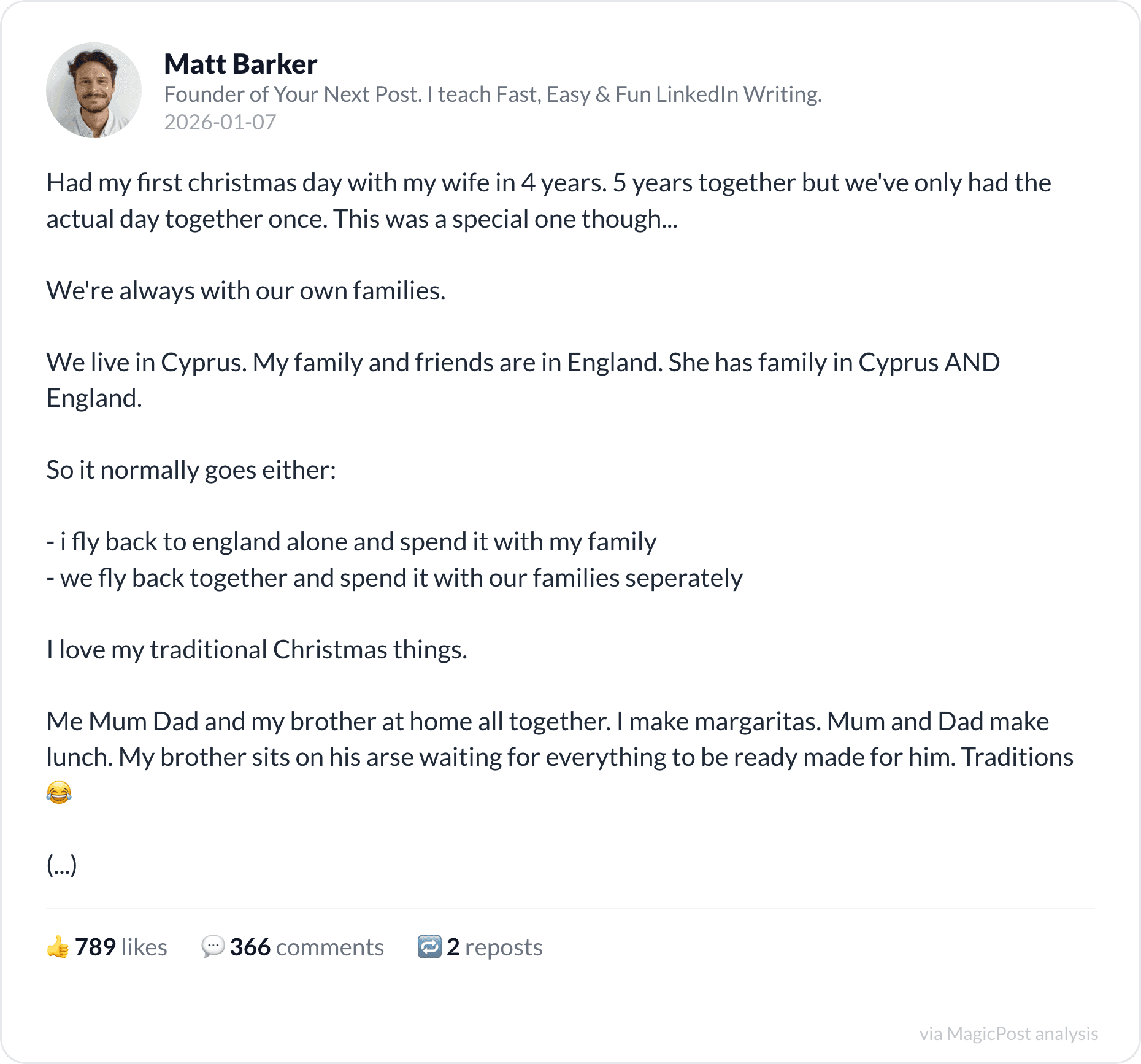
789 likes. An unhurried story about his first Christmas Day with his wife in four years, landing on "Baby on the way in March." Proof a slow personal narrative can outperform any tactic post.
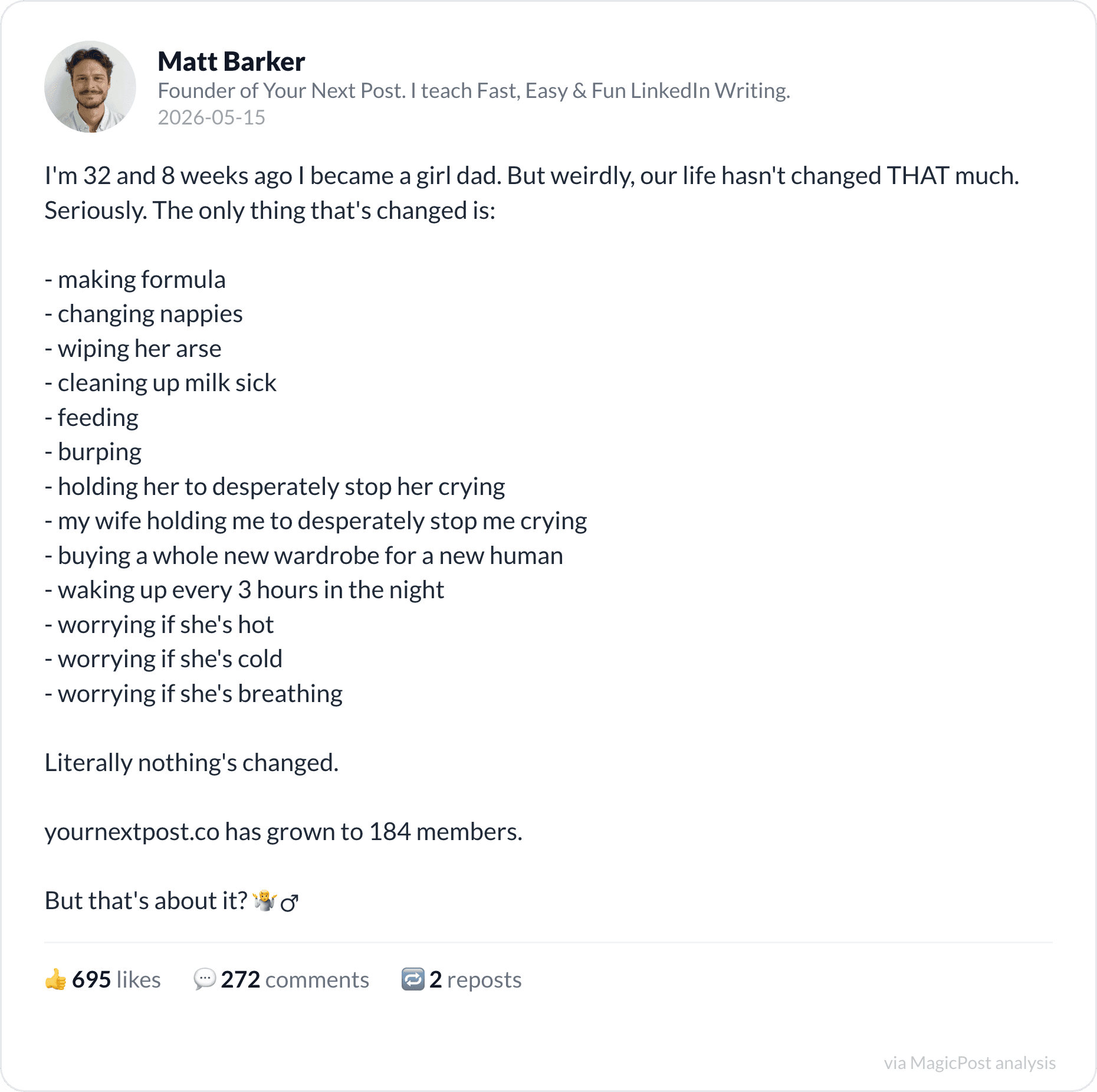
695 likes. The girl-dad list ("making formula, changing nappies... waking up every 3 hours in the night") with one business line smuggled in the middle, then the punchline: "Literally nothing's changed." His teach-while-being-human formula at its cleanest.
Is he still growing?
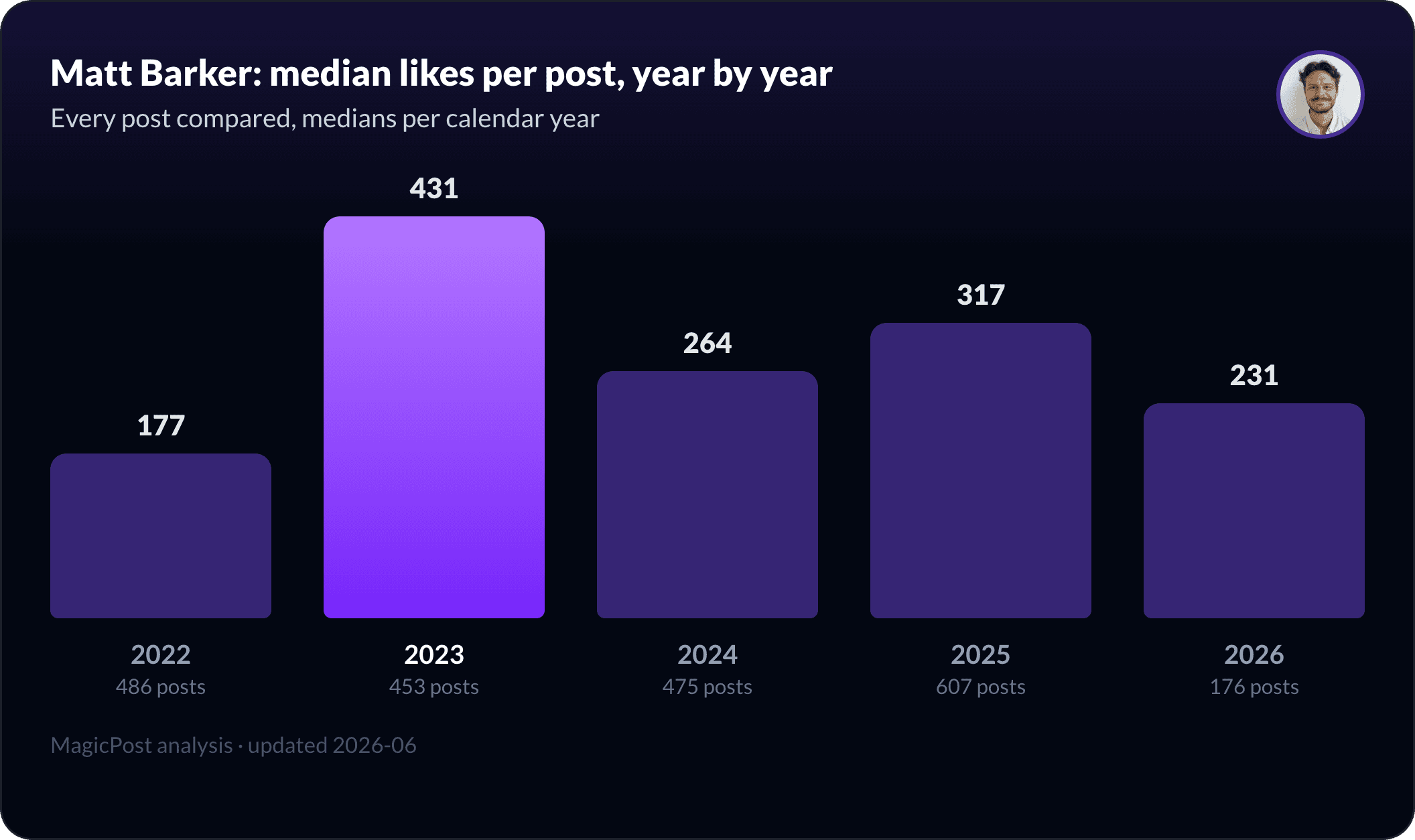
Honestly, his per-post engagement has not climbed in a straight line. His median post drew about 177 likes in 2022, spiked to about 431 in 2023, then settled to about 264 in 2024, about 317 in 2025, and about 231 across early 2026, all while his follower count grew past 192,000. That is the honest shape of a mature creator: more followers does not automatically mean more likes per post. We measure engagement, not followers over time, so this is the trajectory of how hard each post lands, not of his audience size, which has only grown.
What the medians hide is his real signature: conversation. His typical post pulls about 280 likes and about 197 comments, a ratio that high almost no one matches. It is no accident: "I replied to every comment on my post, fast... It made people come back," he wrote.
Where do these charts come from? Everything on this page runs on MagicPost's LinkedIn analytics, and it works on your profile too: your best posts, your audience, your benchmark, even a side-by-side with him.
How he writes
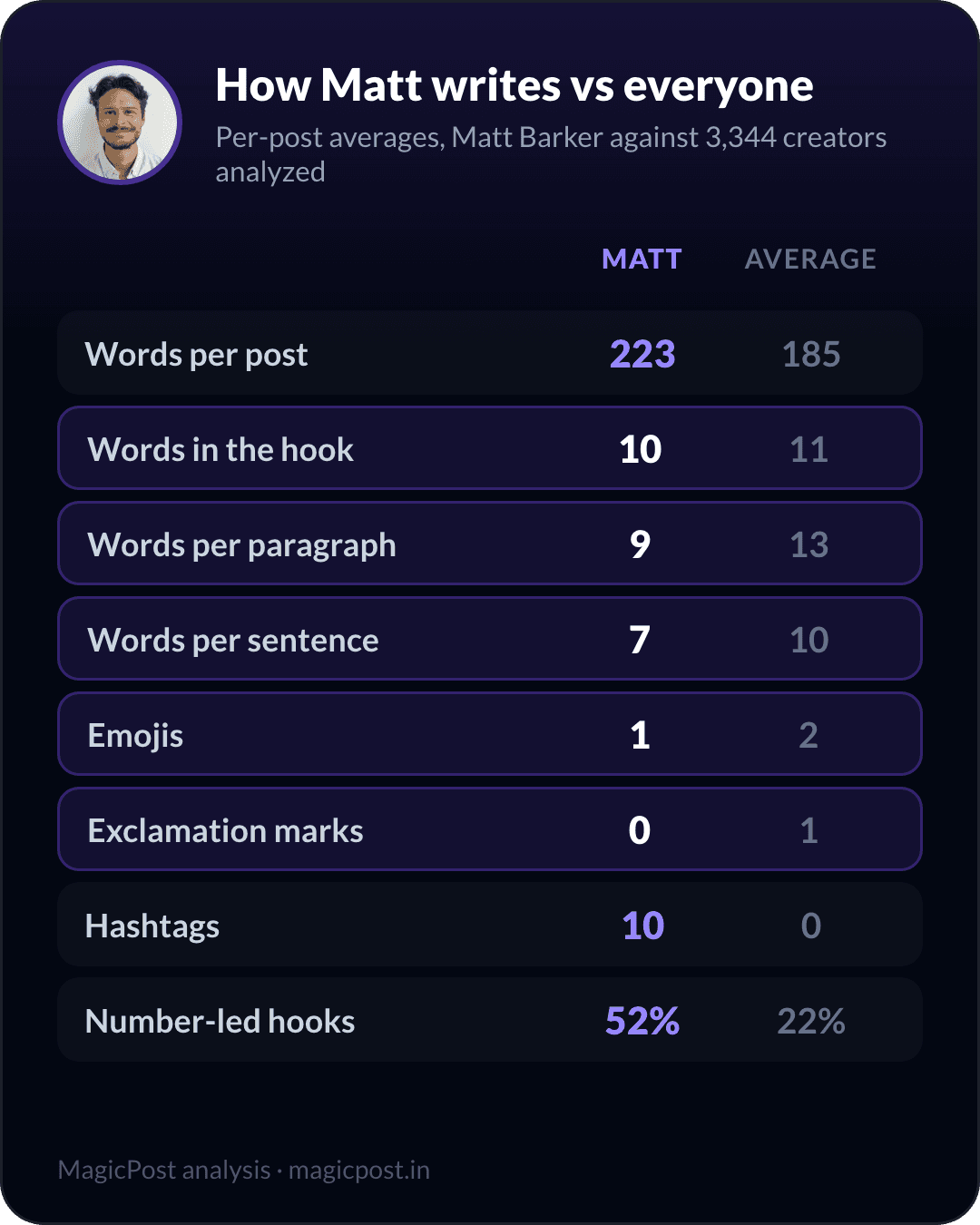
Metric (per post) | Matt Barker | Average creator* |
Words | ~223 | 185 |
Words in the hook | 10 | 11 |
Words per paragraph | 9 | 13 |
Words per sentence | 7 | 10 |
Emojis | 1 | 2 |
Exclamation marks | 0 | 1 |
Hashtags | 10 | 0 |
Hooks built on numbers | 52% | 22% |
*Median across the 3,344 creators we analyzed with 20+ posts each.
He is not a short writer: at about 223 words he runs longer than average. What makes him read fast is rhythm inside the length. His typical sentence is seven words against the average ten, his typical paragraph nine against thirteen, so a long post is really many tiny lines stacked with air between them. The number that jumps off the table is the hook: more than half his posts open on a number ("hit $300k", "3 years ago I was single"), against 22% for the average creator. In one word, our system calls his style: punchy.
The "AI tells" in his style (read this the right way)
Run Barker through the patterns people now call "AI tells," and the result is almost funny, because no creator has been louder about AI copycats than him.
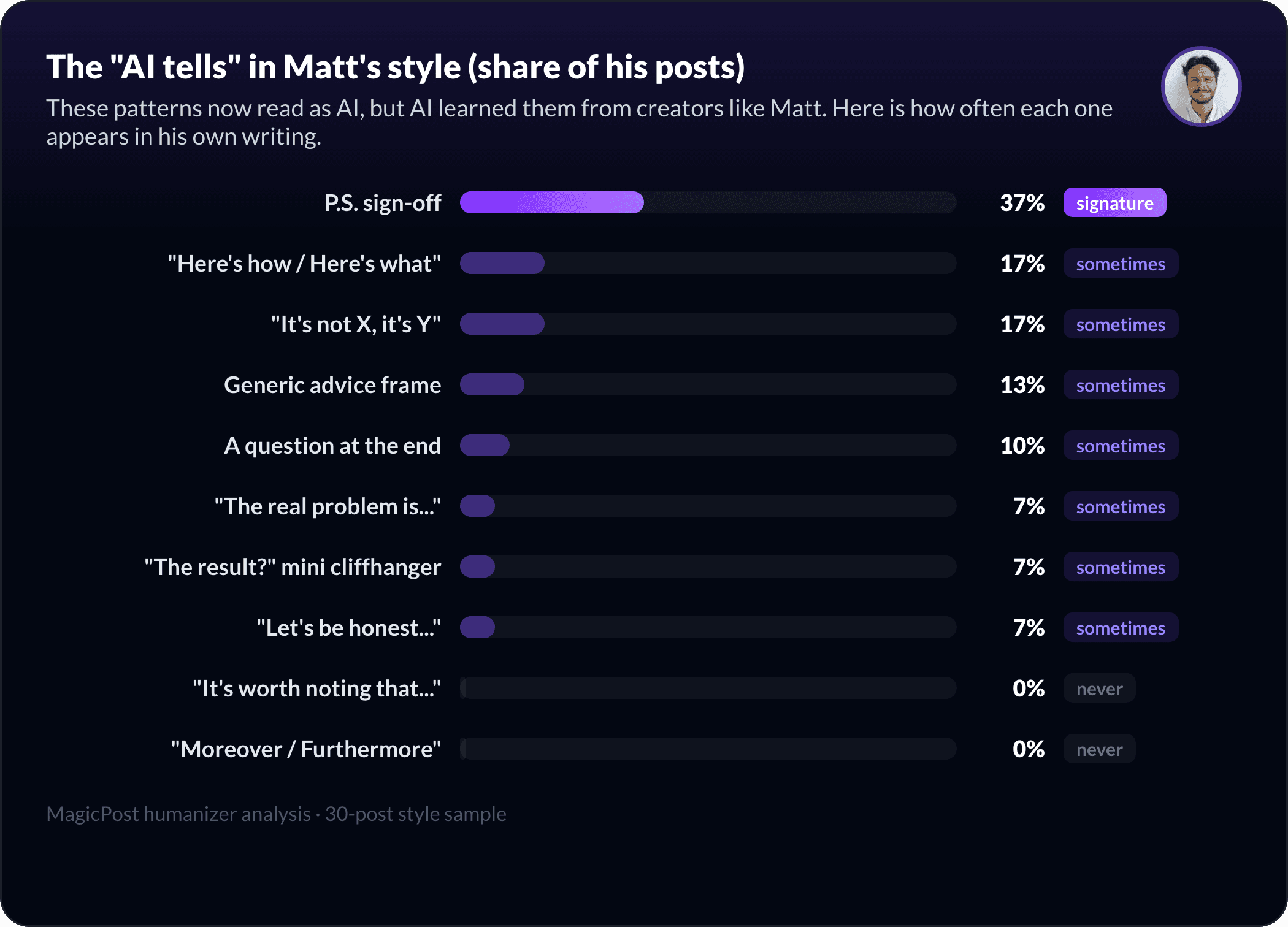
The most "characteristic" device in his profile is the P.S. sign-off, in roughly a third of his posts, almost always a personal aside ("p.s. this is me holding wads of cash"). After that the numbers drop fast: about one in six posts opens with a "Here's how" framing or uses the "It's not X, it's Y" contrast move, and the rest of the catalog of generic AI patterns is occasional at most.
Do not read it backwards. Barker does not write like an AI; AI writes like Barker. These moves read as robotic today because the models trained on the best creators of this platform, then deployed every move at once, in every post. The other half of his profile is what AI cannot resist adding and he refuses to: he never opens with a "Moreover"-style transition, and he never hedges with "it's worth noting that." And he is gleeful about it. "Every day I see lazy AI copy pasted posts, I smile... I never use AI to replace my personality and individuality," he wrote. The discipline is his signature.
When he posts
Barker publishes about 10 times a week, favorite slot Tuesday 1 PM London time, with 28% of his posts on weekends and only 19% in the morning, despite the 7:55am routine he built his early audience on. That weekend share sits well above most creators, and it fits what our UK timing data shows about an audience that scrolls outside office hours. His volume sits near the top of what our posting-frequency study measured, but he is blunt that it came after years of daily reps. And if part of your playbook is showing up in his comments, where he replies to everyone, that is what an engagement feed is for: his posts, every day, without hunting the timeline.
What to steal from Matt Barker
Open on a number. More than half his posts do. A concrete figure in line one ("$292k", "22 likes") earns the click before the reader decides.
Build a signature story and reformat it. His Cyprus origin tale has run in multiple shapes over three years, pulling thousands of likes each time. It is an asset, not a one-off.
Be a human, not a brand. His biggest post of 2026 was baby news. The life posts out-earn the tactic posts, because they are why people follow a person.
Reply to every comment, fast. It is why his comment count rivals his like count. The conversation is the moat, not the post.
One strong move per post, never six. A P.S. here, a contrast there, never the full AI stack. That restraint is the difference between a signature and a tell.
Study him, then study yourself. With MagicPost you can dig into Matt Barker's numbers the way we just did, analyze your own LinkedIn the same way, and write in the spirit of his style, as 464 people already do, more than for any creator we track.
Where this data comes from
Everything here is MagicPost's own research. We analyzed 1,047 Matt Barker posts back to 2022: timing, engagement, topics, writing metrics, and the AI-pattern profile from a 30-post style sample. Every biographical claim is quoted from one of his own public LinkedIn posts and linked to it. Barker is an advisor to MagicPost, which he has said publicly; separately, his style is one of those MagicPost tracks most closely.
Perguntas Frequentes
Who is Matt Barker?
A British LinkedIn writer based in Cyprus, founder of Your Next Post, who left a £35,000 London job in 2021 and built a one-person LinkedIn writing business he reports at around $1M in cumulative revenue, with about 192,000 followers. His tagline: make LinkedIn writing "Fast, Easy & Fun."
How does Matt Barker make money?
By his own public account: teaching LinkedIn writing and growth to CEOs, founders and leaders, a writing club, and a free book funnel, with no team or payroll. He reported tracking toward roughly $300k in 2025.
How often does Matt Barker post on LinkedIn?
About 10 posts a week in our data, most often around 1 PM London time on a Tuesday, with 28% of his posts on weekends.
Does Matt Barker write with AI?
He says he uses AI to speed up his workflow but never to replace his personality, and openly celebrates competitors who copy-paste AI posts. His style predates the AI era; the patterns people now call "AI tells" (like the contrast move) read that way because AI tools learned from creators like him, then overused them.
Is Matt Barker still growing on LinkedIn?
His follower count has grown past 192,000. His per-post engagement has been steadier than rising, normal for a mature creator, but his comment counts (about 197 per post) stay unusually high, a sign of a genuinely engaged audience.
Can I write like Matt Barker?
You can learn the mechanics: MagicPost learns a creator's writing style (length, rhythm, hooks, signature moves) and helps you write in that spirit, in your own voice.
The Top LinkedIn Creators to Study in 2026 (By the Data)
The top LinkedIn creators to study in 2026, by the data: 62 creators, six languages, 27 countries, 32,000 posts analyzed by MagicPost. Grouped by what they teach.
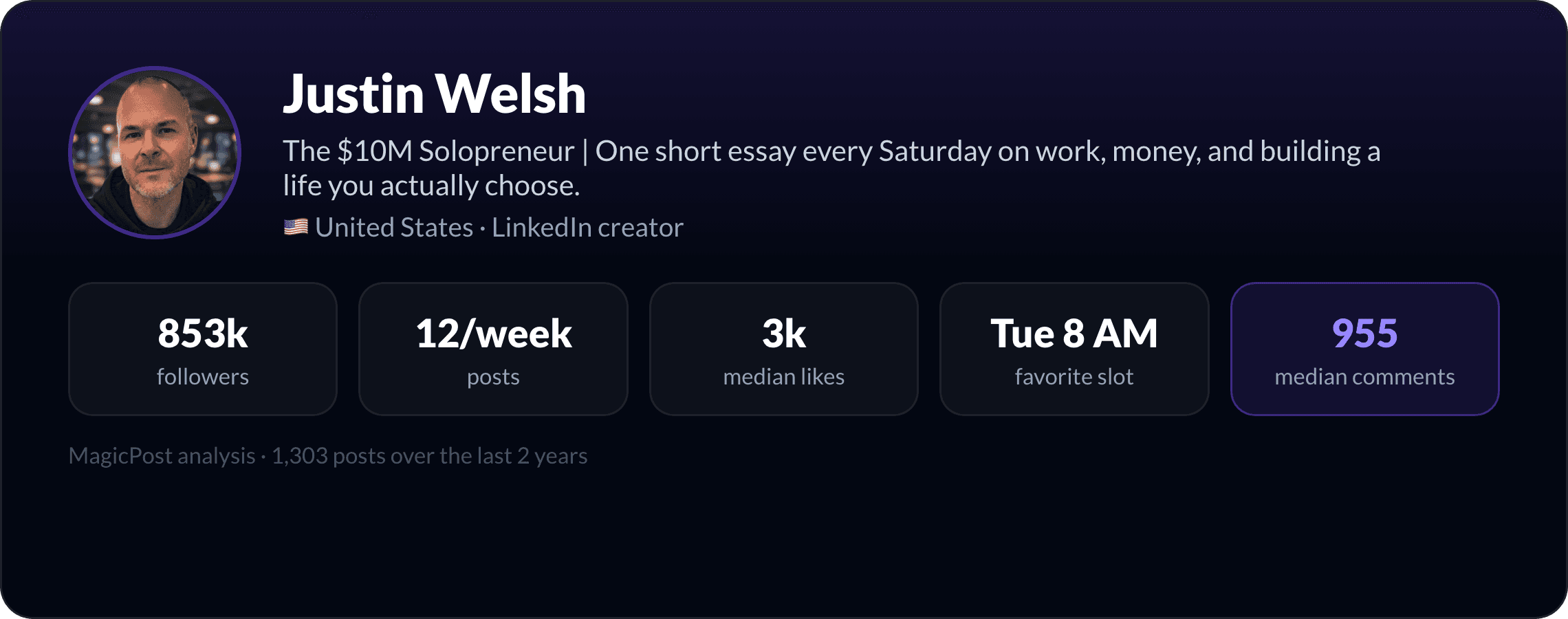
Who Is Justin Welsh? The $10M Solopreneur, Explained by Data (2026)
Who is Justin Welsh? MagicPost analyzed 1,303 of their LinkedIn posts: topics, timing, signature moves and the writing fingerprint behind their growth, with rea
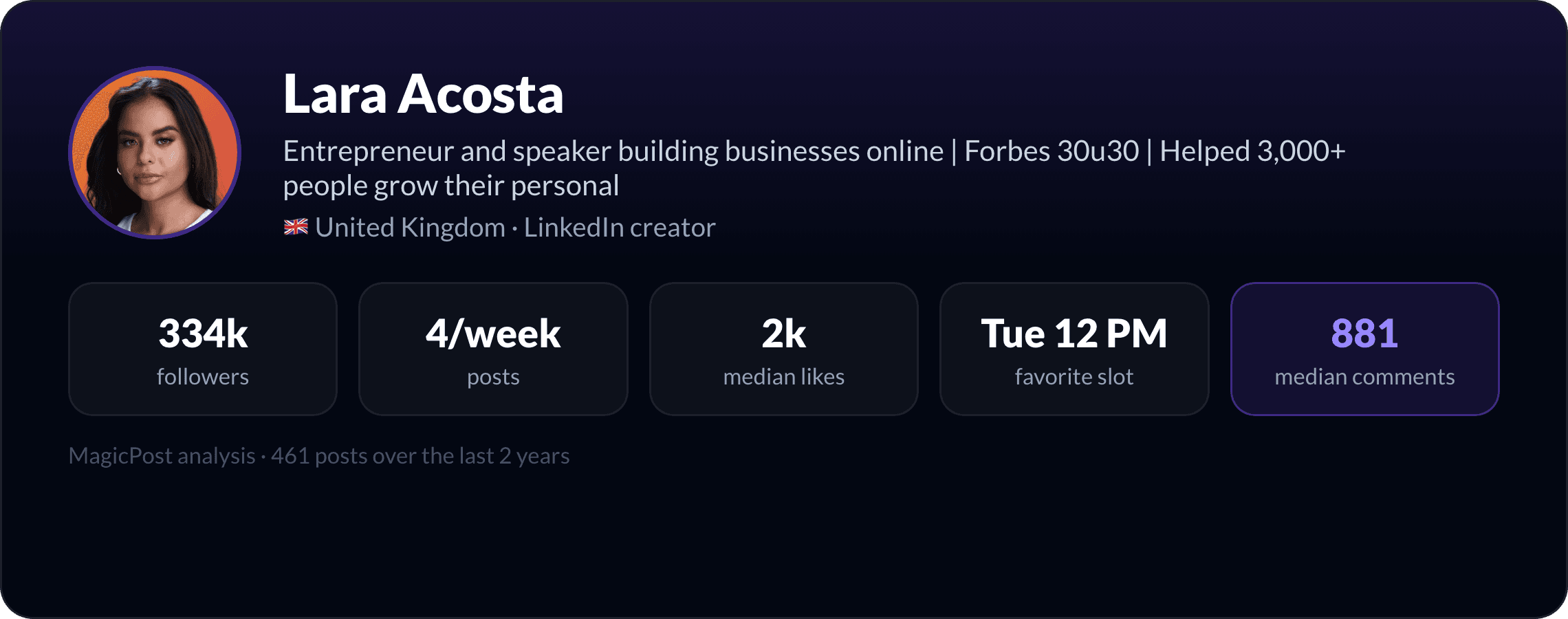
Who Is Lara Acosta? The Forbes 30 Under 30 Comment Machine, Explained by Data (2026)
Who is Lara Acosta? MagicPost analyzed 461 of their LinkedIn posts: topics, timing, signature moves and the writing fingerprint behind their growth, with real n
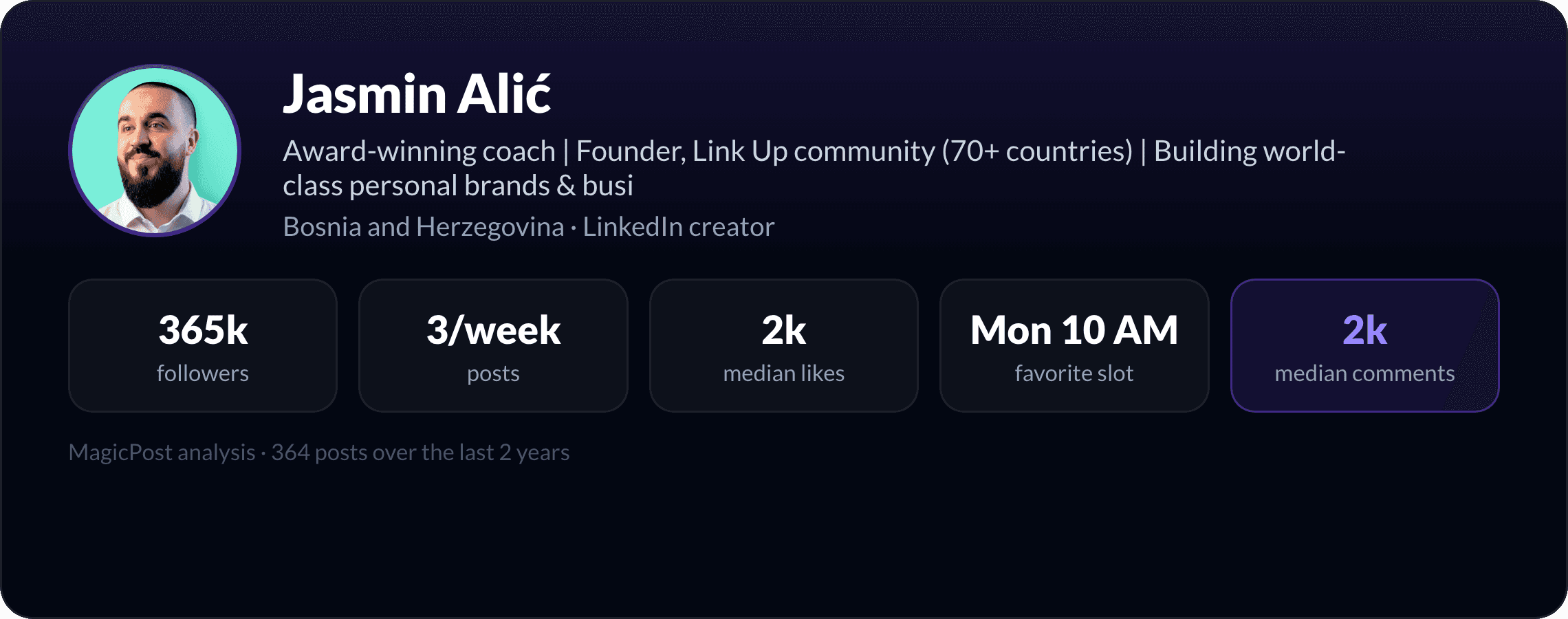
Who Is Jasmin Alić? The Bosnian Coach LinkedIn Mistook for a Bot (2026)
Who is Jasmin Alić? MagicPost analyzed 364 of their LinkedIn posts: topics, timing, signature moves and the writing fingerprint behind their growth, with real n
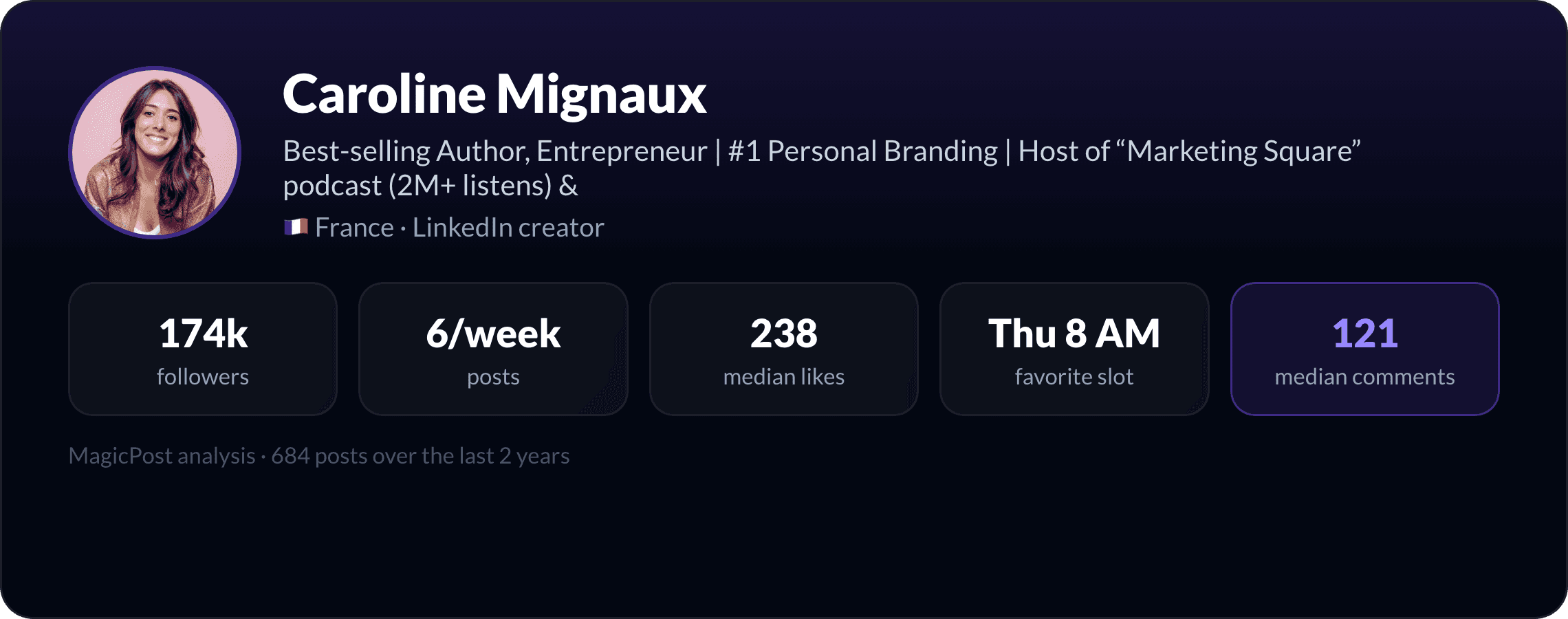
Who Is Caroline Mignaux? France's LinkedIn Top Voice Who Turned Shame Into a Following (2026)
Who is Caroline Mignaux? MagicPost analyzed 684 of their LinkedIn posts: topics, timing, signature moves and the writing fingerprint behind their growth, with r
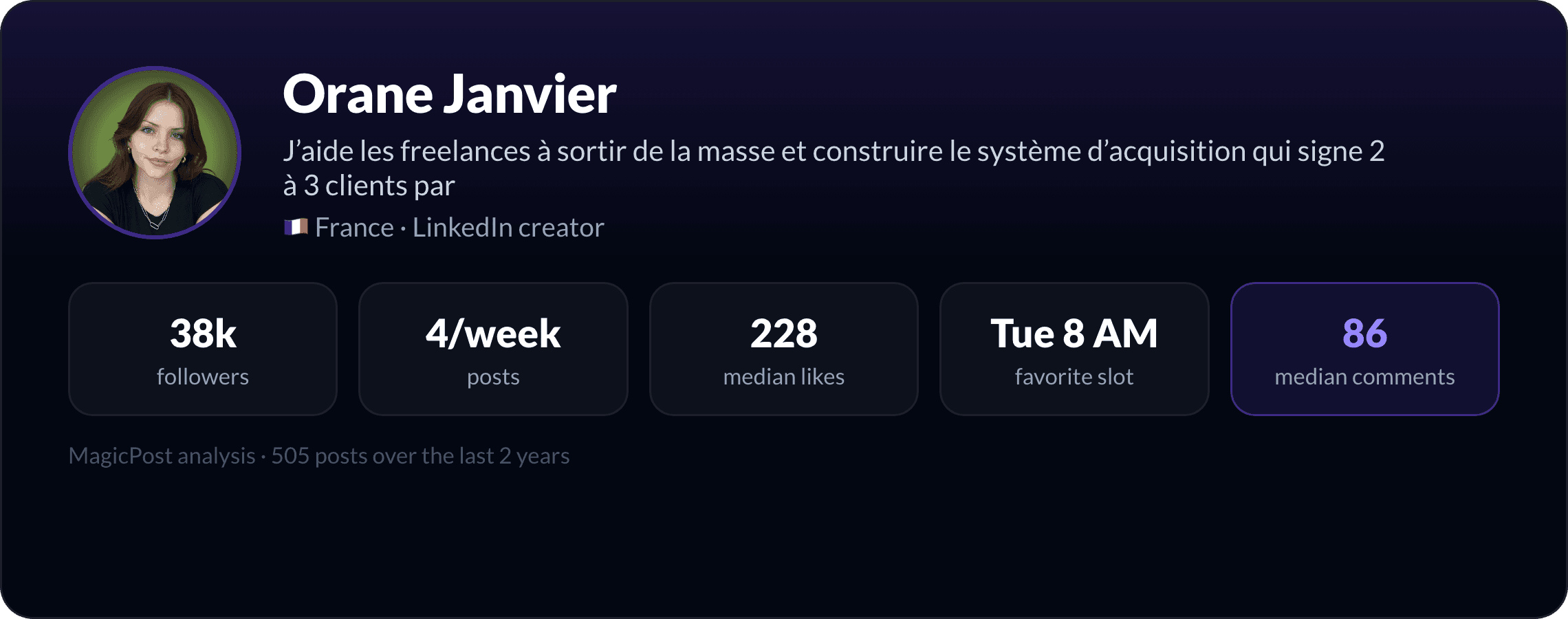
Who Is Orane Janvier? The Freelance Coach LinkedIn Quietly Copies (2026)
Who is Orane Janvier? MagicPost analyzed 505 of their LinkedIn posts: topics, timing, signature moves and the writing fingerprint behind their growth, with real
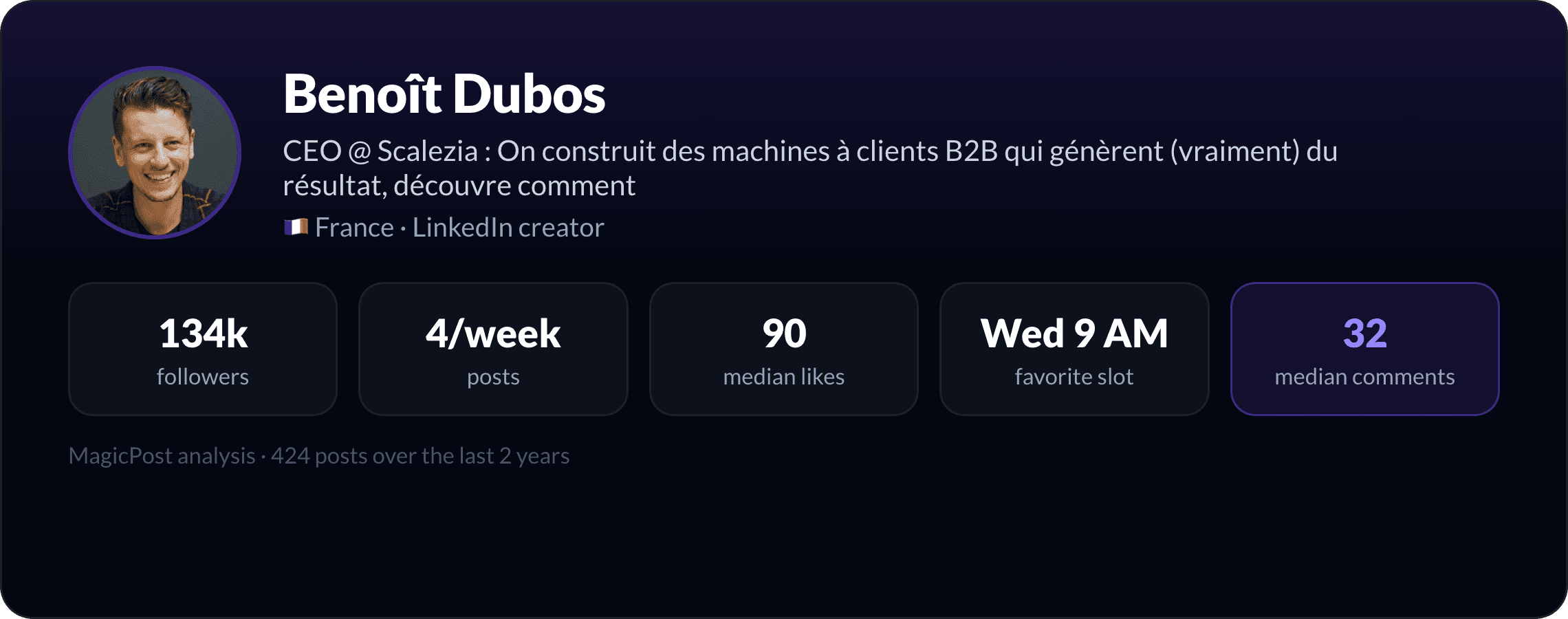
Who Is Benoît Dubos? The Growth Operator Who Turned a Falling Reach Into a Lead Machine (2026)
Who is Benoît Dubos? MagicPost analyzed 424 of their LinkedIn posts: topics, timing, signature moves and the writing fingerprint behind their growth, with real
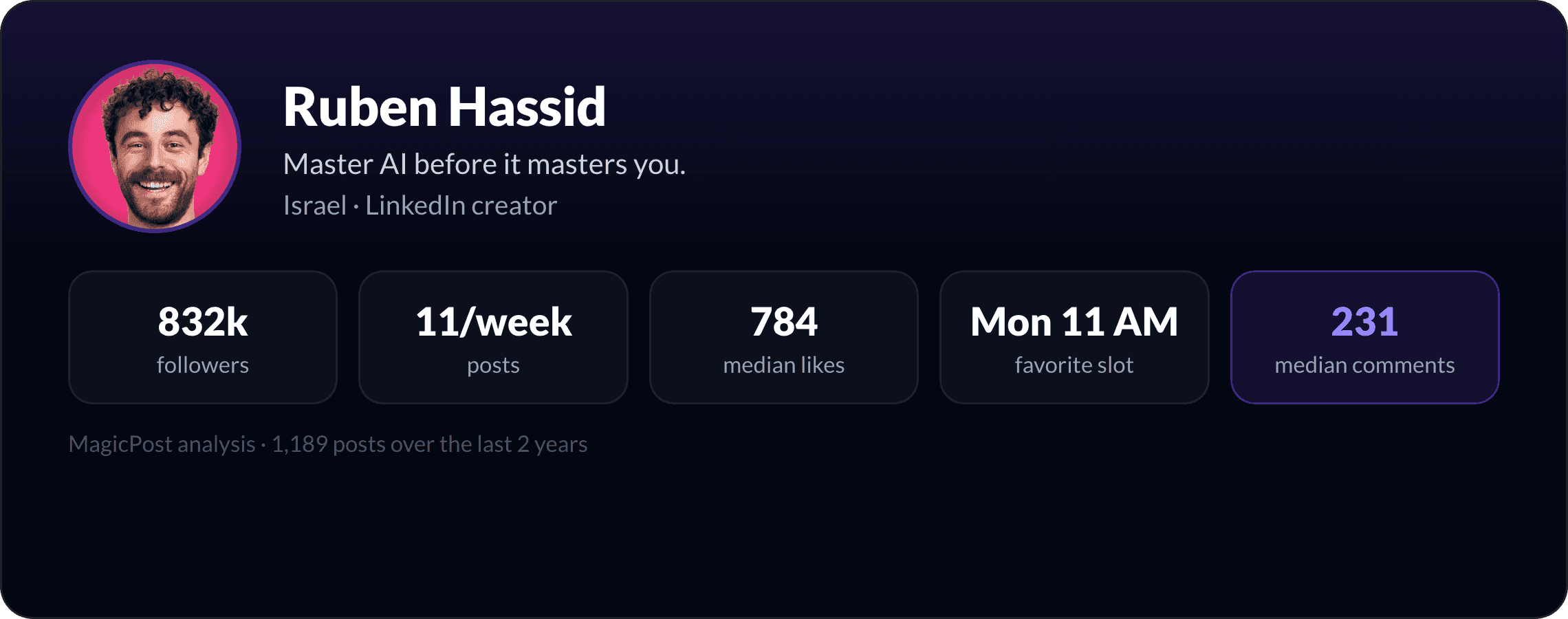
Who Is Ruben Hassid? The "Master AI Before It Masters You" Creator, Explained by Data (2026)
Who is Ruben Hassid? MagicPost analyzed 1,189 of their LinkedIn posts: topics, timing, signature moves and the writing fingerprint behind their growth, with rea
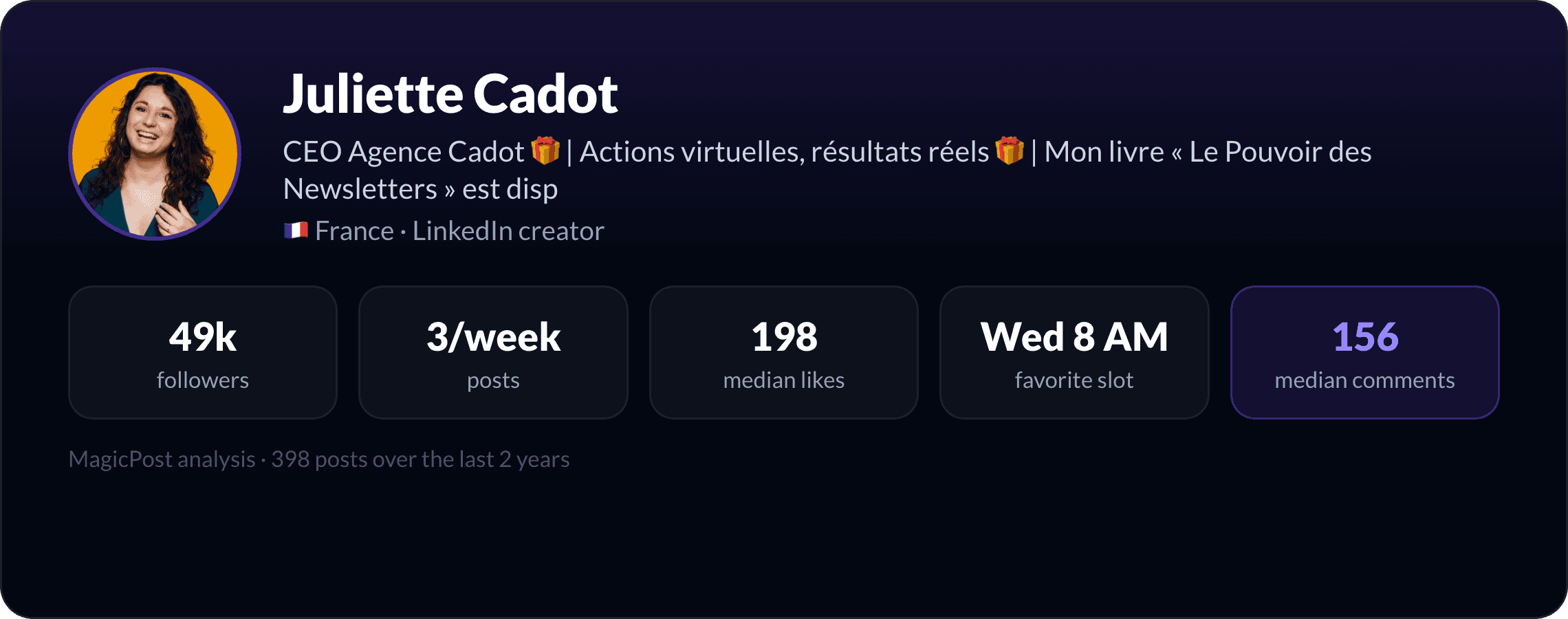
Who Is Juliette Cadot? The Agency Founder Whose Audience Talks Back (2026)
Who is Juliette Cadot? MagicPost analyzed 398 of their LinkedIn posts: topics, timing, signature moves and the writing fingerprint behind their growth, with rea
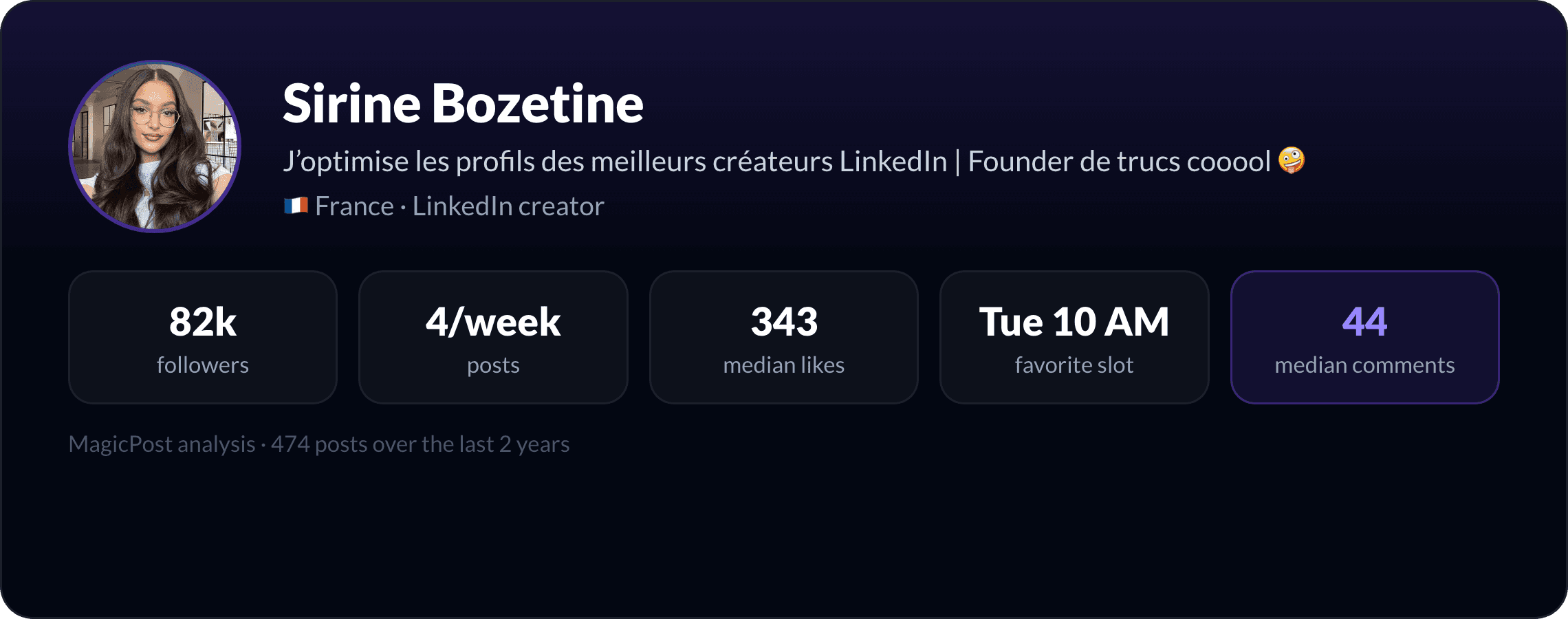
Who Is Sirine Bozetine? The Creator Who Turned Getting Rejected Into 82k Followers (2026)
Who is Sirine Bozetine? MagicPost analyzed 474 of their LinkedIn posts: topics, timing, signature moves and the writing fingerprint behind their growth, with re