The old advice was a comfortable lie: keep it short, respect people's time, get to the point. We sorted 1,194,021 LinkedIn posts published over the last 12 months by how many words they contain and lined each band up against the engagement it earned. The result is the cleanest curve in this entire study.
The short version: longer posts win, and they win at every single step. A post under 25 words earns a median of 19 likes. A post of 400 words or more earns 47. There is no peak in the middle, no sweet spot where it turns around. The line goes up the whole way.
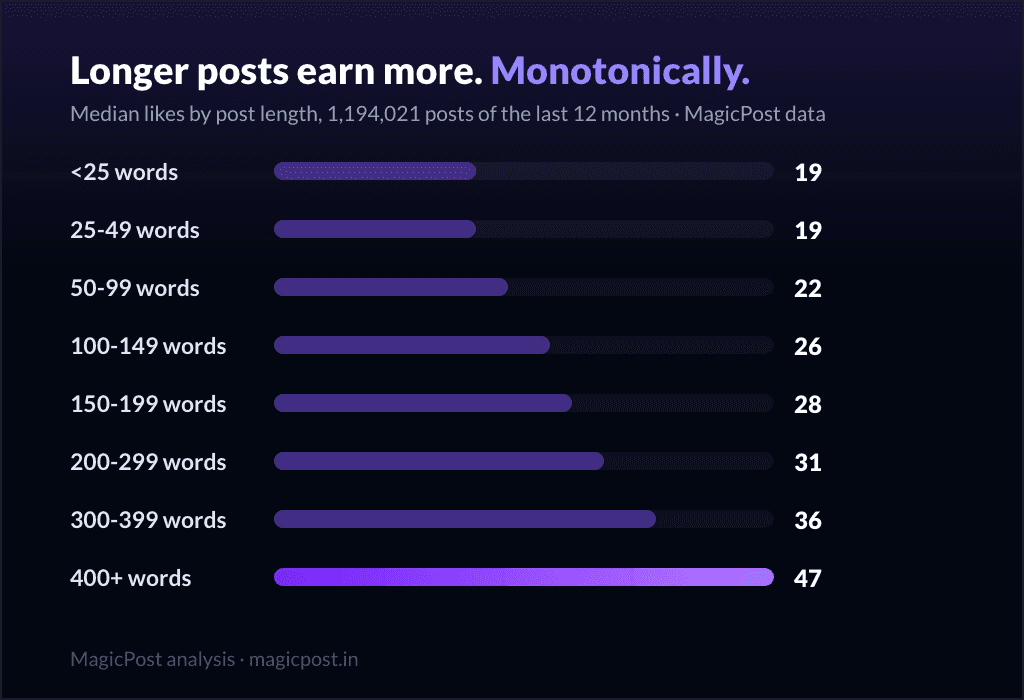
The full curve: every length band beats the one before it
Here is the whole thing, all eight bands, with the number of posts behind each row so you can see none of this rests on a thin sample:
Post length (words) | Posts measured | Median likes | Median comments |
Under 25 | 77,668 | 19 | 2 |
25 to 49 | 74,864 | 19 | 3 |
50 to 99 | 164,552 | 22 | 3 |
100 to 149 | 205,682 | 26 | 5 |
150 to 199 | 218,416 | 28 | 7 |
200 to 299 | 289,578 | 31 | 8 |
300 to 399 | 111,064 | 36 | 10 |
400 or more | 52,197 | 47 | 14 |
Read it top to bottom. Every band beats the one above it on likes, and every band beats it on comments too. Comments climb even harder than likes: from 2 on the shortest posts to 14 on the longest, a 7x spread. Longer posts do not just collect more passive approval, they start more conversations.
The jump at the very top is the loudest. A 400-plus-word post earns 47 median likes, against 19 for a sub-25-word post: roughly two and a half times the engagement for writing more. The folklore had it exactly backwards.
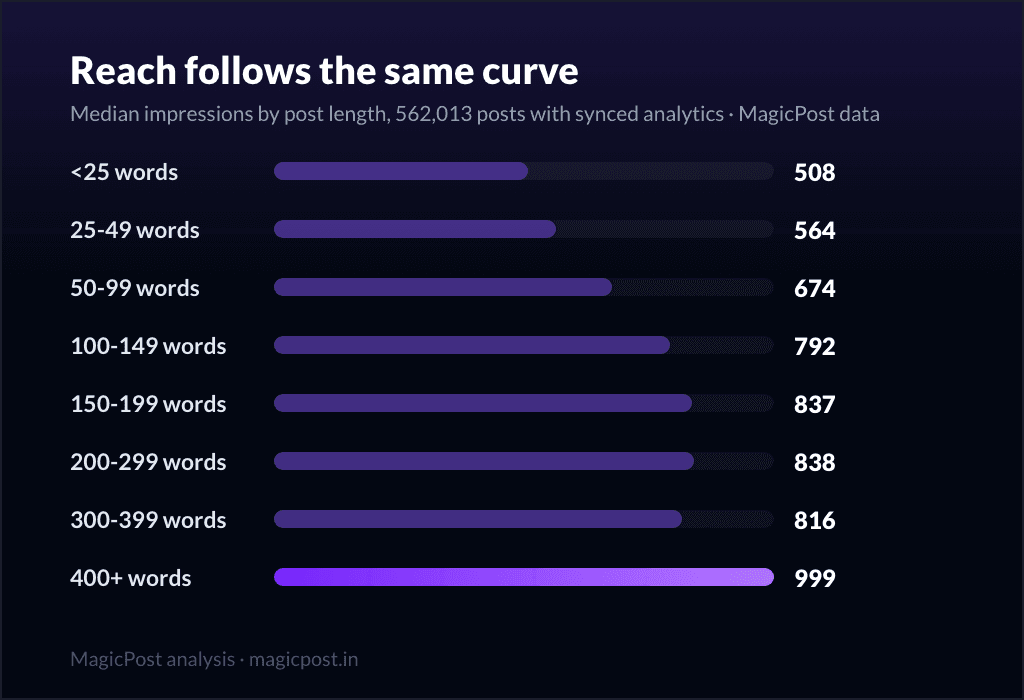
Reach follows the same line
You might suspect that longer posts earn more likes only because they get shown to more people. They do get shown to more people, and that is part of the story, but reach alone does not explain the gap. Here is median reach by the same length bands, on the 562,013 posts with synced analytics:
Post length (words) | Posts with synced analytics | Median impressions |
Under 25 | 33,684 | 508 |
25 to 49 | 31,433 | 564 |
50 to 99 | 75,773 | 674 |
100 to 149 | 100,351 | 792 |
150 to 199 | 109,911 | 837 |
200 to 299 | 141,482 | 838 |
300 to 399 | 49,842 | 816 |
400 or more | 19,537 | 999 |
Reach climbs from 508 median impressions on the shortest posts to 999 on the longest, almost doubling. The curve flattens in the middle (837 and 838 around the 150-to-299 range) and then jumps again at 400-plus words. So the algorithm does reward length with distribution.
But note the shape: reach not even doubles from end to end, while likes more than double. The extra engagement on long posts is not purely a distribution artifact. People who reach the bottom of a long, structured post are more likely to react than people who skim a one-liner.
The bombshell: posts more than doubled in length since 2022
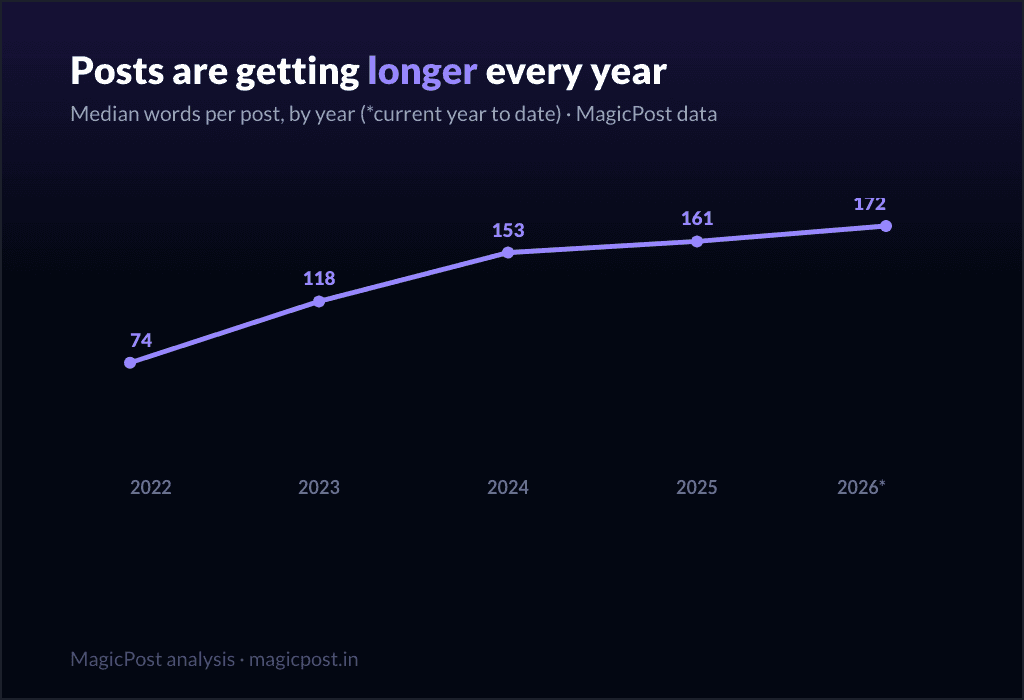
If longer is better, you would expect creators to have figured it out. They have. This is the most dramatic chart in the whole length story:
Year | Posts measured | Median post length (words) |
2022 | 64,478 | 74 |
2023 | 166,924 | 118 |
2024 | 597,775 | 153 |
2025 | 1,317,826 | 161 |
2026 | 466,432 | 172 |
The median LinkedIn post went from 74 words in 2022 to 172 words in 2026. It more than doubled in four years. The biggest single jump was 2022 to 2023 (74 to 118), and the climb has continued every year since.
Two things happened at once, and both belong on the table. First, creators learned what this article just showed you: long, structured posts outperform short takes, so the people paying attention wrote more.
Second, and you cannot ignore it, the same years that post length exploded are the years AI writing assistants went mainstream. Long writing got cheap. What used to cost twenty minutes of drafting now costs one prompt.
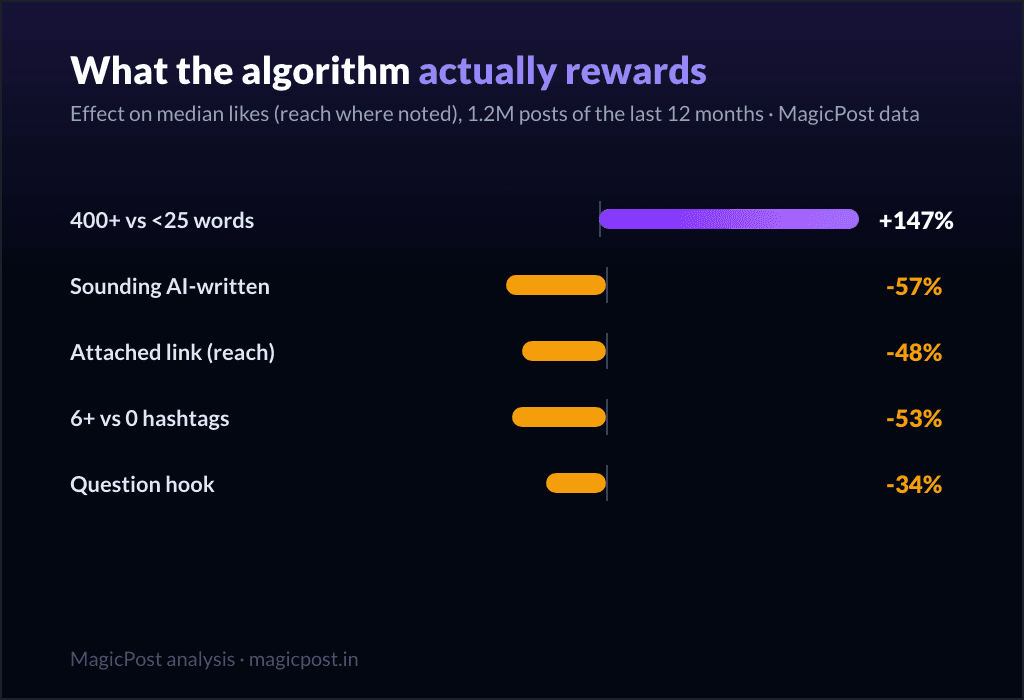
That second force comes with a warning we measured separately. Length helps; sounding AI-written hurts. In our companion study, posts that read as machine-generated earned far less engagement than posts that did not, regardless of length.
The takeaway is not "let AI pad your posts to 400 words." It is "write longer, structured posts that still sound like you." We pulled that apart in does LinkedIn penalize AI content, and it is the single most important caveat to this entire page.
Write longer, structured posts without staring at a blank page. The MagicPost AI post generator drafts in the shape the data rewards: a real hook, a developed body, a clear ending, in your voice rather than a generic one. You get the length that performs without the twenty-minute blank-page tax, and you keep the human edits that stop it sounding machine-made.
The caveat: correlation is not causation
Before you set a 400-word minimum and walk away, here is the selection effect, stated plainly. People do not choose post length at random. A 400-word post is usually written by someone who took the topic seriously, structured an argument, edited it, and cared about the result. A 20-word post is often a drive-by.
Part of what the curve measures is not the words, it is the writer behind them. Length correlates with effort, and effort correlates with engagement.
So we ran the control. If length only worked because big invested accounts write long, the curve would collapse once we held account size constant. It does not. We re-ran the whole thing inside each follower band, and the climb survives in every one:
Length band | Under 5k followers | 5k to 50k | 50k or more |
Under 25 words | 6 | 18 | 141 |
100 to 149 words | 13 | 33 | 177 |
200 to 299 words | 14 | 38 | 205 |
400 or more words | 15 | 45 | 228 |
Inside every band, longer still wins. A small account (under 5k followers) lifts its median from 6 likes on sub-25-word posts to 15 on 400-plus-word posts. A mid account (5k to 50k) goes from 18 to 45. A large account (50k-plus) goes from 141 to 228.
The effect is real for everyone, not just the giants. The same climb shows up under 5k followers as above 50k, so it is the length doing the work, not the audience or some self-selected long-form writers. (More on what is normal for your size in how many impressions are good on LinkedIn.)
What this means in practice: writing more will not magically make a thin idea perform. But for the same idea, the same care, the same person, the longer treatment earns more. Length is not a trick. It is room to actually make a point.
Different formats, different natural lengths
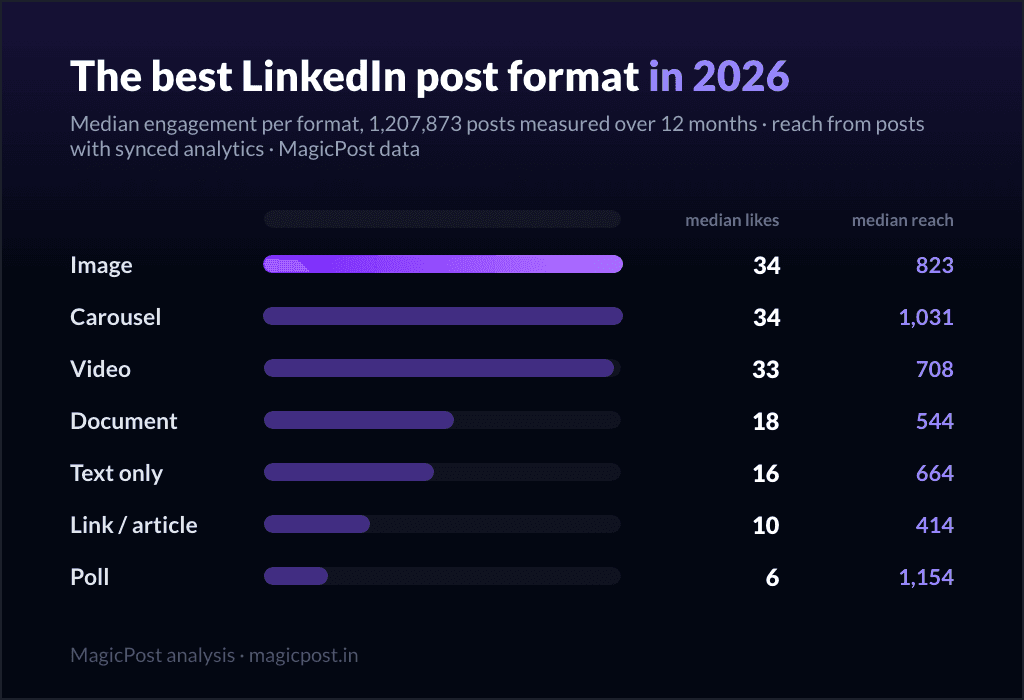
"How long should my post be" also depends on what you are posting. We measured the median word count of the text attached to each format, and they differ a lot:
Format | Posts measured | Median words |
Image | 724,494 | 184 |
Carousel | 69,169 | 164 |
Text only | 193,934 | 159 |
Video | 120,803 | 117 |
Link / article | 69,387 | 88 |
Poll | 9,950 | 63 |
Image posts carry the longest captions (184 median words), because the image does the stopping and the caption does the convincing. Carousels and text-only posts sit in the 159-to-164 range. Video captions are shorter (117), since the video carries the message.
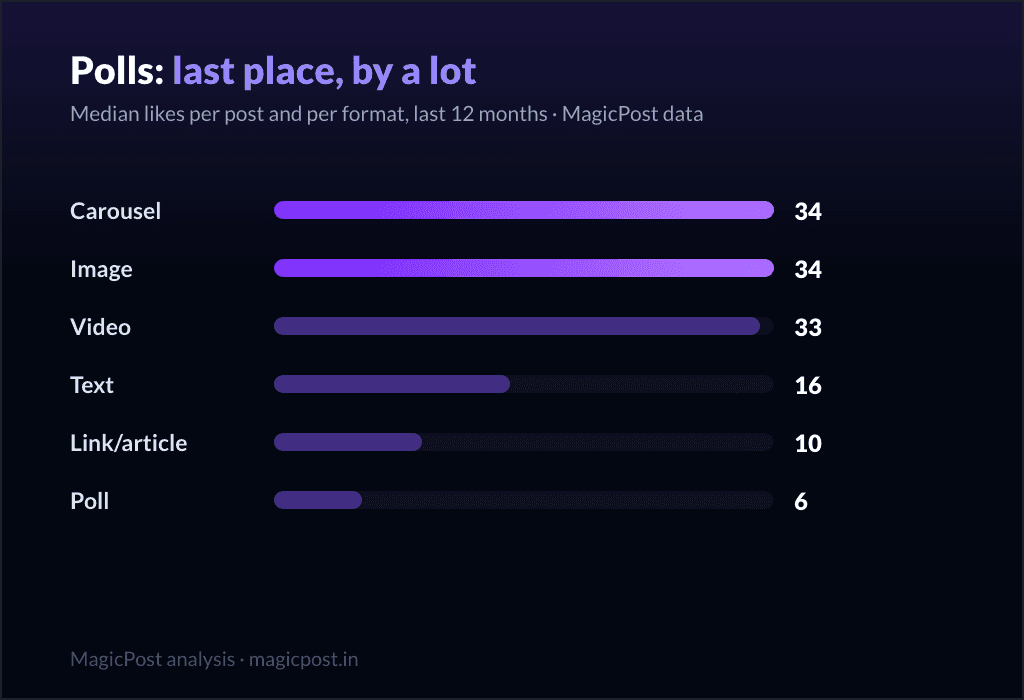
Link posts and polls have the shortest text of all (88 and 63), which is part of why they underperform: thin captions plus a format the feed already discounts. If you want the full format ranking and which one to default to, that is the pillar: the best LinkedIn post format.
So what does a winning-length post actually look like?
The data points at 200 to 400 words as the zone where engagement is high and you have not yet hit diminishing room to hold attention. That is roughly a 60-to-90-second read. Concretely, that length is enough for three real parts:
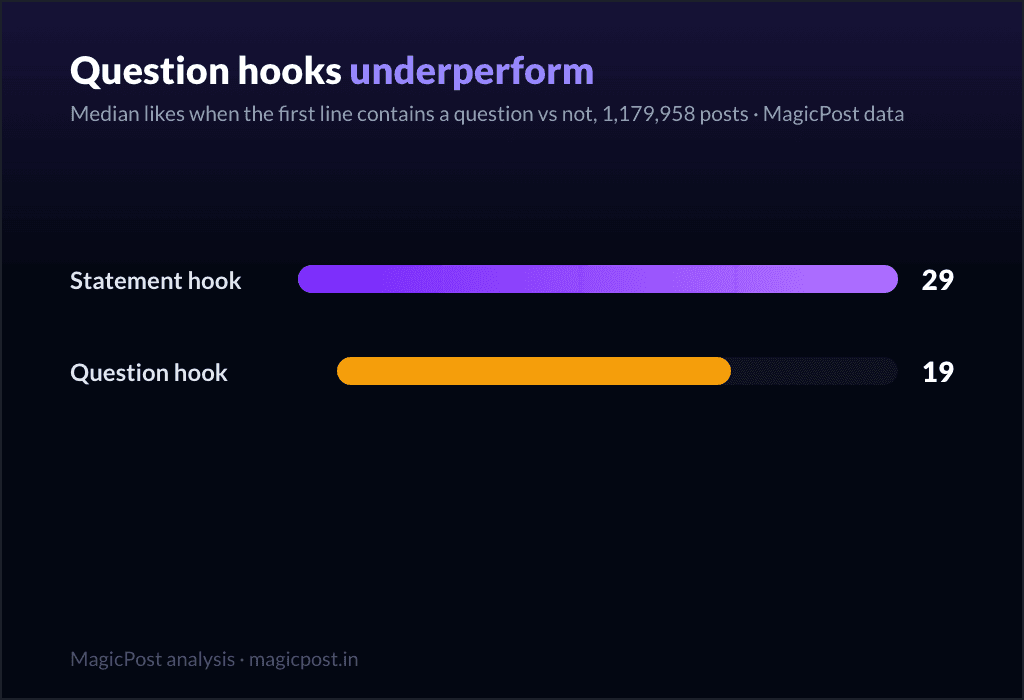
A hook that earns the "see more" click. The first two lines are all the feed shows before the fold. Make them a complete, intriguing thought, not a throat-clear. (We measured what works and what backfires in LinkedIn hooks: question hooks, for one, underperform statements.)
A body that develops one idea. A story, a framework, a before/after, a list of three. Short paragraphs, one line of whitespace between them, so a 300-word post still scans in seconds. This is where the comment-driving substance lives.
An ending that asks for something. A takeaway, a question, an invitation. The longer posts in our data earn 14 median comments versus 2 for the shortest; part of that is simply that they leave room to end with a prompt.
You do not pad to reach 300 words. You pick a topic big enough to deserve them.
Does short ever win?
By the numbers in this study: no. Across 1,194,021 posts, no length band beats the band above it. Even the very shortest posts (under 25 words, on 77,668 posts) sit at the bottom of both the likes curve and the reach curve. If your only goal is median engagement, there is no length at which going shorter helps.
That said, raw median engagement is not every creator's only goal, and short posts have legitimate jobs. A one-line reaction to breaking news in your field, posted fast, can ride a moment that a 300-word essay would miss. A single sharp sentence can land as a deliberate change of pace in a feed of long posts. A quick "we're hiring" or "I'm speaking here" is a utility post, not an engagement play, and length is beside the point.
Use short posts on purpose, knowing the trade. Just do not reach for short because you think it performs better. It does not.
Where this data comes from (post length methodology)
This is MagicPost's own first-party research. Core figures: 1,194,021 LinkedIn posts published over the last 12 months (reshares and excluded posts filtered out, deleted posts excluded), bucketed by word count and compared on median engagement. Reach figures come from the 562,013 posts with synced analytics, aggregated and anonymized. The four-year history uses the same corpus, median post length within each year, directional by construction since the corpus grows over time. The follower-band control re-runs the length curve inside each band (people only). We report medians throughout, so one viral post cannot distort a row. The figures reflect the June 2026 cut and move as new posts land. The two caveats (length correlates with writer effort; the AI-writing era made long posts cheaper) are stated above rather than buried, and the algorithm context lives in how the LinkedIn algorithm works in 2026.
Find your own winning length. MagicPost keeps drafting, scheduling and analytics for your LinkedIn posts in one place, so you can see which of your own lengths actually perform and double down on what works for your audience.
FAQ
How long should a LinkedIn post be?
Longer than most advice tells you. Across 1,194,021 posts, engagement climbs with length at every step: a post under 25 words earns 19 median likes, a 400-plus-word post earns 47, and there is no peak in between. The practical sweet spot is 200 to 400 words (roughly a 60-to-90-second read), long enough for a hook, a developed body, and an ending that earns comments, without padding. Posts in that range sit near the top of both the engagement curve (31 to 36 median likes) and the reach curve.
Do longer LinkedIn posts really get more engagement?
Yes, and at every length we measured. Median likes rise from 19 (under 25 words) to 47 (400-plus words), and median comments rise even faster, from 2 to 14. Reach follows too, from 508 median impressions on the shortest posts to 999 on the longest, on 562,013 posts with synced analytics. The climb holds inside every follower band, so it is not just an artifact of big accounts writing long.
Is there an ideal LinkedIn post length?
If you want a single target, aim for 200 to 400 words. That band earns 31 to 36 median likes (versus 19 for very short posts) while staying short enough to hold attention. Going beyond 400 words earns even more on average (47 median likes), but only when you genuinely have that much to say. Do not pad to hit a word count, pick a topic worth the words.
Have LinkedIn posts gotten longer over time?
Dramatically. The median LinkedIn post went from 74 words in 2022 to 172 words in 2026, more than doubling in four years. Creators learned that long, structured posts outperform short takes, and AI writing assistants made longer drafts cheap to produce. The catch: length helps, but posts that sound AI-written earn less, so write longer in your own voice.
Why do longer posts perform better on LinkedIn?
Two reasons, one honest caveat. First, longer posts get more reach: the algorithm rewards content that holds attention. Second, readers who finish a structured 300-word post are likelier to react and comment than people skimming a one-liner. The caveat: longer posts also tend to come from more invested writers, so part of the effect is the effort behind the words, not just the words. But when we control for account size, the curve still holds, so length does real work on its own.
How many characters is a good LinkedIn post?
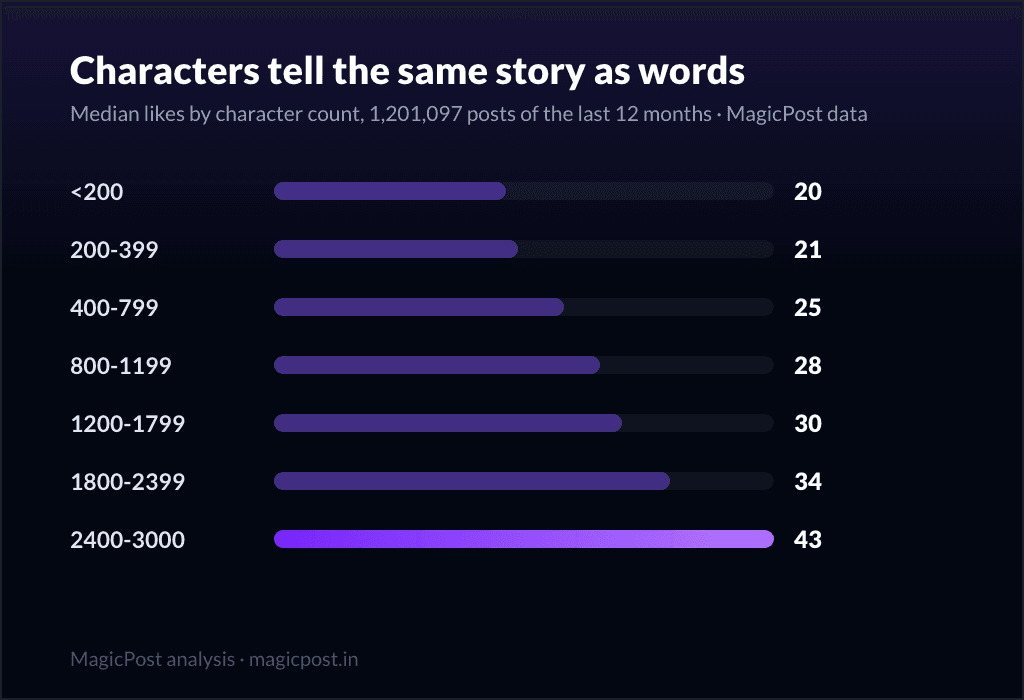
LinkedIn caps feed posts at 3,000 characters, but you rarely want the cap. The 200-to-400-word zone that performs best lands roughly in the 1,200-to-2,400-character range. For the full breakdown of limits, the "see more" fold, and how characters map to words, see how many characters in a LinkedIn post.