You typed a great post, and it is sitting in the feed as a flat wall of text. So you reach for the obvious fix: make the key line bold so it stops the scroll. LinkedIn gives you no bold button, so you have to fake it with a Unicode workaround.
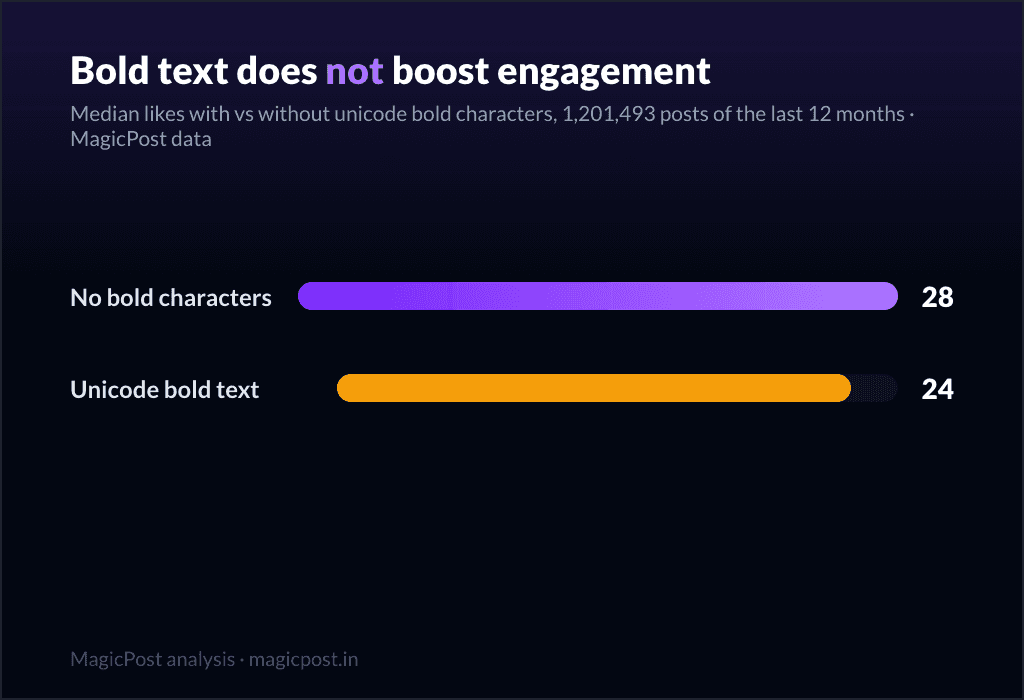
Then comes the part nobody who sells you the trick will tell you. We measured 111,485 posts that use bold against 1,090,008 that do not, and the bold posts earn slightly less engagement, not more.
Both things are true at once. The how-to is real and worth knowing. The promise that bold lifts your numbers is not. Start with the mechanics, then we will look at the receipts.
Can you bold text on LinkedIn? Not natively
LinkedIn has no native bold. The post composer, comments, and your profile are plain text by default, with no bold, italic, or styling toolbar. The only exceptions are LinkedIn articles and newsletters, which have a real formatting bar. Regular posts, the ones almost everyone writes, do not.
What people call "bold on LinkedIn" is a workaround. It uses Unicode mathematical alphanumeric characters, a separate block of the Unicode standard that happens to look like bold or italic Latin letters.
You are not bolding your text. You are swapping each letter for a different character that resembles a bold version of it. The feed renders those characters as-is on desktop and mobile, so the line looks bold even though LinkedIn never styled anything.
That distinction matters, and not just as trivia. It carries two real costs, which we will come back to once you have seen the data.
How to bold text in a LinkedIn post
The fastest way is a Unicode converter. Use MagicPost's free LinkedIn text formatter:
Paste or write your post text into the formatter.
Select the word or phrase you want to bold.
Pick a bold style to convert that selection into Unicode characters.
Copy the full formatted text.
Paste it straight into the LinkedIn post composer.
The phrase looks bold in the feed on desktop and mobile with no further steps, and no account is required. The same Unicode trick works in comments too: convert, copy, paste. It renders the same way it does in a post.
Where it does not belong is anywhere a machine has to read your words. That is the first real cost.
The two real costs of fake bold
These are platform facts, not opinions.
Screen readers cannot read it. A Unicode bold "a" is a math symbol, not the letter "a." Visually impaired readers using a screen reader hear gibberish, or nothing, where your bold words are. Put your hook or call to action in fake bold and they lose exactly the part you most wanted them to catch.
Search cannot index it. Those characters are not the plain letters that search engines and LinkedIn's own search match against. A keyword you bold is, to search, a different word, and effectively invisible.
Neither is a penalty LinkedIn applies. They are consequences of the trick itself. Now the engagement question, which is the one we can actually measure.
The measured verdict: bold does not lift engagement
Here is the claim almost every "how to bold" guide makes and never tests: bold makes your post pop, so it performs better. We checked it against the corpus. Posts are grouped by whether they contain any Unicode bold characters, and we compare the median of each group so a few viral outliers cannot tilt the result:
Posts | Posts measured | Median likes | Median comments |
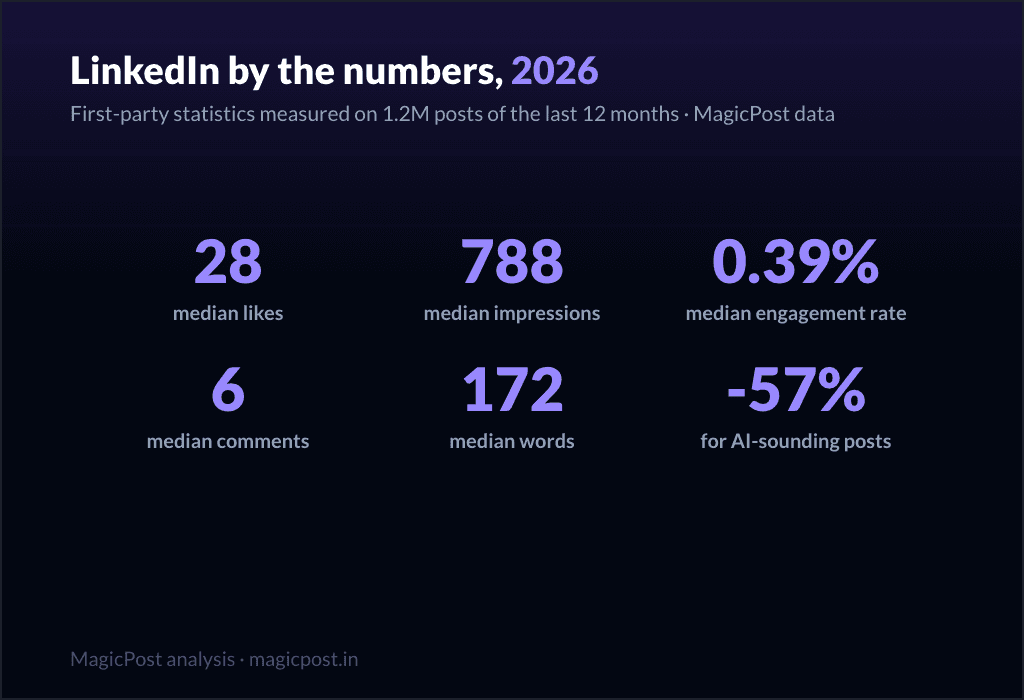
No bold | 1,090,008 | 28 | 6 |
With bold | 111,485 | 24 | 5 |
The gap is small, but every column points the wrong way: likes and comments both come in a notch lower for bold. Bold does not boost engagement; it correlates with slightly less of it.
That does not mean the bold characters reach into the feed and suppress your post. It means the kind of post that leans on fake bold tends, on average, to be the kind of post that earns a little less. We will separate those two ideas in a moment. First, reach.
Does the feed show bold posts to fewer people?
A fair next question: maybe bold posts get the same engagement from a smaller crowd, or the algorithm quietly buries them. For the subset of posts with synced analytics, we can see impressions directly:
Posts | Posts with synced analytics | Median impressions |
No bold | 500,132 | 774 |
With bold | 63,535 | 725 |
Impressions land a hair lower for bold, the same direction as likes and comments, and nowhere near a suppression-sized gap. So there is no hidden boost and no hidden burial here.
If anything, bold posts are seen a touch less and engaged with a touch less. (For what the feed actually rewards, see how the LinkedIn algorithm works in 2026.)
Four years of bold: hyped, then cooling
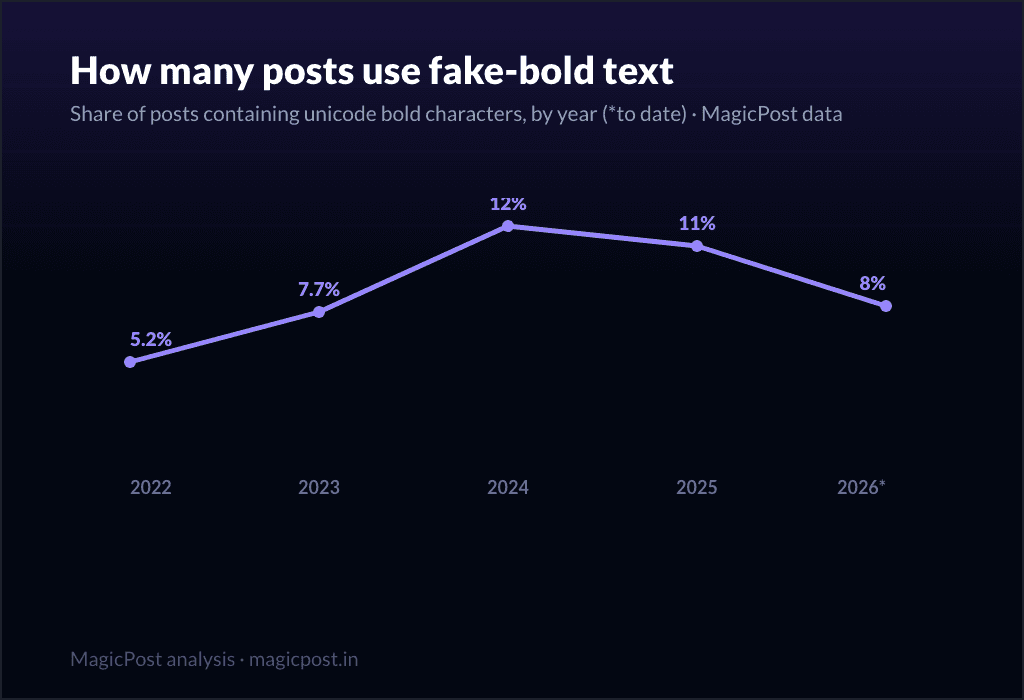
The 12-month snapshot hides the trend. Here is the share of all LinkedIn posts that used Unicode bold, year by year:
Year | Posts measured | Share using bold |
2022 | 65,298 | 5.2% |
2023 | 169,537 | 7.7% |
2024 | 604,716 | 12.0% |
2025 | 1,335,648 | 11.0% |
2026 | 467,480 | 8.0% |
Bold climbed fast through 2022 and 2023, peaked in 2024 as formatter tools and "make your post stand out" advice spread, then cooled across 2025 and 2026. (The 2026 figure covers a partial year and a thinner sample, so read it as directional.)
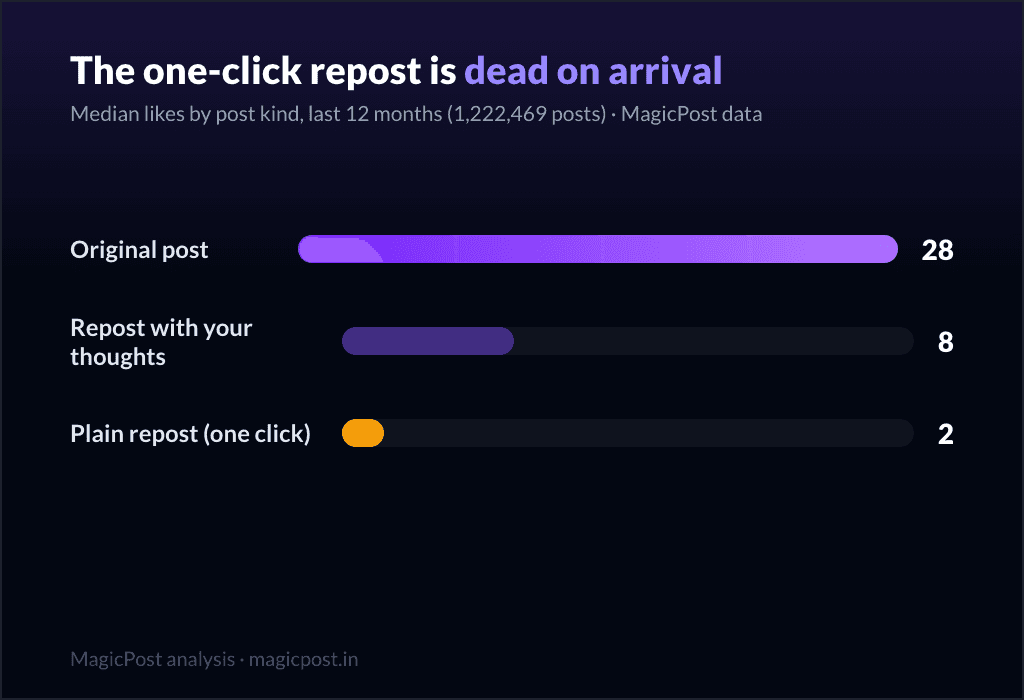
The shape is familiar across this whole cluster: a trick gets hyped, adoption spikes, and then it settles back as people notice it is not doing what they were promised. The one-click repost button follows the same curve, and it is another measured myth from the same corpus: a one-second shortcut that earns a fraction of what real work earns.
The control: does the gap survive a size check?
The honest objection to the headline table is that bold-users are not a random slice of LinkedIn. Heavier sellers, growth-hackers, and very large accounts may bold more, and account size drives engagement on its own. So we split the comparison by follower band, which removes account size from the picture:
Follower band | Median likes, no bold | Median likes, with bold |
Under 5k | 12 | 13 |
5k to 50k | 33 | 33 |
50k and up | 183 | 158 |
The bands do not behave the same way, so take them one at a time. The smallest accounts give bold its one and only edge, a single extra median like. Mid-size accounts split it down the middle, a dead tie. The big accounts are where the real damage lives, and they take a clear haircut.
So the small overall deficit in the headline table is mostly the big accounts dragging the average. The trick neither helps nor hurts smaller accounts in any meaningful way, and it travels with lower engagement at the top. Nowhere does the band control reveal the boost the hack promises.
Want posts that work without formatting tricks? MagicPost's AI LinkedIn post generator drafts posts built on a strong hook and a clear idea, the things that actually move the numbers, so you are not leaning on fake bold to rescue a flat line. Structure first, decoration last.
Honest causality
Be precise about what these numbers prove. The follower-band split removes account size, and only that. It does not remove everything else that makes bold-users different: people who reach for Unicode bold skew toward selling and "engagement optimization," and that mix earns less per post regardless of formatting. Part of the gap is the formatting; part is who chooses to use it.
What we can say cleanly: in over 1.2 million posts, bold shows no measurable upside, and a small downside that is real at the top of the follower range and survives a size control. The claim that bold lifts engagement is not supported anywhere in the data.
So when does bold still make sense?
Bold is not banned. It is a readability tool, not a growth tool, and used with discipline it can help a reader find the one line that matters. Reach for it only on these terms:
One or two key phrases per post, maximum. When everything is bold, nothing is. Bold works by contrast with the plain text around it; remove the contrast and you remove the function. Keep it under roughly 10 to 15 percent of the post.
Never a full sentence or paragraph. That is the fastest way to tire a reader on mobile and lose the contrast entirely.
Never in the hook, and never on your call to action. This is where the two real costs bite hardest: a screen reader drops your opening line, and search cannot index your key term.
Bold the concrete part, not the filler. A number, a result, a specific claim, the action you want taken. Generic words like "important" or "amazing" do not earn bold; they are noise.
And avoid it entirely when you are stacking it with italics, all-caps, and emojis in the same block. That reads like a promotional email, and emoji-heavy formatting is now one of the tells that a post was written by AI. For the full toolkit, line breaks, spacing, and structure that actually carry a post, see how to format LinkedIn posts.
The honest summary: bold is fine as a quiet readability aid for one phrase a reader's eye can land on. It is not a performance lever, and across 1.2 million posts, it does not move your numbers.
Where this data comes from
The numbers on this page come from MagicPost's own post corpus, not a third-party estimate. The presence figures come from LinkedIn posts published over the last 12 months, reshares and excluded posts filtered out, deleted posts removed, split by whether the post contains any Unicode mathematical bold characters: 111,485 posts with bold and 1,090,008 without. We report the median of each group rather than the mean, so one bold post that happens to go viral cannot inflate the whole row. Reach figures come only from the posts with synced analytics (63,535 with bold and 500,132 without), aggregated and anonymized. History covers 2022 to mid-2026, with the share of bold posts taken within each year; because the corpus grows over time and 2026 is a partial year, year-to-year comparisons are directional by construction. The follower-band control compares bold against no-bold within three size bands (under 5k, 5k to 50k, 50k and up) to remove account size from the gap.
One caveat worth stating plainly: bold-users are not a random slice of LinkedIn. They skew toward sellers and self-promoters, a group that earns less per post anyway, so part of the deficit is who picks up the trick rather than the trick itself. The band control strips out account size, nothing more. The corpus was last pulled in June 2026.
FAQ
Can you bold text on LinkedIn?
Yes, but not natively, and it may not do what you hope. LinkedIn's post composer has no bold button; the only formatting toolbar lives in articles and newsletters. To "bold" a post you use a text formatter that swaps your letters for Unicode mathematical bold characters, then paste the result into LinkedIn. It looks bold in the feed. But measured across 1.2 million posts, bold posts earn slightly less, not more: 24 median likes with bold versus 28 without. Bold is a readability aid for one or two phrases, not a way to boost engagement.
Does bold text help LinkedIn post performance?
No, the data shows no upside. Across 111,485 posts with bold and 1,090,008 without, bold posts earn 24 median likes versus 28 and 5 median comments versus 6. Reach is similar: 725 median impressions with bold versus 774 without, on posts with synced analytics. Splitting by follower size, the gap is a tie for mid-size accounts, a single extra like for the smallest, and a clear deficit for large accounts (158 versus 183). Use bold for readability, not for reach.
Can you bold text in LinkedIn comments?
Yes. The same Unicode trick works in comments: run your text through a text formatter, copy the bold output, and paste it into the comment box. It renders exactly as it does in a post. The same two costs apply, though: screen readers cannot read the characters, and search cannot index them, so keep it to a phrase and never your key term.
Will LinkedIn penalize my post for using bold text?
No. LinkedIn does not penalize Unicode formatting; there is no algorithmic flag for it. The small engagement deficit we measured is not a penalty, it reflects who tends to use bold and how. The two real costs are baked into the trick itself, not imposed by LinkedIn: screen readers cannot read fake bold (an accessibility cost), and search cannot index it (a discoverability cost). Used on one or two phrases, away from the hook and the call to action, bold is harmless. Used everywhere, it just makes a post harder to read.
How much bold should I use in a LinkedIn post?
One or two phrases at most, well under roughly 10 to 15 percent of the post. Bold works by contrast, so bolding a full sentence or paragraph erases the effect and tires the reader on mobile. Bold the concrete part, a number, a result, a specific claim, never filler like "important" or "amazing," and keep it out of the hook and the call to action so screen readers and search still get your most important words.
> Stop decorating flat posts. With MagicPost you can write, format, preview, and schedule all your LinkedIn content in one place, so each post earns its spot on a strong idea and a clean structure instead of a formatting trick that does not move the numbers.