Every LinkedIn how-to guide tells you to add three to five hashtags. We measured what those hashtags actually do, across 1.2 million posts published in the last 12 months, and the advice is backwards.
The posts that win carry zero or one hashtag. Every tag after the first one drags the median down, and by the time you reach five, you have cut your engagement in half.
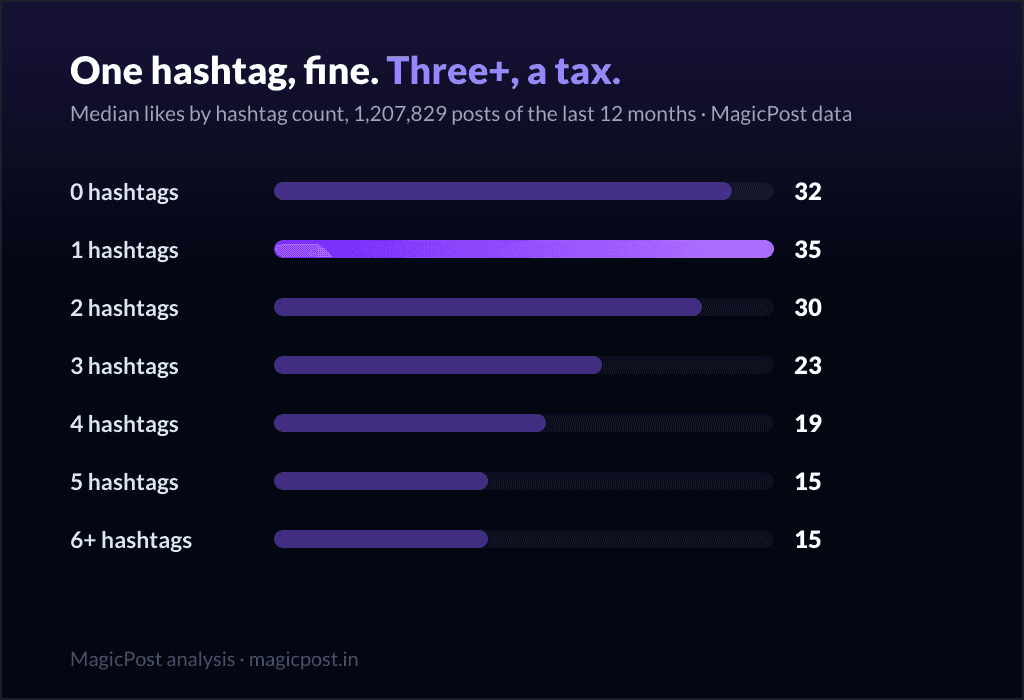
The short version: a post with no hashtag earns 32 median likes, a post with exactly one earns 35 (the peak), and from there it collapses straight down to 15 at five tags and stays at 15 for everyone piling on six or more. More tags, fewer likes, every step of the way.
Here is the whole curve before we argue about it:
How many hashtags perform best on LinkedIn?
Hashtags on the post | Posts measured | Median likes |
0 | 865,441 | 32 |
1 | 43,919 | 35 |
2 | 25,515 | 30 |
3 | 45,689 | 23 |
4 | 40,003 | 19 |
5 | 50,921 | 15 |
6+ | 136,341 | 15 |
Read it once and the whole hashtag debate is over. There is exactly one bump in this table, and it is tiny: going from zero to one tag lifts the median from 32 to 35. That is the entire upside hashtags have left on LinkedIn.
After that, it is all downhill. Two tags already sit below the no-hashtag baseline (30 vs 32). Posts with three tags sit nearly a third lower (23), and posts with five at half (15).
The most striking number is hiding in the last row. 136,341 posts in our window carry six or more hashtags, more than any band except the zero-tag majority. A sixth of the people who tag heavily sit at the bottom of the curve: 15 median likes, less than half what a clean one-tag post earns.
At that volume, heavy tagging is a habit rather than an accident. In our June 2026 data, the extra tags never come with more likes.
Reach tells the same story
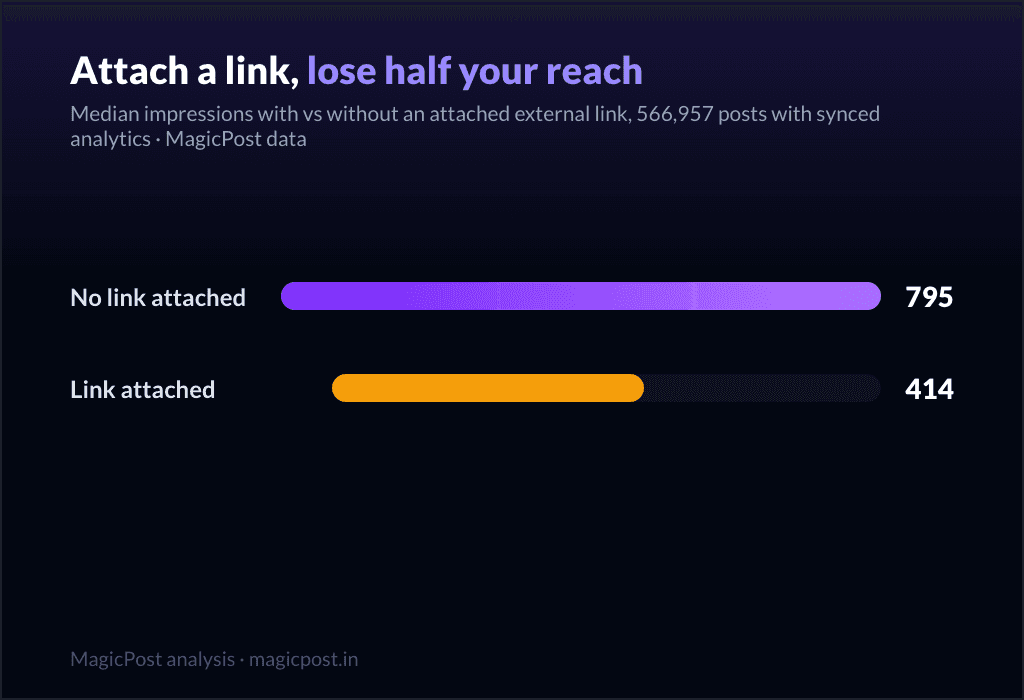
If you suspect engagement is the wrong lens (maybe hashtags buy reach and the likes just do not follow), the impressions data closes that door too. On the 566,957 posts with synced analytics, more hashtags go with fewer eyeballs, not more:
Hashtags on the post | Posts with analytics | Median impressions |
0 | 381,948 | 874 |
1 | 17,919 | 847 |
2 | 11,647 | 825 |
3 | 20,892 | 637 |
4 | 21,283 | 604 |
5 | 28,439 | 492 |
6+ | 84,829 | 529 |
Same shape, same slide. A no-hashtag post is seen by a median of 874 people; pile on five and you are down to 492.
The "hashtags expand your reach to new audiences" pitch was true on Instagram in 2018. On LinkedIn in 2026, the tags that were supposed to find you new readers sit next to posts that reach fewer readers, not more. Whatever discovery hashtags once unlocked does not show up in these medians.
These are raw medians up to June 2026. Against the same creator's average post, one to three hashtags show no measurable effect on reach since July 27, 2026: 5% below, within the margin of error (14% below to 5% above), in our 2026 study of LinkedIn reach. Up to three tags, the raw slope mostly reflects which posts carry them.
Want posts that perform without hashtag crutches? The MagicPost AI LinkedIn post generator writes with these patterns baked in: the right length, the right format, and no engagement-killing habits like a wall of tags at the bottom. You bring the idea; it handles the parts the data already settled.
The platform quietly moved on, and so did creators
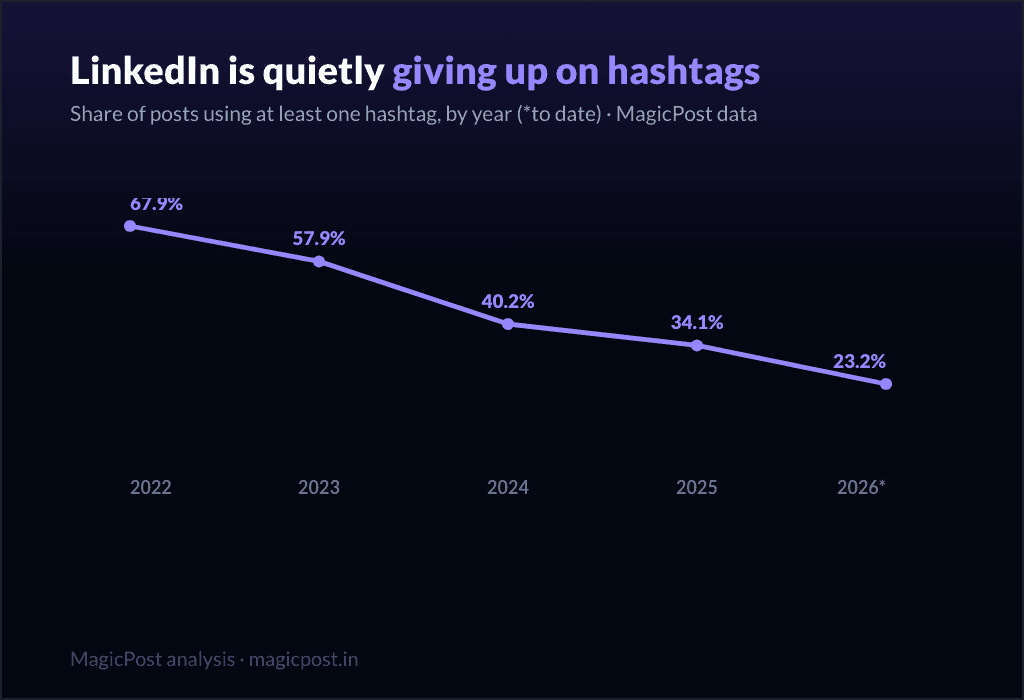
The clearest proof that hashtags lost their job is not in the engagement curve. It is in how fast everyone abandoned them once LinkedIn stopped pushing them. We split the same corpus by year and looked at how many posts carried at least one hashtag:
Year | Posts measured | Share with >= 1 hashtag | Share with 3+ hashtags |
2022 | 65,739 | 67.9% | 52.1% |
2023 | 170,452 | 57.9% | 46.1% |
2024 | 606,050 | 40.2% | 32.2% |
2025 | 1,342,058 | 34.1% | 28.0% |
2026 | 468,826 | 23.2% | 17.7% |
In 2022, two posts out of three carried a hashtag, and more than half carried three or more. By 2026 to date, only 23.2% still bother, and the heavy taggers (3+) have shrunk from 52.1% to 17.7%. That is not a slow drift. That is the feed voting with its feet.
What happened in between is no secret: LinkedIn removed the hashtag-following emphasis it used to surface, stopped treating a hashtag as a discovery channel, and leaned its ranking on content quality, dwell time, and what your network actually engages with.
Creators read the room. The share of hashtagged posts roughly tripled downward in four years. When the people who post for a living drop a tactic this fast, that is the answer, written in behavior instead of opinion.
"But it must work for big accounts" (it does not)
The usual rescue for any uncomfortable LinkedIn finding is to claim it only holds for small accounts, one of the LinkedIn myths that refuses to die. So we re-ran the curve inside three follower bands. The pattern survives everywhere:
Hashtags | Under 5k followers | 5k to 50k | 50k+ |
0 | 13 | 35 | 190 |
1 | 13 | 34 | 159 |
2 | 13 | 30 | 167 |
3+ | 10 | 22 | 136 |
The numbers scale with audience size (a 50k+ account's median is an order of magnitude above a beginner's), but the direction is identical in every band: posts with three or more hashtags sit lowest, whatever the audience size.
For accounts under 5k, zero and one tag tie at 13 median likes and 3+ drops to 10. For the 50k+ crowd, a clean post earns 190 against 136 for the heavy taggers. There is no follower count at which a wall of hashtags starts helping; the dip shows up whether you have 500 followers or 500,000.
So, the generator question: how to pick your one hashtag
You came here partly because you want a hashtag, not a lecture. Fair. The data says one tag is the only setting that beats zero, so the real skill is choosing that single tag well. This part is craft advice, not a measured claim:
1. Decide which job the tag is doing. There are only two good ones.
A brand or campaign tag you own (`#MagicPostBuild`, your event name, your newsletter): it groups your own content so a reader or a teammate can click through your archive. This is the strongest reason to keep a single tag, because it works for you whether or not the algorithm cares.
A topic tag that genuinely matches the post (`#ProductManagement`, `#B2BMarketing`): a small bet that someone browsing that topic finds you. Smaller payoff in 2026, but harmless at one tag.
2. Pick specific over broad. `#Leadership` competes with millions of posts and tells the reader nothing. `#RemoteTeamLeadership` is narrower, more relevant, and more likely to reach someone who actually cares. If your one tag could sit under any post in your industry, it is too generic to bother with.
3. Put it where it does not break the read. A hashtag mid-sentence turns a clause into a link and yanks the reader out of your flow. Place your single tag on its own line at the very end, after the post has done its work. The hook and the body should never contain a tag; the first two lines are the most valuable real estate on LinkedIn and a blue `#word` there only invites the eye to leave.
4. When zero is the right answer. If you do not own a brand tag and no topic tag fits naturally, post with none. Zero tags (32 median likes) beats two (30) and crushes five (15). A hashtag added out of obligation buys you nothing in our data. The default in 2026 is no hashtag, with one tag as a deliberate, specific exception.
That is the whole "generator" you need: one tag, specific, owned or genuinely on-topic, parked at the bottom, or none at all.
What this means for your next post
Stop at one, or use none. One tag is the only count that beats a clean post, and barely. Everything from two up sits lower in our raw data.
Skip the wall of tags. Posts with three or more hashtags sit lowest in our raw medians, and 17.7% of 2026 posts still carry that many.
Make the one tag earn its place: specific, owned or on-topic, on its own line at the end.
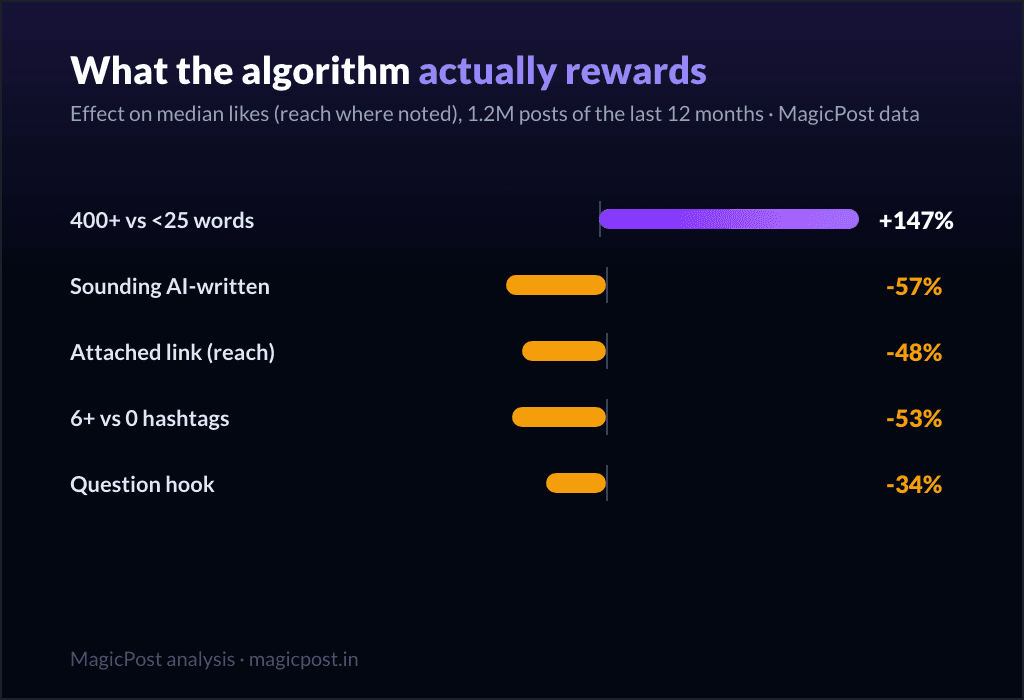
Spend the freed-up effort on the things that move the needle: the right format, the right length, and a first line that does not waste itself. Those decide your reach far more than any tag.
Trust the feed's own verdict. Creators dropped hashtags from 67.9% of posts to 23.2% in four years. They were right.
For the full picture of how LinkedIn ranks posts in 2026 (length, links, formats, timing, and hashtags together), see our data breakdown of how the LinkedIn algorithm works in 2026.
Put the findings to work. MagicPost brings your drafting, scheduling, and analytics under one roof, so the next post goes out with the right length, the right format, and exactly as many hashtags as the data rewards: at most one.
Where this data comes from
These figures are drawn from our own data, not a third-party study. Core figures: 1,207,829 LinkedIn posts published over the last 12 months (reshares and deleted posts excluded), grouped by the number of hashtags each one carries, compared on median engagement. The "6+" band pools every post with six or more tags. Reach figures come from the 566,957 posts with synced analytics, aggregated and anonymized; we report the n on every impressions claim. History: the same corpus split by year from 2022 to mid-2026, comparing the share of posts carrying at least one (and three or more) hashtags; shares are within-year, and our corpus grows over time, so read the trend as directional (the collapse from 67.9% to 23.2% survives that caveat comfortably). Follower-band control: the same curve re-run inside three audience sizes, 200+ posts minimum per cell, people only. We report medians rather than means throughout, which keeps a few viral outliers from skewing any band. The hashtag-picking advice is editorial craft guidance, not a measured result, and is labeled as such. The numbers here reflect our June 2026 pull and move as the corpus grows.
FAQ
Are hashtags still useful on LinkedIn?
Barely, and only at one. Across 1.2 million posts from the last 12 months, a post with no hashtag earns 32 median likes and a post with exactly one earns 35, the peak. From there it falls monotonically: 30 at two tags, 23 at three, 19 at four, and 15 at five or more.
These are raw medians up to June 2026. Compared with the same creator's average post, one to three hashtags show no measurable effect on reach since July 27, 2026 (5% below, within the margin of error).
How many hashtags should I use on LinkedIn in 2026?
One, or zero. One tag is the single setting that outperforms a clean post (35 vs 32 median likes). Two already drops below the no-hashtag baseline, and posts with three or more sit roughly a third lower or worse. The old "3 to 5 hashtags" advice maps directly onto the worst-performing bands in our data.
Do hashtags increase reach on LinkedIn?
No. On the 566,957 posts with synced analytics, a no-hashtag post reaches a median of 874 people and a five-hashtag post reaches 492. More tags correlate with fewer impressions, not more. Against the same creator's average post, one to three hashtags show no measurable effect on reach since July 27, 2026.
Why did LinkedIn stop favoring hashtags?
LinkedIn removed the hashtag-following emphasis it once surfaced and shifted ranking toward content quality, dwell time, and what your own network engages with. Creators followed: the share of posts carrying at least one hashtag fell from 67.9% in 2022 to 23.2% in 2026, and heavy taggers (3+) dropped from 52.1% to 17.7%. The behavior change is the clearest signal that tags lost their job.
Where should I put a hashtag if I use one?
On its own line at the very end of the post, never in the hook or the body. The first two lines are your most valuable real estate, and a hashtag there only invites the reader to click away. Keep the one tag specific (`#RemoteTeamLeadership` beats `#Leadership`) and ideally a brand or campaign tag you own, so it groups your own content even if the algorithm ignores it.