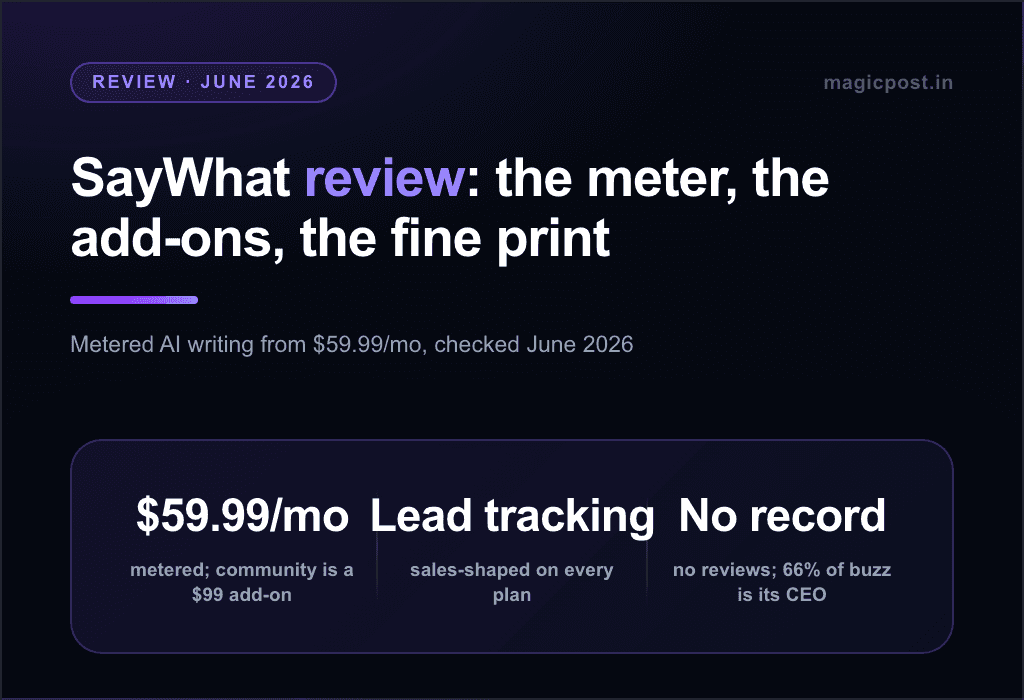
SayWhat pairs voice-matched AI writing with engagement analytics and lead tracking, the rare tool that treats posts as pipeline. People go looking for alternatives at three friction points.
The meter: every tier caps how many posts the AI generates, 6 to 40 per cycle. The ladder: $59.99/mo to $299.99/mo is a fast climb when your posting volume grows. And the operating mode: everything runs through your local browser rather than an official integration.
This page does the other job: what to use instead. Ten alternatives at equal depth, with best-for, the receipts, key features, pros and cons, and monthly pricing. Our full verdict is in our SayWhat review.
The alternatives at a glance
Tool | Best for | Price/mo | Publishing | Start |
The pipeline thesis without the meter | $49 (AI $69) | Official LinkedIn API | No-card trial | |
Taplio | Outreach automation | $39 to $199 | Cookie/extension | 7-day full Pro |
Supergrow | The writing half at entry price | $39 to $199 | Claims official API | 7-day trial |
Stanley | Voice depth without pipeline | $97 | None (you publish) | No trial, 30-day refund |
Kleo V3 | Human coaching | $99 | Schedules (undocumented) | No trial |
EasyGen | Creator-grade generation | Not public* | Manual by design | 7-day trial |
RedactAI | The cheapest voice mimicry | $11.90 to $66 | Copy-paste | Free start |
SocialSonic | Budget lead attribution | $20 to $200 | Account (undocumented) | 7-day no-card |
TypeGrow | A budget unmetered start | $29 | Claims official API | No-card trial |
AuthoredUp | Craft and counting (no AI) | $14.95 to $19.95 | Extension, your own session | No-card trial |
*EasyGen advertises a 7-day trial but does not publish pricing; third-party reviews report ~$59.99/mo.
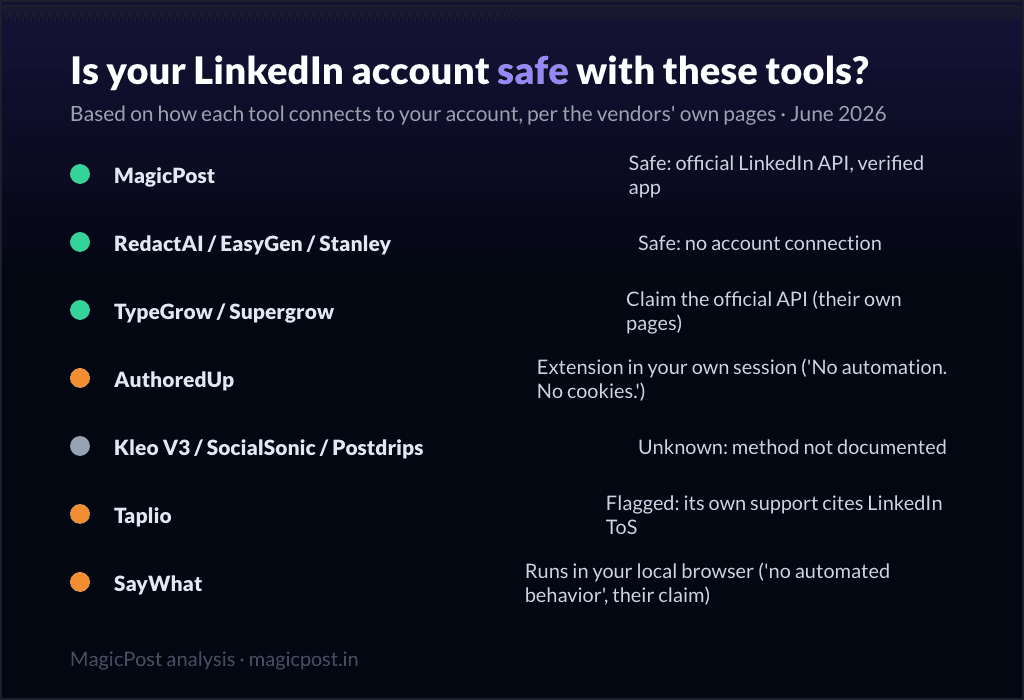
On the safety map, SayWhat sits in the amber zone: its own wording is that actions run through your local browser with no automated behaviour that violates LinkedIn policies. That is a claim worth respecting and a category worth understanding, because browser-side operation is not the official API.
Two context points before the list. SayWhat has no Trustpilot reviews at all. And its LinkedIn visibility is largely its own CEO's audience: in our research corpus, 10 of its 12 most-liked mentions over the last six months are posts by its co-founder and CEO (439,000 followers and an excellent poster, to be fair).
Neither is a verdict on the product; both tell you the third-party record is thinner than the feed suggests.
1. MagicPost: Best for the pipeline thesis without the meter
MagicPost agrees with SayWhat's core thesis, LinkedIn posts should feed a pipeline, and disagrees with the meter.
The writing is unmetered AI in your voice (style import from your account), backed by a humanizer built on published research.
The pipeline part is the like-for-like: lead detection with AI scoring and CRM integrations, plus an engagement routine (curated feeds, saved comments you reuse, scheduled comments) that turns who reacts to your posts into named prospects.
The whole loop runs on LinkedIn's official API as a verified application, all through the sanctioned path rather than your browser.
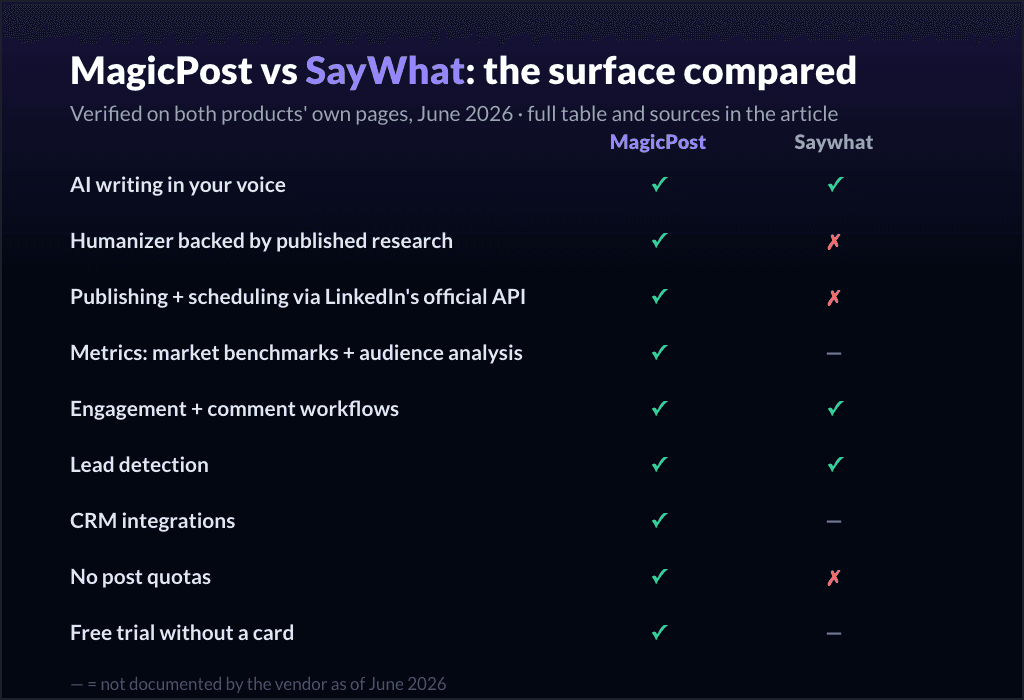
Three things separate it coming from SayWhat. There are no post quotas anywhere, where SayWhat prices by generated posts (6 to 40 per cycle). The leads have a CRM exit, where SayWhat's tracking keeps them in-app, so the pipeline enters your actual sales motion. And the analytics benchmark, market benchmarks and audience analysis, where SayWhat only charts your own engagement.
Key features
Unmetered AI writing in your voice, with a research-backed humanizer.
Lead detection with AI scoring and CRM integrations (the pipeline exits the tool).
Engagement workflows on the official API (curated feeds, saved comments, scheduling).
Analytics with market benchmarks and audience analysis.
No post quotas; a no-card trial.
MagicPost | SayWhat | |
AI writing in your voice | ✅ Unmetered | ✅ 6-40 posts per cycle |
Posts that don't read as AI | ✅ Humanizer, research-backed | ❌ |
Publishing | ✅ Official API, verified app | ⚠️ Browser-based |
Market benchmarks | ✅ | ❌ |
Engagement | ✅ Workflow on the API | ✅ Comment management |
Lead detection | ✅ AI scoring + CRM | ✅ Lead tracking (in-app) |
Post quotas | ✅ None | ❌ 6-40 per cycle |
Trustpilot | ✅ 4.7/5 (91) | ❌ No reviews found |
SayWhat's sales orientation is real and rare, its trending-formats database is a genuine ideation shortcut, and the annual plans add human strategy sessions nothing else at this price includes. The meter is the business model, and the browser is the architecture; you are not changing either with feedback.
Pros | Cons |
✅ The pipeline thesis, unmetered, on the official API | ❌ Premium positioning |
✅ Lead detection that exits to your CRM | ❌ LinkedIn-only |
✅ Benchmarked analytics, safe engagement | |
✅ No post quotas; no-card trial |
Plan | Price/mo | Includes |
Growth | $49 | Scheduling, analytics, market benchmarks, engagement, leads |
Creator (AI) | $69 | Unmetered AI, humanizer, scheduled comments |
2. Taplio: Best for outreach automation
Taplio is the old guard's answer to the same brief, with the most aggressive outreach stack here.
AI writing on a large viral library, Kanban scheduling, analytics and engagement tools surround auto-DMs and auto-connections on Pro.
The quota disappears coming from SayWhat, and three asterisks appear: the advertised $39 Starter ships zero AI credits (AI from $69, outreach at $199), and its own support acknowledges its extension is treated by LinkedIn as an automation tool against the ToS, a documented step below SayWhat's browser-based amber.
Its Trustpilot at 2.4/5 is led by billing complaints, including one user flagged off LinkedIn through its engagement tools, the cautionary tale for this entire category of outreach automation.
Key features
Auto-DMs and auto-connections on Pro.
AI writing on a large viral library.
Kanban scheduling and analytics.
A built-in lead database.
Pros | Cons |
✅ The widest sales-adjacent surface and outreach | ❌ Extension flagged by its own support |
✅ Full-Pro 7-day trial | ❌ AI locked out of the $39 entry plan |
✅ Built-in lead database | ❌ 2.4/5 Trustpilot, billing complaints |
Plan | Price/mo | Includes |
Starter | $39 | Suite without AI credits |
Growth | $69 | 250 AI credits |
Pro | $199 | Auto-DMs and auto-connections |
The full picture: Taplio alternatives.
3. Supergrow: Best for the writing half at entry price
Supergrow takes SayWhat's voice promise and drops the sales layer.
"Content DNA" voice training, "Postcast" AI interviews, voice-to-post and Kanban scheduling come at $39/mo, unmetered writing for two thirds of SayWhat Standard, plus real scheduling SayWhat does not headline. What disappears is the lead tracking and comment management that justified SayWhat's price, entirely.
Two diligence notes: its pages never document the publishing mechanism, and its own reviewers' most repeated critique is the analytics. The honest fit is the SayWhat user who discovered they used the writer and ignored the pipeline.
Key features
"Content DNA" voice training and "Postcast" interviews.
Voice-to-post and repurposing.
Calendar/queue/Kanban scheduling with auto first-comment.
Carousel maker on Pro.
Pros | Cons |
✅ Unmetered writing for two thirds of SayWhat | ❌ No lead layer at all |
✅ Real scheduling | ❌ Publishing mechanism not documented |
✅ AI at entry | ❌ Analytics flagged by its own reviewers |
Plan | Price/mo | Includes |
Pro | $39 | Full writing, carousels |
Teams | $199 | 5 accounts, approvals |
Full breakdown: Supergrow alternatives.
4. Stanley: Best for voice depth without pipeline
Stanley, from the Stan Store team, is the deepest conversational writer in the field.
It interviews you, drafts in your voice, critiques your recent posts, and keeps a native analytics dashboard. Coming from SayWhat you trade the sales engine for the coach: Stanley has no lead tracking, no comment tools, no publishing and no scheduling, it reads your posts and never touches anything else, which makes it the zero-risk pole of this list.
Stanley charges $97/mo on its main plan for the writing alone, roughly SayWhat-Premium money, with a cheaper single-user Stanley Lite tier below it, no free plan and no free trial, only a 30-day refund.
Key features
Conversational interviews and drafting in your voice.
Post critiques on request.
Native analytics: growth, pillars, projections.
No publishing (zero account connection).
Pros | Cons |
✅ The deepest writing conversation | ❌ No pipeline features at all |
✅ Serious analytics; zero account risk | ❌ $97/mo, no free trial (30-day refund) |
✅ Reads only, never touches your account | ❌ Premium money for writing alone |
Plan | Price/mo | Includes |
Stanley | $97 | Writing + analytics; cheaper single-user Lite tier below |
The full picture: Stanley alternatives.
5. Kleo V3: Best for human coaching
Kleo V3 bundles a conversational writing app with weekly live group coaching and a private creator community, at $99/mo with no trial.
There is an interesting overlap: SayWhat's annual plans include community calls and 1:1 strategy sessions, so you have already sampled the coaching idea. Kleo makes it the whole product, weekly and live, with founders who are two of LinkedIn's best-known creators.
What you lose is everything measurable: no analytics documented, no lead layer, no engagement tooling, and a young product with bug reports.
Key features
Weekly live group coaching and a private community.
Conversational writing app with deep template libraries.
Included graphics (20/month).
Schedules to LinkedIn (mechanism not documented).
Pros | Cons |
✅ The coaching idea SayWhat samples, made the product | ❌ $99/mo, no trial |
✅ Voice-first writing, real community | ❌ No analytics or lead layer |
✅ Founder credibility | ❌ Young product |
Plan | Price/mo | Includes |
Kleo | $99 | Writing app, graphics, community |
The full comparison: Kleo alternatives.
6. EasyGen: Best for creator-grade generation
EasyGen, built by creator Ruben Hassid (100M+ LinkedIn views), generates posts with a creator's editorial taste.
A content calendar, creator search and trending-topic intelligence surround the generation, a different flavour of SayWhat's pre-validated formats. The pipeline ambition vanishes; the trend mining stays. Note the parallels before switching: like SayWhat, pricing transparency is not its strength (not published, ~$59.99/mo per third-party reviews).
Its Trustpilot sits at 3.0/5 across 3 reviews, including a no-refund policy quoted back to a reviewer, and it publishes nothing by stated conviction (its anti-automation claim ships without published data, so test both).
Key features
Creator-grade generation with editorial taste.
Trending-topic intelligence from four sources.
Voice notes and an in-feed Chrome extension.
Content calendar (manual publishing by design).
Pros | Cons |
✅ Creator-grade draft quality | ❌ Manual publishing by design |
✅ Trend intelligence | ❌ Pricing not public |
✅ Famous-founder pedigree | ❌ 3.0/5 Trustpilot, no-refund note |
Plan | Price/mo | Includes |
Not published | ~$59.99* | 7-day trial advertised |
*Per third-party reviews. The full field: EasyGen alternatives.
7. RedactAI: Best for the cheapest voice mimicry
RedactAI mimics your style from a pasted profile URL, and never connects to your account.
Niche idea generation, light scheduling and free tools surround the writing. The meter survives but the price collapses: fifteen posts at $11.90 versus six posts at $59.99 is a quota argument that settles itself, and Creator is $24/mo unlimited. What you lose is the entire sales layer, real publishing (copy-paste only), and any public footprint.
Its footprint is near-zero: no reviews anywhere, and just 45 corpus mentions over a year, 38 from a single account.
Key features
Style-matched generation from a pasted profile URL.
Niche idea generation from viral posts.
Light scheduling with top-post recycling.
Free tools (profile review, formatter).
Pros | Cons |
✅ Style mimicry at the lowest price | ❌ No lead layer |
✅ Zero account exposure | ❌ Copy-paste publishing |
✅ Free start | ❌ Near-zero public footprint |
Plan | Price/mo | Includes |
Essential | $11.90 | 15 posts/mo (billed yearly) |
Creator | $24 | Unlimited posts (billed yearly) |
Copywriter | $66 | Write for multiple profiles |
The full picture: RedactAI alternatives.
8. SocialSonic: Best for budget lead attribution
SocialSonic, from the team behind Writesonic, is the cheapest way to keep a lead angle.
AI writing trained on viral posts, smart scheduling, analytics with lead attribution, and carousels come at Pro $20/mo (a locked early-adopter rate; listed future price $39), with team tiers above. A third of SayWhat Standard buys most of the surface plus carousels, and the lead attribution is the closest thing here to SayWhat's tracking outside MagicPost.
The diligence: the publishing mechanism is undocumented, its comment-suggestion extension spans four networks (the same amber family you are leaving, wider), and several features were "coming soon" at check time.
Key features
Analytics with lead attribution.
AI writing trained on viral posts, smart scheduling.
Carousel maker with AI branding, polls.
Team ($75) and agency ($200) tiers.
Pros | Cons |
✅ Lead attribution under $25 | ❌ Publishing mechanism not documented |
✅ The widest budget surface plus carousels | ❌ Four-network engagement extension |
✅ No-card trial | ❌ Several features marked coming soon |
Plan | Price/mo | Includes |
Pro | $20 | Solo writing + scheduling |
Team Accelerator | $75 | 3 users |
Agency | $200 | 10 users, branding |
The full picture: SocialSonic alternatives.
9. TypeGrow: Best for a budget unmetered start
TypeGrow is $29/mo after a no-card free trial, and unmetered: the meter goes away and the bill drops to a flat $29.
An AI writing assistant, scheduler, hook generator, carousel maker and a 1M+ viral-post library come at that price, and the architecture improves on paper too: it runs entirely in the cloud with no extension and a stated use of the official LinkedIn API. Vendor claims, but published ones, which is more than the browser model offers.
There is no lead layer, no documented analytics, and a thin public footprint. As a no-card landing spot while you decide, it is hard to beat.
Key features
AI writing assistant, hook generator, carousel maker.
One-click scheduler and post previews.
A 1M+ viral-post library.
Claims official-API publishing, no extension.
Pros | Cons |
✅ Unmetered, generous no-card trial | ❌ No lead layer |
✅ Claims official API, no extension | ❌ No documented analytics |
✅ Real scheduling and carousels | ❌ Official-API claim not independently verified |
Plan | Price/mo | Includes |
Starter | $29/mo | Writing, scheduling, carousels |
10. AuthoredUp: Best for craft and counting (no AI)
AuthoredUp is the inverse bet: no AI at all, by design.
Every word stays yours, and around your writing it builds the craft bench: formatting, fold-accurate previews, 150+ hook and 100+ CTA references, readability grading, a calendar, and a counting dashboard with real depth (saves, sends, profile views, CSV export). It runs as a Chrome extension in your own session, privacy-first with no automation and no cookies.
Coming from SayWhat, everything generative and everything sales-related goes; the measurement culture stays and sharpens. The honest fit is the SayWhat user whose best posts were the ones they rewrote entirely, and who tracks leads in a CRM anyway.
Key features
LinkedIn-native formatting and fold-accurate previews.
150+ hooks, 100+ CTA references, readability grading.
Deep counting analytics (saves, sends, CSV export).
Scheduling and content calendar (no AI generation).
Pros | Cons |
✅ Deep counting analytics, sharpened | ❌ No AI writing at all |
✅ Best-in-class formatting and previews | ❌ No lead layer |
✅ Privacy-first stance | ❌ Lives in a Chrome extension |
Plan | Price/mo | Includes |
Individual | $19.95 | One profile, craft + stats |
Business | $14.95/profile | Min 3 profiles |
More options: AuthoredUp alternatives.
If you only used SayWhat for one thing
Name the job, then pick:
The voice-matched writing. Every gen-AI tool here does it, unmetered in most cases. The deciders are the training source and what surrounds the output.
The lead tracking. MagicPost is the direct upgrade (AI scoring plus CRM integrations); SocialSonic's lead attribution is the budget echo. Nothing else here does the job natively.
The comment management. MagicPost's engagement workflow covers it through the official API; SocialSonic's extension covers it browser-side, the architecture you already know.
The trending pre-validated formats. EasyGen's multi-source trend mining and MagicPost's 2M+ inspiration library are the two scaled versions of that shortcut.
The strategy calls on annual plans. Kleo V3 makes them the product; Stanley replaces them with an always-on AI coach.
How to choose the best SayWhat alternative for LinkedIn
Are you paying for posts or for outcomes? Quota pricing means your bill tracks your volume, not your results. Decide whether a meter belongs in your writing process at all; most of this list says no.
Where does the pipeline go? Lead tracking that ends inside the tool is a dashboard; lead detection that exits to your CRM is a sales motion. Check the export path before paying for any lead feature.
What is the operating architecture? Browser-side operation sits one shelf below a documented official API and one above flagged cookie automation. The chart above maps every tool; pick your shelf deliberately.
What does the third-party record say? SayWhat has no Trustpilot reviews, and most of its LinkedIn visibility is its own CEO's content. A thin public record settles nothing by itself, but it shifts the burden of proof to the trial; insist on one.
Building a solo brand on LinkedIn? MagicPost was built for exactly that workflow: see how solopreneurs use it, from first idea to published post, with the lead detection that turns conversations into pipeline, all on the official API.
Want the Pipeline Without the Meter? There's a Fit
SayWhat's sales orientation is genuinely rare, its trending-formats database is a real shortcut, and its annual strategy sessions add humans nothing else at the price includes. But the meter is the business model and the browser is the architecture, and neither changes with feedback.
MagicPost is the same pipeline thesis without either: unmetered AI in your voice with a research-backed humanizer, lead detection that scores engagers and exits to your CRM, benchmarked analytics, all on the official API and testable on a no-card trial.
FAQ
What is the best SayWhat alternative?
MagicPost is the closest match to what SayWhat actually sells, voice-matched writing plus engagement and leads, with the meter removed and the architecture upgraded: unmetered AI in your voice, lead detection with AI scoring and CRM integrations, on the official LinkedIn API as a verified application, with a no-card trial. Budget lead angle: SocialSonic. Writing only: Supergrow. Budget and unmetered: TypeGrow ($29/mo after a free trial).
Why look for a SayWhat alternative?
Three structural reasons: the post quotas (every tier meters AI generation, 6 to 40 posts per cycle), the price ladder ($59.99 to $299.99/mo, climbing with volume), and the browser-based operating mode, which is not an official integration. Plus a thin third-party record: no Trustpilot reviews.
How much does SayWhat cost?
Standard $59.99/mo, Premium $99.99/mo, Executive $149.99/mo, Executive+ $299.99/mo, each with a post-generation quota (6 to 40 per cycle); annual billing runs about 20% lower and adds community calls and 1:1 strategy sessions. Trial terms are not clearly stated on the site.
Is SayWhat safe for your LinkedIn account?
Its own wording: actions run through your local browser with no automated behaviour that violates LinkedIn policies, and no enforcement incident is on record. Browser-side operation is still a different category from an official API integration; LinkedIn's policy reserves the right to cut off prohibited tools without notice, which is the structural risk to price in.
Does SayWhat have reviews?
No Trustpilot reviews exist at the time of writing. Most of its visible LinkedIn praise comes from its own co-founder and CEO's account (10 of its 12 most-liked corpus mentions over six months), which is normal for a founder-led product and worth knowing when you weigh the feed against the absence of a third-party record.
What is the best SayWhat alternative with lead tracking?
MagicPost: lead detection with AI scoring plus CRM integrations, fed by engagement workflows on the official API. SocialSonic offers lead attribution in its analytics at budget prices. Taplio's outreach automation sits on its $199/mo plan, with the safety and billing asterisks documented above.
SayWhat vs MagicPost: what is the real difference?
Both pair voice-matched AI with engagement and lead features. MagicPost is unmetered, runs on the official LinkedIn API (verified application), adds market benchmarks and audience analysis, scores leads with AI and exports them to your CRM, and offers a no-card trial. SayWhat meters posts by tier, operates through your browser, and keeps leads in-app. The head-to-head: SayWhat vs MagicPost.