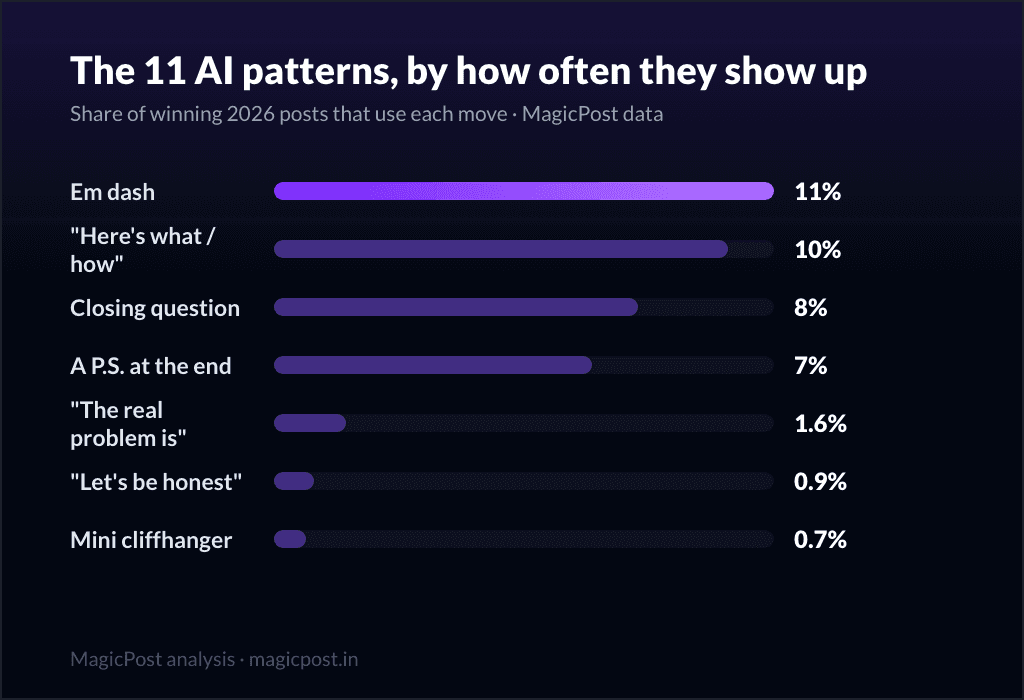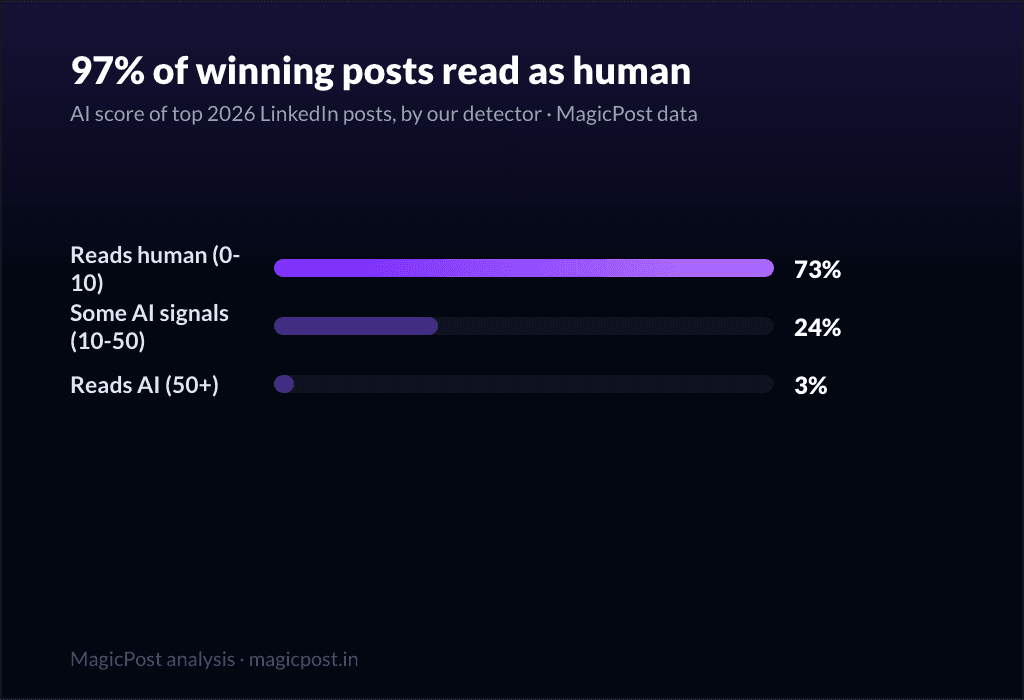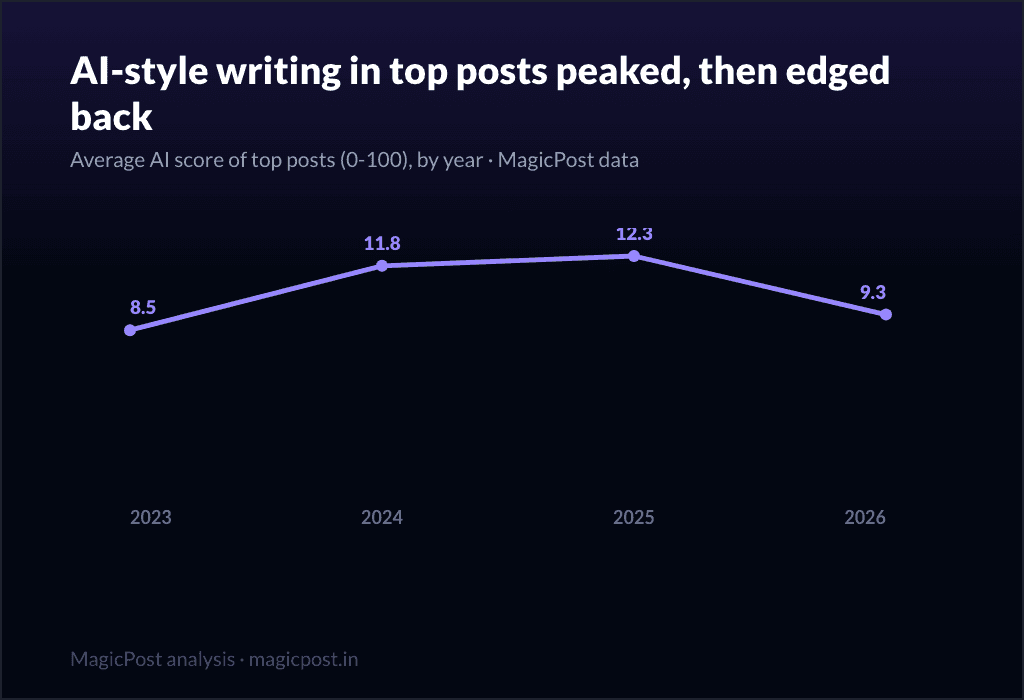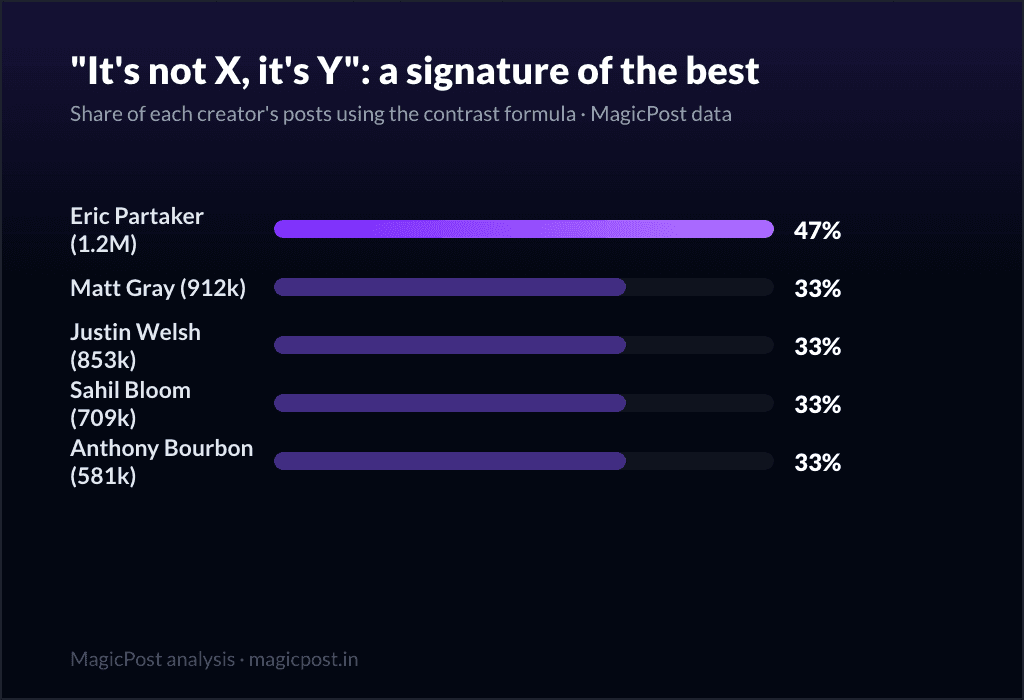
Four specific templated turns of phrase cost English LinkedIn posts a measurable slice of reach. We compared every post to the same author's other posts, so audience size is taken out of the picture, and these four stand out:
"Stop X, start Y" / "If you want to..." (the generic advice frame): about -6.7%, the most reliable of the four
"Here's what / Here's how / what nobody tells you" openers: about -4.3%
"The result?" dramatic bridge: about -4.8%
"It's not X, it's Y" contrast formula: about -4.9%
These figures come from 143,515 English posts by 3,000 authors, published between December 2024 and May 2026. Our first reading, in June 2026, was that this cost appeared in 2026. A line-by-line rerun on our production data corrected it: on posts from June to December 2025 alone, the same four turns already cost between 3% and 7% of reach, and January 1, 2026 shows no break. The cost is real but modest, and it predates 2026.
What moved in the week of July 27, 2026 is the weight of substance. In our study of AI slop on LinkedIn (40,937 posts, 660 creators), posts with no concrete detail and no lived experience went from 13% to 23% below their author's average post. At equal substance, the turns of phrase show no extra cost we can detect since that date. So fix the substance first, then clean the four turns.
One caution before the data. This is observational and second-order. Reach is still driven overwhelmingly by your audience and your topic; cleaning these phrasings wins back a few percent at the margin, not a different league.
It is a correlation, not proof, and we will never tell you it doubles your reach. But the four turns are specific, nameable and measurably costly, which is why they are worth removing.
Below: what each phrasing costs and since when, the evidence within individual authors, and the three habits you should never strip.
The Short Version: What the Four Turns Cost
Four templated phrasings cost reach. The generic advice frame, the "here's how" opener, the "The result?" bridge and the "it's not X, it's Y" contrast formula each lose about 4% to 7% of reach within the same author.
The cost is not new. On English posts from June to December 2025, the same four turns already cost between 3.0% and 6.6%. Posts carrying at least one of them sat about 3% below their author's average post in 2025 and again in 2026 up to late July, with no break at January 1, 2026.
Substance weighs more, and more since July 27, 2026. Against a comparable post by the same creator, a lived experience went from +7% to +25% more impressions and a concrete detail from +2% to +14%. At equal substance, the turns show no extra cost we can detect since that date.
Three habits cost nothing. Never touch them. A genuine "honestly" (+4.6%), a closing question and the P.S. sign-off all sit on the safe side. A blunt "AI score" would tell you to delete the very things that work.
It is still a second-order lever. Reach is driven by your audience, not your phrasing. Fixing the costly turns wins back a few percent, not a different league.
The finding: the four turns already cost reach in 2025
One confounder has to be cleared first, because it is the source of the scary "AI posts earn far less engagement" numbers. Line a pile of posts up by how AI they read and the AI ones really do earn far fewer likes, but that gap is mostly audience, not writing.
The biggest creators write in a more personal, less templated voice; beginners reaching for a viral formula write in the most templated one. To measure the writing itself you have to hold the author constant and compare each person's templated posts to their own other posts. Every number in this article does that.
Our June 2026 run cut the data at January 1, 2026 and read the result as a cost that appeared that year. We have since rerun the same method line by line on our production data, 298,740 English posts published from June 2025 to September 2026. It finds the same orders of magnitude, with a different timeline: the four turns were already costly in 2025.
English posts, reach vs the author's own normal | June to December 2025 | January to mid-May 2026 |
"Stop X, start Y" / "If you want to..." | -6.6% | -6.0% |
"It's not X, it's Y" | -5.1% | -3.3% |
"Here's what / Here's how" | -4.1% | -3.5% |
"The result?" | -3.0% | -3.8% |
Most AI-sounding 5% of posts | -3.0% | -4.4% |
All four 2025 figures are statistically significant. Month by month, posts carrying at least one of the four turns stay close to 3% below their author's average post from June 2025 to July 2026. We also tested 27 dates, two weeks apart, comparing the same authors eight weeks before and after each one: January 1, 2026 ranks 16th of 27 (x0.99), which means no break.
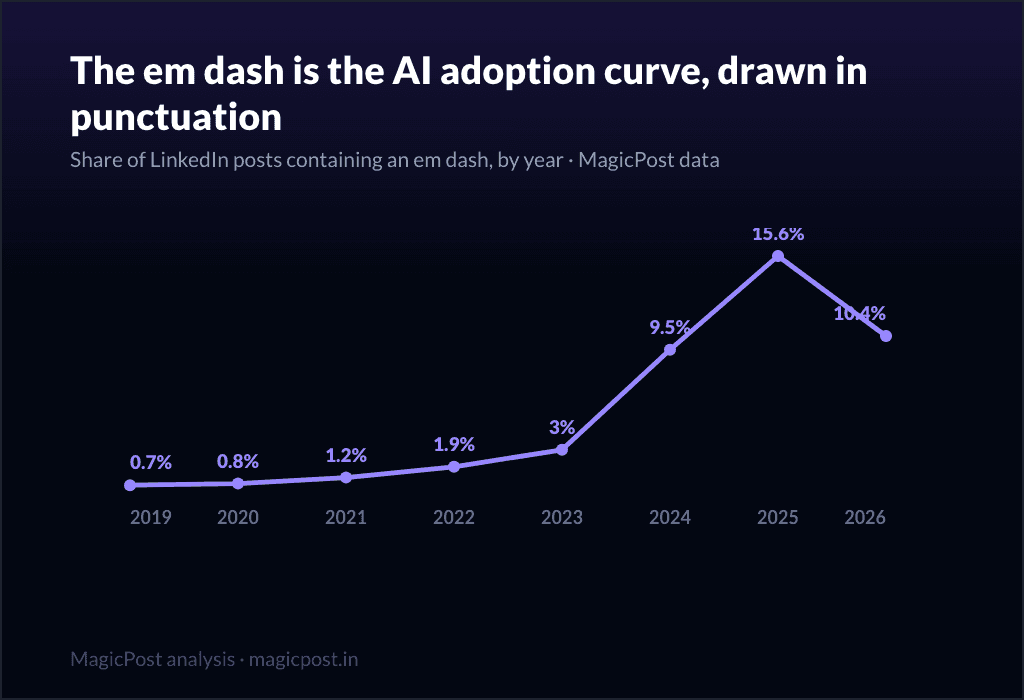
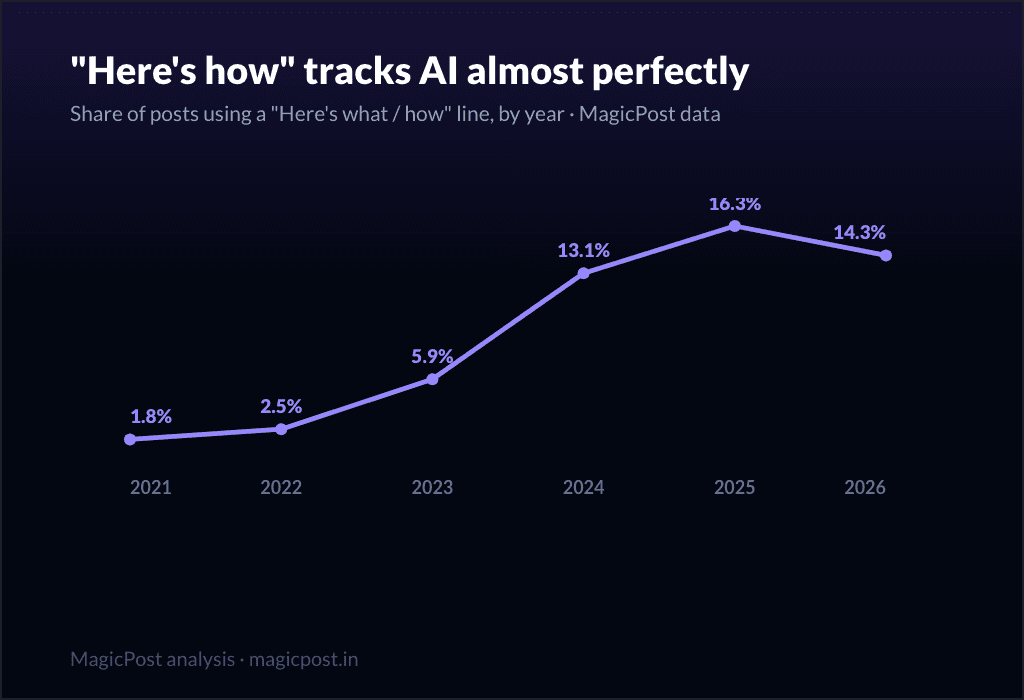
The change between 2025 and 2026 is more diffuse. Among the same authors, the most AI-sounding tenth of their posts went from 3.5% to 5.7% below their normal. And fewer people use the turns at all: the share of English posts carrying at least one of them fell from 24% in June 2025 to 14% in September 2026, and among the same 494 authors, "Here's what / how" dropped from 17% of their posts in 2025 to 7% in the weeks after July 27, 2026.
For what the platform itself has said about AI content, see our separate piece on whether LinkedIn penalizes AI content.
Creators who watch the feed closely point at the idea rather than the wording. Pierre Hérubel, who runs a 170,000-follower account and an agency publishing 500-plus B2B posts a month, calls it the "AI Slop Trap" and offers a one-line test, "could a competent AI generate something 90% as good as this in 30 seconds, given my topic?" His test is a question about substance, and that is where our newer data points too (more on this below).
Which phrasings actually cost you reach
Holding the author constant lets us ask, net of everything else, what each phrasing pattern does. The "AI tells" split into two groups pointing in opposite directions. Some templated scaffolding costs reach; some habits people think are AI tells actually help.
Across our English data, comparing each author to their own posts, the generic advice frame ("Stop X, start Y") leads at -6.7% and the "here's what" opener at -4.3%, while genuine-sincerity framing helps at +4.6%:
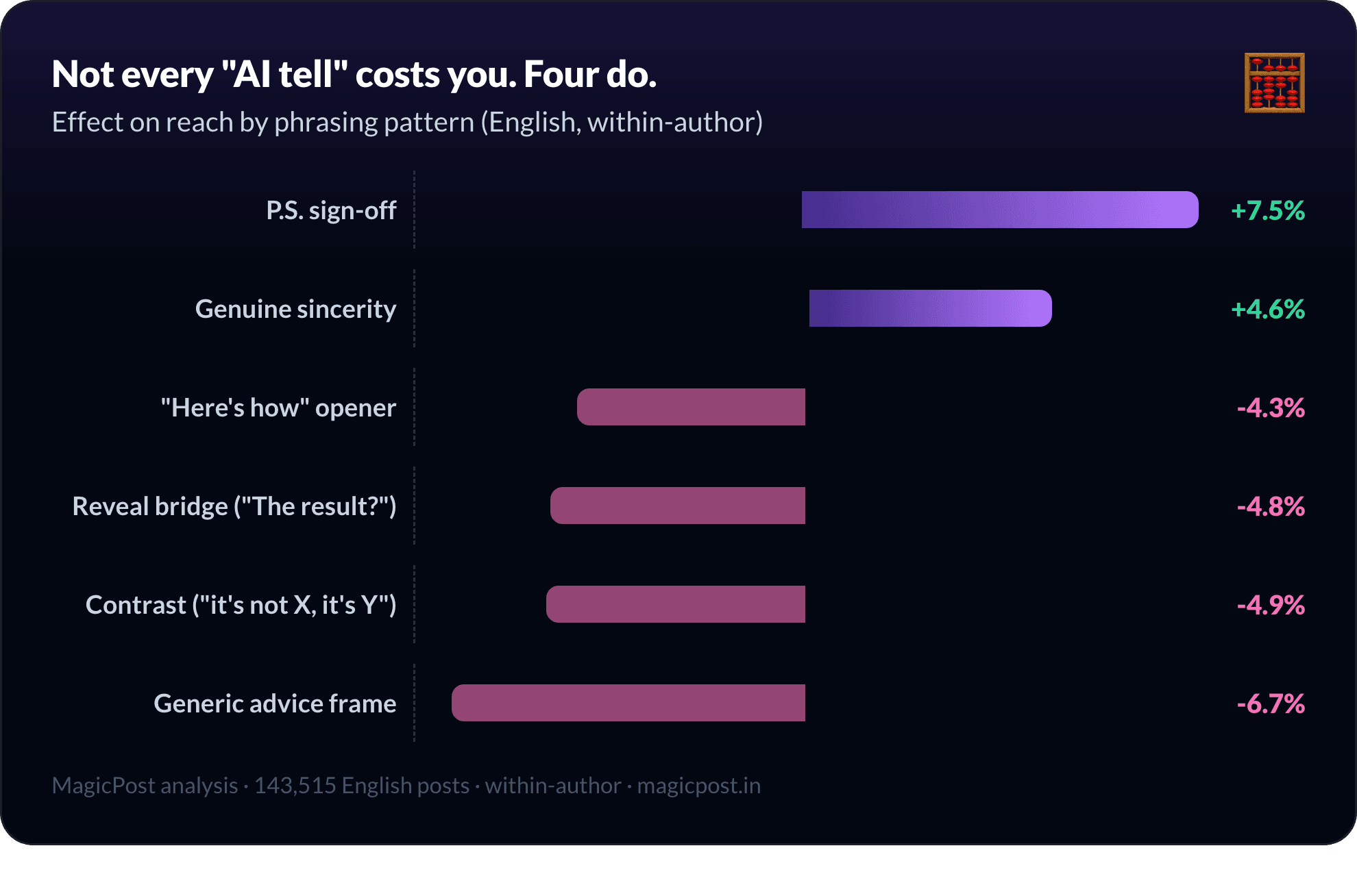
This chart comes from our June 2026 run, pooled over December 2024 to May 2026. One bar has not held up in the production rerun: the P.S. sign-off added 5.9% in 2025, and since late July 2026 we no longer measure any gain from it, nor any cost.
The phrasings worth removing are the templated scaffolding, the opener and the formula that signal "I have read this exact post a hundred times." The ones to keep are the human habits: vulnerability, a postscript, a closing question. A blunt "AI score" would tell you to delete the things that work, which is exactly why it is the wrong editing tool.
The four phrasings that cost reach: a cheat-sheet
Here are the four turns, English-first, each with a paraphrased example drawn from real 2026 posts in our corpus and the rewrite that recovers the reach. Each links to its full breakdown.
1. The generic advice frame: "Stop X, start Y" / "If you want to...". About -6.7% within an author in our English data (-6.6% on 2025 posts alone), the single most reliable reach-killer of the four. It sounds like "Stop chasing likes, start solving problems" or "Stop overplanning, start empowering." The negate-then-prescribe symmetry reads as a template the moment it lands. The "If you want to X, do Y" variant belongs to the same family and makes up about 40% of it in English.
Rewrite it as the concrete, topic-specific action: instead of "stop describing the tool, start owning the result," say what owning the result actually looks like for your reader. (See how to spot an AI-written LinkedIn post.)
2. The "here's what / here's how" opener. About -4.3% in our English data (-4.1% on 2025 posts alone). It sounds like "Here's what nobody tells you when you run a sales team" or "Here's what changed everything for the teams I work with." The announcement adds nothing; it just delays the substance. Open straight on the substance and drop the "here's what" framing entirely.
3. The "The result?" bridge. About -4.8% in our English data (-3.0% on 2025 posts alone). It sounds like "They stitch workflows from five different apps. The result? The frontline is lost" or "Companies bring it in-house too early. The result? They underperform." The dramatic one-word question is pure scaffolding. Chain the consequence directly: "...so the frontline is lost."
4. The "it's not X, it's Y" contrast formula. About -4.9% within an author in our English data (-5.1% on 2025 posts alone). It sounds like "That's not a branding question, that's a system question" or "That's not a hiring problem, it's a process problem." State the point directly ("This is a system question") without the negate-then-reframe pivot.
Same author, two regimes
The aggregate numbers neutralise audience across thousands of authors. The sharpest way to see the pattern is to zoom into one author at a time and compare their flagged posts to their own clean ones. Audience is constant by construction, the creator is the same person writing on the same kind of topic, and the gap is still there.
Creator (anonymised) | Posts | Flagged posts | Clean posts | Gap |
A SaaS founder | 15 | -1.0% | +39.7% | 41 pp |
A recruiter | 15 | -18.1% | +18.1% | 36 pp |
A B2B consultant | 14 | -2.0% | +19.8% | 22 pp |
A coach | 18 | -7.8% | +10.3% | 18 pp |
For the SaaS founder, the posts leaning on the contrast formula (a line in the shape of "that's not a branding question, that's a system question") landed at roughly their average, while their clean posts ran nearly 40% above it.
The recruiter's "The result?" posts sat 18% below their own baseline, their cleaner posts 18% above, a 36-point swing inside one account. Across the case studies, posts carrying one of the four flagged turns run 18 to 41 points below the same author's clean posts.
This is correlational at the per-author level (topic and format vary post to post, so it is not proof on its own), and these per-author gaps are much larger than the few percent the turns cost at equal substance, so most of each gap comes from what the posts say rather than from the turn itself.
What HELPS reach: do not strip these
The reason a raw "AI detector" is the wrong editing tool is that three of the habits it flags as "LinkedIn-sounding" never cost reach, and two of them raise it. They are engagement practices, not AI you are stuck with:
Genuine sincerity and vulnerability: +4.6% within an author, and still positive in 2026. A real, unpolished admission ("This month I hit 40K in revenue, and this morning I realised I have no one to celebrate with") earns reach. Keep it.
A closing question: slightly positive (+2.9% on 2025 posts), never a cost, and it pulls comments. Ending on the question your reader has been avoiding ("Am I on track?") invites the comment that feeds reach.
The P.S. / CTA sign-off: harmless. It added 5.9% in 2025 and shows no measurable gain since late July 2026, but no cost either. A clear close that says where to go next does not read as AI.
If an editing pass asks you to flatten these out in the name of sounding less like AI, ignore it. Clean the four templated turns above; leave the three human ones alone.
Want AI's speed without the patterns that cost you? That is what MagicPost's AI post generator is built for.
It drafts from your ideas, then its humanizer rewrites the templated scaffolding this study flags as costly (the "here's how" opener, the contrast formula, the generic advice frame) while keeping your voice and the habits that actually earn engagement. You get the draft in seconds, with time left to add the detail or the experience that only you can bring.
What this does and does not mean
What it means. Leaning on templated AI phrasing has a real, modest reach cost, it has had one since at least 2025, and we can name the turns that carry it. For anyone opening every post with "here's how" or reaching for the contrast formula, cleaning that up wins back a few percent. The patterns to fix are specific and few.
What it does not mean. It does not mean AI writing collapses your reach (the scary "far less engagement" figure was mostly the audience gap, not the writing).
It does not mean phrasing is the main lever: reach is dominated by your audience and your topic, and phrasing is a second-order tweak that wins back a few percent at the margin. And because this is observational, part of the cost may be effort rather than texture, since a post built from pure formula often has a thinner idea underneath.
That thinner idea is where the data moved in 2026. In our AI slop study of 40,937 LinkedIn posts, since the week of July 27, 2026, a post with a lived experience gets 25% more impressions than a comparable post by the same creator (7% before), and a post with a concrete detail 14% more (2% before). At equal substance, sounding like AI and the turns flagged by MagicPost's detector show no extra cost we can detect since that date. LinkedIn announced classifiers to identify AI slop on July 30, 2026. The timing matches, but we cannot see how the feed ranks posts, so we do not claim a cause.
Holding the author constant and isolating each pattern makes the phrasing explanation plausible for the four turns, but it does not prove cause.
So the order of the edit matters. First put something checkable, or something that happened to you, into the post. Then drop the templated scaffolding. (For the patterns themselves, see how to spot an AI-written LinkedIn post; for where they came from, AI writing on LinkedIn: the state of play.)
Where This AI-Reach Data Comes From
Everything here is MagicPost's own research, reproducible from the scripts behind it. The analysis covers English LinkedIn posts (text and image, 40 to 400 words, stable impressions). The per-pattern costs come from our June 2026 run on 143,515 posts across 3,000 authors, December 2024 to May 2026. The timing comes from a line-by-line rerun of that method on our production data, 298,740 English posts from June 2025 to September 2026.
Reach is `ln(impressions)` centered on each author's own mean within each period, so audience size and its growth are removed by construction. To date a change, we tested 27 dates two weeks apart, from August 2025 to August 2026, comparing the same authors eight weeks before and after each date. A real break ranks first; January 1, 2026 ranks 16th.
The per-pattern effects come from one regression of all device families together, with controls for length, format and post age, and confidence intervals from author-level bootstrap resamples. The AI scorer is our own `ai_likelihood_v2`, validated against an 800-post LLM-judge sample at a rank correlation of 0.82.
Honest caveat: this is an intra-author correlation, not an experiment; it removes the audience confounder but not a residual effort confounder. Per-pattern figures from the June 2026 run, checked against the production rerun.
FAQ
Do AI-written posts get less engagement on LinkedIn?
A little, and much less than the scary numbers suggest. Measured naively, AI-sounding posts look like they earn far less engagement, but most of that gap is audience size, not writing.
Comparing each author to themselves, four templated AI turns of phrase cost English LinkedIn posts about 3% to 7% of reach, and they already did in 2025. The bigger lever is substance: since July 27, 2026, posts with no concrete detail and no lived experience get 23% fewer impressions than their author's average post, up from 13% before.
Did something change in 2026?
Not for the AI turns of phrase, and not on January 1. On English LinkedIn posts, the four costly turns already cost about 3% to 7% of reach in 2025, and comparing the same authors before and after 27 dates shows no break at January 1, 2026.
What changed came in the week of July 27, 2026: the extra reach a concrete detail or a lived experience brings rose sharply, while the turns showed no extra cost at equal substance. LinkedIn announced classifiers to identify AI slop on July 30, 2026. The timing matches, but we do not know how the feed ranks posts.
Which AI phrasings cost the most reach?
Templated scaffolding, not every "AI-sounding" habit. In our English data the costliest are the generic advice frame ("Stop X, start Y" or "If you want to...", about -6.7%), the "it's not X, it's Y" contrast formula (-4.9%), the "The result?" bridge (-4.8%), and the "here's what / here's how" opener (-4.3%), each measured within a single author. All four already cost reach on 2025 posts.
Three patterns often mistaken for AI tells cost nothing and should be kept: genuine-sincerity framing and a closing question, which both raise reach, and the P.S. sign-off.
Does this prove AI hurts your posts?
It does not prove cause. It is a consistent correlation within each author, found on 2025 posts and again on 2026 posts. Holding each author constant rules out audience size, and isolating each pattern shows which phrasings carry the cost.
What it cannot fully separate is effort: posts built from pure formula often have thinner ideas underneath, and a missing detail or lived experience costs more than any single turn of phrase. The practical fix is the same either way: put something real into the post, drop the templated scaffolding, and reach recovers at the margin.
> Manage your whole LinkedIn presence in one place. With MagicPost you write, schedule and analyze every post in one workspace, so you can keep your voice, fix the few phrasings that cost reach, and watch what each change does to your numbers over time.