" height="26.80529977783203px" id="tymKb8bqC" width="128.00300311279295px"/><path d="M 0 2.417 L 0 0 L 12.909 0 L 12.909 2.417 Z" fill="rgb(126, 78, 253)" height="2.417099999999998px" id="aYr4em6zK" transform="translate(128.341 22.325)" width="12.908999999999992px"/></svg>)

"/><stop offset="1" stop-color="rgb(118, 37, 250)"/></linearGradient></defs><g d="M 19.242 21.22 L 19.362 6.204 L 19.272 6.204 L 13.757 21.22 L 10.161 21.22 L 4.796 6.204 L 4.706 6.204 L 4.825 21.22 L 0 21.22 L 0 0 L 7.283 0 L 12.109 13.607 L 12.229 13.607 L 16.844 0 L 24.247 0 L 24.247 21.22 Z M 26.421 26.113 L 26.421 23.445 L 41.407 23.445 L 41.407 26.113 Z" fill="transparent" height="26.112508199679183px" id="DvfaAIHYn" width="41.40731898311435px"><path d="M 19.242 21.22 L 19.362 6.204 L 19.272 6.204 L 13.757 21.22 L 10.161 21.22 L 4.796 6.204 L 4.706 6.204 L 4.825 21.22 L 0 21.22 L 0 0 L 7.283 0 L 12.109 13.607 L 12.229 13.607 L 16.844 0 L 24.247 0 L 24.247 21.22 Z" fill="rgb(46, 46, 46)" height="21.220180016149442px" id="pLsxRCobd" width="24.247352589074694px"/><path d="M 0 2.668 L 0 0 L 14.986 0 L 14.986 2.668 Z" fill="url(%23yD9d4I5GR-3279285344-linear-gradient)" height="2.6675085048549647px" id="yD9d4I5GR" transform="translate(26.421 23.445)" width="14.986002836263765px"/></g></svg>)

Naïlé Titah
Open LinkedIn today and you can feel it. The posts have started to rhyme. The same openers, the same neat contrasts, the same tidy little question at the end. AI did not just arrive on the feed; it gave the whole feed a house style.
And in 2026, that house style started costing reach. We studied the impressions of every eligible post by thousands of authors, comparing each writer only against their own other posts, so audience size never enters the comparison. Four templated turns of phrase each pull a post below its author's own baseline, and the penalty was statistically absent before 2026. Each runs about 4% to 7% below the same author's normal reach in our English data; the steepest, the "stop X, start Y / the key is" advice frame, runs about 6.7% below. (The full study is Do AI posts get less engagement on LinkedIn?.)
So this is two stories at once: a map of the house style, and the year it turned from an asset into a tax. The uncomfortable part of the history is that almost none of these turns were invented by a machine. They were invented by the best humans on the platform, refined for years because they worked. The machine only copied them, at scale, until they read as a stamp instead of a skill, and the feed started discounting the stamp.
TL;DR: AI gave LinkedIn a house style: the same openers, the same neat contrasts, the same tidy closing questions. This page maps the patterns that now read as AI in 2026, tracks their rise in our data, and explains where they came from: models trained on the platform's best writers.
The recognizable shapes
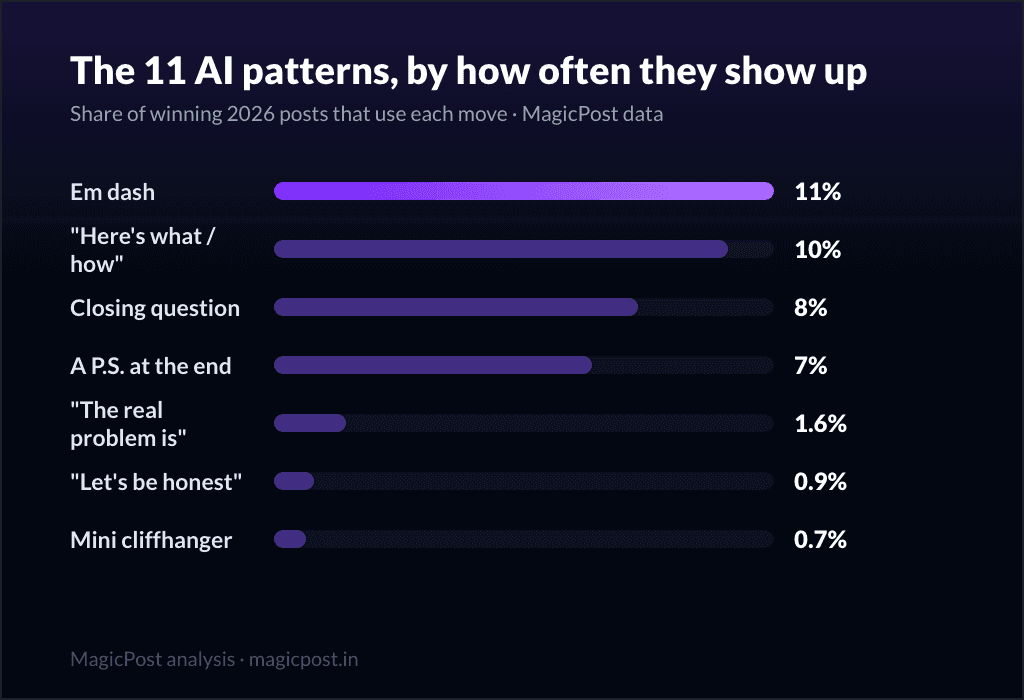
If you have scrolled LinkedIn in 2026, you already know these by feel. Here they are by name. (The full breakdown of all eleven is in How to spot an AI-written LinkedIn post; this is the short tour.)
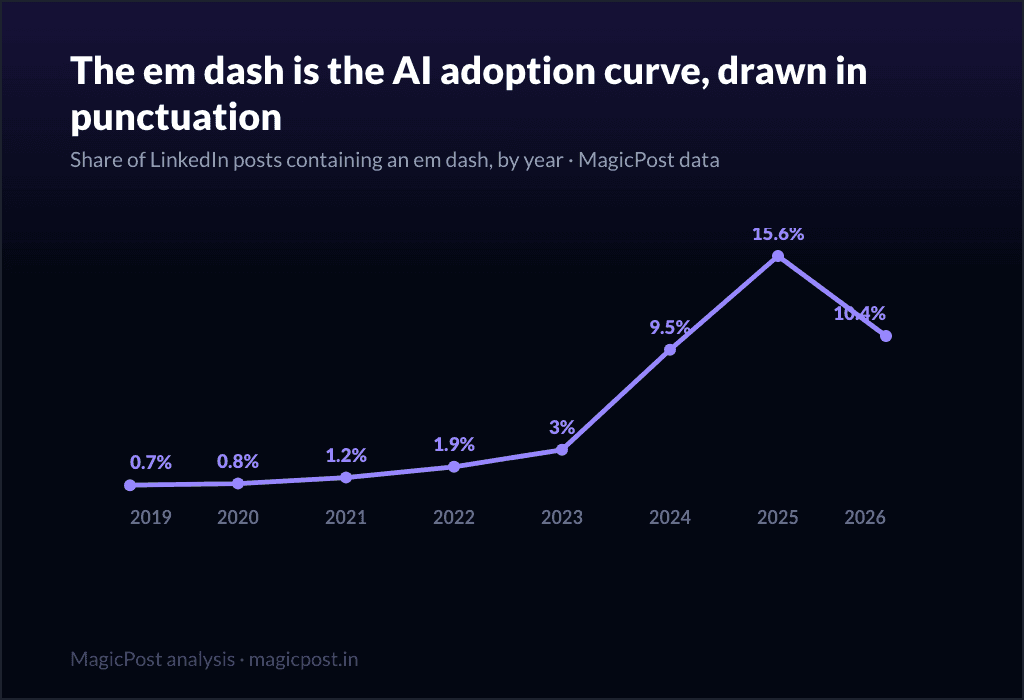
The em dash. The long dash dropped mid sentence. It sat under 2% of posts for years, then jumped to 9.5% in 2024 and 15.6% in 2025 as AI tools spread. It went from rare to everywhere in two years.
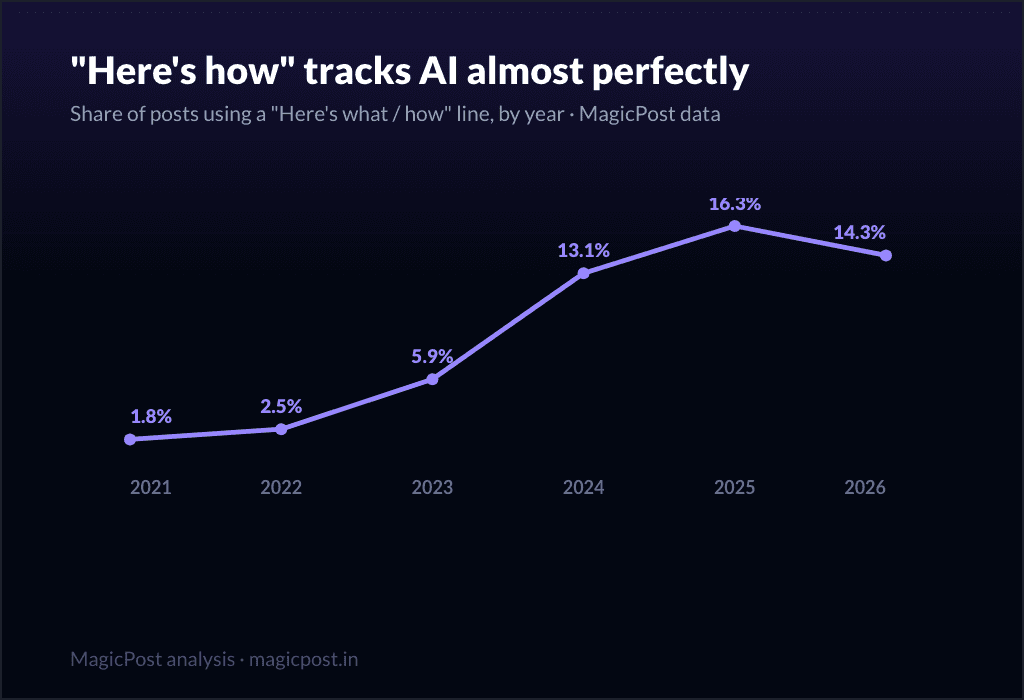
"Here's how / Here's what." The promise opener. Chris Donnelly (1.2M followers) opened a post with "Here's the breakdown:" and it pulled more than 23,000 likes. It works, which is exactly why it is everywhere.
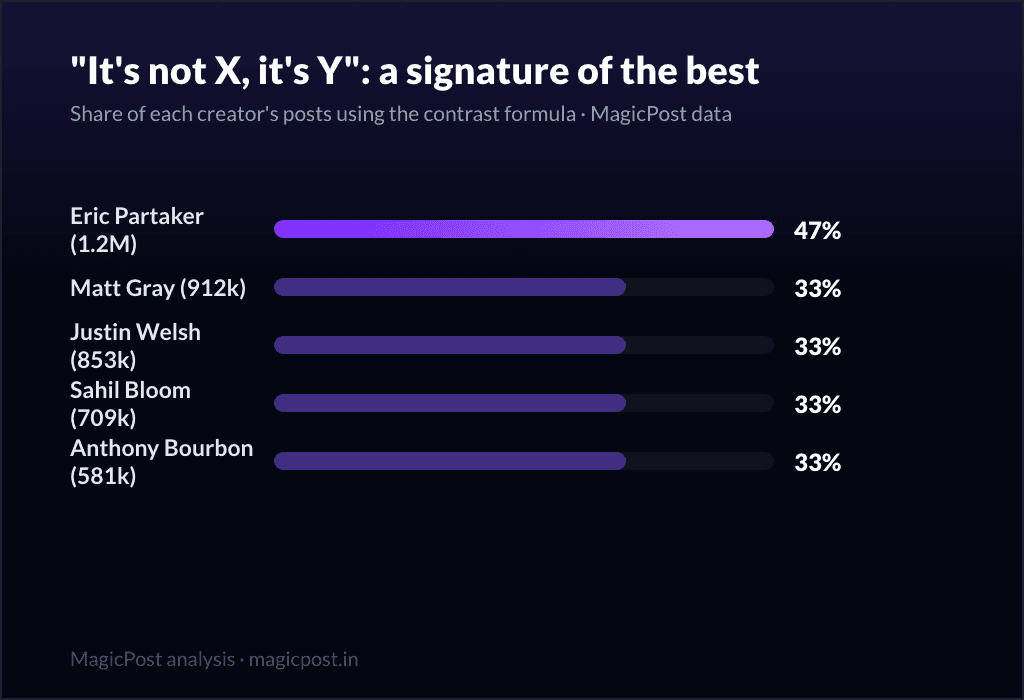
"It's not X, it's Y." The contrast formula. "It's not about the cost, it's about the value." It is the single most common move among top creators.
The closing question. "What about you?" The reflex ask for comments, now so automatic it reads as a script.
The reveal bridge. "The result?" "Plot twist:" The mini cliffhanger before the payoff.
One creator, Allie K. Miller (1.6M followers), summed up the collective recognition in a single post: "Insanely obvious signs you used AI: 'It's not X, it's Y', equal-length bullets, ending a post with a weird question, a parade of em dashes, certain words (harness, supercharge)." When a list like that gets thousands of likes, the patterns are not a secret anymore. The whole platform can see the seams.



The four turns that now cost reach
Recognition is one thing. Reach is another, and this is where 2026 broke from every year before it. We measured the impressions of each post against the same author's other posts, so a creator's audience size cancels out of the comparison. On that within-author basis, four specific phrasings each drag a post below its writer's own normal, and the effect that was missing in 2025 is present and measurable in 2026.
Turn of phrase | What it sounds like | Reach cost (English, within-author) |
Generic advice frame | "Stop X. Start Y." / "the key is" | −6.7% |
"Here's what nobody tells you" | −4.3% | |
Reveal bridge | "The result?" / "Plot twist:" | −4.8% |
"It's not X, it's Y" | −4.9% |
Read the table honestly. These are measured across our English posts, each author compared only to their own work, and all four clear statistical significance. The penalty is real, it is measured within each author, and it is a second-order lever: audience still drives reach far more than phrasing does. Cleaning these turns recovers a few percent on the most templated posts, not an order of magnitude. It will not double anyone's reach, and we are not going to pretend it does.
These are the turns in the wild, reworded from real 2026 posts so no one is named:
Generic advice frame. "Stop describing the tool. Start owning the result." "Stop chasing likes, start solving problems." Replace the template with the concrete, topic-specific action and the cost goes away.
The "Here's" opener. "Here's what nobody tells you when you run a team this size." Open straight on the substance instead of announcing it.
The reveal bridge. "Teams stitch a workflow out of five different apps. The result? The frontline gets lost." Chain the consequence directly: "...so the frontline gets lost."
The contrast formula. "That's not a branding question. It's a system question." State it plainly ("This is a system question") and skip the negate-then-reframe pivot.
Three other moves that often get lumped in with "AI writing" do the opposite: they help. Genuine sincerity and vulnerability runs +7 to +10% within an author, a closing question adds about +3%, and a P.S. or CTA sign-off reads as a clean positive. These are engagement practices, not AI tells, and stripping them to "sound human" would be exactly the wrong move. Sounding human means dropping the four shared templates while keeping the sincerity and the question that actually earn attention.
Where they actually came from
This is the part that gets lost in the panic. These are not AI inventions. They are the signature moves of the most successful writers on LinkedIn.
We profiled 100 of the biggest creators on the platform (a median of roughly 79,000 followers). The "AI" moves are their moves:
Move now read as "AI" | Top creators who use it |
"It's not X, it's Y" | 100% (28% in nearly every post) |
"Here's how / Here's what" | 98% |
"The key is / Stop doing X" | 100% |
A question at the end | 98% |
Gary Vaynerchuk (5.9M followers) writes "It's not always how much money you make, it's how much you spend." Justin Welsh (853k) opens with "Here's." These posts win, thousands of likes at a time. The patterns work because they were refined over years by people who write for a living.
So why do they now read as a robot? Because of how language models learn. As the writer Ann Handley (511k followers) put it in a widely shared post: "AI models love the em dash because humans do. They are trained on millions of human-written sentences." The model studied the best creators, absorbed their highest-performing moves, and now serves them back to everyone, all at once, in every post. What gives it away was never the move itself; it is the saturation, the same handful of turns repeated across the whole feed.
The backlash, and the over-correction
The community noticed, and the mood turned fast. Some of the most-liked posts of the year are now about the tells themselves. There are parody lists of "phrases that scream AI." There is a running joke about the em dash being put "on trial."
But the backlash misfired on aim, not on instinct. People started stripping em dashes, clean bullet points, and any sharp sentence out of their writing, and several well-known writers pushed back on the punctuation panic specifically. Netflix co-founder Marc Randolph (380k followers) noted he has written with em dashes for nearly 50 years. The em dash is 400 years old, and a single dash is not a verdict.
They were right about the dash and wrong to extend the amnesty to everything. The reach data draws a sharp line between the two. A lone em dash is cosmetic and carries no measurable reach penalty. The four templated turns above are structural, and they do carry one in 2026. So the readers tearing dashes out of their drafts were sanding the wrong surface, while the genuinely costly moves, the advice frame and the "Here's" opener and the contrast formula, sat untouched. None of which means AI phrasing is harmless; it means the crowd flagged the wrong tell and left the expensive ones in place.
The same author, two versions
The cleanest evidence sits inside individual creators, where audience is held constant by definition. We compared each author's posts that carry one of the four killer turns against their own clean posts in 2026. The flagged posts run consistently below.
A SaaS founder who leans on the reveal bridge ("...companies bring it in-house too early. The result?") averages 18 points of reach below their own posts that drop the device. A recruiter whose flagged posts use the contrast pivot ("That's not a branding question. It's a system question.") sits 41 points under their cleaner writing, posts that open on something specific and lived-in instead. Across the creators we checked, the gap between a writer's templated posts and their own clean ones ran from 18 to 41 points.
That comparison is correlational, since topic and format vary inside one account too. But it points the same direction as the controlled, audience-neutralised estimate, and it does it author by author: the post that wears the template under-performs the post that does not, by the same hand, to the same audience.
What LinkedIn is doing about it
The platform decided to weigh in. In May 2026 it announced it would demote "generic or repetitive" content that "lacks any real unique perspective," and reported flagging generic content with about 94% accuracy in early tests. It banned no specific phrase; the stated target is emptiness, the repeated and the templated. That lines up with what the reach numbers already show. The posts that wear the same four turns as everyone else are exactly the ones reading as generic, and exactly the ones losing impressions. (We unpack what that means for reach in Does LinkedIn penalize AI content?.)
Where that leaves us
So this is the state of play in 2026. A feed that converged on a shared set of moves, partly because models trained on the best creators, partly because everyone imitates the same ones, and a community that can now spot all of it. The patterns are not going away; they are too effective. What changed is that they no longer signal "good writer." They signal "wrote like everyone else."
The interesting writing now is the writing that does not rhyme with the rest of the feed. Not because it dropped the em dash. Because there is an actual person behind it.
How to Spot an AI-Written LinkedIn Post: 11 Patterns (We Analyzed 46,000 Posts)
We analyzed 46,000 LinkedIn posts to find the 11 patterns that make a post read as AI in 2026, with real examples from top creators and how to fix each.
"It's Not X, It's Y": The LinkedIn Formula Everyone Now Reads as AI
"It's not X, it's Y" is the most-flagged AI formula on LinkedIn. Every top creator uses it, why it became a tell, and the reach it now costs in 2026 (around -9% in French).
Is the Em Dash a Sign of AI on LinkedIn? Yes, and It Has a Bigger Cousin
Is the em dash a sign of AI on LinkedIn? Yes. Em-dash use jumped from under 2% of posts to over 15% with ChatGPT. The data, and what to use instead.
"Here's How" and "Here's What": AI Openers That Cost Reach
"Here's how" is LinkedIn's most common AI handoff. It went from under 3% of posts to over 16% with ChatGPT. Why it reads as AI, and how to vary it.
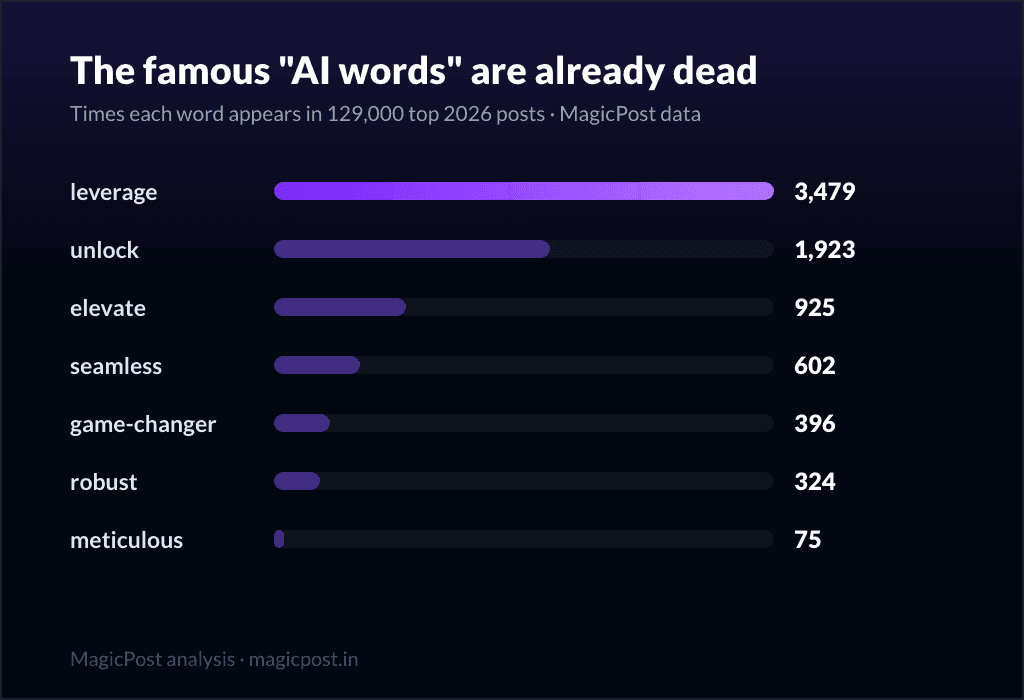
AI Words to Avoid on LinkedIn: We Analyzed 129,000 Posts (2026)
The famous AI words to avoid (delve, tapestry) are already dead on LinkedIn. We checked 129,000 posts. The real tells moved from vocabulary to structure.
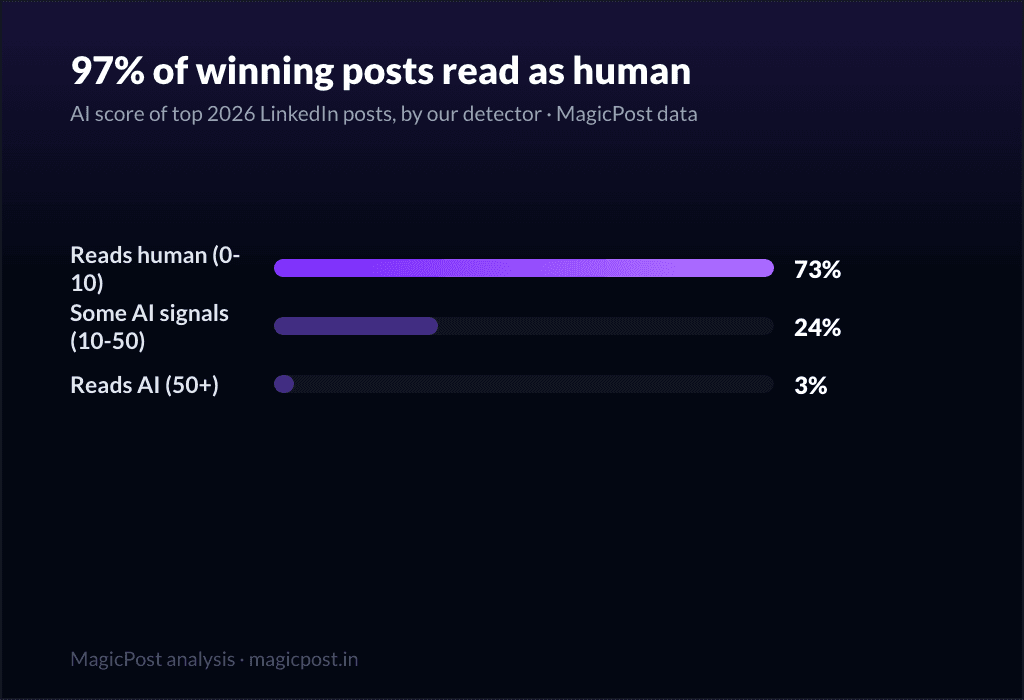
Does LinkedIn Penalize AI Content? What the Data Says (2026)
Does LinkedIn penalize AI content? Not exactly. It demotes generic posts, not AI. We scored 46,000 top posts and 97% read as human. Learn more here.