You have seen the lists. "30 ChatGPT words that scream AI: delve, tapestry, robust, underscore, in the realm of..." They get reshared every week, and people genuinely scan their drafts for these words before posting.
That hunt is aimed at the wrong target. The famous AI words to avoid on LinkedIn are no longer a threat. They are already dead. Meanwhile a different set of AI tells, structural ones, now measurably costs you reach in 2026.
We will show you both: why the word lists are fighting the last war, and which four sentence shapes actually shrink your distribution today.
Does Structure Affect Your LinkedIn Post Reach?
We analysed 143,515 English LinkedIn posts across 3,000 authors, comparing each post against the same author's own normal output, so audience size is neutralised. (Full study here.)
Four templated sentence shapes each lose reach, and the effect was statistically absent before 2026:
Sentence shape | What it looks like | Reach cost (English, within-author) |
|---|---|---|
`generic_advice_frame` | "Stop X, start Y" / "the key is" | -6.7% |
`here_is` | "Here's what nobody tells you" / "Here's how" | -4.3% |
`reveal_bridge` | "The result?" as a dramatic bridge | -4.8% |
`contrast_formula` | "It's not X, it's Y" | -4.9% |
At the extreme, the most AI-phrased English posts (top 5%) lose a few percent of their impressions versus what their author normally gets. The same gradient was near zero in 2025, which lines up with LinkedIn beginning to penalise AI phrasing in Q1 2026.
A few honest caveats so you can trust the number. This is observational: a correlation measured within each author, not a controlled experiment, so read it as strong evidence rather than proof. And it is a second-order lever.
Your reach is still driven first by your audience, not by your phrasing. Cleaning these shapes recovers a few percent on your most templated posts. It does not double your reach, and anyone promising that is selling you something.
The point that ties this page together: in 2026 the tells that cost reach are sentence shapes, while the vocabulary has gone quiet. So scanning for "delve" misses the thing that actually moves your numbers.
What Are the AI Words to Avoid on LinkedIn?
Now the vocabulary side, which is where the old lists go wrong. This is how often the classic giveaway words actually showed up in top posts. We checked 129,000 English posts from 2026, all with more than 20 likes:
The word the lists warn about | Posts (out of 129,000) | How rare |
|---|---|---|
"in the realm of" | 5 | 1 in ~26,000 |
bustling | 7 | 1 in ~18,000 |
tapestry | 20 | 1 in ~6,500 |
ever-evolving | 48 | 0.04% |
underscore | 58 | 0.04% |
delve | 65 | 0.05% |
"a testament to" | 68 | 0.05% |
meticulous | 75 | 0.06% |
Every one of them sits below 0.06% of posts. "Delve," the single most famous AI word on the internet, appeared in 65 posts out of 129,000. You could read LinkedIn for a month and not trip over it. Scanning your drafts for these words is checking the locks on a house nobody is breaking into.
AI LinkedIn Banned Words Evolution
These words are not rare because AI never produced them. They are rare because the internet learned them and scrubbed them out. Watch "delve" rise and fall:
Year | Posts using "delve" |
|---|---|
2021 | 0.08% |
2022 | 0.11% |
2023 | 0.91% |
2024 | 0.56% |
2025 | 0.12% |
2026 (so far) | 0.05% |
"Delve" exploded almost tenfold in 2023, ChatGPT's first full year. Then the takes went viral, everyone added it to their ban list, and it crashed. By 2026 it is rarer than it was before ChatGPT existed. "Ever-evolving" traces the exact same arc: a 2023 spike, then back to near-zero. The vocabulary tells were a real wave. The wave broke three years ago.
So the "avoid these words" lists are fighting the last war. They describe what AI sounded like in 2023, not what it sounds like now, and not what costs you reach now.
Are AI Words Risky to Use on LinkedIn?
There is a second problem with banned word lists: a chunk of their entries are not AI words at all. They are ordinary business jargon. Look at the "AI words" that are still common:
"AI word" still in use | Posts | Frequency |
|---|---|---|
leverage | 3,479 | 2.7% |
unlock | 1,923 | 1.5% |
elevate | 925 | 0.7% |
seamless | 602 | 0.5% |
game-changer | 396 | 0.3% |
robust | 324 | 0.3% |
"Leverage" appears 53 times more often than "delve." Not because AI loves it, but because business people have said "leverage" for decades.
These words survive because they were never distinctive to AI in the first place. Banning "leverage" to avoid sounding like a robot is like banning "synergy": you will sound less corporate, maybe, but no human ever pegged a post as AI because it said "unlock."
So the lists fail twice: the genuinely AI-flavored words are already dead, and the words that remain were never the tell.
How Does Post Structure Affect LinkedIn Reach?
What happened is a simple arms race. As soon as a word becomes a known AI giveaway, people stop using it. Vocabulary is the easiest thing to fix, so it gets fixed fast. That is why the 2023 words are gone.
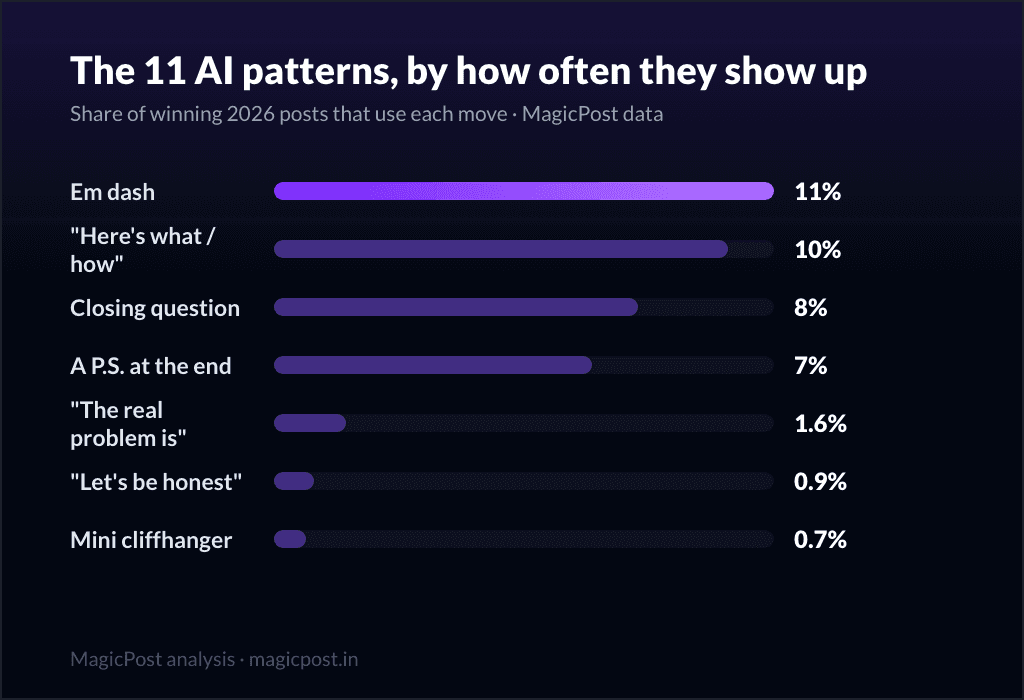
What replaced them is harder to scrub, because structure has no find-and-replace. And as the table above showed, structure is what now costs reach. The tells of 2026 live in sentence shapes:
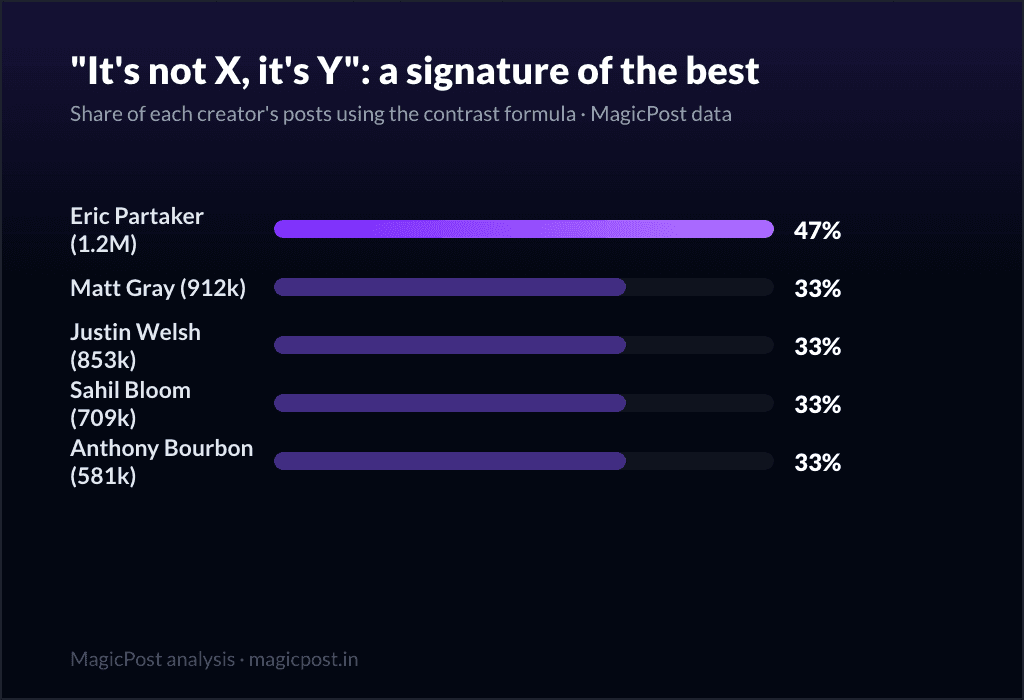
The contrast formula, "It's not X, it's Y", about -4.9% within an author in our English data.
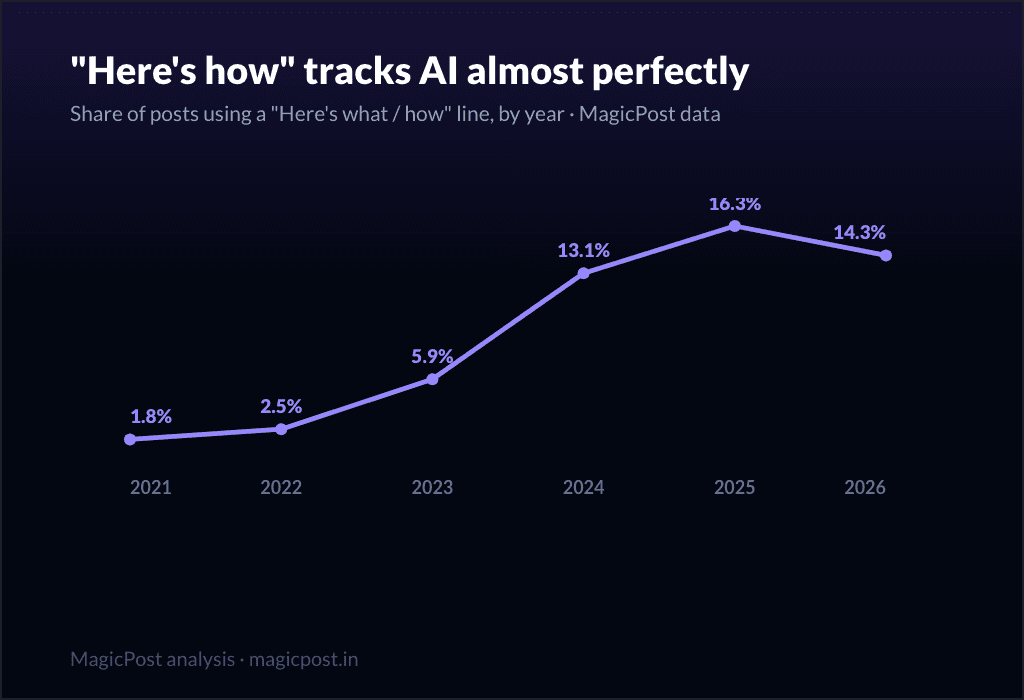
The "Here's how:" handoff and the templated how-to structure around it, a robust -4.3% within an author in English.
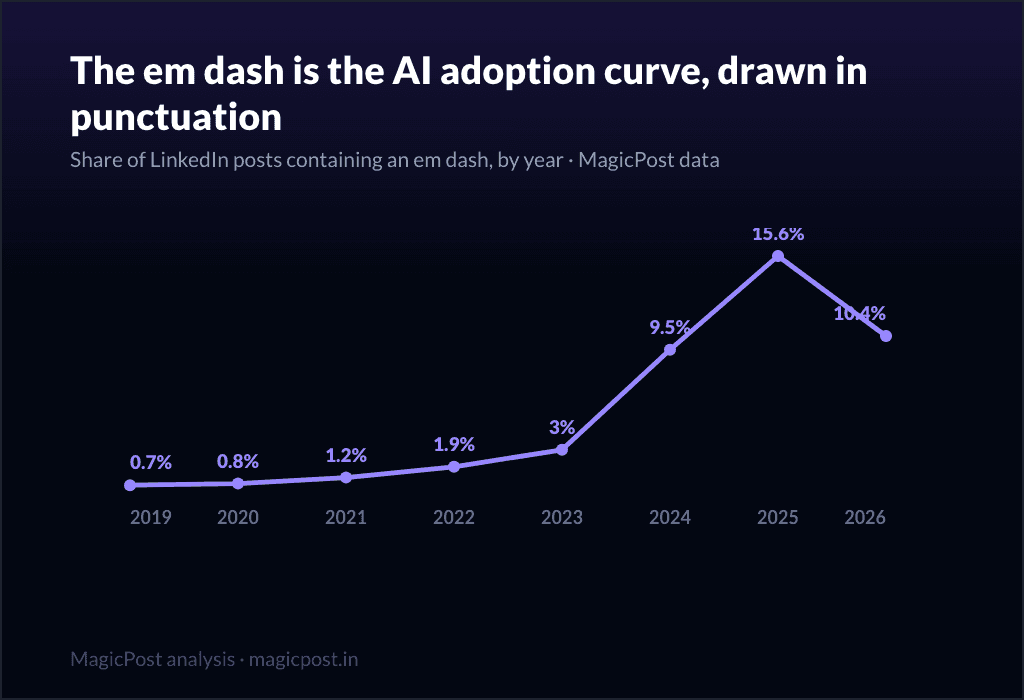
The em dash, which went from under 2% of posts to over 15% in step with AI tools.
None of these is a word. You cannot catch them by scanning a banned list, which is exactly why they survived while "delve" died. The full set is in our pillar, How to spot an AI-written LinkedIn post.
AI Post Giveaways on LinkedIn and How to Find Them
Real LinkedIn posts run into these constantly. Here are paraphrased examples of each shape and a straight rewrite. The fix is almost always the same: drop the templated scaffolding and say the substance directly.
The "stop X, start Y" frame (the most reliable English reach-killer at -6.6%). A coaching post that says "Stop chasing likes, start solving problems" or "Stop overplanning, start empowering." The rewrite swaps the generic command for the concrete, topic-specific action you actually mean.
The "here's what nobody tells you" handoff. A post that builds to "Here's what nobody tells you when you run a remote team" before delivering the point. Open straight on the substance and the announcement disappears, along with the tell.
The "The result?" bridge . A B2B post that lists a few problems, then drops "The result? Deals slip through the cracks." Chain the consequence directly instead: "...so deals slip through the cracks."
The "it's not X, it's Y" pivot. A post that negates, then reframes: "That's not a branding question. That's a system question." State it once, directly: "This is a system question." No negate-then-flip.
AI LinkedIn Post Penalties: An Example
The clearest evidence sits inside individual accounts, where the audience is held constant. A SaaS founder we looked at posts both ways.
Their flagged posts, the ones carrying a contrast pivot like "that's not a branding question, that's a system question," landed essentially flat versus their baseline, while their clean posts ran about 40 points higher. A recruiter showed the same split with the "The result?" bridge: flagged posts roughly 18 points below their own clean ones.
Across the creators we tracked this way, the posts carrying a killer shape ran 18 to 41 points below the same author's clean posts. It is correlational (topic and format vary too), but it points the same direction as the controlled estimate above.
What Helps Your LinkedIn Reach?
This is the part the "everything LinkedIn-y is AI" crowd gets wrong. Three habits that sound formulaic actually raise reach, and you should keep them:
Genuine vulnerability or candor (+7% to +10%). A real opener like "This month I hit 40K in revenue, and this morning I realized I have no one to celebrate with."
A closing question (+3%). Ending on the real question someone is avoiding: "Am I on track?"
A P.S. or CTA sign-off. "LinkedIn's algorithm changed and reach dropped for everyone, but you don't need to panic (here's why)."
These are engagement practices, not AI artifacts. Stripping them to "sound less AI" costs you the reach the four templated shapes are already taking. So the useful rule is narrow: cut the four hollow shapes, keep the sincerity, the question, and the sign-off. "Avoid anything that sounds like LinkedIn" throws away the parts that help.
What to actually do
Scanning for words is 2023 advice, and it catches nothing that is still out there. Read your draft for structure instead.
Does it open with a dismissive setup and a "Here's what nobody tells you"? Is there a "stop X, start Y" command where a concrete action belongs? Is there a "The result?" bridge, or a contrast line that contrasts nothing real?
Those four shapes are what the 2026 data ties to lost reach, and none of them is a word. The thing to read for is the familiar empty shape, not the rare fancy word.
The one word-level habit still worth keeping: if you genuinely wrote "delve" or "tapestry," you are probably fine, since almost nobody does. The structure is the thing to read for.
MagicPost's Humanizer ignores the dead word lists and rewrites the structural shapes that actually cost reach in 2026, while leaving the sincerity, questions, and sign-offs that help. Try it free.
FAQ
Is "delve" still a sign of AI in 2026?
Barely. It appeared in 65 of 129,000 top LinkedIn posts, about 0.05%, after peaking near 0.9% in 2023. The internet learned it and scrubbed it. Seeing "delve" today is a weak signal at most.
Should I avoid words like "leverage," "unlock," and "robust"?
Not for AI reasons. Those are ordinary business words, not AI tells. They are common because people have used them for years, and no reader flags a post as AI for saying "unlock."
So which AI tells actually cost me reach now?
Templated sentence shapes, rather than any specific word. Four of them are what our 2026 reach study ties to lost distribution: "stop X, start Y" (-6.7%), "here's what nobody tells you" (-4.3%), the "The result?" bridge (-4.8%), and "it's not X, it's Y" (-4.9%), each within a single author's English posts. See the full breakdown.
Does AI phrasing really get penalised, or is that a myth?
It does, but specifically and modestly. The four shapes above lose measurable reach within each author since 2026, and the effect was near zero before then. It is a second-order lever, your audience still drives most of your reach, but it is real and it is structural, not vocabulary.
Why did the AI words disappear?
Because words are the easiest tell to fix. Once "delve" went viral as an AI giveaway, everyone deleted it. Structure is harder to scrub, so that is where the tells, and the reach cost, live now.