Managing multiple LinkedIn accounts gets messy fast. You log out of your own profile, log into a client's, wait on a 2FA code that lands on their phone, post, log out, and start over for the next one. Do that across eight clients and half your day is gone before you have written anything.
But before you reach for a tool, it is worth clearing up what "multiple accounts" even means here, because the answer changes what you are allowed to do.
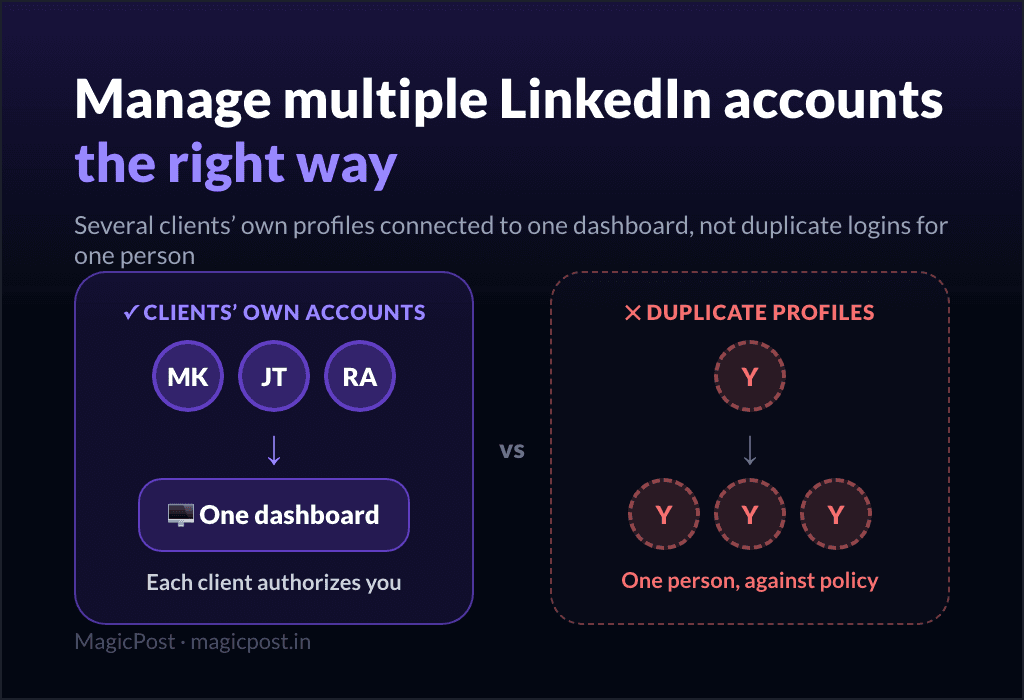
Short answer: for an agency or ghostwriter, "managing multiple LinkedIn accounts" means running several clients' own personal accounts, each a separate person who has authorized you. It does not mean creating extra accounts for yourself, which LinkedIn does not allow.
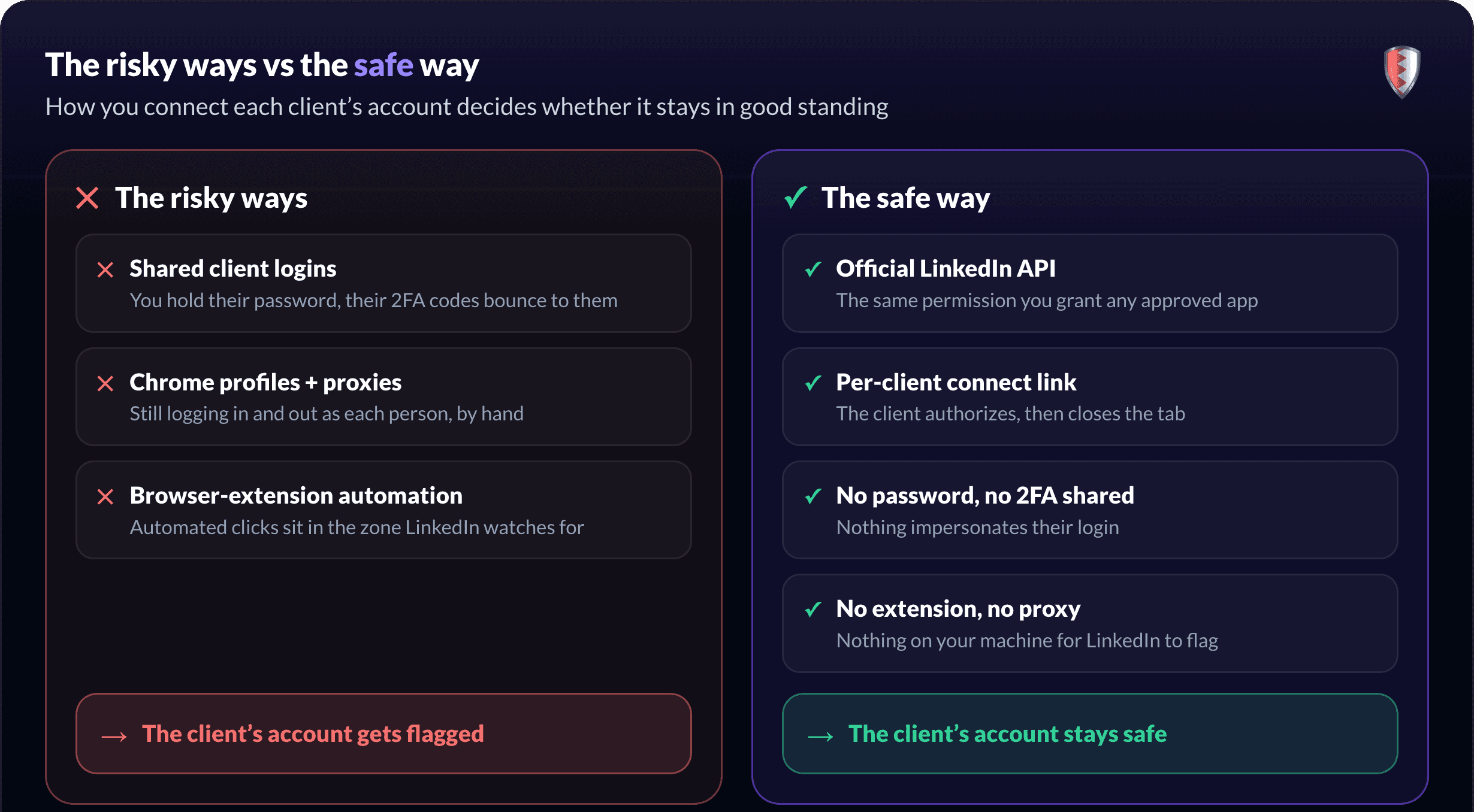
The safe way to do it is an official, per-client connection, with no password sharing, no Chrome profiles, and no proxies. The risky ways (shared logins, browser sessions, automation extensions) are what get accounts flagged. Below is how to tell them apart and set up the safe one.
Can you have multiple LinkedIn accounts?
Not for yourself. LinkedIn's User Agreement is explicit: one person keeps one personal account. Running a second profile for the same individual is against the policy, and duplicate accounts can be merged or restricted.
That rule trips people up because "manage multiple LinkedIn accounts" sounds like it means stacking profiles. For an agency it does not. You are not creating accounts. You are managing accounts that already belong to other people, with their permission.
That distinction is the whole game:
Allowed: you manage the personal accounts of ten different clients, each of whom authorized you.
Not allowed: you spin up several accounts for one person, or operate fake or duplicate profiles.
So the real question isn't whether you can have multiple accounts. It's how to manage several clients' accounts without putting any of them at risk.
What does managing multiple accounts actually involve?
For an agency or ghostwriter, the job behind the phrase is concrete. For each client you need to:
write and schedule content in that client's voice,
get the client to approve it before it publishes,
engage from their profile when that is part of the package,
and report on what worked, separately, per client.
The hard part is doing all of that for ten people at once without mixing anyone up, leaking credentials, or burning out. That is what a multi-account setup has to solve, and it is where the method you pick matters.
The risky ways to manage multiple accounts
Most guides on this topic come from automation tools, and most of them point you at the same browser-level tricks. They work until they do not.
Method | How it works | The risk |
Shared client logins | The client hands over their email and password | You hold credentials you should not, 2FA codes bounce to the client, and a login from your location looks suspicious |
Chrome profiles or sessions | A separate browser profile per account, sometimes with a proxy | Brittle and manual, and you are still logging in and out as each person; one slip looks like account sharing |
Browser-extension automation | An extension acts on the account from your browser | Extensions that automate clicks sit in LinkedIn's gray zone; this is the most common reason an account gets flagged |
The common thread is that all three put your machine in the middle of the client's login. LinkedIn sees one device behaving like many people, which is exactly the pattern it watches for. When an account gets restricted, it is the client's account, and that usually means a cancelled retainer.
The safe way: connect each client's account officially
The alternative is to never touch the login at all. Instead of borrowing a client's credentials, you have the client authorize a connection through the official LinkedIn API, the same kind of permission you grant any approved app. No browser extension automating clicks, no proxy, no workaround that LinkedIn watches for.
That is the core of how MagicPost works, and it is the model worth copying whatever tool you use: authorize through the official API, do not borrow a login.
With that approach:
The client never logs into your tool. You send them a connect link; they click it, authorize LinkedIn, and close the tab. That is the only thing they ever have to do to get started.
You never see a password or a 2FA code. Nothing impersonates their login, so the client's account stays safe and in good standing.
There is no extension or proxy to maintain. The connection runs on the official API, not on your browser pretending to be ten people.
Each client lives in their own isolated space, so content, voice, and reporting never bleed across clients.
The only other thing your client ever receives is a calendar or a single post to validate, again without logging into anything. They click a link, approve, and they are done.
How to manage multiple LinkedIn accounts, step by step
The workflow looks like this once you are working from one dashboard instead of one browser tab per client.
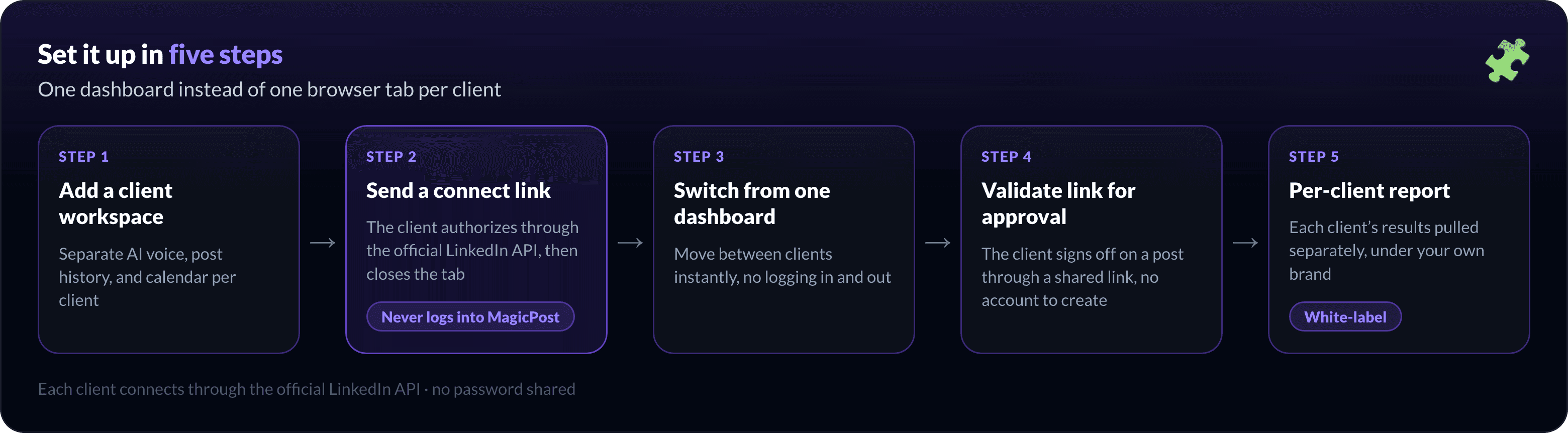
Add each client as their own workspace. Every client gets a separate space with its own AI voice settings, post history, and calendar, so nothing mixes.
Send a connect link instead of asking for a password. The client clicks it, authorizes LinkedIn, and closes the tab. Their profile attaches to your dashboard with no credentials shared.
Switch between clients from one menu. No logging in and out. You move between accounts instantly and see what is scheduled across the whole roster at a glance.
Turn on approval where the client wants it. Hold each post until the client signs off through a shared link, with no account for them to create. Leave it off for hands-off clients.
Report per client. Pull each client's performance separately, under your own brand, instead of screenshotting stats account by account.
If you want the full client-side detail, the help center covers managing agency clients in one workspace end to end. And if you work inside Claude or Cursor, you can run the same multi-account management via MCP and the API instead of the dashboard.
For the calendar side of the roster, LinkedIn scheduling for agencies covers time zones, approvals and the checks before a client post goes out.
Mistakes to avoid when managing multiple accounts
Even with the right setup, a few habits quietly cap a roster.
Cross-posting identical content. The same post under five names reads as a template and reaches fewer people. Each client needs their own angle.
Letting voices blur. When you write for ten people in a day, they start sounding alike. Per-client voice settings and a quick style reference keep them distinct.
Reporting in one lump. Clients pay for their results, not the agency average. Keep performance separate, per account.
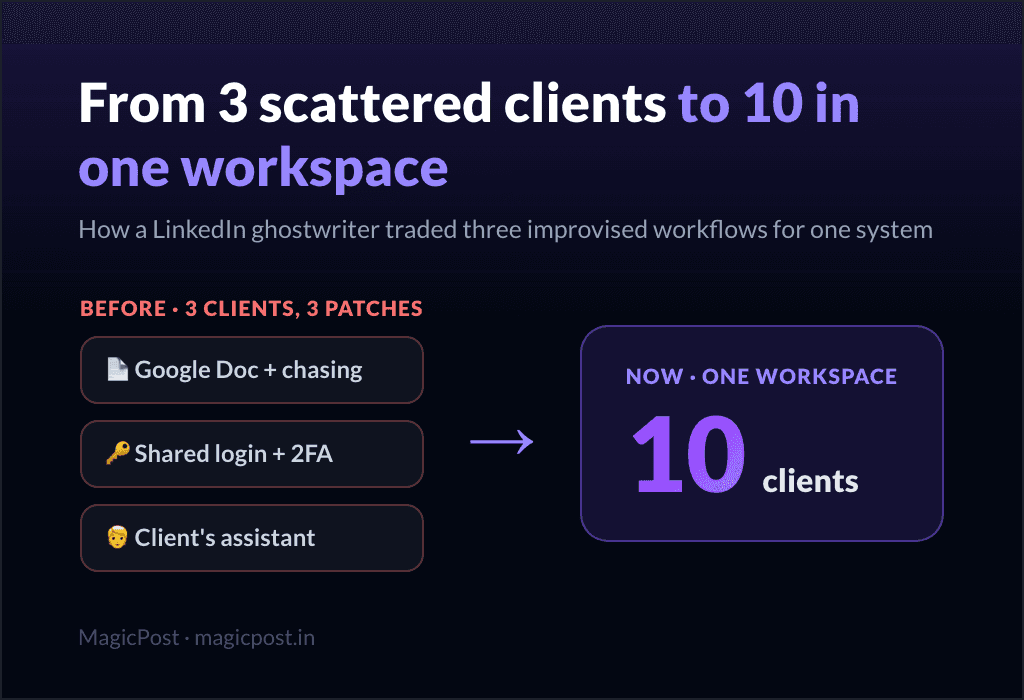
Scaling past your system. Most ghostwriters stall around three or four clients because the workarounds break. Fix the setup first, then add clients, the same way you would build and scale a ghostwriting business. Nicole Ramirez went from 3 to 10 exactly that way.
How does MagicPost handle multi-client management?
If you are juggling logins and browser profiles today, the upgrade is not a faster way to switch accounts. It is removing the switching entirely, and collapsing your whole stack into one place.
MagicPost's agency mode connects each client's LinkedIn through the official API with no password sharing, so every client's account stays safe.
The client never logs into MagicPost: they get a connect link to set up, then a calendar or post to validate, and nothing else. Each client sits in their own isolated workspace, posts are held for approval when they want it, and reports go out per client under your brand.
It also means one tool instead of three. The ghostwriting, the scheduling, and the day-to-day social media management (engagement, inspiration, reporting) all happen in the same place, per client, instead of stitched across a writing app, a scheduler, and a spreadsheet. That is the part the browser-level methods never solve.
FAQ
Is it against LinkedIn's policy to manage multiple accounts?
Managing other people's accounts with their authorization is fine. What the policy forbids is one person keeping more than one personal account. As an agency you are not creating accounts, you are managing clients' existing accounts on their behalf.
Can I have two LinkedIn accounts for myself?
No. LinkedIn's User Agreement allows one personal account per person, and duplicates can be restricted or merged. If you need a presence for a business, that is a Company Page attached to your single personal account, not a second profile.
Do I need my client's password to manage their account?
No, and you should avoid it. The safe approach is an official connection the client authorizes, so you never hold their password or receive their 2FA codes. Shared logins are the most common way an account gets flagged.
Can I manage multiple LinkedIn accounts without a Chrome extension?
Yes. Extensions and browser sessions are the risky, manual route. A platform that connects each account through LinkedIn's official flow lets you manage everyone from one dashboard with no extension and no proxies.
How many clients can one person realistically manage?
It depends on the setup, not on effort. On manual workarounds most people stall at three or four. With per-client workspaces, approvals, and reporting in one place, a single operator can comfortably handle many more, which is the whole point of removing the login juggling.