Claude is one of the best writers you can put in a browser tab, and on LinkedIn in 2026 that is precisely the problem. Its default output is polished, balanced, and structured. That is the exact register the feed has started to read as generic and quietly show to fewer people.
Using AI is fine. Publishing raw Claude is the part that costs you.
This is not a "never touch AI" piece. LinkedIn itself says it is "ok to use AI to help you write." The issue is narrower and more practical.
A general-purpose chatbot has no idea what reach looks like on LinkedIn, does not write in your voice, and gravitates toward the same handful of shapes every other AI draft lands on. Below: what goes wrong, the data behind it, and what to do instead.
Is Claude Good for Writing LinkedIn Posts?
As a writer, yes. Claude produces clean, confident, well-organized prose, and that is genuinely useful for a first draft. The trouble is that "clean, confident, well-organized" is now a tell.
In early 2026 LinkedIn announced it would show "generic-feeling" posts to fewer people. In a post titled "Keeping conversations real on LinkedIn", Laura Lorenzetti (VP and Executive Editor, LinkedIn Global Editorial) named the target as "AI slop." Her definition: content "that may sound polished on the surface but lacks any real unique perspective or substance." The key line, in LinkedIn's own words:
"It's ok to use AI to help you write, but your posts and comments need to represent your voice and your perspectives. The ultimate value comes from the human behind the tool."
The polish that makes Claude impressive on an essay is the same polish LinkedIn now discounts on a post. The tool is not the villain. Shipping its default voice unedited is. If ChatGPT is your drafting tool instead, see how ChatGPT compares with a dedicated LinkedIn tool.
Why Does Claude Sound Like AI on LinkedIn?
Because its instincts point straight at the patterns the feed reads as machine-made. Three of them in particular.
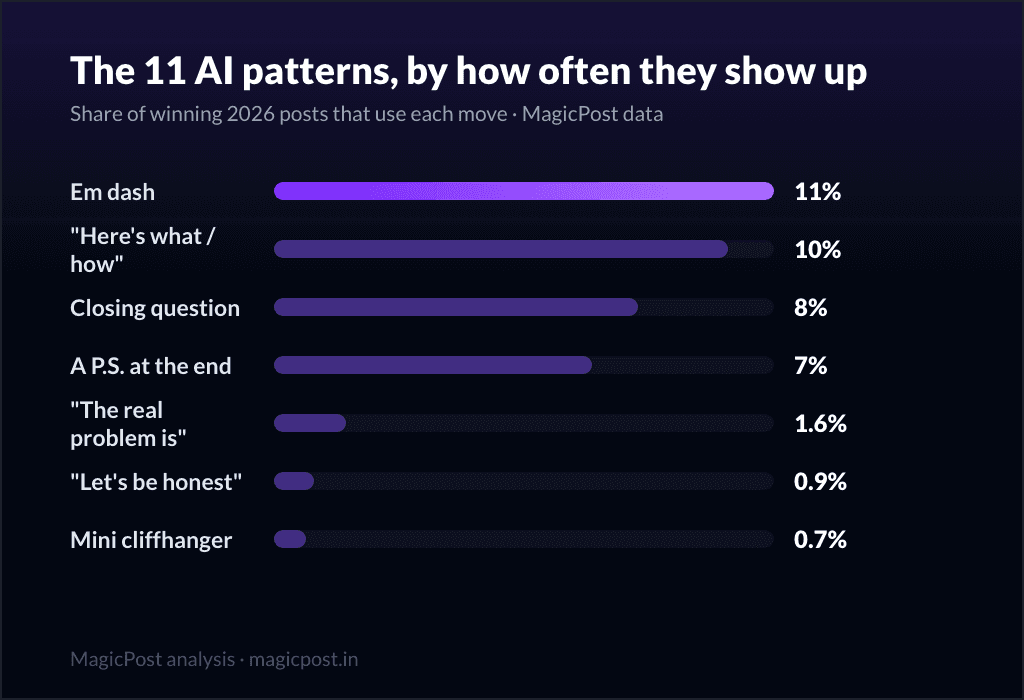
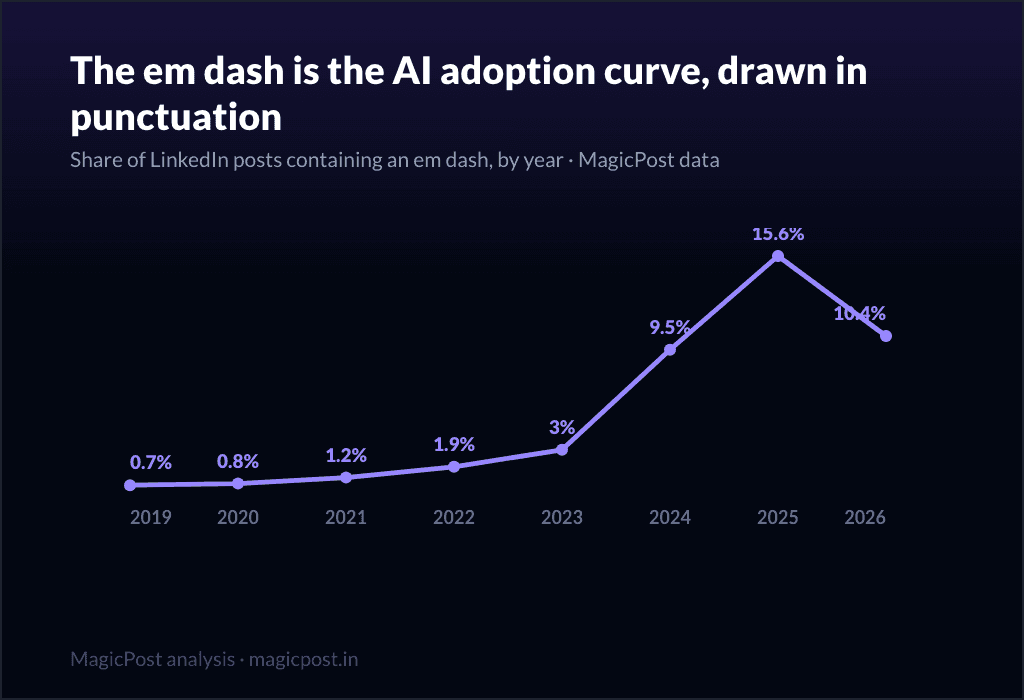
The em dash. Claude reaches for the em dash constantly, the way polished print prose does. By 2026 the em dash is the first thing readers check when a post smells AI, a "dead giveaway" repeated across thousands of LinkedIn threads. We break down the real signal in is the em dash a sign of AI?.
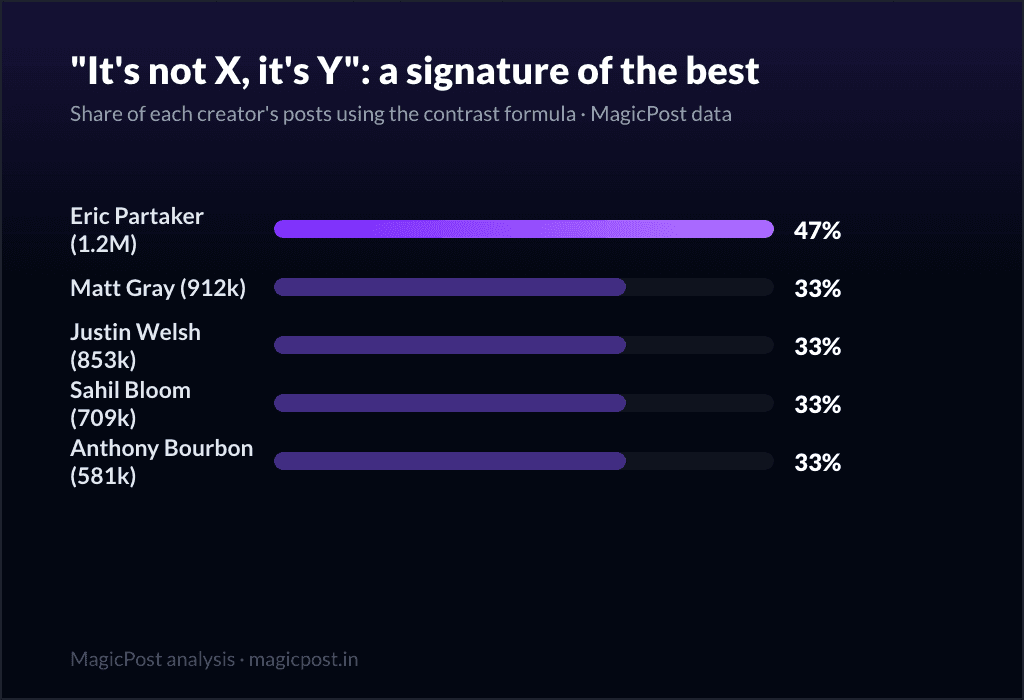
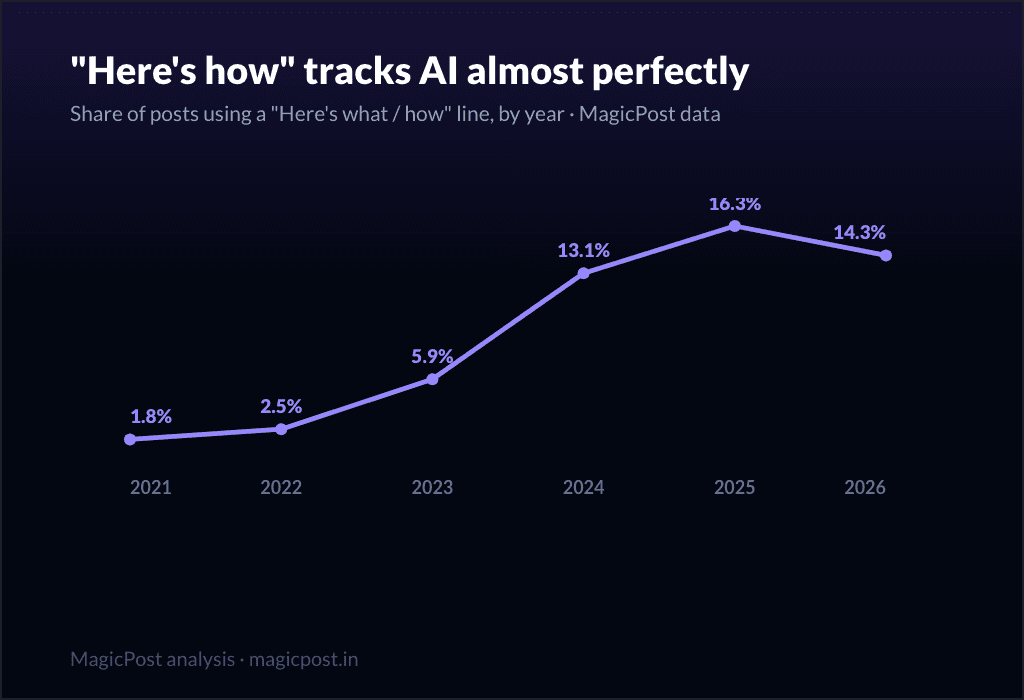
The contrast and reveal structures. "It's not X, it's Y." "Here's what nobody tells you." "The result?" These symmetrical, dramatic turns are Claude's comfort zone, and they are exactly the templated forms readers now pattern-match as AI.
Frictionless balance. Claude rarely commits to a sharp, lopsided, slightly-too-personal opinion. It rounds the edges. On LinkedIn the rounded edge is what gets buried, because it reads like everyone else's draft.
When we ran our own AI detector across drafts from the major models, Claude's leaned hardest into these exact structures. That was an internal read rather than a published study, but it matches what writers report in public: of the big models, Claude's prose is among the most recognizably "AI-polished."
Why Do All AI Models Drift Toward the Same Voice?
This is not a Claude quirk you can prompt your way out of. It is structural, and it has a name.
Models increasingly train on text that earlier models produced. Generation after generation, the rare, idiosyncratic, distinctly-human edges of the writing get sampled out, until output converges on a smooth, uniform middle.
The Oxford and Cambridge team that formalized this published in Nature in 2024: training on recursively generated data makes "tails of the original content distribution disappear" and the result collapse toward a single, averaged mode (Shumailov et al., Nature).
A Nature commentary on the study traces the trajectory: feed models too much AI-generated data and their output first flattens into sameness, then, over enough generations, degrades into gibberish (Wenger, Nature). LinkedIn sits at the early stage of that curve, the flattening, not the gibberish.
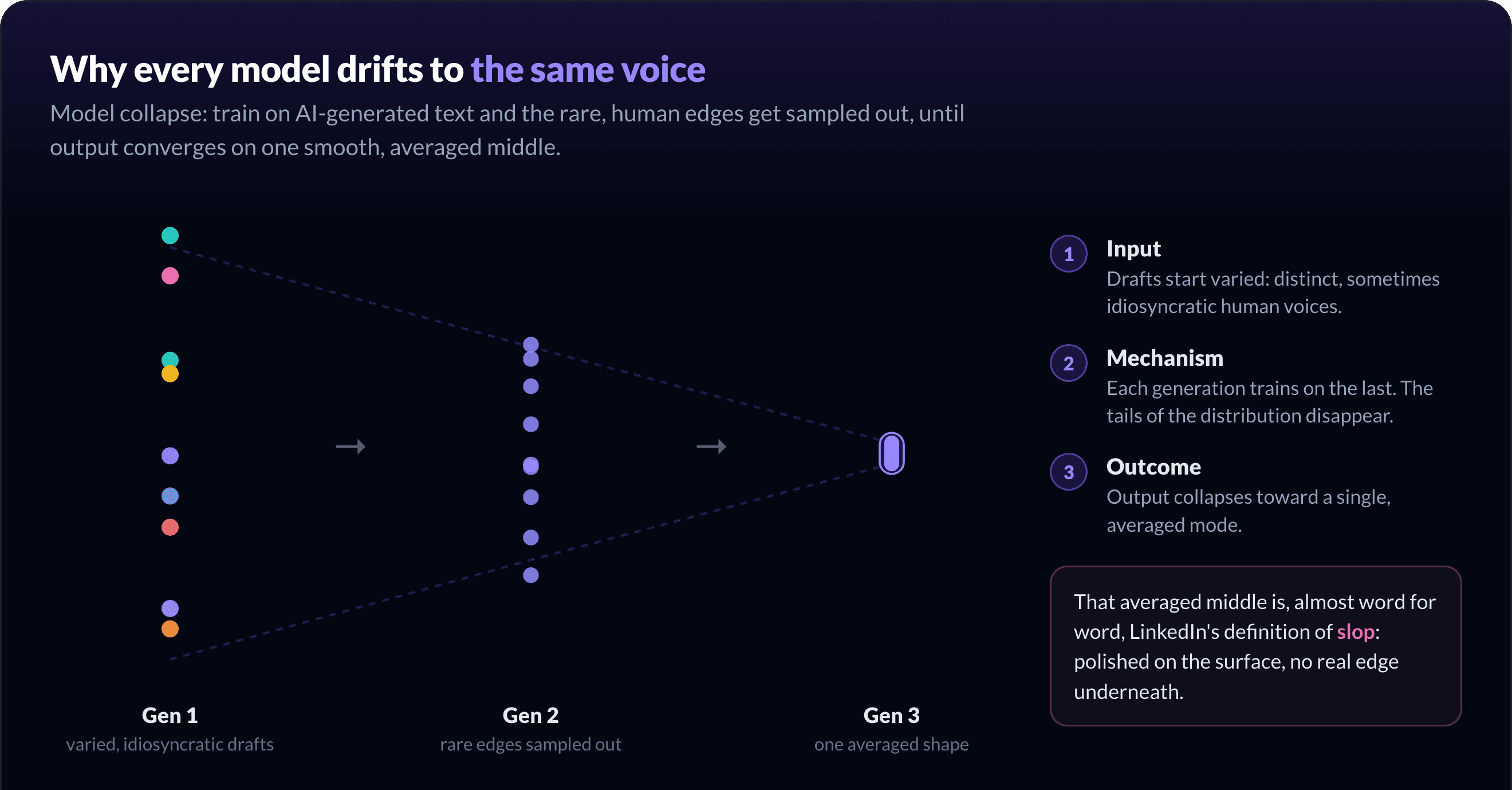
That loop is already running on LinkedIn, and you can feed it without noticing.
You stop on a post you admire, which may itself have been written by AI. You ask a model for "something similar," and that model was trained on posts already calibrated to sound like AI. You publish, and your post becomes one more example the next reader copies and the next model learns from. Each pass adds another coat of the same gloss.
That averaged middle is, in practice, what LinkedIn calls slop: polished on the surface, with no real perspective underneath. It is also why these few patterns now show up everywhere at once, the fuller story of how AI writing took over the LinkedIn feed and where the patterns came from.
It is also why heavy prompt engineering or bolt-on "skills" only move the needle so far. You can push Claude off its defaults for one draft. But the gravity always pulls back toward the mean, because the mean is what it was trained to produce.
There is a flip side worth keeping in view. The more the feed fills with averaged AI prose, the rarer a genuinely original human post becomes, and the more it stands out. In 2026, reading carefully, thinking for yourself, and writing in a voice no model could average into the middle is not just good manners. It is the edge.
Does Publishing Raw Claude Actually Cost You Reach?
Yes, and the cost is new. We measured it across 287,120 LinkedIn posts, comparing each author only against their own other posts, so audience size cannot explain the result. A handful of templated turns each drag a post below that author's own normal. They are the turns a general-purpose model reaches for by default. The effect was statistically absent before 2026.
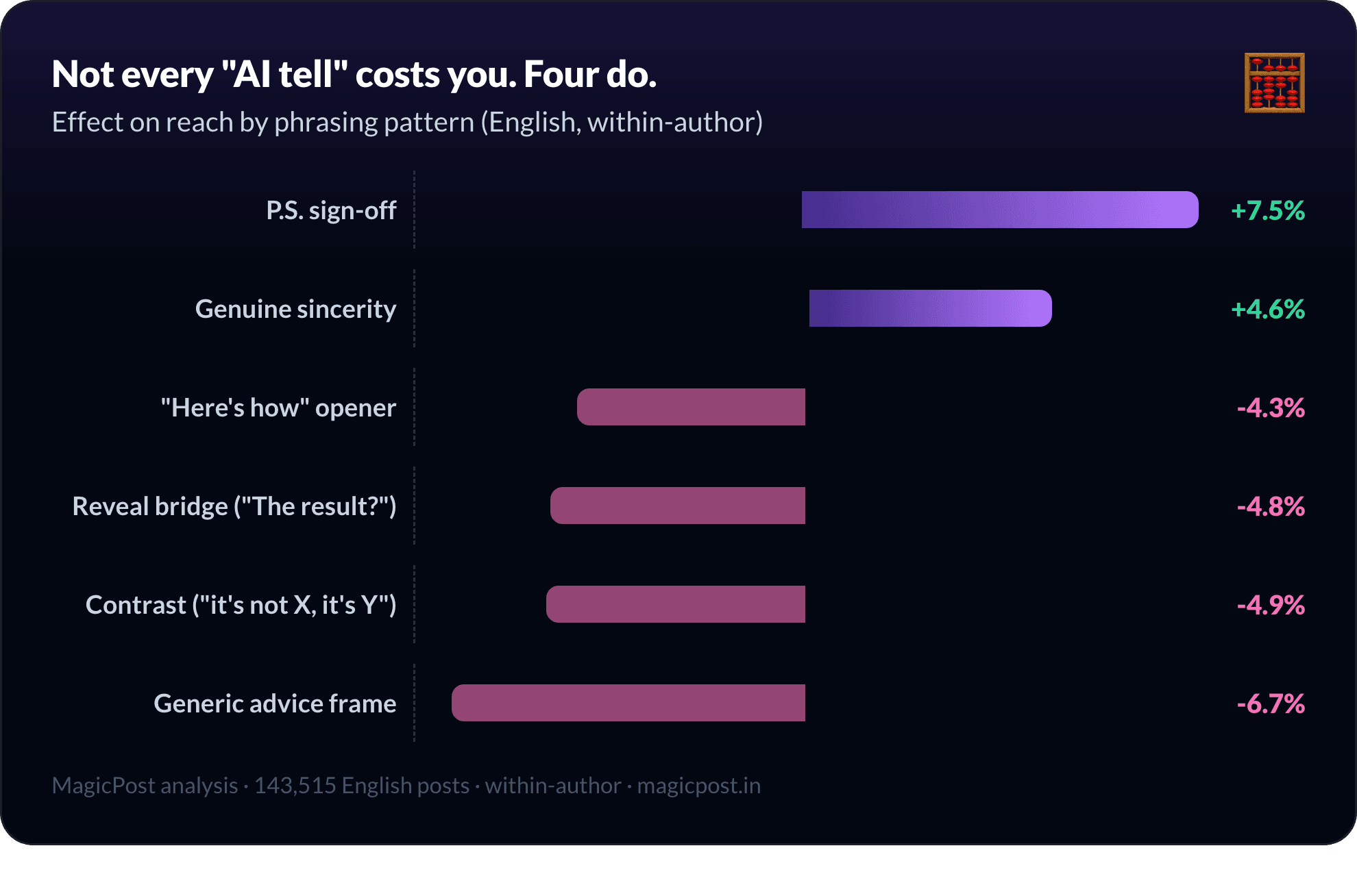
Turn of phrase | Sounds like | Within-author reach cost |
Generic advice frame | "Stop chasing likes, start solving problems" | -6.7% |
"That's not a hiring problem, it's a process problem" | -4.9% | |
The "The result?" bridge | "...they underperform. The result? They lose the deal" | -4.8% |
"Here's what nobody tells you about hiring" | -4.3% |
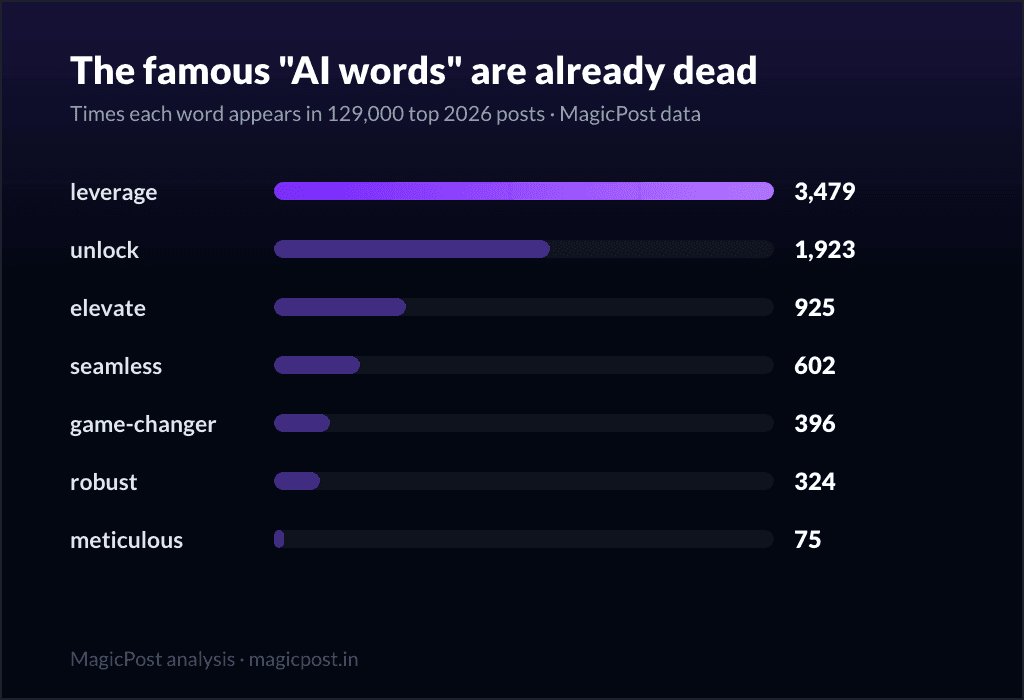
None of these are banned words. They are shapes, and they are Claude's defaults. This is the trap with the usual advice: the "AI words" everyone tells you to avoid (delve, tapestry, "in the realm of") barely register anymore, while these structural turns are what actually cost reach.
The full same-author evidence is in our reach study, and it lines up with LinkedIn's own early-2026 move. The platform reports it is "correctly identifying generic content 94% of the time," and generic posts are "less likely to be widely distributed beyond a person's immediate network."
This is a real, second-order effect, not a magic lever. Reach is still driven mostly by your audience and your topic. But the direction is clear: the raw-Claude form is the form the feed has started to hold back.
Can't You Just Prompt Claude Better, or Add a Skill?
You can, a little, and it does not hold. Two reasons.
It drifts back. A model's default is the averaged voice it was trained on, so a clever prompt fixes one draft, not the next fifty.
It over-corrects. A blanket "make this sound less like AI" instruction cannot tell apart the turns that cost reach from the human habits that earn it. In the same 2026 data, three moves that "sound LinkedIn-y" are actually reach-positive:
Genuine sincerity (a real, unpolished admission): +4.6%
A P.S. or CTA sign-off: +7.5%
A real closing question: neutral on reach, and it pulls the comments that feed it
A generic de-AI prompt flattens these along with the scaffolding, so you strip out the parts that were helping you. The job is surgical: remove four specific structures, protect three specific habits, in your voice. That is not what a saved prompt does well.
How Should You Use AI for LinkedIn in 2026?
The same way LinkedIn frames it: AI is a tool, the value is the human behind it. In practice:
Let Claude draft, never decide. Use it to get words on the page faster. The opinion, the example, the conclusion are yours, or the post has no author.
Anchor every post in one thing only you could say. A real number, a named client situation, a mistake that cost you something. One specific detail a model could not invent is the fastest way to read human.
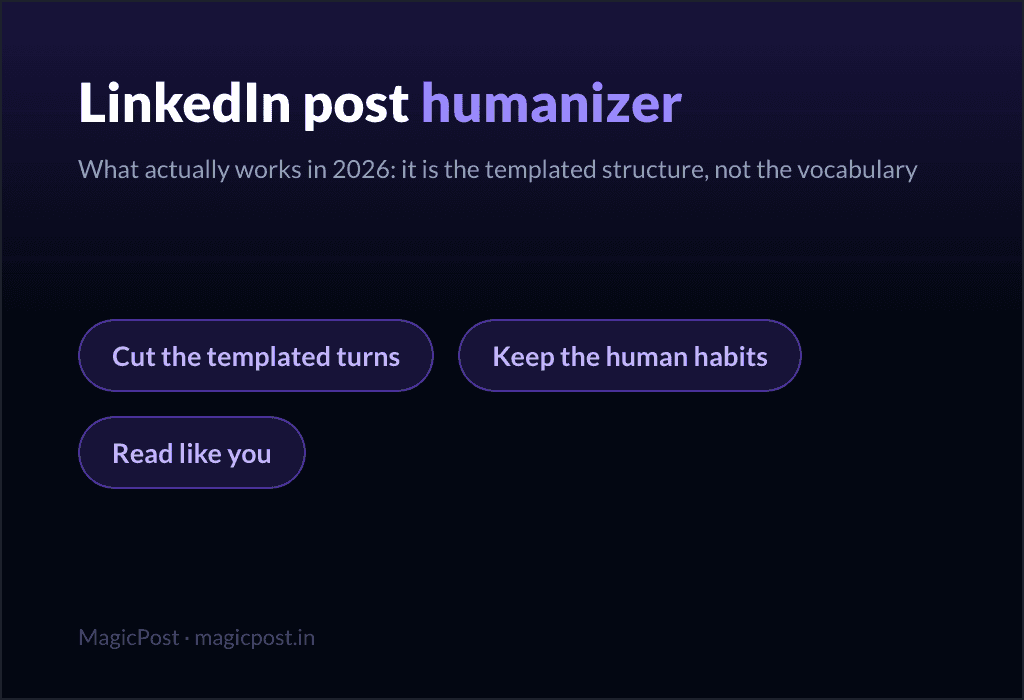
Cut the four reach-killers, keep the three habits. Rewrite the contrast, the reveal opener, the "The result?" bridge, and the advice formula as plain statements. Leave the sincerity, the question, and the sign-off alone.
Use an AI built for LinkedIn, not a general chatbot. This is the real difference, and it is the difference between Claude and a purpose-built tool:
A general chatbot (Claude) | An AI built for LinkedIn (MagicPost) | |
Knows what costs reach on LinkedIn | No | Yes, from the 287,120-post study |
Writes in your voice | Generic by default | Learns your style, three intensity levels |
Removes the patterns the feed demotes | No, it produces them | Yes, structurally, on every generation |
Keeps the human habits that help | Flattens them | Protects sincerity, question, sign-off |

That last row is what MagicPost's Humanizer is built to do. It runs inside the post generator. Switch it on once, and every post ships with the templated turns stripped out and your voice intact. You still get the speed of AI, without the generic form that now costs reach. Free to try, no credit card needed.
FAQ
Is it bad to use Claude to write LinkedIn posts?
Using Claude to draft is fine. Publishing its output unedited is the problem. Claude's default voice is polished and templated, which is exactly the "generic" form LinkedIn started showing to fewer people in 2026. Edit for your voice, or run it through a tool built for LinkedIn, before you post.
Does LinkedIn detect AI-written posts?
It detects generic content, not AI specifically. LinkedIn's editorial team reported "correctly identifying generic content 94% of the time" in early testing, and those posts are distributed less widely. AI-assisted writing that reads like a real person with a point of view is explicitly fine.
Why does Claude sound so much like AI?
Two reasons. Its defaults (the em dash, the "it's not X, it's Y" contrast, the polished balance) are the shapes readers now pattern-match as machine-made. And all major models drift toward an averaged, uniform voice as they train on AI-generated text. That effect is documented as "model collapse" (Shumailov et al., Nature, 2024).
Can prompt engineering make Claude write human LinkedIn posts?
Only at the margin. A good prompt fixes one draft, but the model drifts back to its averaged voice. And a blanket "sound less like AI" instruction over-corrects, flattening the sincerity and sign-off that actually help reach. The reliable fix is structural and voice-aware, which is what a LinkedIn-specific tool does.
What should I use instead of Claude for LinkedIn?
An AI built for LinkedIn rather than a general chatbot. MagicPost generates posts in your own voice with the Humanizer on, removing the templated turns that cost reach while keeping the human habits that earn it, then lets you schedule and measure them in one place.