LinkedIn ghostwriting is in demand. Executives know they need to be visible, with 86% of B2B decision-makers saying they would be more likely to invite an organization into their RFP process if it consistently produced high-quality thought leadership (Edelman-LinkedIn, 2024), but most simply don’t have the time to write.
The gap is a real business opportunity for freelancers and agencies. However, ghostwriters usually stall at three or four clients: voices blur together, approvals drag, and the work feels like a second full-time job.
This guide covers how to ghostwrite on LinkedIn well and build a system that scales past five clients without burning out.
What Is LinkedIn Ghostwriting?
LinkedIn ghostwriting is the practice of writing LinkedIn posts, articles, or content on behalf of an executive, founder, or professional in their voice, published under their name.
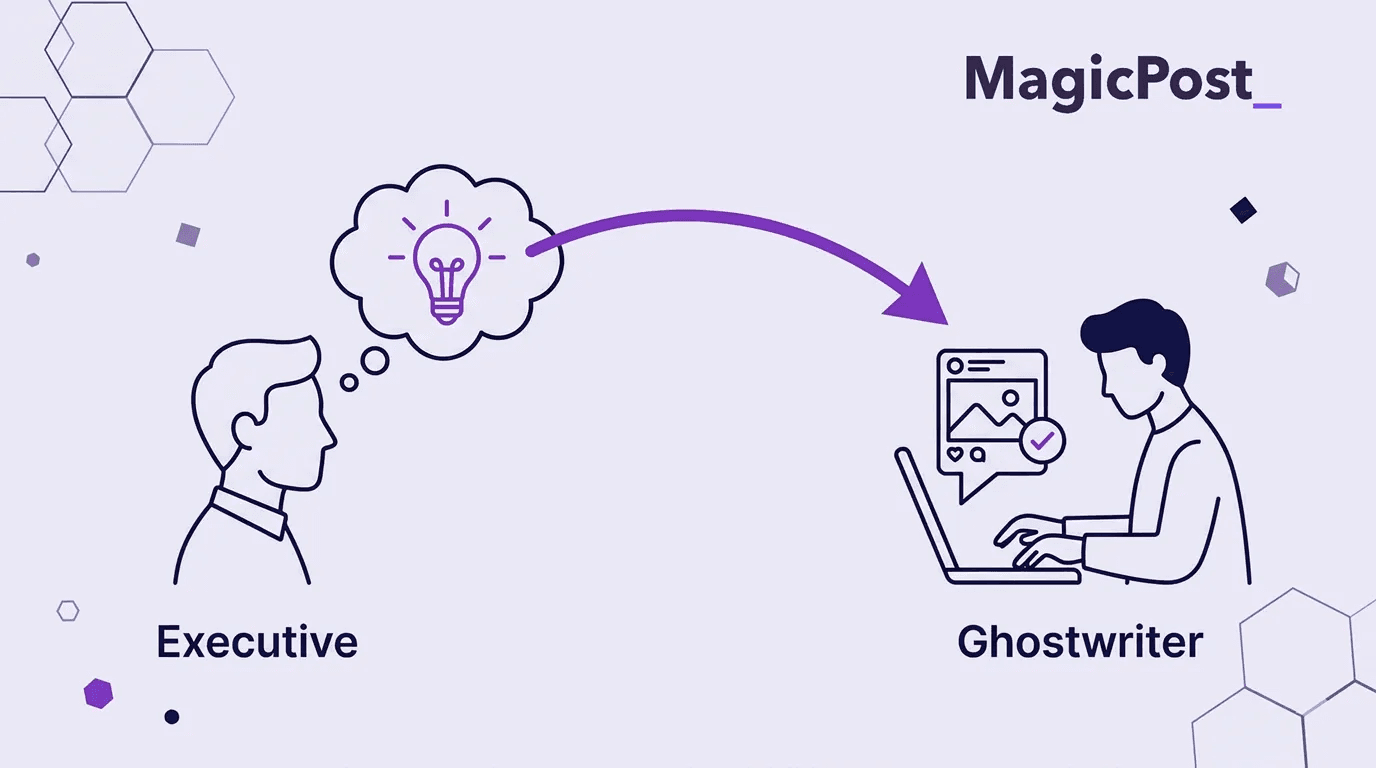
As a professional service, it typically includes voice research, editorial strategy, content creation, client approval, and publishing. Rates range from $500/mo. for entry-level freelancers to $10,000+/mo. for premium executive positioning agencies.
📌 The fastest-growing segment in 2026 is AI-assisted ghostwriting, where tools trained on a client’s posting history handle drafting while the ghostwriter handles strategy, voice refinement, and client management.
What Does a LinkedIn Ghostwriter Actually Do?
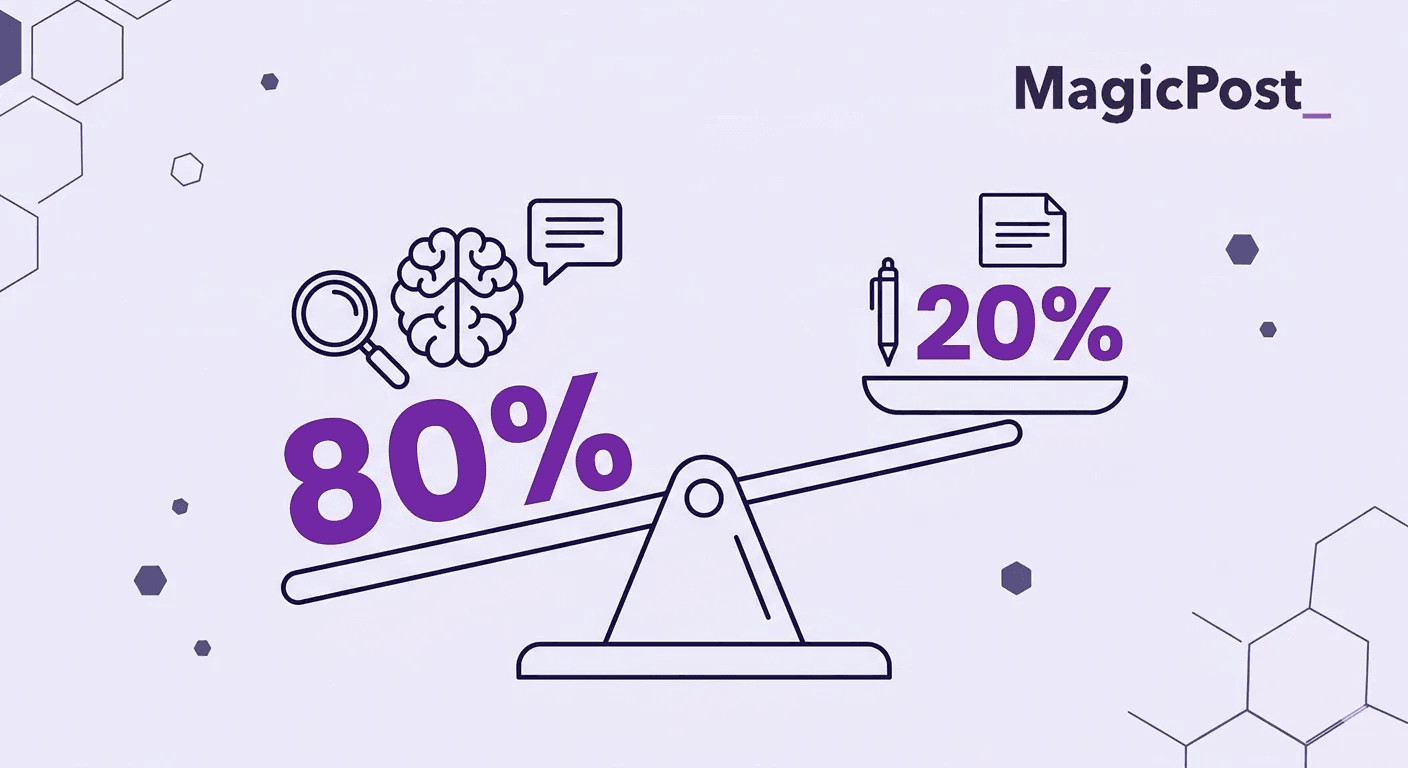
Writing is the smallest part of the job. A useful benchmark from practitioners in the space: ghostwriting is roughly 20% writing and 80% extraction.
Most of the time goes into getting the client’s real thinking out of their head and onto the page, in a way that sounds like them and not like a content template.
In practice, a LinkedIn ghostwriter is responsible for:
Voice research: reviewing past posts, transcripts, and internal decks to map tone and recurring opinions.
Editorial strategy: deciding which topics, formats, and frequency serve goals like inbound pipeline or hiring.
Content creation: drafting posts that match the client's voice and LinkedIn's current format preferences.
Approval management: routing drafts to clients for review, incorporating feedback, and hitting publish deadlines without chasing.
Performance tracking: reporting on impressions, engagement, follower growth, and connecting content performance to outcomes the client cares about.
The ghostwriters who struggle are almost always failing at the extraction layer, not the writing layer. They capture the client's syntax but miss the actual insight: producing posts that sound professional but say nothing specific.
The best LinkedIn posts are specific, opinionated, and grounded in real operational experience. Getting that out of a busy executive is a skill in itself.
✅ Pro Tip: The best ghostwriter interview question is not “What do you want to write about this week?” It’s “What did you tell a client, colleague, or investor last week that made them lean forward?”
Real insights live in the conversations executives are already having, not in a content calendar.
How Much Do LinkedIn Ghostwriters Charge?
Pricing in the LinkedIn ghostwriting market is highly fragmented. Rates vary by deliverable volume, strategic depth, and whether the ghostwriter is a solo freelancer or part of an agency. The ranges below reflect current market data for 2026.
Service Tier | Monthly Rate | Typical Deliverables | Best For |
|---|---|---|---|
Entry-level freelancer | $500 to $1,500 | 8 to 12 posts, basic voice matching, and no strategy layer | Founders testing the market |
Mid-tier ghostwriter | $2,000 to $4,000 | 12 to 16 posts, voice research, topic strategy, and engagement support | Founders and sales leaders with pipeline goals |
Premium agency | $5,000 to $10,000+ | Full executive positioning, multi-format content, reporting, and investor narrative | C-suite executives, IPO-stage companies |
📊 Source: Windmill Growth, The Legacy Ghostwriters, 2026 industry benchmarks.
The economics shift significantly once you’re managing multiple clients. At $2,000 per client and four clients, you’re producing $8,000 in monthly revenue.
But if your workflow is manual (separate drafts in Google Docs, approvals over email, and no style system per client), the operational overhead eats the margin fast.
✅ Pro Tip: When pricing your packages, separate the strategy layer from the content layer explicitly. Clients who understand they’re paying for editorial thinking, not just word count, are less likely to commoditize the service and more likely to retain long-term.
For the full grid by deliverable and by monthly volume, with the source next to every figure, see LinkedIn ghostwriting rates: what to charge in 2026.
What Makes LinkedIn Ghostwriting Difficult?
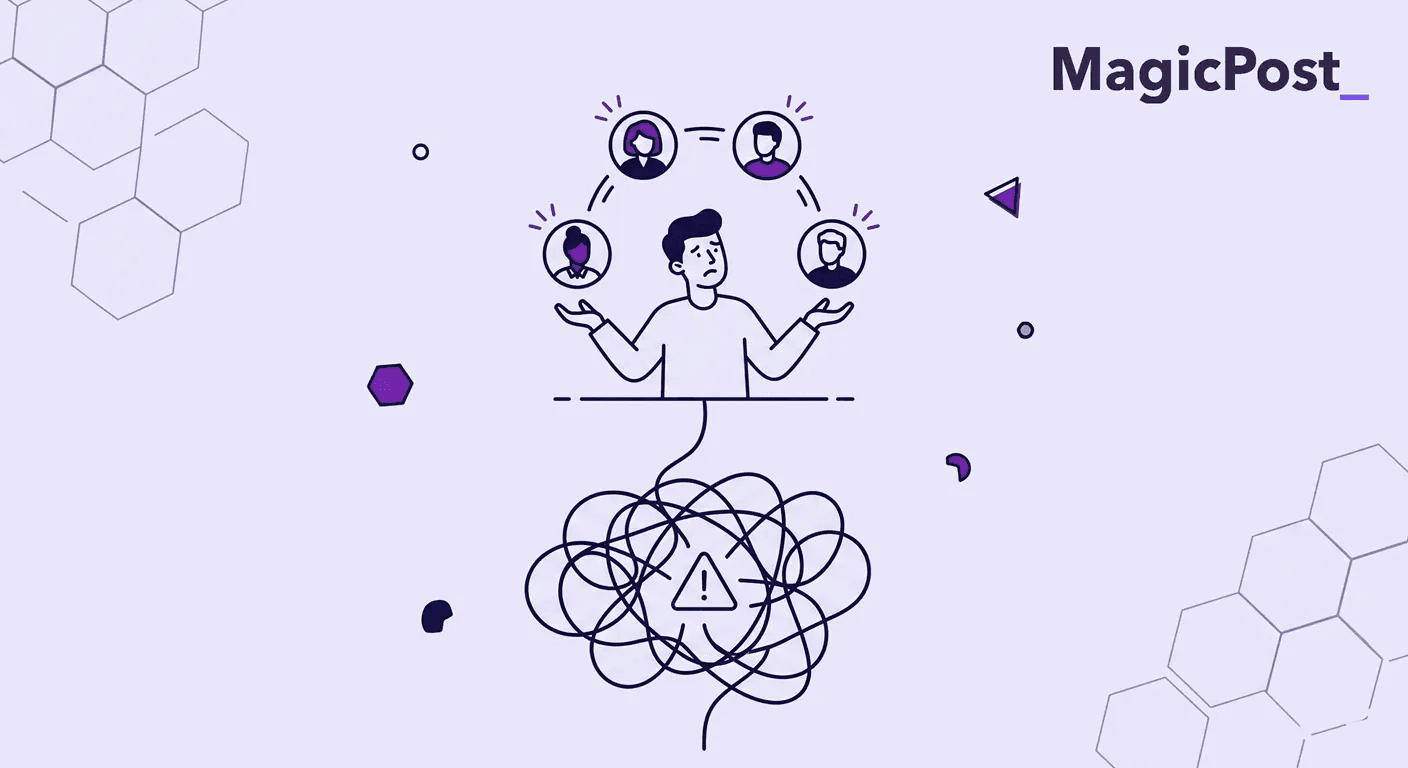
Most of the challenge in LinkedIn ghostwriting is not craft; it’s actually systems. Three things trip up ghostwriters at every stage of growth.
1. Capturing Someone’s Voice Accurately
Voice capture is where ghostwriting relationships succeed or fail. The common failure mode is what practitioners call the thinking translation problem: the ghostwriter reproduces the client's sentence structure and vocabulary but misses the actual operational insight.
The result is a post that sounds like the client but says nothing that only the client could say. A proper client voice capture process should cover the following:
Audit of past posts: Recurring themes, opinions, and the phrases the client uses naturally.
Structured interview: Recent situations, internal decisions, frustrations; what comes up unprompted is the voice.
Style reference document: One page on tone, sentence length, topics they own or avoid, and posts they like.
Ongoing calibration: Voice evolves; a quarterly review catches drift, as do the lines a client keeps editing out.
✅ Pro Tip: If your client consistently rewrites your hooks but approves the body copy, that’s a signal about their voice, not their pickiness. Log these patterns. Over time, you’ll develop an intuition for where they’ll push back before they see the draft.
2. Maintaining Consistency Across Multiple Clients
Managing one client’s voice is manageable with a style doc and a good memory, but managing five is a systems problem.
Without structure, voices bleed into each other. The finance founder starts sounding like the SaaS CEO, and the tech ghostwriter’s favorite phrases appear across half the portfolio.
At scale, four things hold:
Separate style guides per client: Store them somewhere you check before drafting, not just during onboarding.
Client-specific inspiration libraries: A curated folder of their top-performing posts and examples of content they’ve admired.
Naming conventions and folder structures: These prevent the 3 a.m. confusion of which draft belongs to which client.
A no-cross-pollination rule: Never reuse a hook, angle, or structure from one client for another, even when topics overlap.
LinkedIn management tools that import a client’s LinkedIn history and generate drafts in that specific voice, rather than a generic AI style, solve this problem structurally rather than by willpower.
3. Managing Approvals Without Losing Momentum
Approval chaos is the single biggest operational failure in ghostwriting businesses. The typical workflow (draft in Google Docs, share link via WhatsApp, receive feedback across three different channels, and miss a publish window) causes slowdowns that compound with every client added.
Consistent posting frequency matters algorithmically: top LinkedIn creators post at least every three days, and missed windows because of approval delays directly affect reach.
This is what a functional LinkedIn content approval workflow looks like:
Drafts are delivered in one place, not scattered across email threads.
Client reviews and comments are in the same interface, without needing to log in to LinkedIn or your tool.
A clear turnaround expectation is set at onboarding, with 48-hour approval windows being the standard.
A published-without-approval fallback policy exists for clients who consistently miss deadlines.
✅ Pro Tip: Set a published-without-approval clause in your client agreement after 72 hours of no response. It protects your delivery record and trains your client to prioritize the review process. Most will never invoke it, but having it changes the dynamic.
The rules on account access, and the OAuth setup that keeps a ghostwriter inside them, are covered in is LinkedIn ghostwriting allowed.
How to Structure Your LinkedIn Ghostwriting Service
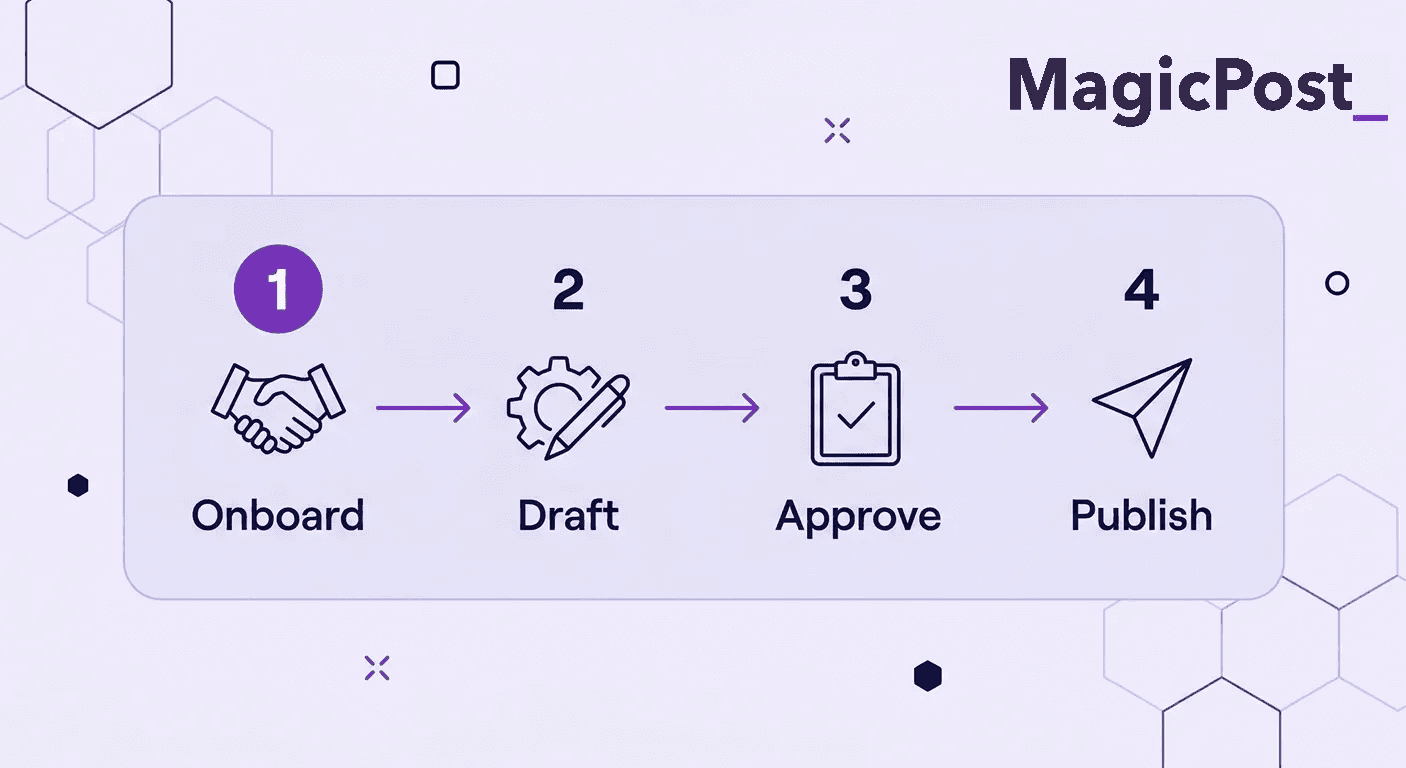
A ghostwriting service that runs well is a product, not a custom arrangement per client. Productizing the workflow is what lets you scale without proportionally increasing your hours. It is the same logic a LinkedIn content agency runs on, applied at solo scale.
Client Onboarding
The onboarding process determines the quality of everything that follows. A minimum viable onboarding covers:
Strategy call (30 to 60 minutes): business goals, target audience, content objectives, topics they own, and topics they avoid.
Voice audit: review 20 to 30 existing posts, or their emails, decks, and reports if they never post.
Style guide creation: document tone, sentence length, vocabulary preferences, and a bank of phrases they use naturally.
Content pillars: 3 to 5 recurring themes, tied to their expertise, that become the editorial backbone.
Approval process agreement: how drafts are delivered, turnaround time, feedback format, and the publish-without-approval policy.
👉 Run that approval step in a tool built for it: MagicPost's LinkedIn post approval lets clients review, comment, and approve drafts without logging in to LinkedIn or your platform.
Workflow Cadence
A standard monthly cadence for a mid-tier ghostwriting package might look like:
Week one: Brainstorm and draft eight posts.
Week two: Client review and revisions.
Week three: Schedule and publish the approved batch.
Week four: Analyze performance and brief the next month.
Scheduling posts in advance through an API-connected tool removes the manual publish step entirely and protects against the reach suppression issues associated with LinkedIn's native scheduler.
✅ Pro Tip: For content format guidance (which formats currently perform best on LinkedIn and why), see our breakdown of LinkedIn post best practices and the best time to post on LinkedIn to brief clients on optimal timing.
Reporting and Retention
Clients who see numbers stay. Clients who have no visibility into performance churn at the first sign of doubt.
A monthly report should cover:
Impressions trend
Engagement rate
Follower growth
Top-performing post of the month and why it worked
Forward-looking content plan
LinkedIn engagement benchmarks for 2026 put average engagement between 3.0% and 3.5%. Having this context helps set realistic expectations from the start and prevents clients from comparing their numbers to outlier viral posts.
✅ Pro Tip: White-label LinkedIn reports are worth including in your agency offering from day one, even if you only have two clients. They signal professionalism, create a repeatable delivery artifact, and give clients something tangible to associate with the value of the retainer.
Buying rather than selling? How to choose a LinkedIn ghostwriting service lists the criteria and red flags, and LinkedIn ghostwriting for founders covers the ghostwriter vs in-house vs tool trade-off.
How LinkedIn Ghostwriters Are Using AI to Scale
The ghostwriters scaling to eight or ten clients have restructured. AI handles first drafts while they own strategy, voice calibration, and the client relationship. How Nicole Ramirez scaled from 3 to 10 clients is that restructuring in practice.
The difference is the tools they use: generic AI (ChatGPT) produces detectable, same-sounding output. The AI LinkedIn tools worth using are trained on each client’s specific post history. The output sounds like the client, not like a content mill.
For a side-by-side comparison, see the best LinkedIn tools for ghostwriters and, for multi-seat teams, the best LinkedIn tools for agencies.
MagicPost's Agency plan is built specifically for this workflow:
You add each client as a separate account in your workspace.
Import their LinkedIn post history so the AI learns their individual voice.
Draft content from within their dedicated space.
The AI generates posts that match each client's specific tone and structure.
You review, refine, and send for client approval.
The client reviews and comments directly in MagicPost without ever needing to log in to LinkedIn or your platform. Once approved, posts are scheduled through LinkedIn's official API. In practice the split looks like this:
Task | Without a System | With MagicPost Agency |
|---|---|---|
Drafting for 5 clients | 5 to 10 hours/week of blank-page writing | AI generates first drafts in each client’s voice; the ghostwriter refines |
Client approval | WhatsApp threads, email chains, and missed windows | Client reviews and comments in-platform; no LinkedIn login needed. |
Publishing | Manual login per account or password sharing (TOS risk) | Scheduled via official API; no credentials held by the ghostwriter |
Reporting | Manual pull from LinkedIn analytics per client | White-label reports downloaded per client from one dashboard |
Scaling from 5 to 10 clients | Proportional increase in hours | Marginal increase in time; the system absorbs the volume |
✅ Pro Tip: If your clients want to extend LinkedIn activity across their teams, employee advocacy and social selling are the natural next conversations to have. If they also expect comments and replies handled on their behalf, how agencies manage LinkedIn engagement for clients covers that workflow.
Final Thoughts on Scaling LinkedIn Ghostwriting
LinkedIn ghostwriting is a viable, scalable service, but only if you treat it like one. The ceiling most ghostwriters hit is not a talent ceiling; it’s a systems ceiling.
Voice capture, approval workflow, account safety, and reporting are the four areas where the service either professionalizes or stalls. On account safety, how to manage multiple LinkedIn accounts covers the client-safe setup.
AI-assisted tools lower the marginal cost of production without lowering quality, provided they’re trained on each client's specific voice rather than a generic prompt. That’s the structural shift that takes a ghostwriter from four clients to ten without the burnout.
Are you managing multiple clients’ LinkedIn content? There’s a better way. Explore MagicPost for agencies. No password sharing, built-in approvals, and white-label reports.
FAQ
Is LinkedIn ghostwriting dishonest?
No. Ghostwriting has existed across every medium for decades: speechwriting, memoir, business books, and op-eds. LinkedIn is no different. The content represents the executive's genuine thinking and expertise; the ghostwriter provides the structure and consistency to communicate it effectively.
The ethical line is preserving the client's authentic perspective, not manufacturing opinions they don’t hold. Whether LinkedIn's own rules allow it is a separate question; is LinkedIn ghostwriting allowed answers it.
How do ghostwriters capture a client's voice accurately?
Through a combination of post audits, structured interviews, and a written style guide that documents tone, phrasing preferences, recurring themes, and examples of content the client approves and rejects.
The voice intake process should happen before any content is written, not through trial and error on the first drafts. Tools that import a client's LinkedIn post history and use it to train AI drafting can significantly accelerate this calibration.
How much should I charge for LinkedIn ghostwriting?
Entry-level freelancers typically charge $500 to $1,500 per month for 8 to 12 posts with minimal strategy input.
Mid-tier ghostwriters with a defined process and strategic layer charge $2,000 to $4,000 for 12 to 16 posts. Premium executive positioning agencies charge $5,000 to $10,000 or more.
Where you land inside a band depends on strategic depth, not word count. Always price for the strategy layer, not just the volume you deliver.
Is it safe to manage a client's LinkedIn account as a ghostwriter?
It depends on how you do it. Logging in with a client's credentials or using browser extension tools to post on their behalf violates LinkedIn's Terms of Service and risks account restrictions.
The safe approach is to use a tool that publishes through LinkedIn's official OAuth API: the client grants permission through an authorized connection, and no passwords are shared. MagicPost's Agency plan is built specifically on this model.
More on what triggers restrictions in our guide to LinkedIn account safety.
How many clients can one LinkedIn ghostwriter realistically manage?
Manually, without a system, most ghostwriters max out at three to four clients before quality degrades or hours become unsustainable. With a structured workflow (style guides, a dedicated approval process, and AI-assisted drafting), eight to twelve clients is achievable for a solo operator.
Agencies with multiple ghostwriters and a centralized tool can scale further. The key variable is not talent but how much of the workflow requires direct human time versus being handled by the system.
For a broader look at building a LinkedIn content operation, see our guide to LinkedIn content strategy.