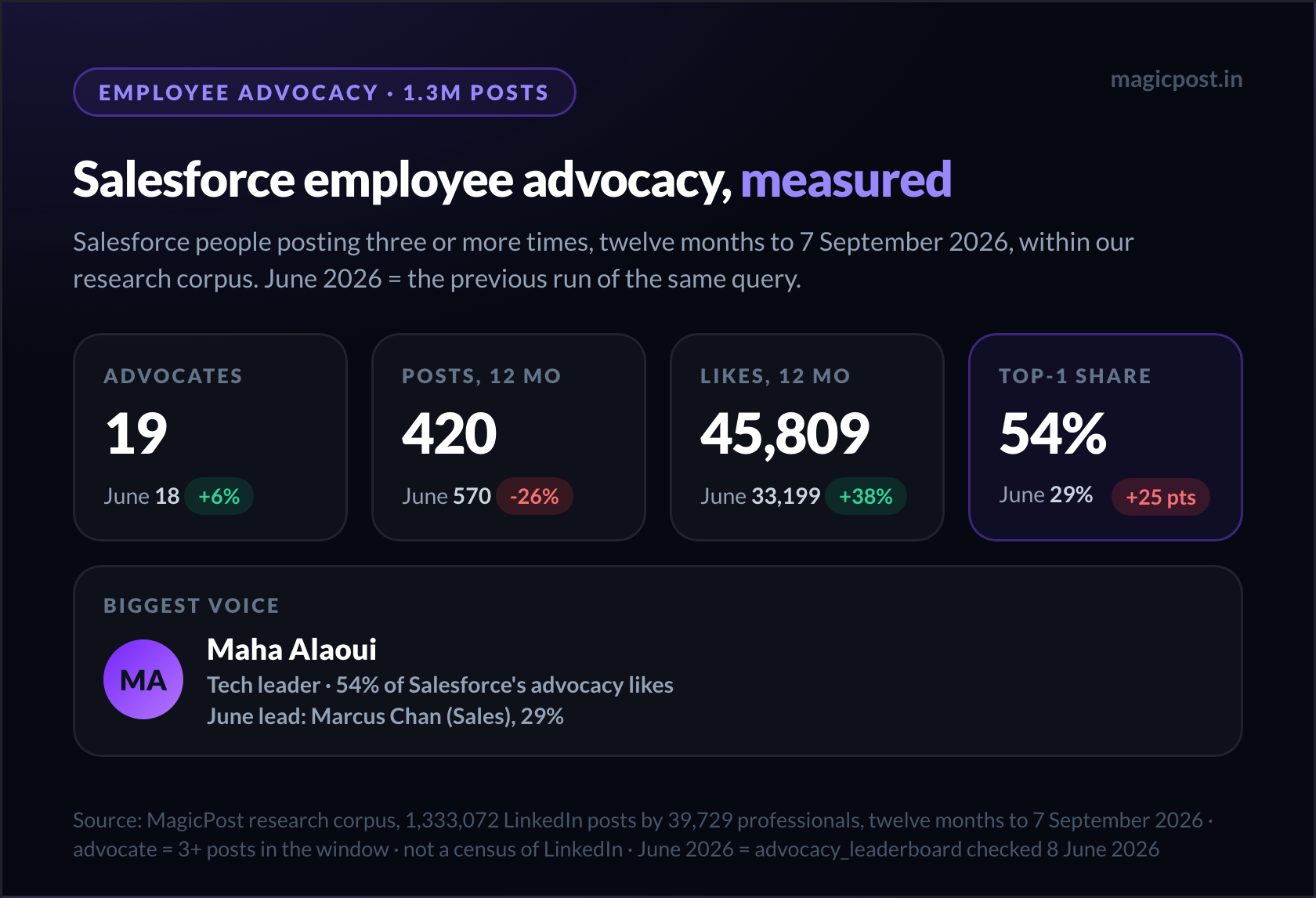
Salesforce employee advocacy was the most distributed footprint in our research corpus in June: 18 people posting, and the largest of them carrying only 29% of the reach. A year later, the same measure reads 54%.
The Salesforce figures on this page are measured from our research corpus over the twelve months to September 2026, with the June reading for comparison. Method and limits are at the end.
Nobody at Salesforce changed a policy in between. One person changed jobs, and another person's videos took off. That is the whole story, and it is the lesson for any distributed program: a top-1 share that came from one prolific poster leaves with that poster.
The Salesforce employee advocacy footprint, measured
Salesforce people in our corpus produced 420 posts and roughly 46,000 likes across the window, from 19 advocates (a profile with at least three posts). That is 2,411 likes per advocate, at a median of 36 likes per post.
The June reading had 18 advocates, 570 posts and roughly 33,000 likes, at a median of 24. So the footprint grew in likes and shrank in posts. The number that moved most is concentration.
Salesforce voice | Role | Posts (12 mo) | Median likes | Likes (12 mo) |
Maha Alaoui | Tech leader, Women in Tech advocate | 114 | 92 | 24,871 |
Blake Edwards | Salesforce, "The Quiet Wealth Dad" | 52 | 111 | 10,671 |
Simon Macklin | SVP Customer Success | 10 | 196 | 2,191 |
James Barker | Strategist, AI Research Lab | 3 | 455 | 1,249 |
Julien Samson | CEO, 2PACE (Salesforce partner) | 11 | 53 | 888 |
Alex Bruschi | Account Executive, Slack | 20 | 18 | 831 |
Maha Alaoui's 24,871 likes are 54% of the total on her own. The next five together add up to less than her.
One line in that table needs a label. Julien Samson runs 2PACE, a Salesforce partner, and our match key is the company text on a profile, so he appears in the Salesforce set. We keep him, labelled, rather than quietly edit the data.
What is distinctive: the widest voice was one person, and he left
In June, the biggest Salesforce voice was Marcus Chan, in sales: 213 posts in the window, a median of 24 likes, and a following of 93,691, the largest in the set. He accounted for 29% of the reach, which made Salesforce the distributed reference of the corpus.
He has since moved to Venli. On a program of 18 people, one departure took 29% of the measured reach out of the Salesforce column.
A new lead filled the gap rather than the remaining 17 spreading out. Maha Alaoui did not appear among the June leaders at all; by September her 114 posts, led by two short leadership videos, were more than half of everything Salesforce produced.
So the shift from 29% to 54% has two causes, both outside anyone's program. A high-volume voice left, and a high-reach voice arrived. Total likes went up 38% at the same time. Salesforce's footprint got bigger and more fragile in the same year.
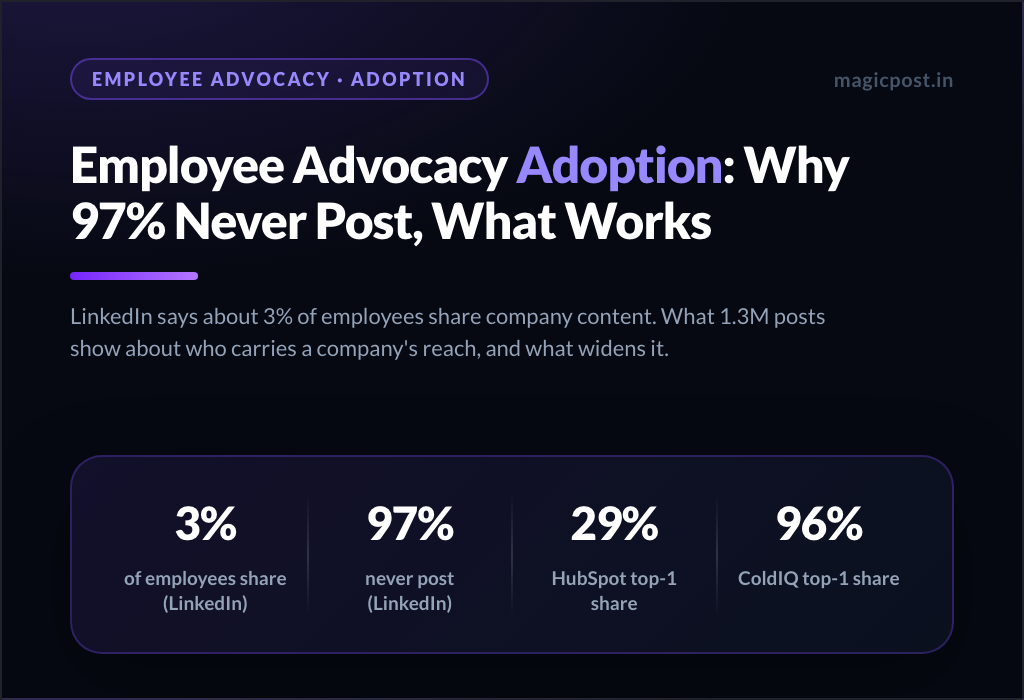
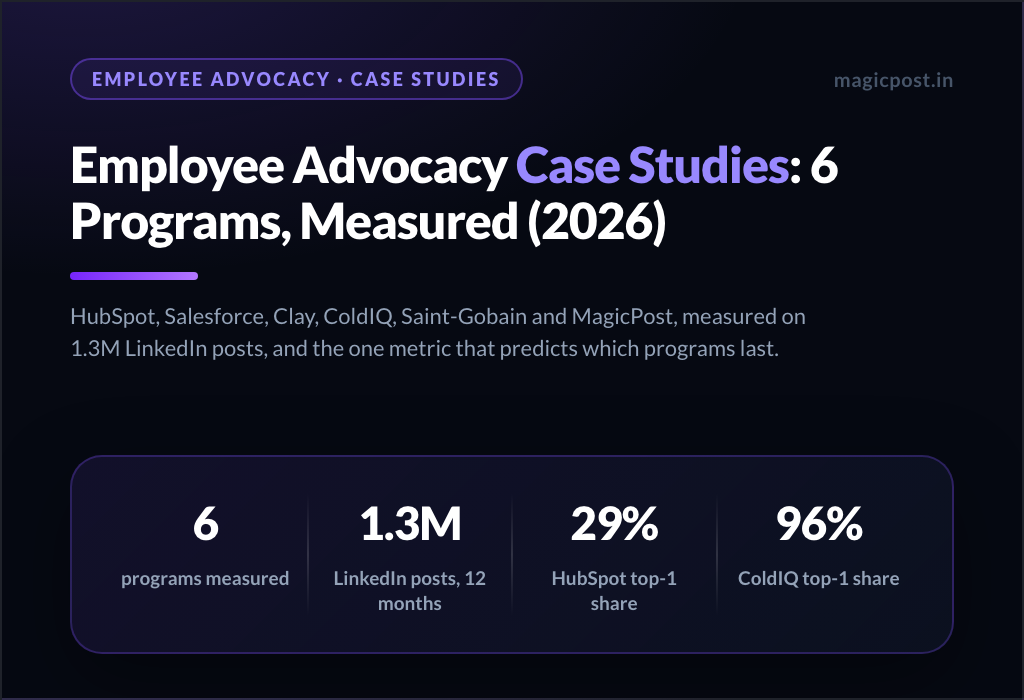
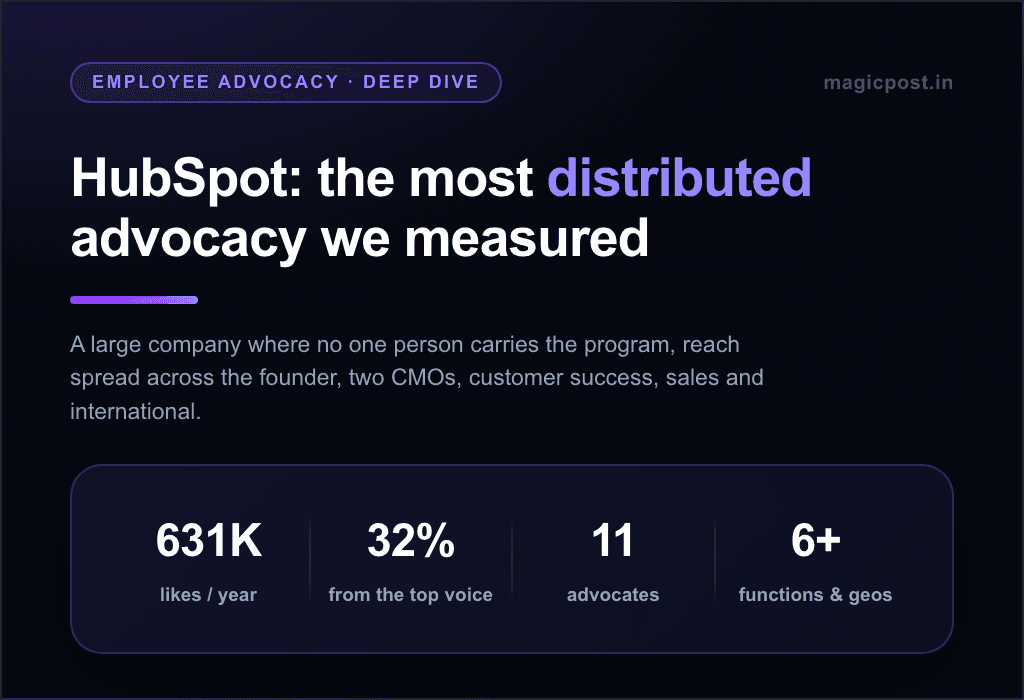
This is the pattern our study of 1.3 million posts keeps surfacing: a low top-1 share often means nobody dominant has posted yet, with no program behind the spread. HubSpot, which went from 32% to 29% over the same year, is the counter-example where the spread held.
What you can take from Salesforce's employee advocacy
Three lessons come out of a year in which the roster grew by one and the top-1 share went from 29% to 54%.
Distribution stays a reading until someone owns it. Salesforce's 29% was real. It was also one job change away from 54%. A program that wants a low top-1 share has to keep producing the second, third and fourth voice on purpose.
Volume and reach are different people. Marcus Chan posted 213 times at a median of 24 likes. James Barker posted three times at a median of 455. Simon Macklin posted ten times at a median of 196. Across this set, median engagement runs opposite to posting frequency.
The biggest voices are not talking about Salesforce. Maha Alaoui posts leadership coaching. Blake Edwards posts personal finance. The one senior executive posting about Salesforce itself, Simon Macklin, has the best median of anyone with a real posting rhythm, and one tenth of the volume.
The practical version of lesson three is a lane per person: the SVP's office visits and planning rituals, the engineer's prototype demo, the creator's list videos. Employee advocacy adoption rises when each of those lanes is explicit rather than left to whoever happens to post.
How each Salesforce voice works
Maha Alaoui, tech leader, the coach
Alaoui is a Women in Tech advocate and coach at Salesforce, with 4,654 followers, one of the smallest followings in the top five. Her 114 posts are the single largest block of reach in the set.
Her two best posts of the year are both short videos built the same way: a hook, a line telling you to keep it for later, then a numbered list of five behaviours.
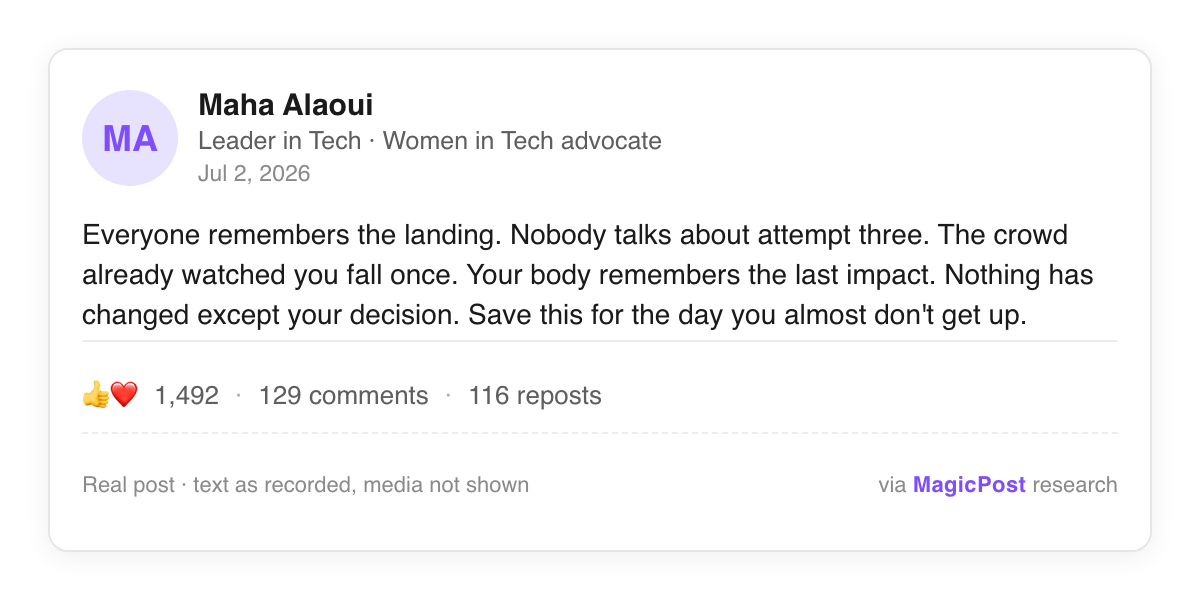
The July video, on attempt three, pulled 1,492 likes and 116 reposts. See the post.
The June video, on what strong leaders do in the first 30 seconds when someone walks in, landed at 1,458 likes and 125 reposts. See the post.
The ratio of reposts to likes is close to one in twelve on both. Advice framed as a list travels through reshares in a way company news does not. Neither post mentions Salesforce.
Blake Edwards, "The Quiet Wealth Dad", the personal-finance persona
Edwards lists Salesforce as his employer and runs a personal-finance persona with 11,749 followers. He doubled his output since June, from 25 posts to 52, while his median slipped from 153 likes to 111.
His biggest post of the year is a single image with a one-line caption, the Tesla versus the old Land Cruiser: 3,062 likes and 1,232 comments, the single most-liked Salesforce post in the set. See the post.
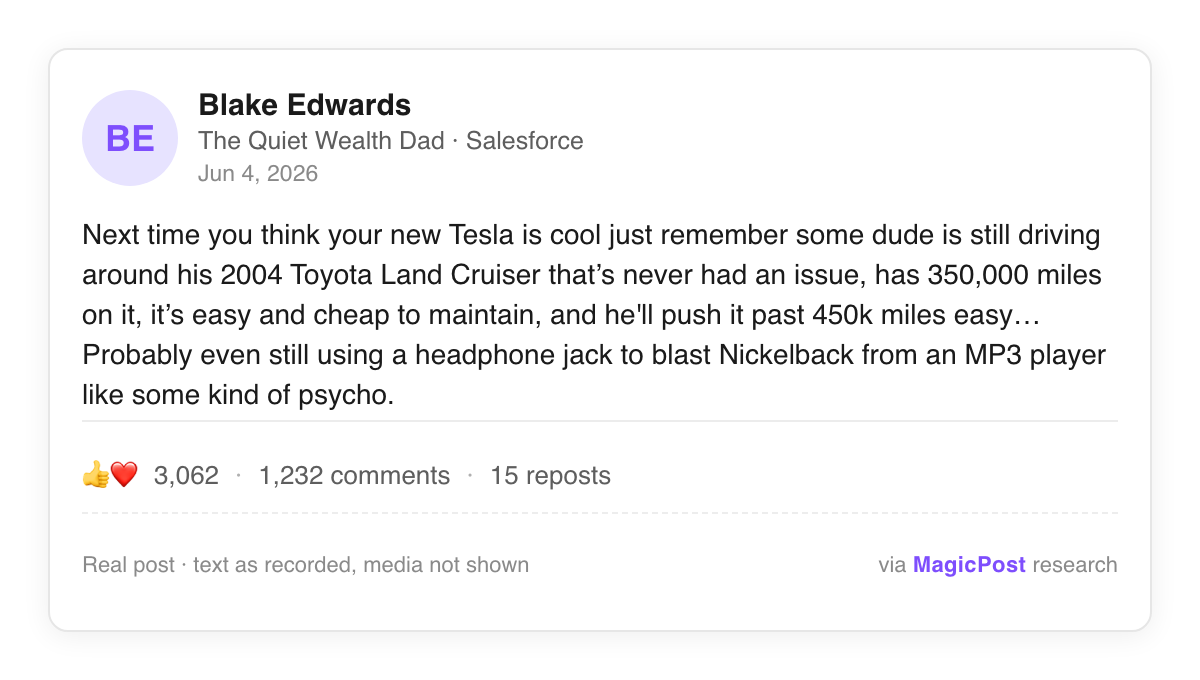
The comment count gives it away: 1,232 comments on 3,062 likes means the post started an argument. His April post on crossing $1,000,000 in net worth at 31 and 32, on two salaries and a 1,400-square-foot house, drew 883 likes and 253 comments. See the post.
Both posts work on specificity: a mileage figure, a house size, an age. The persona has nothing to do with CRM, and Salesforce gets the employer line on the profile.
Simon Macklin, SVP Customer Success, the executive
Macklin is the one senior leader in the top five whose posts are about Salesforce, and he has the highest median of anyone posting more than three times: 196 likes on 10 posts.
His April post from the Hyderabad office, with the global leadership team, reached 628 likes. See the post. His March post from the new Amsterdam office, where he brought his leaders together to write the FY27 V2MOM, reached 302. See the post.
Neither post has a single repost. That is the executive lane: an audience of colleagues and customers, high engagement per post, no spread beyond it.
Ten posts a year at that median is worth more to a program than it looks, and it is the lane most companies leave empty.
James Barker, AI Research Lab, the builder
Barker posted exactly three times in the window, the minimum to count, and his median of 455 likes is the best in the set.
His February announcement of a new role as Incubation Strategist in AI Research reached 595 likes and 102 comments. See the post.
His January video, a prototype of a Salesforce interface that reshapes itself around a live call to remove tab switching, reached 455 likes and 64 reposts. See the post.
The prototype is the more interesting number. A build demo, shown rather than described, out-shared everything else in this table except Alaoui's videos. One builder posting once a quarter would move Salesforce's median more than most of the volume in the set.
Julien Samson, partner CEO, the ecosystem voice
Samson runs 2PACE, a French Salesforce partner, and posts in French: 11 posts, a median of 53 likes, 6,321 followers. He is in the data because his profile names Salesforce, and we flag rather than remove him.
His best post, from October 2025, announces that four of his team will attend Dreamforce in San Francisco, up from two the year before, with 2PACE sponsoring the French delegation: 307 likes. See the post.
Partner voices are a real part of how a platform company shows up on LinkedIn, and a real trap in measuring it. Counting them inflates breadth; excluding them hides the ecosystem. We show the line and say what it is.
Alex Bruschi, an account executive at Slack, closes the table with the largest following of the six, 27,133, and the lowest median, 18. Followers and reach are not the same column.
Where these numbers come from
Salesforce's advocate count, posting volume and concentration are computed from our research corpus (3.2 million LinkedIn posts, 1.3 million in the window, 39,729 distinct posters) by matching each post's author to the company on their profile and counting profiles with at least three posts. The company page is excluded.
The corpus is the set of profiles MagicPost has imported. It over-indexes B2B, sales-tech and big tech, and it is not a census of LinkedIn. Every figure here describes Salesforce's footprint within the companies in our research corpus, not Salesforce as a whole.
Post text and engagement are reproduced as recorded, with a link to the live post; figures move over time, and a post can be edited or removed after we read it. The June reading comes from the previous run of the same query. Corrections land at the next refresh.
Build the second Salesforce employee advocacy voice before the first one leaves
If your program's spread depends on whoever happens to post most this year, the fix is to see it before the next departure does.
MagicPost for enterprises is an employee advocacy platform that shows who is active, what each person's reach looks like, and how much of the total sits with one voice, so the second and third voices get built before the first one leaves.
FAQ
Does Salesforce have an employee advocacy program?
Salesforce has a measurable employee advocacy footprint on LinkedIn: within our research corpus, 19 Salesforce people posted at least three times in the past twelve months, producing 420 posts and about 46,000 likes.
Whether that reflects a managed program or individual habits, the data cannot say. What it does show is that the reach was distributed in June (29% top-1 share) and is concentrated now (54%).
Who are Salesforce's biggest voices on LinkedIn?
Maha Alaoui, a tech leader and Women in Tech advocate, is the largest Salesforce voice in our corpus, with 114 posts and 24,871 likes, about 54% of the total.
Blake Edwards follows at 10,671 likes, then Simon Macklin, SVP Customer Success, James Barker in AI Research, and Julien Samson, a partner CEO.
In June the lead was Marcus Chan in sales, with 213 posts, who has since moved to Venli.
Why did Salesforce's advocacy concentration go from 29% to 54%?
Salesforce's top-1 share rose from 29% to 54% because its widest voice, Marcus Chan, left the company, and a new voice, Maha Alaoui, became more than half of the reach on her own. Total likes grew 38% over the same period.
Neither change came from a program decision, which is why the measure moved so far in a year.
What can other companies learn from Salesforce's employee advocacy?
Salesforce shows that a low top-1 share is only durable if the program keeps producing new voices on purpose. It also shows that median reach runs opposite to volume: the three-post builder and the ten-post SVP out-perform the 200-post creators per post.
Give each person an explicit lane, and measure how much of the total one voice holds before that voice moves on.