Nobody outside LinkedIn has read the algorithm's source code, and the people who have are not allowed to tell you. So every "the LinkedIn algorithm rewards X" claim you have ever read is either a leak, a guess, or a guru's hunch dressed as fact.
We took a different route. We cannot read the code, but we can measure its outcomes at scale. So we took 1,207,853 LinkedIn posts published over the last 12 months (reshares and deleted posts excluded) and asked one question of each ingredient a post can carry: when this thing is present, does the post earn more or less?
Length, format, links, hashtags, hooks, whether it reads like AI wrote it, polls, and the size of the account behind it. The answers are remarkably consistent, and several of them contradict advice you have heard a thousand times.
One caveat first, because it governs everything below: these are correlations measured at scale, not controlled experiments. A post is not a coin flip.
People who write 400-word posts also tend to be more invested writers; that is a confounder we name every time it matters, and where we can, we re-run the numbers inside follower bands to check the effect survives. Read this as "what wins on LinkedIn, measured," not "what LinkedIn's ranking function literally does."
These numbers pool the 12 months up to June 2026. Some levers moved inside that window or after it, and we dated each move on the same creators in our study of LinkedIn algorithm changes in 2026. Where a lever moved, the section below gives the dated figure next to the June one.
Here are the levers, ranked by how hard they pull:
Length: the biggest lever, and it points up (+147%)
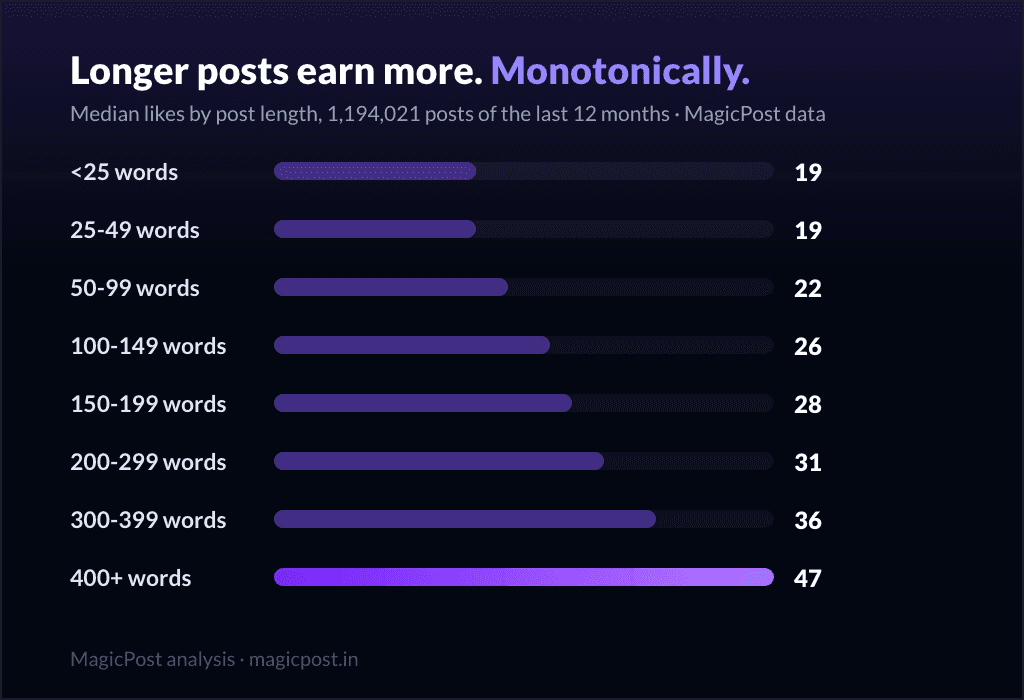
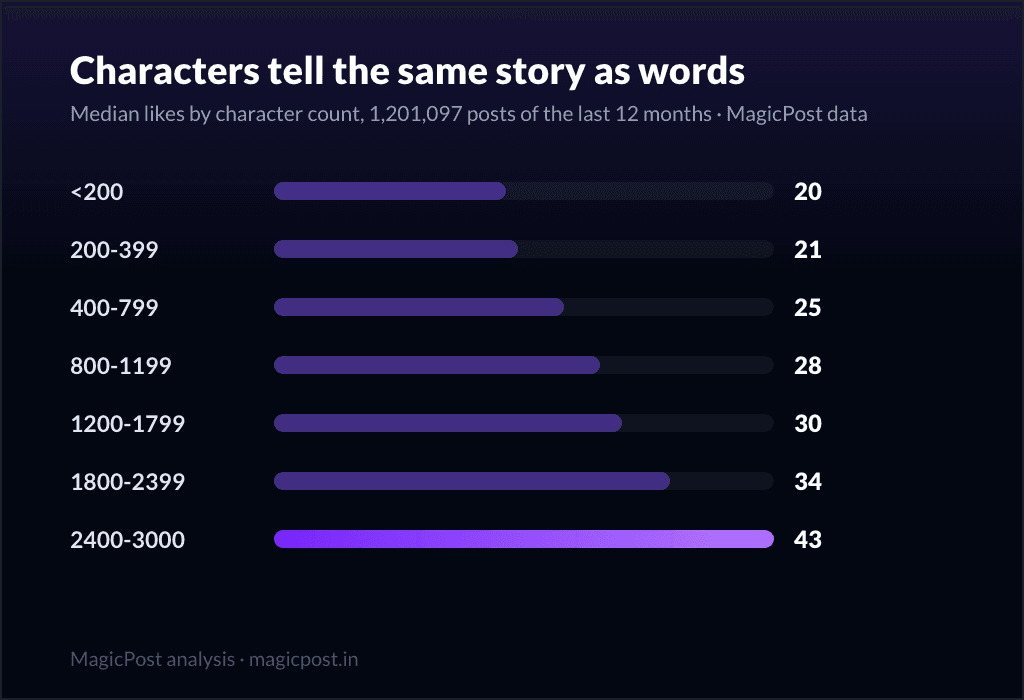
The strongest single signal we found is the dullest one: how much you write. Median likes climb monotonically with post length, with no plateau in the range people actually use.
Post length (words) | Posts measured | Median likes |
Under 25 | 77,668 | 19 |
25-49 | 74,864 | 19 |
50-99 | 164,552 | 22 |
100-149 | 205,682 | 26 |
150-199 | 218,416 | 28 |
200-299 | 289,578 | 31 |
300-399 | 111,064 | 36 |
400+ | 52,197 | 47 |
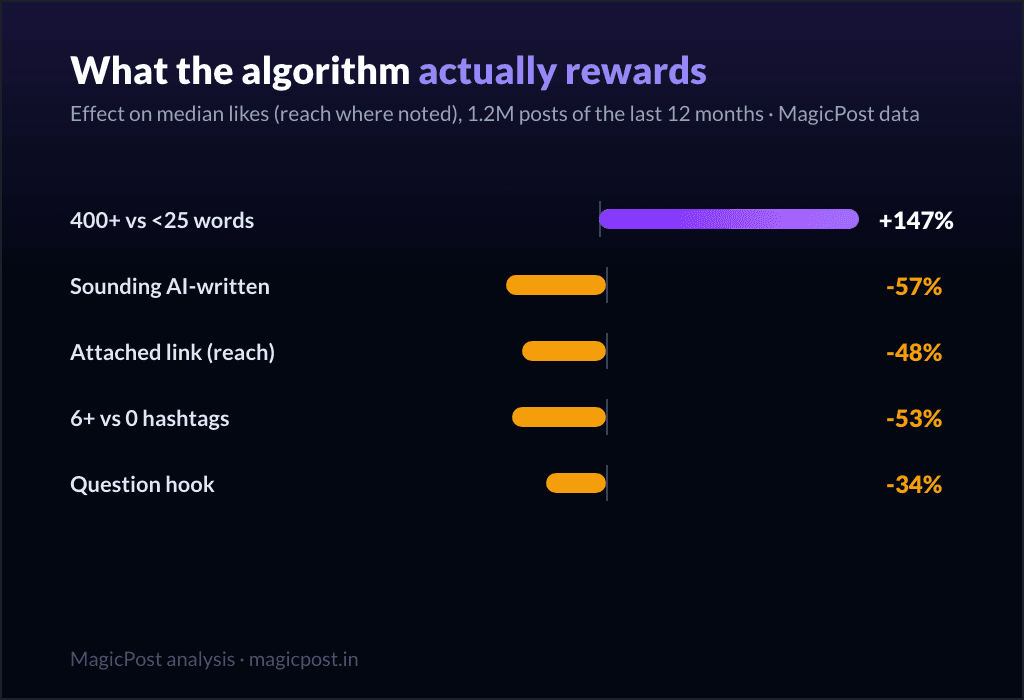
A 400-plus-word post earns 47 median likes against 19 for a post under 25 words, +147%. The mechanism hypothesis: longer posts give the reader more reasons to stop scrolling, and dwell time is one of the few signals LinkedIn has publicly confirmed it uses.
The confounder is real (longer posts come from more committed writers), but the effect holds inside every follower band we tested, so it is not purely a celebrity artifact. Full length curve, with the by-follower-band control.
Format: pick the visual ones
What you attach to the words is the next-biggest choice. Across the same corpus:
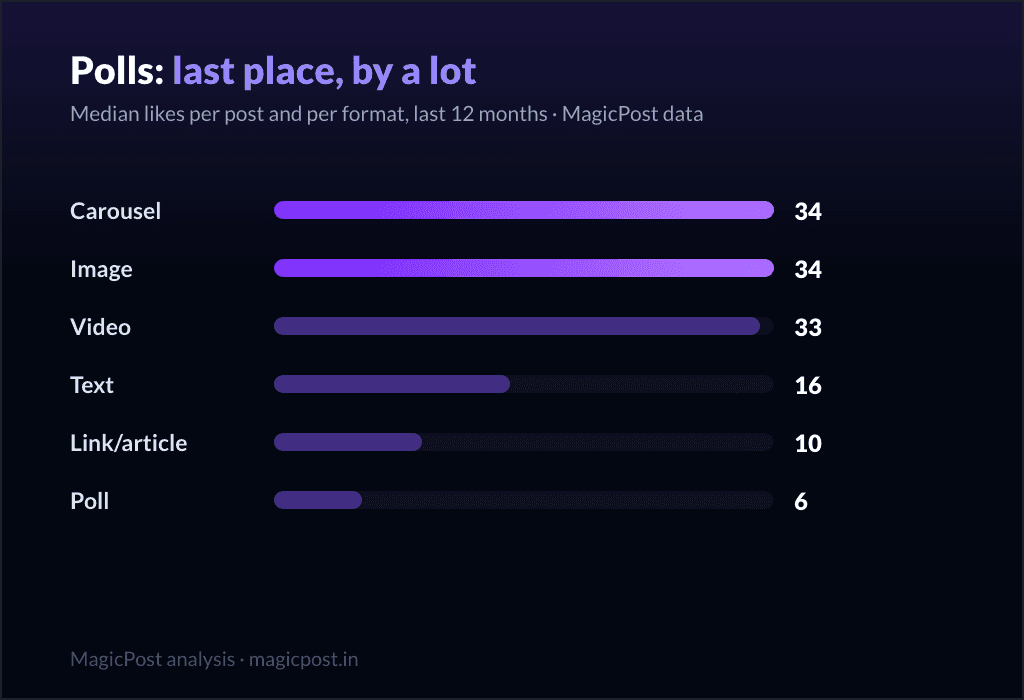
Format | Posts measured | Median likes |
Image | 731,277 | 34 |
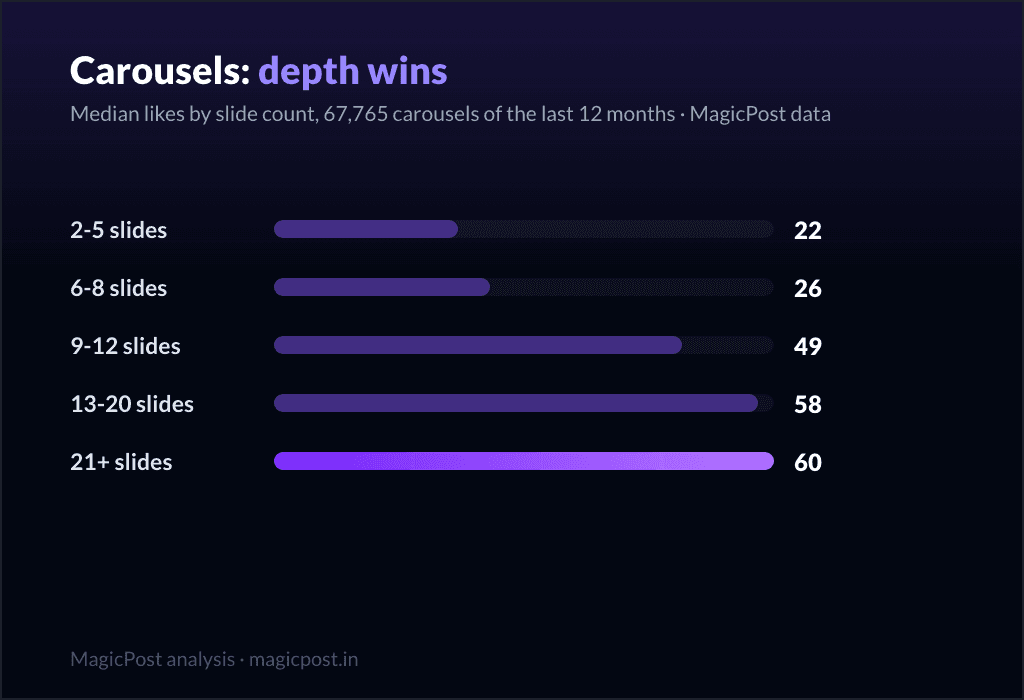
Carousel | 69,835 | 34 |
Video | 122,165 | 33 |
Document | 6,380 | 18 |
Text only | 195,686 | 16 |
Link / article | 71,326 | 10 |
Poll | 11,126 | 6 |
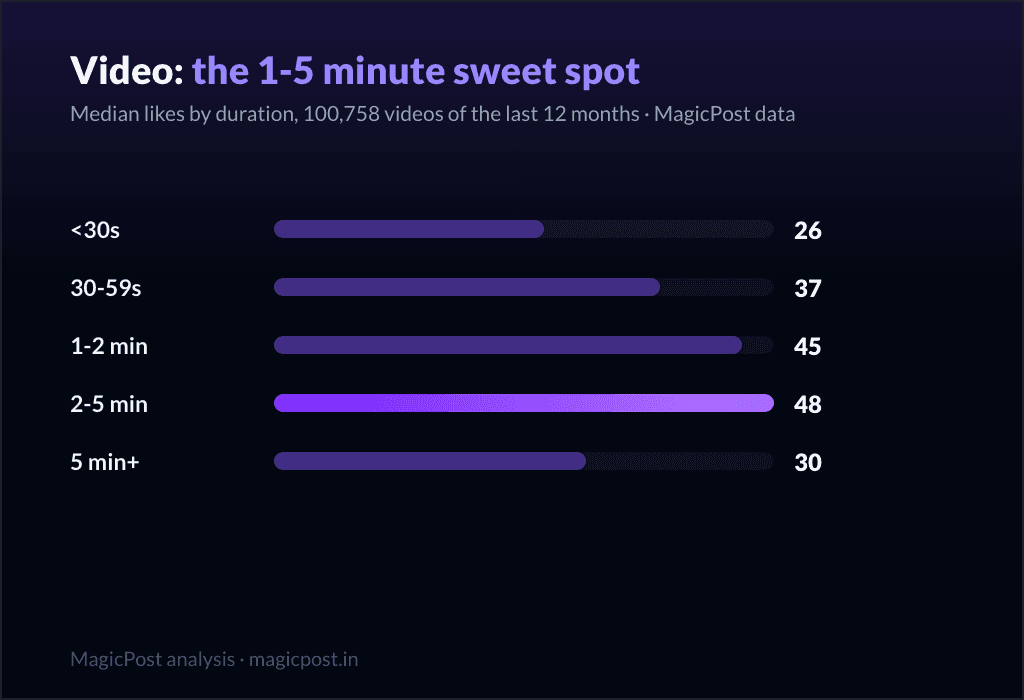
Image and carousel posts tie at the top (34 median likes), video sits one point behind (33), and bare text earns less than half of that (16). The cheapest upgrade in this entire study is attaching a single image to words you were going to post anyway: it roughly doubles the median.
Within the same creator, the ranking at the top shifted during the year: carousels' lead over photo posts fell from +21% to +9% in mid-March 2026.
Mechanism hypothesis: a visual occupies more screen, holds the eye a beat longer, and the feed reads that beat as interest. The full format ranking, four years of history, and the masters of each one.
Attached links: roughly half the reach (-48%)
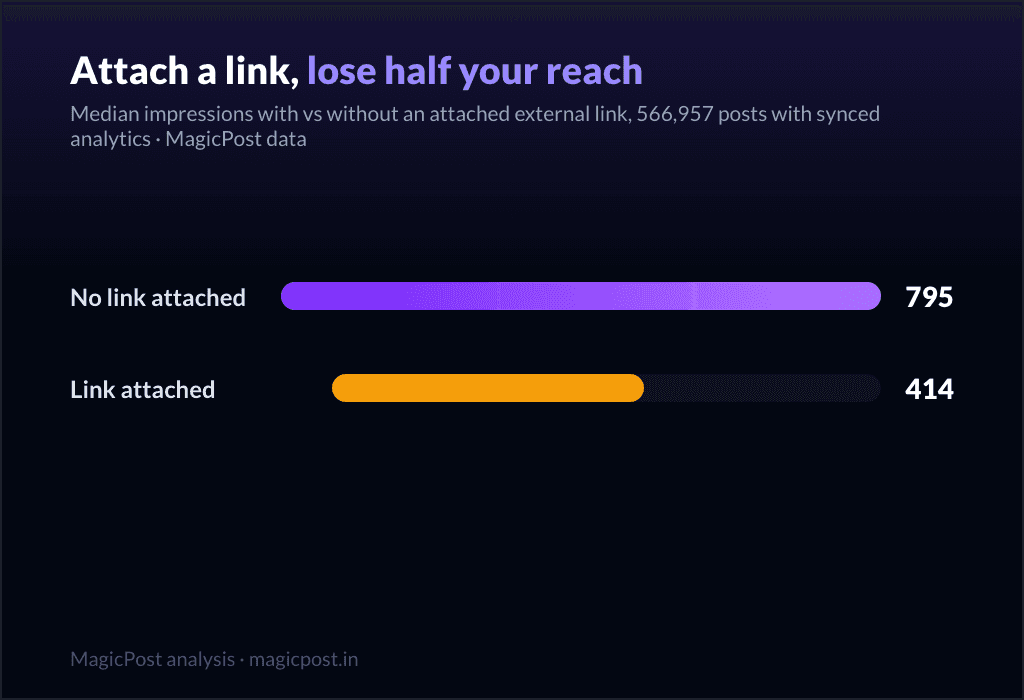
The oldest argument on LinkedIn has a clear answer in our pooled data up to June 2026. Posts with an external link attached earn 414 median impressions against 795 for posts without one, on 566,957 posts with synced analytics: -48% reach. Likes fall in step (6 versus 19).
But the nuance matters, and it is the difference between "links are bad" and "the link preview card is bad." We split links by where they live:
Link placement | Posts measured | Median impressions | Median likes |
Attached (preview card) | 32,927 | 414 | 6 |
In the post body (no card) | 69,166 | 858 | 20 |
No link at all | 464,864 | 786 | 19 |
In this raw cut, a link written into the body of the post shows no cost (858 median impressions, slightly above the no-link baseline). The gap is specific to the attached preview card, which is also what makes a post register as "article" format.
Compared with the same creator's posts without links, every placement sits lower since mid-May 2026: a link card 19% below (39% before), a URL typed in the text 21% below (12% before), and a "link in the comments" line 16% below (8% before). The typed URL now sits about as low as the card.
Mechanism hypothesis: the feed would rather keep you on LinkedIn than hand you a one-click exit. The full link study, including the "link in first comment" option.
Hashtags: the more you stack, the fewer likes (-53%)
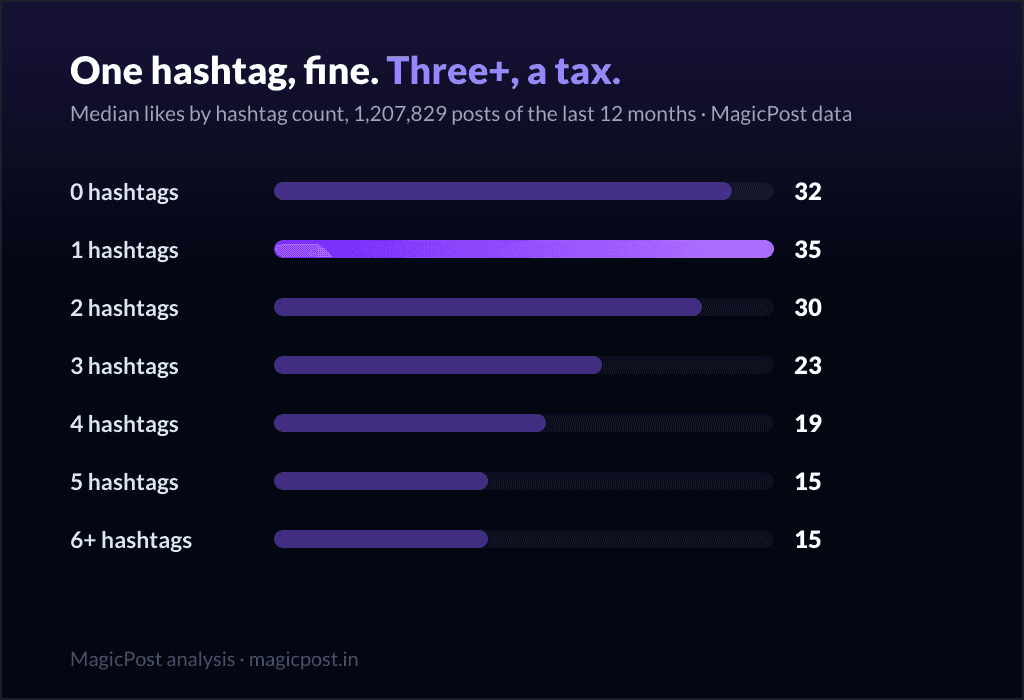
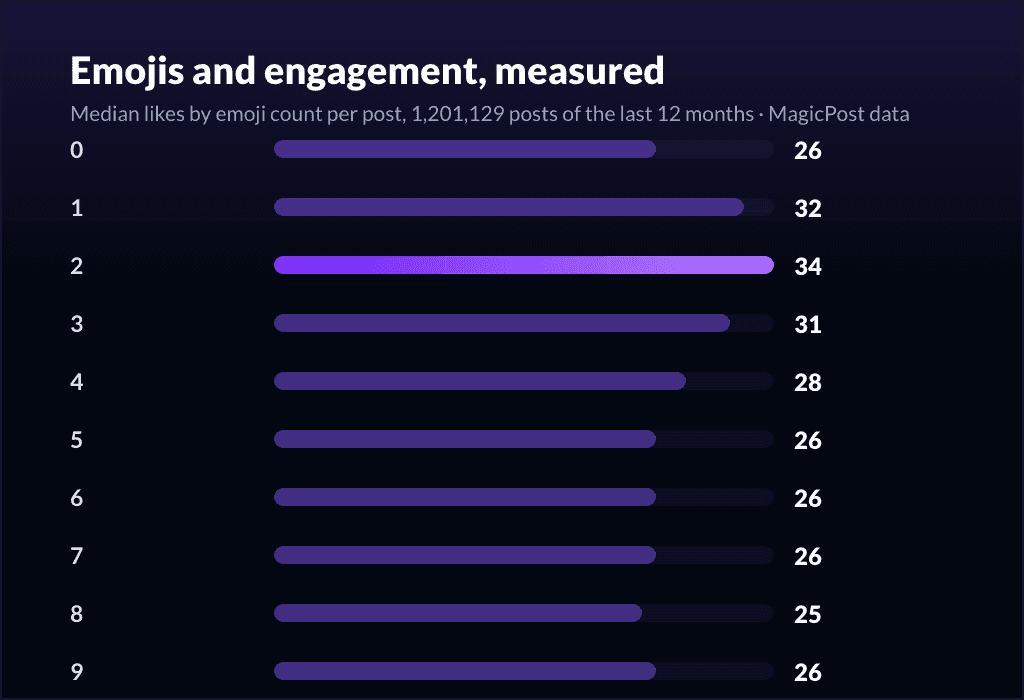
Hashtags are the clearest case of doing the opposite of folklore. One hashtag is fine, even marginally good. Stacking them is a steady downhill.
Hashtags | Posts measured | Median likes |
0 | 865,441 | 32 |
1 | 43,919 | 35 |
2 | 25,515 | 30 |
3 | 45,689 | 23 |
4 | 40,003 | 19 |
5 | 50,921 | 15 |
6 | 136,341 | 15 |
A post with one hashtag peaks at 35 median likes; pile on six and you are at 15, a -53% drop versus zero hashtags and worse than posting none at all. And 136,341 posts in our window still used six or more, so the habit is far from dead.
These are raw medians up to June 2026, so they also reflect which posts carry many tags. Compared with the same creator's average post, one to three hashtags sit 5% below since July 27, 2026, within the margin of error (-14% to +5%): no measurable effect on reach. We have no same-creator figure for four or more.
Mechanism hypothesis: a wall of hashtags reads as reach-chasing, and the feed seems to have learned to discount it. Are hashtags still useful on LinkedIn, and how many to use.
Question hooks: the advice everyone gives, inverted (-34%)
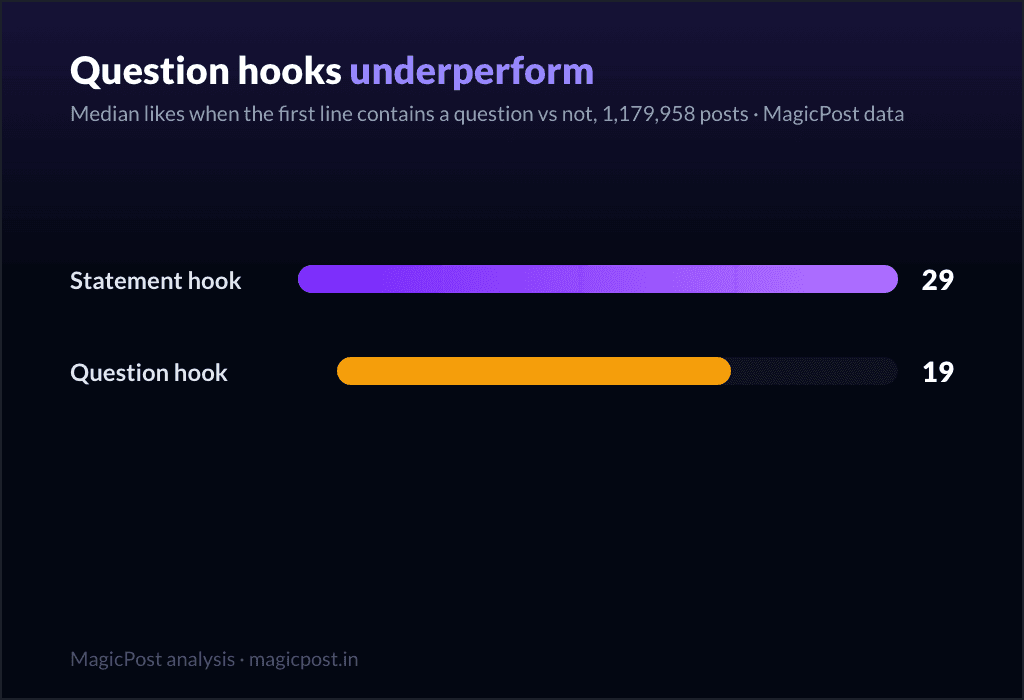
"Open with a question" is the single most-repeated hook tip on LinkedIn. Measured on 1.18 million posts, it backfires.
First line | Posts measured | Median likes |
Not a question | 1,036,169 | 29 |
A question | 143,789 | 19 |
Posts whose hook is a question earn 19 median likes against 29 for every other opening: -34%. Number-led hooks, by contrast, go the other way (35 versus 26 without).
The last line is a separate case. Since July 27, 2026, a closing question has held level with its author's average post in our 2026 algorithm study, while comment requests fell: "Comment KEYWORD" went from 10% above that average to 47% below (our comment-bait study), other requests from 2% to 19% below.
Mechanism hypothesis: a question asks the reader to do work before they have any reason to; a statement or a number gives them the payoff up front. The full hook study, with 20 examples and the number-hook lift.
See which of these levers your own posts are pulling: where do you stand? MagicPost's LinkedIn analytics break your own posts down the same way: length, format, links, hooks, reach and engagement, so you can find which lever is costing you. And to get these benchmark numbers refreshed in your inbox every month, subscribe to the monthly MagicPost Benchmark.
Sounding AI-written: a raw gap that is mostly audience
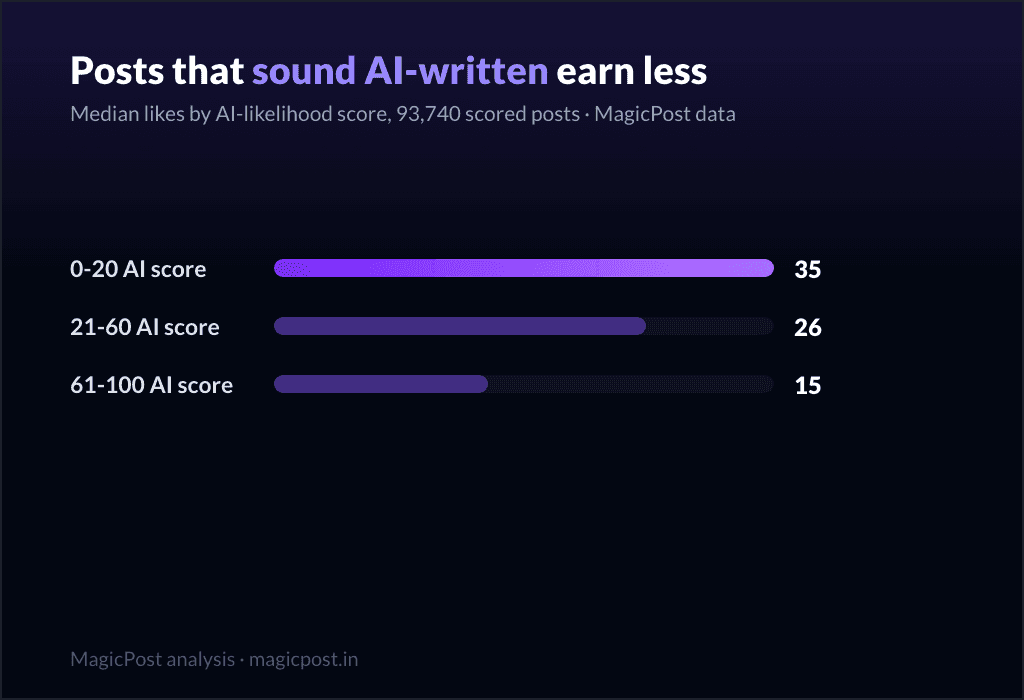
This is the lever that did not exist two years ago. We score every post for how likely it reads as AI-generated, and grouped 93,740 scored posts into three bands.
AI-likelihood (our score) | Posts measured | Median likes |
0-20 (reads human) | 77,436 | 35 |
21-60 (mixed) | 14,705 | 26 |
61-100 (reads AI) | 1,599 | 15 |
Posts that read as clearly AI-written earn 15 median likes against 35 for human-sounding ones: -57% in this raw cut, up to June 2026. But read that as a correlation, not a clean effect, and a big part of it is audience: bigger accounts write in a less templated voice, so some of the gap is who is posting, not how.
A separate, audience-neutralized study (comparing each author only to their own posts) puts the real phrasing cost far lower, and shows it only emerged in 2026: do AI posts get less engagement on LinkedIn.
Our same-creator data puts a size on it. At equal substance and equally generic writing, a post that reads more like AI got about 9% fewer impressions before July 27, 2026 (between 6% and 12% fewer), and we detect no extra cost since.
Posts with no concrete detail and no lived experience lost more: 23% below their author's average post since July 27, against 13% below from April to July 26.
This is also our own AI-likelihood score correlating with engagement, not evidence that LinkedIn detects and demotes AI; the likelier mechanism is human, readers recognize the cadence and scroll past. See also does LinkedIn penalize AI content, and why the em dash became an AI tell.
Polls: seen, and not rewarded
Polls are the strangest entry on the board because they break the usual rule that reach and reward travel together. In our data up to June 2026, polls get the highest median reach of any format, 1,154 impressions, and the lowest engagement, 6 median likes against 34 for image posts. They get seen; readers don't react. A poll buys impressions and spends the engagement those impressions would have earned.
That reach did not hold. Compared with the same creator's average photo post, polls went from 9% more impressions earlier in 2026 to 22% fewer since mid-May 2026.
Mechanism hypothesis: a poll invites a one-tap vote, but a vote is not a like and the audience treats the two very differently. Do LinkedIn polls actually work.
Your size sets your baseline
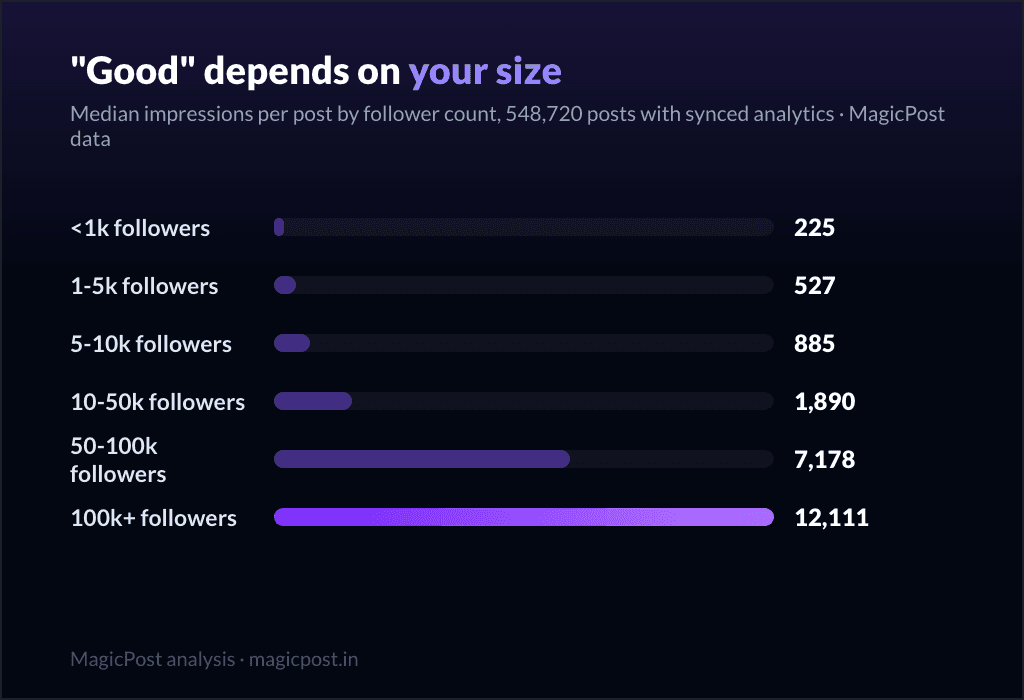
Before you blame any of the levers above, know that the largest determinant of a post's raw numbers is the one you cannot edit on any given day: how many followers you already have. Median impressions by follower band, on the 566,957 posts with synced analytics:
Followers | Posts measured | Median impressions |
Under 1k | 65,852 | 225 |
1-5k | 219,796 | 527 |
5-10k | 101,378 | 885 |
10-50k | 137,892 | 1,890 |
50-100k | 13,544 | 7,178 |
100k+ | 10,258 | 12,111 |
A 100k-plus account's median post is seen by 12,111 people; an account under 1k sees 225. That is the real "baseline" the levers move you around within.
And there is a humbling twist for the big accounts: the median like rate (likes per impression) actually falls as you grow, from 2.38% under 1k followers to 1.55% past 100k. Bigger reach, thinner engagement per view. This is why "good" only means anything relative to your own size. What counts as a good number of impressions for your follower band.
Timing: we measured when, separately
Everything above is about what a post contains. When you publish is its own lever, and we measured it in a separate study rather than fold a weak number into this one. The short version: there are clear best-day and best-hour patterns, and consistency of posting matters as much as the slot you pick.
Those patterns score engagement against each author's usual level. Final reach is a different measure: on 28,852 posts published through MagicPost and read hour by hour, the slot moves views at one hour from 21% fewer to 11% more than usual for the author, and final reach by 2% at most.
If timing is the lever you want to pull, post at the right time consistently with scheduled publishing, and read the data behind it: the best time to post on LinkedIn and how often you should post.
What we did NOT find
The null results matter as much as the wins. Several popular "algorithm hacks" produced no signal we are willing to publish, or no measurable effect on final reach when we tested them later:
No measurable dwell-time hack beyond length. We can show longer posts earn more, but we cannot isolate "dwell time" as a lever separate from the words that create it. We only claim what we can measure: length.
No creator-mode or "broetry line-break" magic. Nothing in our data isolates a formatting trick that beats simply writing more, in a visual format, that does not read as AI.
No "first 60 minutes golden hour". Read hour by hour on 28,852 posts in our study of how LinkedIn reach moved in 2026, a typical post has 8% of its final views after one hour, 23% after four hours and 72% after three days. Replying to comments within the hour shows no measurable effect (+2%, between -11% and +16%).
No engagement-pod effect on final reach. Early comments from a pod bring 31% more views at one hour, and the post finishes no higher (-6%, between -18% and +7%, against the same creator's comparable posts).
The levers we publish are the ones that survived the data. The hacks we left out are the ones that did not.
What to actually do with this
Write more. Length is the biggest upward lever we found: aim past 200 words, toward 300-plus. +147% from shortest to longest.
Attach a visual. Image or carousel doubles the median of bare text. It is the cheapest win on the board.
Post a link only when it is worth some reach. Since mid-May 2026, a link card, a URL in the text and a link in the comments all sit 16% to 21% below the same creator's posts without links.
Keep hashtags to a few. Raw likes fall with each tag past one. Within the same creator, one to three tags show no measurable effect on reach since July 27, 2026.
Don't open with a question. Lead with a number or a statement; question hooks earned 34% fewer likes. A real question as the last line is fine; a comment request sits 19% to 47% below the author's average post since July 27, 2026.
Don't let it read like a robot, and give it substance. At equal substance, sounding like AI cost about 9% of impressions before July 27, 2026. Posts with no concrete detail and no lived experience sit 23% below their author's average post since then.
Skip polls unless you only want votes; since mid-May 2026 they get 22% fewer impressions than the same creator's photo posts.
Judge yourself against your own size, not against a celebrity's raw numbers.
Pull the levers, not your hair. MagicPost hands you one place to draft, schedule and measure every LinkedIn post, with the patterns from this study built in: right length, right format, no engagement-killing habits.
All the headline numbers from this study and its siblings live in one quotable page: LinkedIn statistics 2026.
Where this data comes from (how we measured the algorithm)
The numbers here are MagicPost's own first-party research. Core figures: 1,207,853 LinkedIn posts published over the last 12 months (reshares and deleted posts excluded), grouped by the feature being studied and compared on median engagement. Reach (impressions) figures come from the 566,957 posts with synced analytics, aggregated and anonymized; we state the n on every impressions claim. The AI-likelihood figures come from 93,740 posts scored by our own AI-likelihood model (we report the score's correlation with engagement, nothing about LinkedIn's internals). We work in medians, so one viral post cannot swing a number. Effects are correlations at scale, with the main confounders (length and author quality, links and format) named in the text and controlled by follower band where it matters. The data is the June 2026 cut and gets refreshed as the corpus grows.
Figures dated after a 2026 shift (mid-March, mid-May, July 27) and the hour-by-hour readings come from our separate same-creator study of 687,000 posts, where each post is compared with the same creator's other posts.
FAQ
How does the LinkedIn algorithm work in 2026?
Nobody outside LinkedIn has the source code, but its outcomes are measurable. Across 1,207,853 posts up to June 2026, length pays most (400-plus-word posts earn 147% more likes than sub-25-word ones), images and carousels roughly double bare text, and attached link cards went with about half the reach. Since July 27, 2026, posts asking for comments and posts with no concrete detail have lost the most reach. These are measured outcomes, not LinkedIn's ranking rules.
Does post length really matter for the LinkedIn algorithm?
Yes, more than anything else we measured. Median likes climb steadily from 19 for posts under 25 words to 47 for posts over 400 words, a +147% difference, and the effect holds inside every follower band. Longer posts give readers more reason to stop, and dwell time is one of the few signals LinkedIn has confirmed it uses.
Do hashtags help or hurt on LinkedIn in 2026?
In raw medians up to June 2026, one hashtag is marginally positive (35 median likes versus 32 for none), three drop you to 23 and six to 15, a 53% fall versus zero. Compared with the same creator's average post, one to three hashtags show no measurable effect on reach since July 27, 2026. Keep it to three or fewer.
Do external links reduce LinkedIn reach?
In pooled data up to June 2026, link-card posts earn 414 median impressions versus 795 without (566,957 posts with synced analytics), and a URL in the body showed no gap (858). Against the same creator's posts without links, every placement sits lower since mid-May 2026: a link card 19%, a typed URL 21%, a link in the comments 16%.
Does LinkedIn penalize AI-written posts?
We cannot see whether LinkedIn detects AI. In raw data up to June 2026, posts scoring highest on our AI-likelihood model earn 15 median likes versus 35 for human-sounding ones, largely an audience gap. At equal substance, reading more like AI cost about 9% of impressions before July 27, 2026, with no extra cost detected since.
Are question hooks bad for engagement?
Measured on 1.18 million posts up to June 2026, yes: opening with a question earns 19 median likes versus 29 for other openings, a 34% drop. Number-led openings lift engagement to 35. A closing question is different: since July 27, 2026, it has held level with its author's average post, while comment requests now sit 19% to 47% below it.