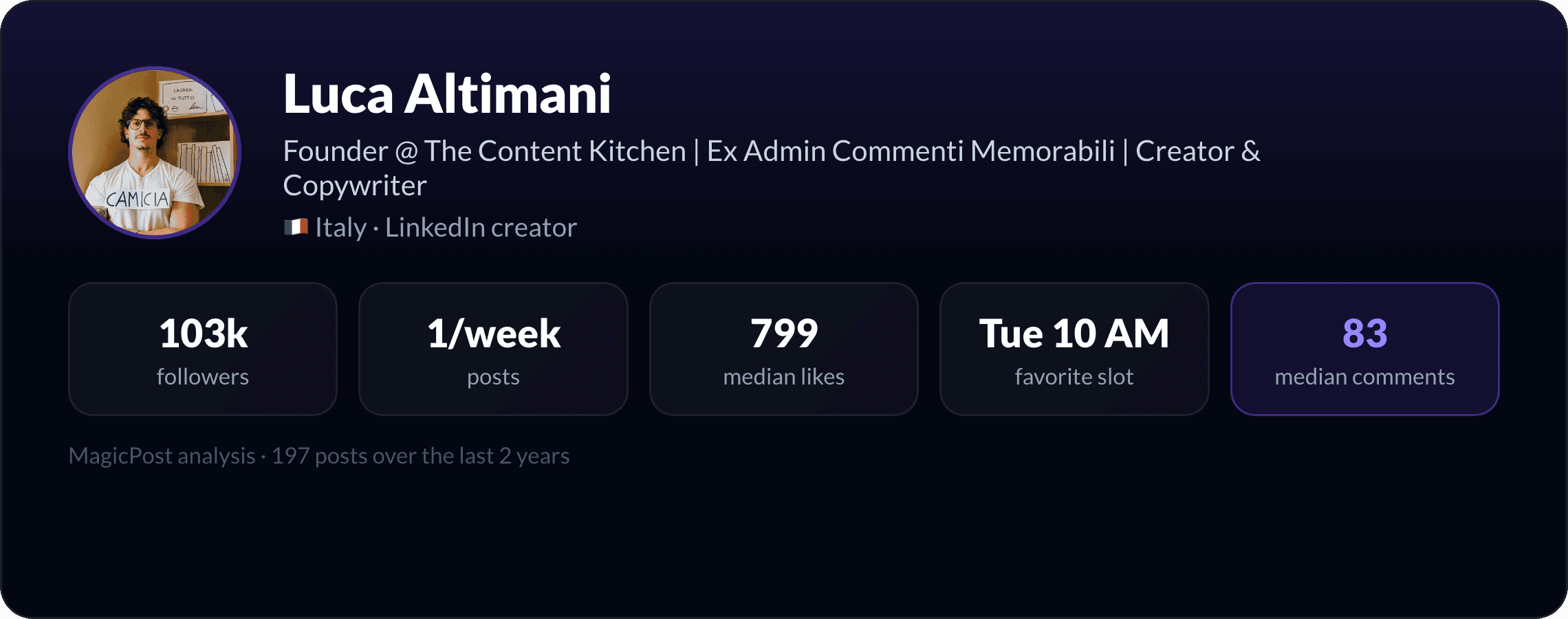
Luca Altimani is the founder of The Content Kitchen, a copywriter from La Loggia in Piedmont, and the rarest thing on Italian LinkedIn: a man who built about 103,000 followers by making fun of LinkedIn.
At MagicPost we analyzed 197 of his posts (rhythm, engagement, topics, writing metrics, and an AI-pattern profile from a 30-post sample), and one number defines him.
His median post earns about 799 likes. His biggest post of all time earns 18,307. That post is nine words long, and it is a joke at the platform's expense. This is who Luca Altimani is, according to the best possible source: his own posts, measured.
His story, in his own posts
Luca rarely tells a tidy origin story. He tells it in fragments, almost always wrapped in a joke, which is itself the truest biography he has.
No university, no master plan. His most direct piece of self-history comes in a post on whether success is skill or luck: "non ho fatto l'università perché non ne avevo nessuna voglia. Nel garage non fondavo aziende multimilionarie, ma parcheggiavo lo scooter e ci nascondevo i pacchetti di sigarette." ("I didn't go to university because I just didn't feel like it. In the garage I wasn't founding million-euro companies, I was parking my scooter and hiding cigarette packs in there.")
That is the post, his whole anti-guru thesis in one paragraph.
Doubted early, and he agrees with the doubters. When he crossed 100,000 followers, he opened with: "Ricordo ancora quando la mia professoressa d'arte mi diceva che non sarei arrivato da nessuna parte." ("I still remember when my art teacher told me I'd never get anywhere.")
In the same post he signs off "AD MALORA SEMPER ET COMUNQUE!", his recurring mock-Latin battle cry, and states his closest thing to a manifesto: "ridere del lavoro non è sinonimo di mancanza di professionalità, ma è letteralmente terapia di gruppo" ("laughing about work isn't a lack of professionalism, it's literally group therapy").
The award he refuses to take seriously. When he topped Favikon's Italian "Writing & Storytelling" ranking, his celebration post is a parody of celebration posts: "Questo mi mette nella spiacevole condizione di sottoporvi un post autocelebrativo di successoh, come fanno i premi Nobel della cucciolata su LinkedIn." ("This puts me in the unpleasant position of subjecting you to a self-congratulatory success post, like the Nobel laureates of the litter do on LinkedIn.")
That post ends "AD MARADONA SEMPER", same gag, new saint.
One pattern our data surfaces that a normal bio never would: Luca's signature move is not a recycled life story, it is a recurring target. He satirizes the LinkedIn success-post genre itself, over and over, even building a step-by-step recipe for it.
His enemy is not a competitor; it is a writing cliche, and he has made a career out of demolishing it.
What does Luca Altimani post about?
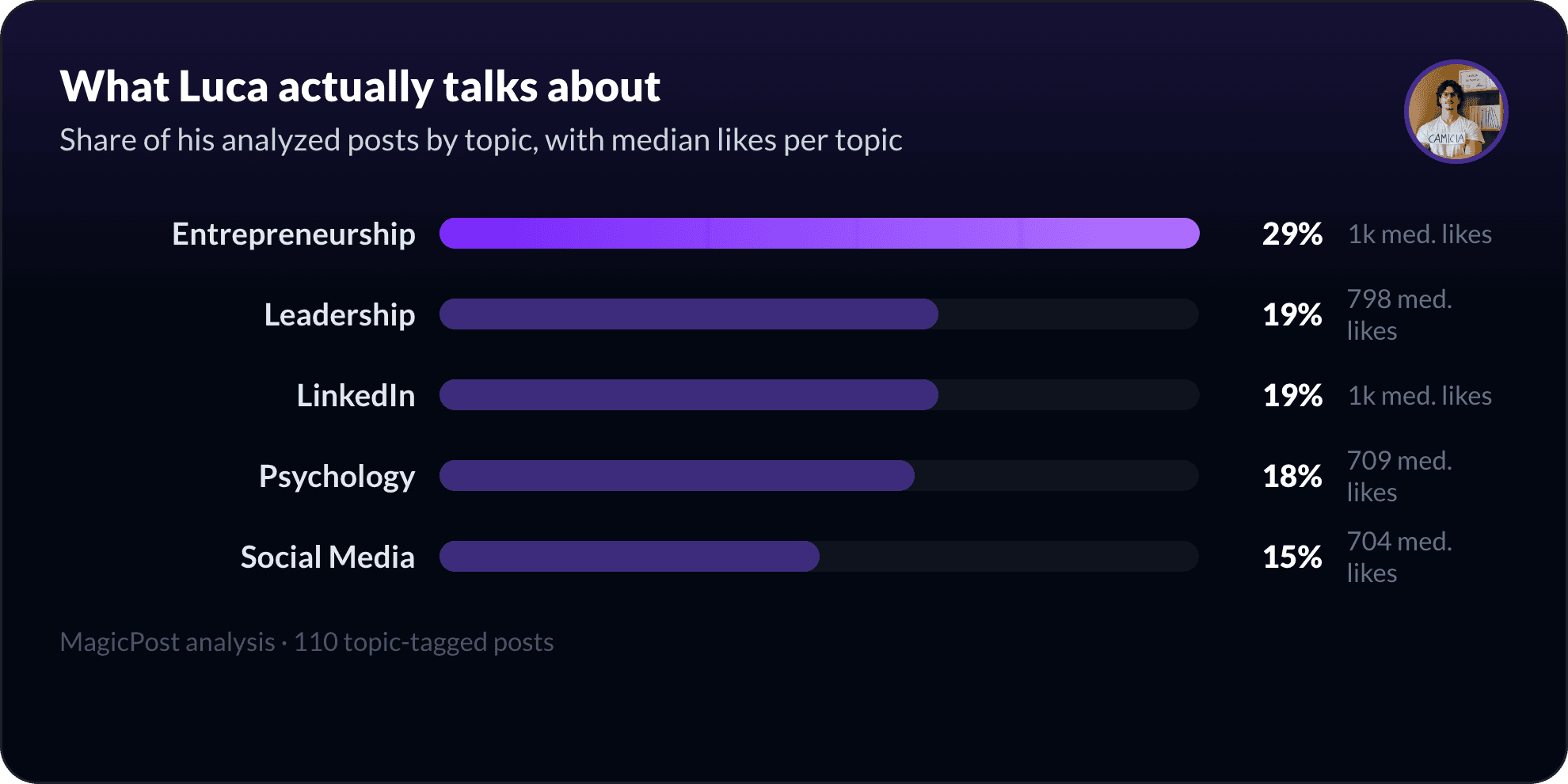
On the surface he is a work-and-management creator: Entrepreneurship, Leadership, LinkedIn, Psychology and Social Media are his five biggest themes. But two numbers reframe the feed.
LinkedIn-about-LinkedIn is his highest-performing theme (about 1,399 median likes versus his overall 799). When Luca turns the platform on itself, parodying its trends and tropes, his audience rewards him hardest. Entrepreneurship is second (about 1,106); his more earnest psychology posts sit closer to baseline (about 709).
Sorted by register rather than topic, the picture is unmistakable: about half of his analyzed posts are provocative positions, the largest category by a wide margin, with personal reflections a distant second and a handful of rants. Luca is not a tips creator. He is a satirist who occasionally puts the jokes down to write something tender, and the contrast is the point.
Who he writes for
His reader is anyone ground down by modern work culture, and he names them directly in his 100k post: a gang that runs "dal CEO al disoccupato, dal candidato all'HR" ("from the CEO to the unemployed, from the candidate to the HR rep," his words).
His recurring villains, the unpaid-overtime job ad, the return-to-office memo, the "thrilled to announce" humblebrag, are the exact frustrations his audience lives. He writes for the worker who suspects the whole performance is absurd, and wants someone to say it out loud.
His best posts of 2026
His biggest posts of 2026 so far (click through to the originals, or browse 2M+ posts like these in MagicPost):
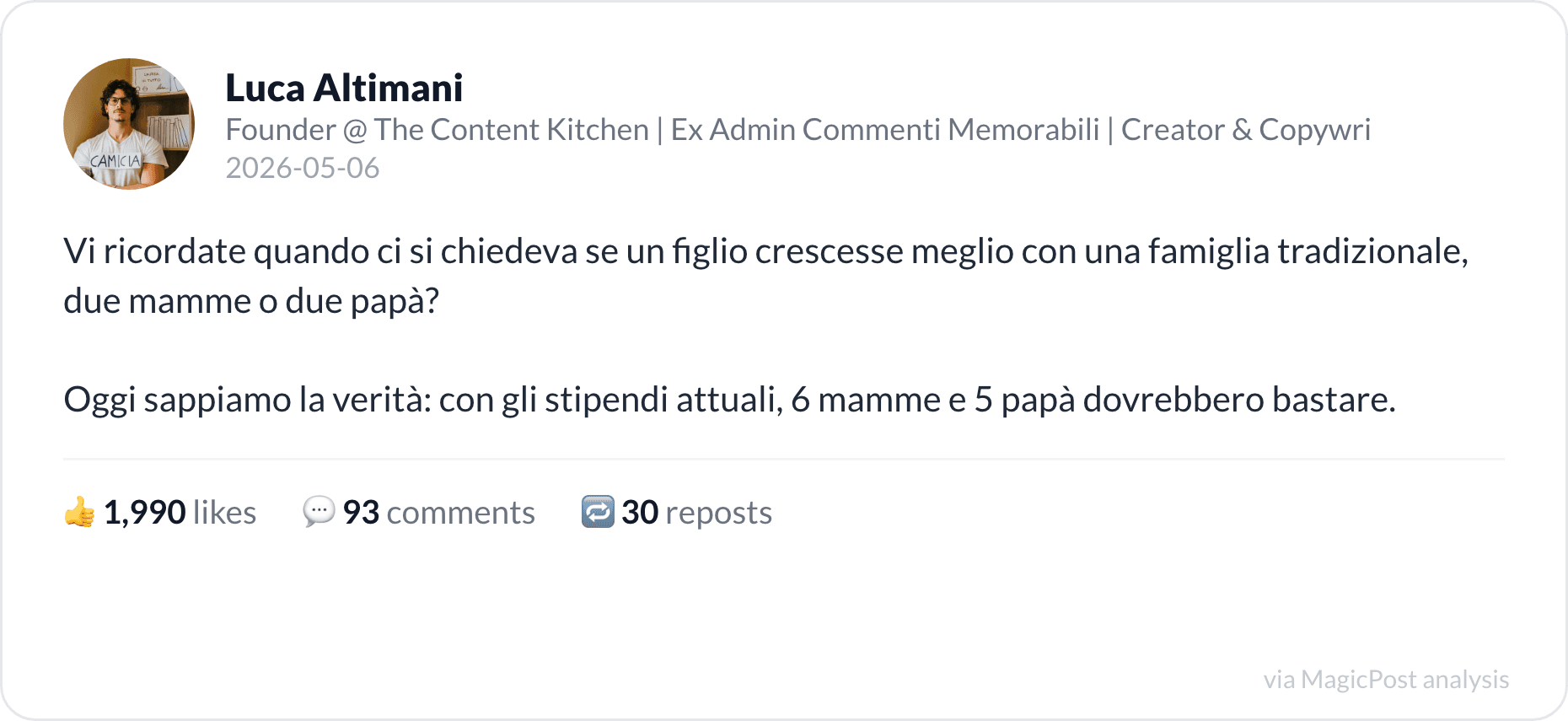
1,990 likes. A two-line bait-and-switch: an old culture-war question about how kids are best raised, answered with "con gli stipendi attuali, 6 mamme e 5 papà dovrebbero bastare" ("with today's salaries, 6 mums and 5 dads should be enough"). The setup invites a fight; the punchline redirects it all at wages.
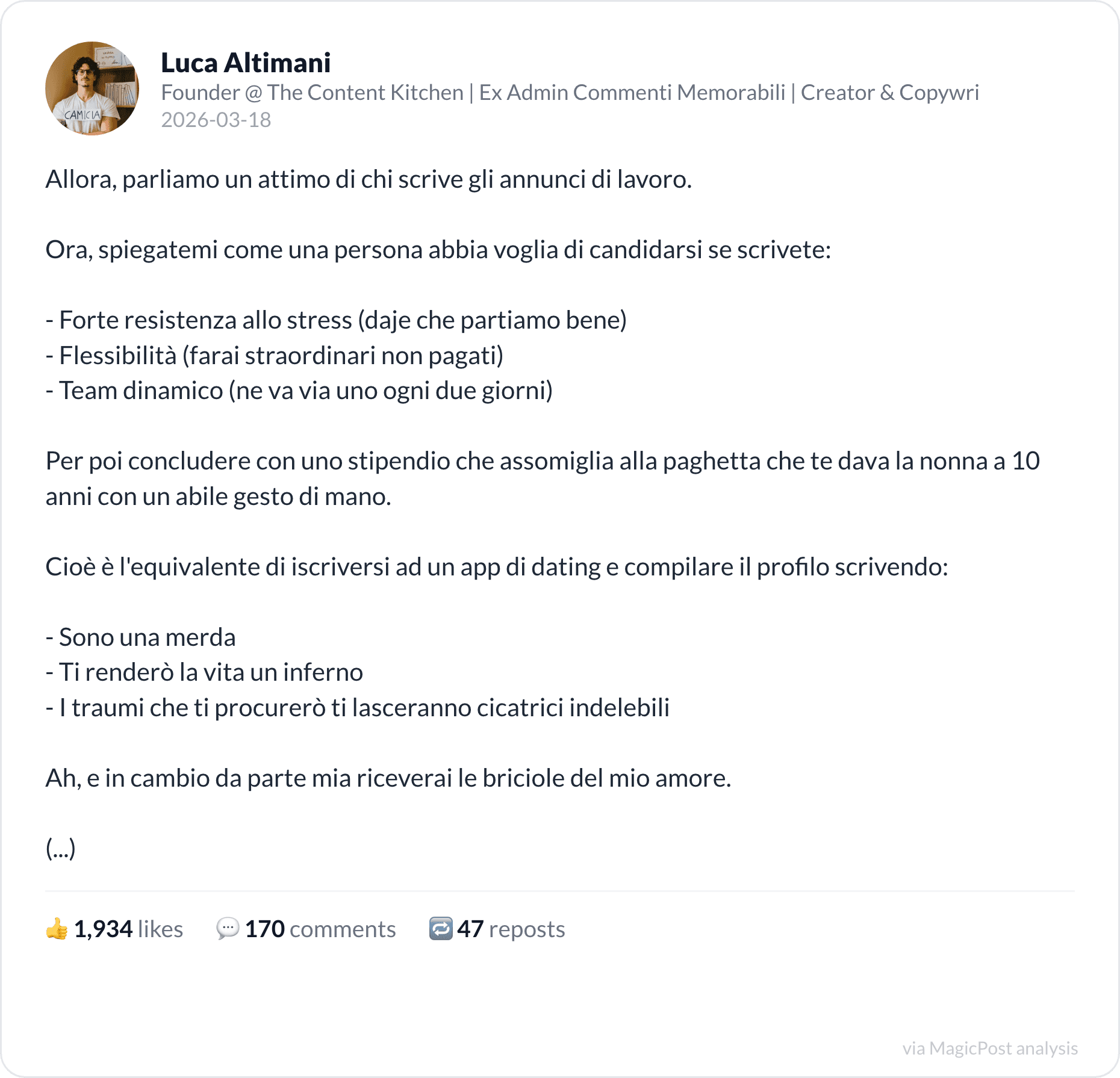
1,934 likes. The job-ad dissection, comparing a toxic listing to a dating profile that advertises "Sono una merda... Ti renderò la vita un inferno" ("I'm garbage... I'll make your life hell"). One of his longest posts, proof his audience will read 200 words when the joke compounds.
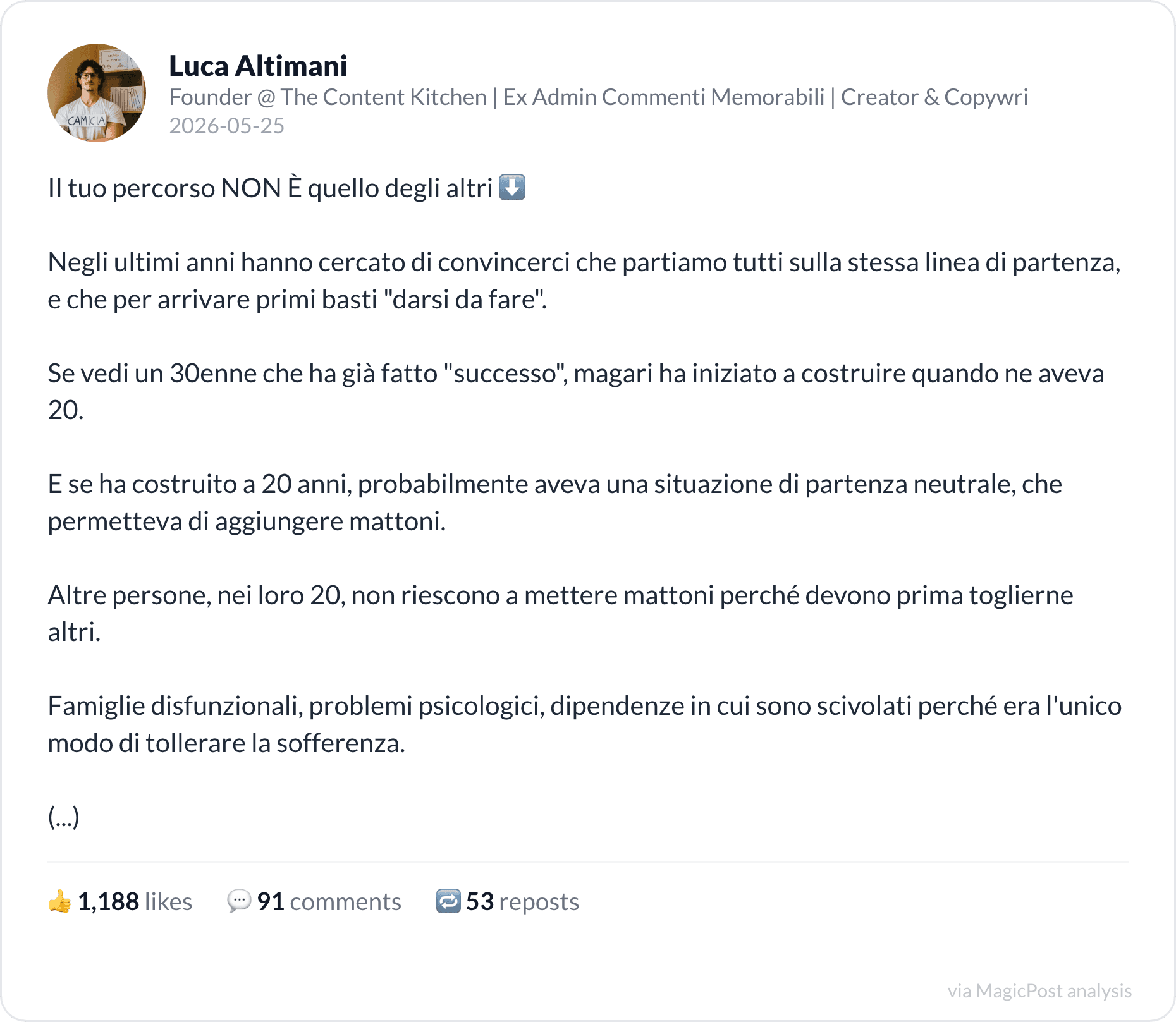
1,188 likes. The rare straight one: a tribute to people who start life behind the line, ending "complimenti soprattutto a chi ha dovuto usare tutta la sua energia a distruggere un passato" ("congratulations above all to those who had to spend all their energy destroying a past" that kept knocking them down). When the satirist drops the irony, it lands too.
Is Luca Altimani still growing on LinkedIn?
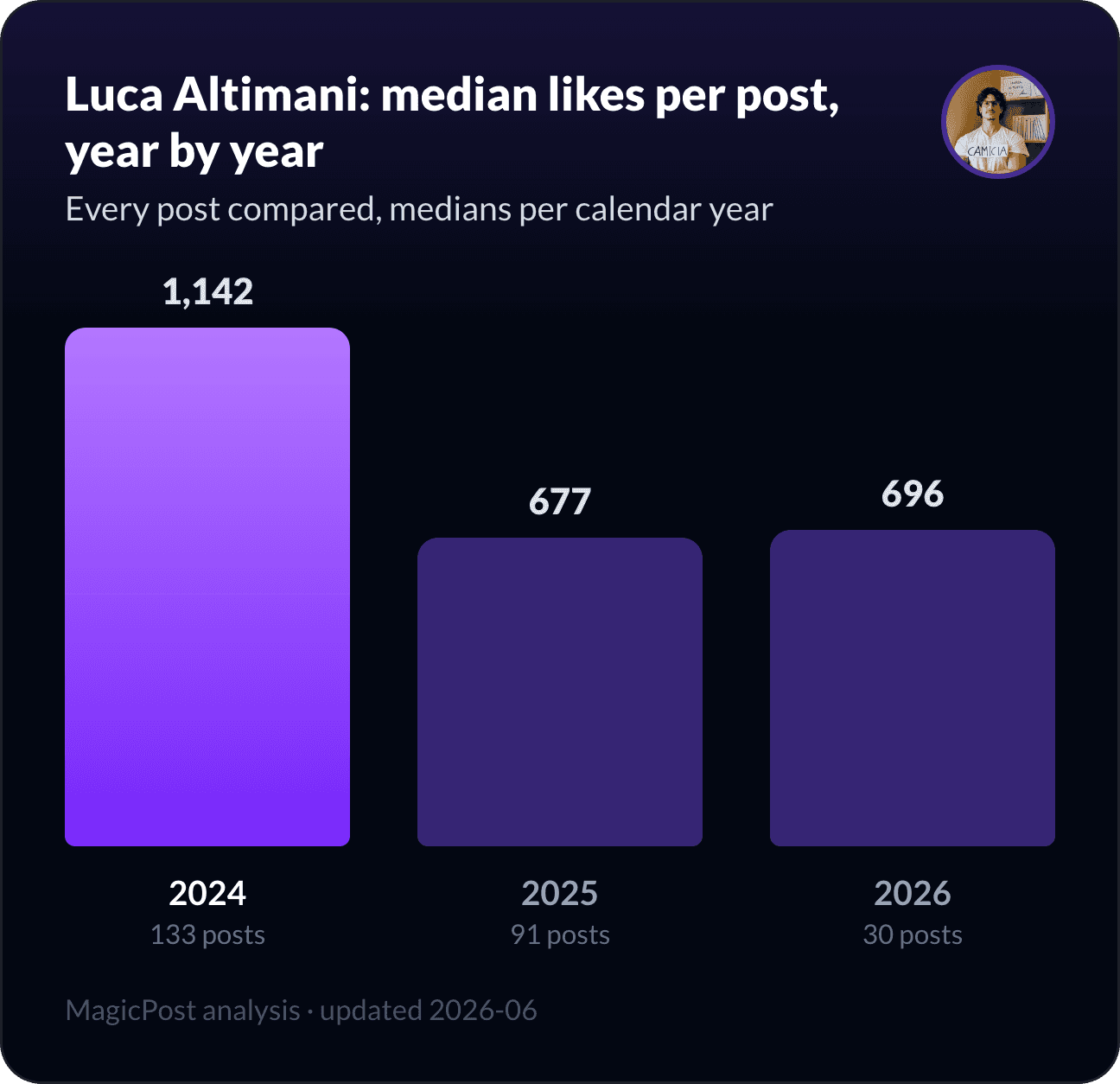
Here the answer is nuanced. His median post earned about 1,142 likes in 2024, then settled near 677 in 2025 and 696 in 2026, a cooling of roughly 40% from his peak year.
One thing to keep straight: we measure engagement per post, not follower count over time. So this tracks how hard his typical post hits, not his audience size, which has kept climbing toward 103,000.
It is the most common shape on LinkedIn right now: a creator who went very wide in a breakout year and now posts to a larger, more diffuse audience, so the median settles lower while the ceiling stays sky-high. The fireworks did not stop; they just got rarer per post.
Where do these charts come from? Everything on this page runs on MagicPost's LinkedIn analytics, and it works on your profile too: your best posts, your audience, your benchmark against thousands of creators, even a side-by-side with creators like Luca.
How he writes (short, punchy, deadpan)
Here is Luca measured against the average creator, and it tells a sharper story than "he writes short":
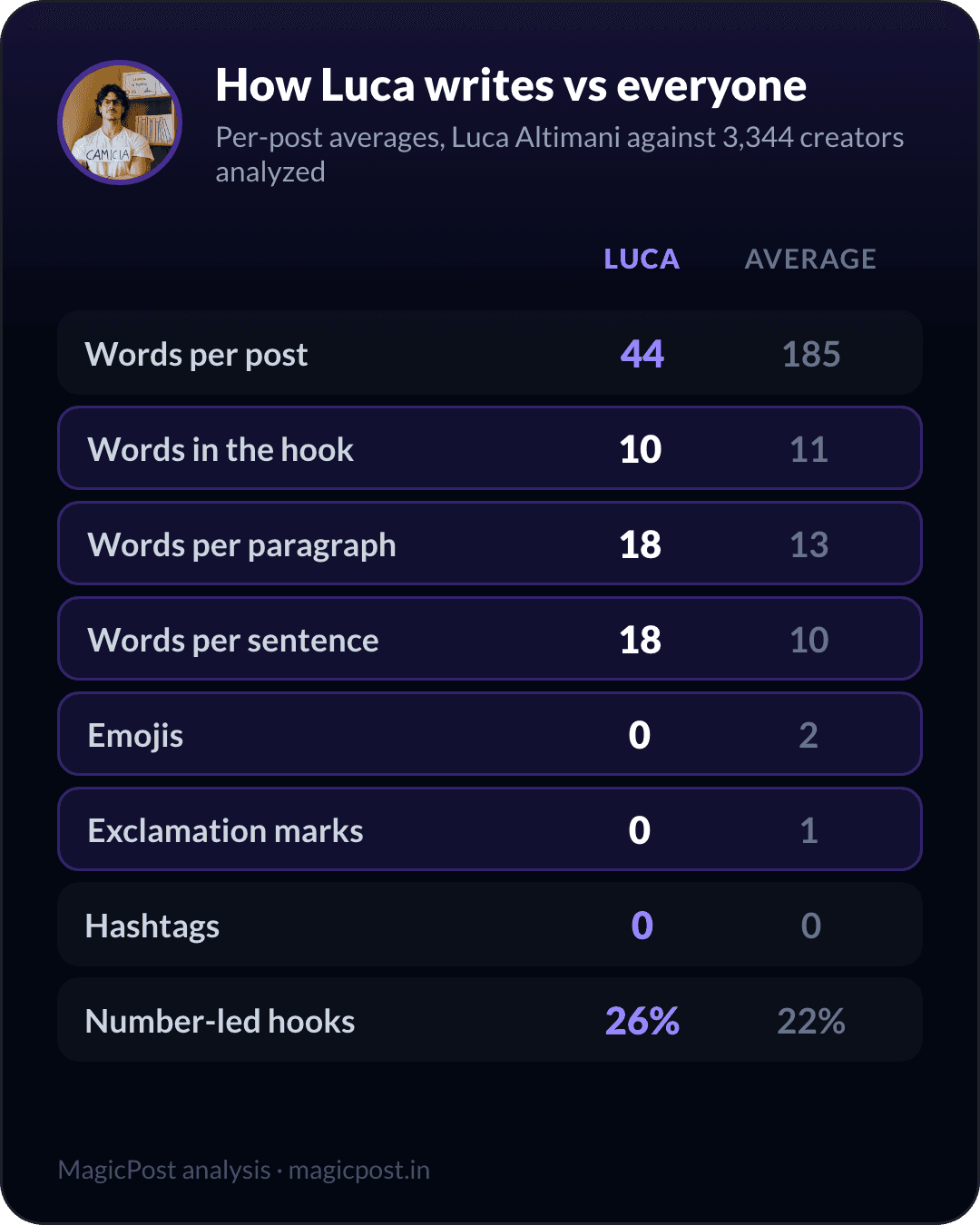
Metric (per post) | Luca Altimani | Average creator* |
Words | 44 | 185 |
Words in the hook | 10 | 11 |
Words per paragraph | 18 | 13 |
Words per sentence | 18 | 10 |
Emojis | 0 | 2 |
Exclamation marks | 0 | 1 |
Hashtags | 0 | 0 |
Hooks built on numbers | 26% | 22% |
*Median across the 3,344 creators we analyzed with 20+ posts each.
The headline number is 44 words, less than a quarter of the 185-word average. But notice what is not short: his typical sentence and paragraph both run about 18 words, longer than average, and in his fingerprint a paragraph and a sentence are nearly the same thing.
That is the deadpan setup-punchline structure made visible: one full thought per line, no fragments, no staircase of one-word drama. He builds the joke in a couple of complete sentences and stops.
Add the three hard zeros (no emojis, exclamation marks or bold across the corpus) and you get a style with zero theatrical decoration. The comedy carries everything; the formatting carries nothing. When our system describes his style in one word, it says: bold.
The "AI tells" in his style (read this the right way)
Run Luca's writing through the patterns people call "AI tells," and the chart is almost empty:
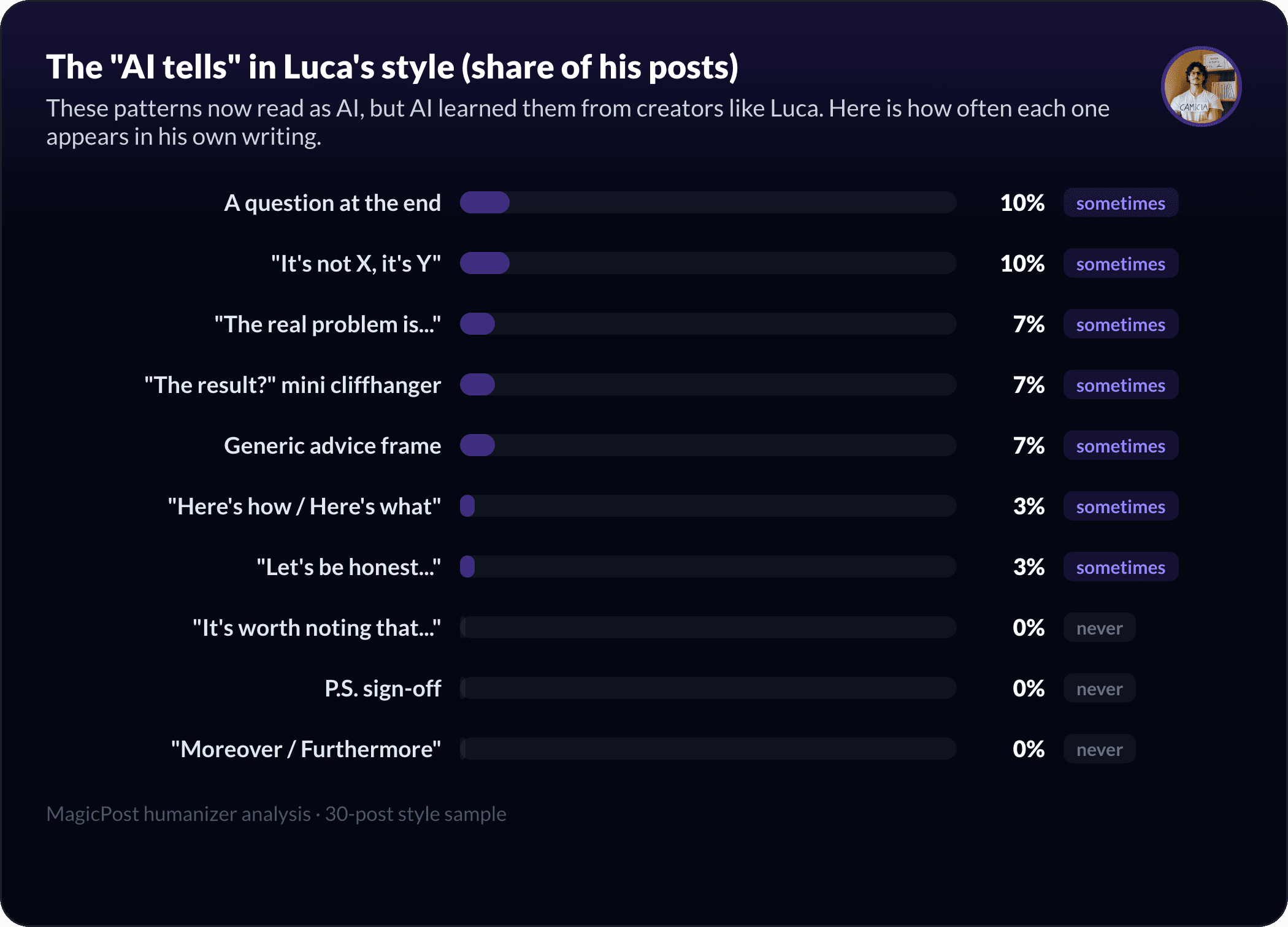
Do not read this backwards. Luca does not write like an AI; AI writes like the polished half of LinkedIn that Luca spends his days mocking. The most flagged patterns are not just rare, they are never present: no hedging ("it's worth noting that..."), no automatic P.S. sign-off, no "Moreover"-style transition openers.
The few devices that appear are occasional and human: about one post in ten closes on a question or uses an "it's not X, it's Y" contrast, which a comedian reaches for naturally to land a turn.
The deeper joke is that Luca has built a whole genre out of parodying exactly the writing AI produces. His funniest post on this is a recipe for the AI-flavored success post, "CREA IL TUO POST DI SUCCESSO" (CREATE YOUR OWN SUCCESS POST), assembled from the usual cliches and ending with the instruction "Una cagata di morale per concludere" ("A crap little moral to wrap it up").
The man who can write the cliche on demand is the last one who would use it sincerely.
When does Luca Altimani post on LinkedIn?
Luca publishes about 2 posts a week, favorite slot Tuesday around 10 AM Rome time, and almost never on weekends (about 1% of posts). His rhythm sits well below the daily-grind creators, fitting for a writer whose whole brand is that the grind is a scam, and it lines up with our best-time-to-post study: a mid-morning weekday slot.
His comment counts are unusually rich for his volume (median about 83 per post), because a good joke pulls replies the way advice never can.
And if part of your playbook is showing up where conversations like his happen, that is what an engagement feed is for: the creators you study, every day, without hunting the timeline. Our posting-frequency study shows you do not need his volume to compound.
What to steal from Luca Altimani
A nine-word joke can outscore a thousand-word essay. His all-time best ("Nessuno, buona giornata") is one line. Brevity plus a real punchline beats effort.
Pick a target, not just a topic. He does not "talk about work," he attacks specific cliches: the toxic job ad, the return-to-office memo, the humblebrag. A clear enemy beats a subject.
Let the comedy carry the formatting. Zero emojis, exclamation marks or bold. If the line is funny it needs no decoration; if it needs decoration it is not funny yet.
Earn the serious posts. Because he is usually joking, his sincere posts hit harder.
Write to the reader's eye-roll. His best lines say out loud what his audience already thinks. Voice the shared frustration and they will repost it for you.
Study him, then study yourself. With MagicPost you can dig into Luca's numbers the way we just did, analyze your own with the same depth, and learn to write in the spirit of a style like his, in your own voice. The data on this page is the product.
The posts behind this profile
Every quote above is from one of Luca Altimani's own public LinkedIn posts. The ones that carry the story:
Where this data comes from
Everything in this article is MagicPost's own research. We analyzed 197 of Luca Altimani's public posts: timing, engagement, topic mix, writing metrics, and an AI-pattern profile from a 30-post style sample.
Every biographical claim is quoted from one of his own public LinkedIn posts, listed in the sources above; quotes are kept verbatim in Italian with an English gloss. Luca is not affiliated with MagicPost; his style is one of those we track closely.
FAQ
Who is Luca Altimani?
An Italian copywriter and creator from La Loggia, Piedmont, founder of The Content Kitchen and former admin of the "Commenti Memorabili" community. With about 103,000 LinkedIn followers, he is best known for sharp, deadpan satire of work and LinkedIn culture, and topped Favikon's Italian "Writing & Storytelling" ranking.
How often does Luca Altimani post on LinkedIn?
About twice a week, most often on Tuesday around 10 AM Rome time, and almost never on weekends.
Does Luca Altimani write with AI?
His fingerprint is about as far from "AI writing" as it gets: none of the most-flagged tells (no hedging, no auto P.S., no formulaic transition openers), and a comedian's instinct for the human turn. The irony is that he parodies the exact template-driven writing AI tends to produce, including a step-by-step recipe for the LinkedIn success post.
What does Luca Altimani write about?
Work culture seen through satire: management, leadership, LinkedIn itself, psychology and social media. His highest-performing theme is LinkedIn-about-LinkedIn, where he parodies the platform's tropes.
Is Luca Altimani still growing on LinkedIn?
His follower count has kept climbing toward 103,000. His median likes per post cooled about 40% from a 2024 peak (around 1,142) to roughly 700 in 2025 and 2026, the common shape for a creator whose audience grew faster than the median post, while his ceiling stayed high.
Can I write like Luca Altimani?
You can learn the mechanics: MagicPost learns a creator's style (length, rhythm, hooks, signature moves) and helps you write in that spirit, in your own voice.