Most LinkedIn founders narrate the climb. Michel Mousa narrated the exit. In July 2025 he told his Dutch audience he was shutting down Mousa Consulting, a business he says cleared hundreds of thousands a year in profit, then spent the following months posting screenshots of the tax bill to prove the numbers were real.
At MagicPost we analyzed 600 of his LinkedIn posts, including a corpus of 53 introspective ones: what he writes, when, for whom, what works, and the one pattern in his data that no normal bio could surface.
This is who Michel Mousa is, according to the best possible source: his own posts, measured.

His story, in his own posts
You do not need a biographer for Mousa. He keeps reflecting on the same turning point, and the data shows which chapters he treats as essential.
The pivots. He did not arrive at LinkedIn consulting in a straight line. He lists the whole zig-zag himself: a marketing agency, a psychology degree, websites, sales funnels, and finally "Maart 2023: De switch naar LinkedIn consulting. En daar was het eindelijk. Mijn 'ding'." (March 2023: the switch to LinkedIn consulting, and there it finally was, my "thing".) His read on it: "Al die 'mislukkingen' waren geen mislukkingen." (All those "failures" were not failures.)
The exit. The defining post of his corpus: "Het was een lastig besluit, maar ik heb besloten om te stoppen met Mousa Consulting." (It was a hard decision, but I have decided to stop with Mousa Consulting.) He frames it as a values shift, not a failure: "Het bedrijf was deels gebouwd om mezelf waardig te voelen als persoon." (The business was partly built to feel worthy as a person.)
The proof. Where most founders keep revenue vague, Mousa posts the documents. In one reflection he attaches what he calls "mijn VPB som van 2024" (his 2024 corporate tax statement) as proof of the profit, then follows up after a mix-up with "mijn bijdrage van €210.000 aan de Nederlandse samenleving" (my contribution of 210,000 euros to Dutch society), selfie with the payment included.
The new direction. The drive did not leave with the business, he just reordered it: "Van geld verdienen als hoofddoel naar God als hoofddoel." (From earning money as the main goal to God as the main goal.) Money still matters; it is simply "alleen niet meer mijn hoofddoel" (just no longer my main goal).
One detail our data surfaces that a normal bio never would: the "I shut down a million-euro company" post is not a post, it is a franchise. The decision to stop Mousa Consulting, almost always paired with proof of profit and the "I found it in myself, not the money" arc, drives at least six of his most-engaged introspective posts across 2025:
the announcement (651 likes),
the "miljoenenbedrijf gestopt" reflection (556),
the 600,000-euro version (443),
the team-trip-to-Bali version (345).
When a story lands, he does not retire it. He re-frames it from a new angle and ships it again.
What does Michel Mousa post about?
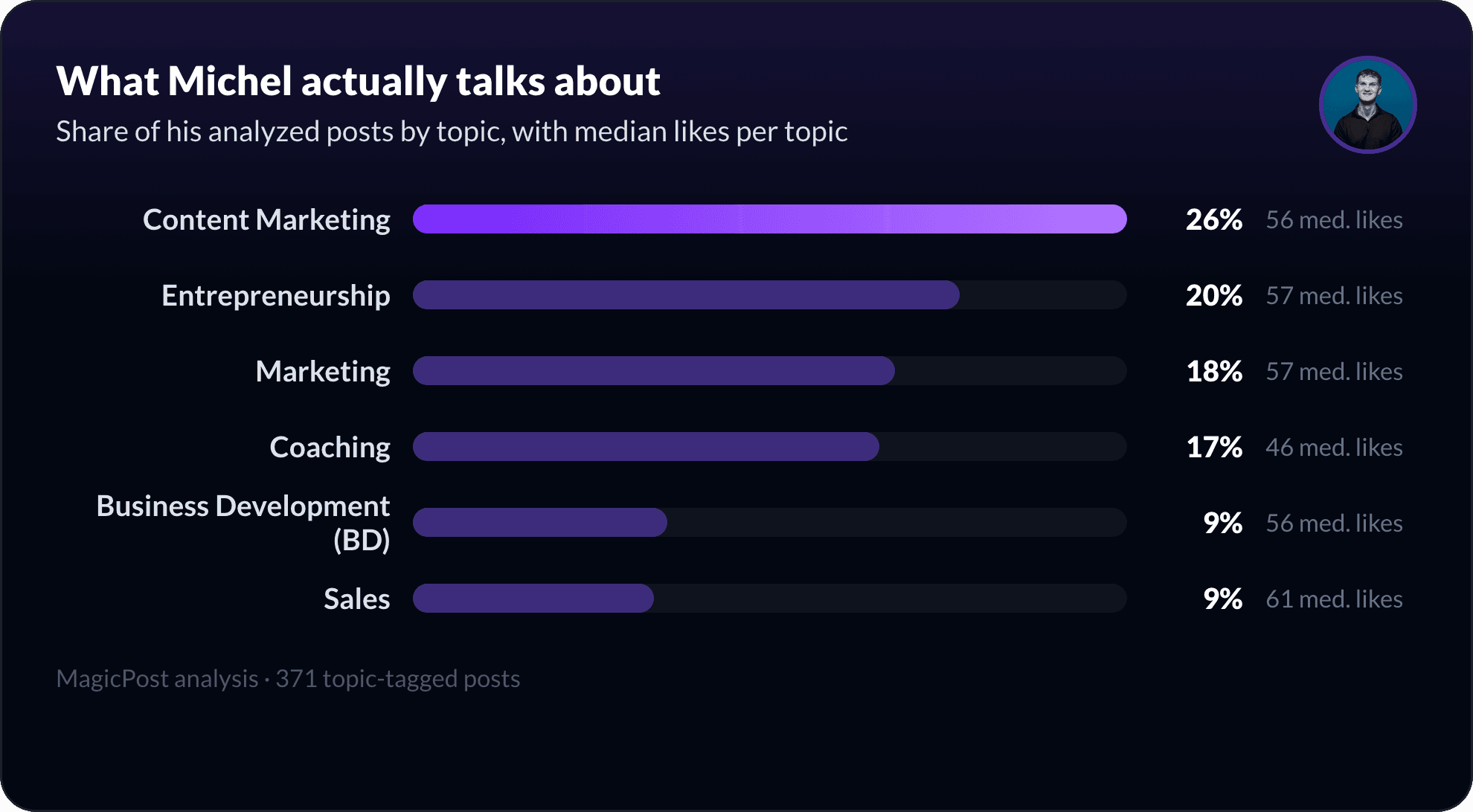
On the surface his feed reads as a marketer's: Content Marketing leads (98 posts), then Entrepreneurship and Marketing, with Coaching, Sales and Business Development close behind. Two details matter more than the ranking:
Psychology is his quietest theme and his strongest. It is his smallest measured topic (22 posts) yet it pulls his highest median (about 69 likes against his roughly 56 overall). When he turns the lens inward, his audience leans in hardest. Sales also over-performs (about 61), while Coaching under-performs (about 46).
Sorted by register rather than topic, the split is striking: his two biggest buckets are lead magnets answered by comment and webinar sign-ups, but right behind them sit personal reflection and lessons learned. Mousa runs a sales machine and a confessional at once, and the confessional earns the deepest engagement.
Who he writes for
His reader is explicit in his own words. He sizes the audience precisely: "ondernemers die tussen de 0 en €2M/y draaien" (entrepreneurs doing between 0 and 2 million a year), stuck on the same problem he says he hears in every session.
And he writes for the founder who feels alone: "Er veel ondernemers zijn die zich eenzaam voelen." (Many entrepreneurs feel lonely, and he hopes his content reminds them they are not the only ones.)
His best posts of 2026
His biggest posts of 2026 so far, reproduced from our data (click through to the originals, or browse 2M+ posts like these in MagicPost):
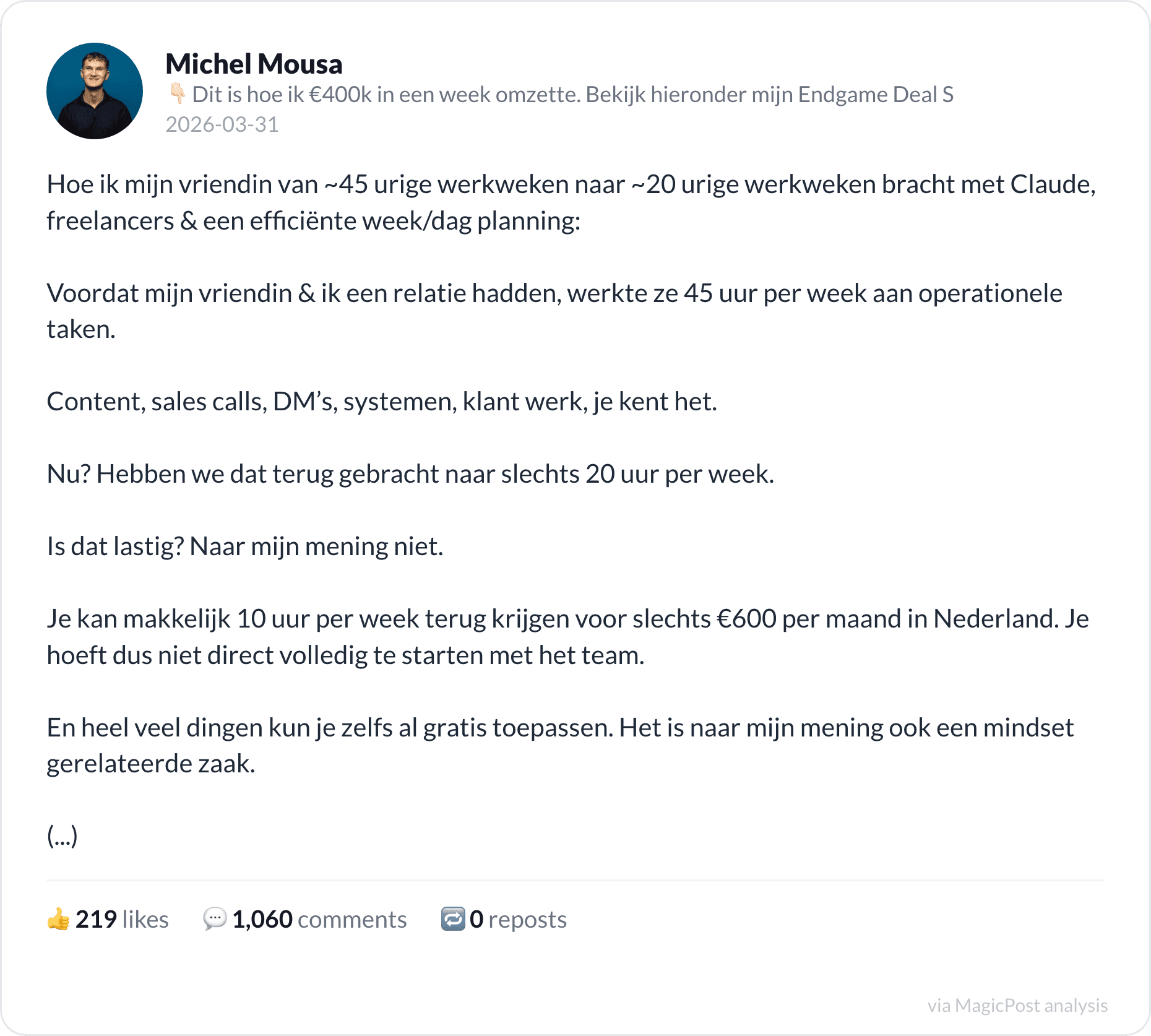
219 likes, and 1,060 comments. A lead magnet built as a story: how he cut his girlfriend's workweek from 45 hours to 20 with AI and freelancers.
The ask is one word, "Laat een comment met 'Claude' achter" (Leave a comment with "Claude" and I'll send it to you). The comment count is five times the like count: a conversation engine, not a like-bait post.
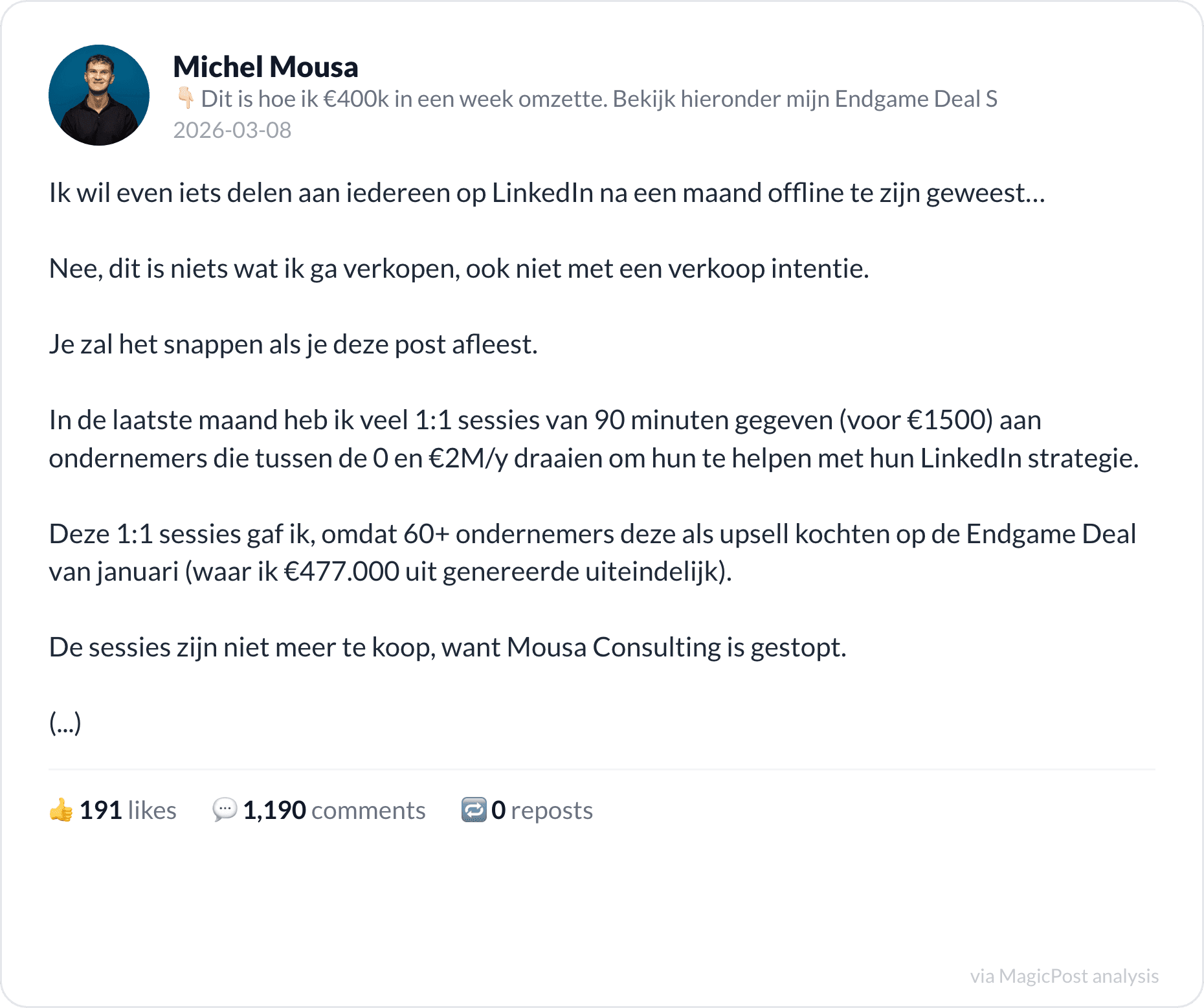
191 likes, and 1,190 comments. A free webinar offer wrapped in a tease: almost every entrepreneur makes "EEN simpele fout" (ONE simple mistake) on LinkedIn, and he will not name it until the session. The withheld answer is what drives the 1,190 comments.
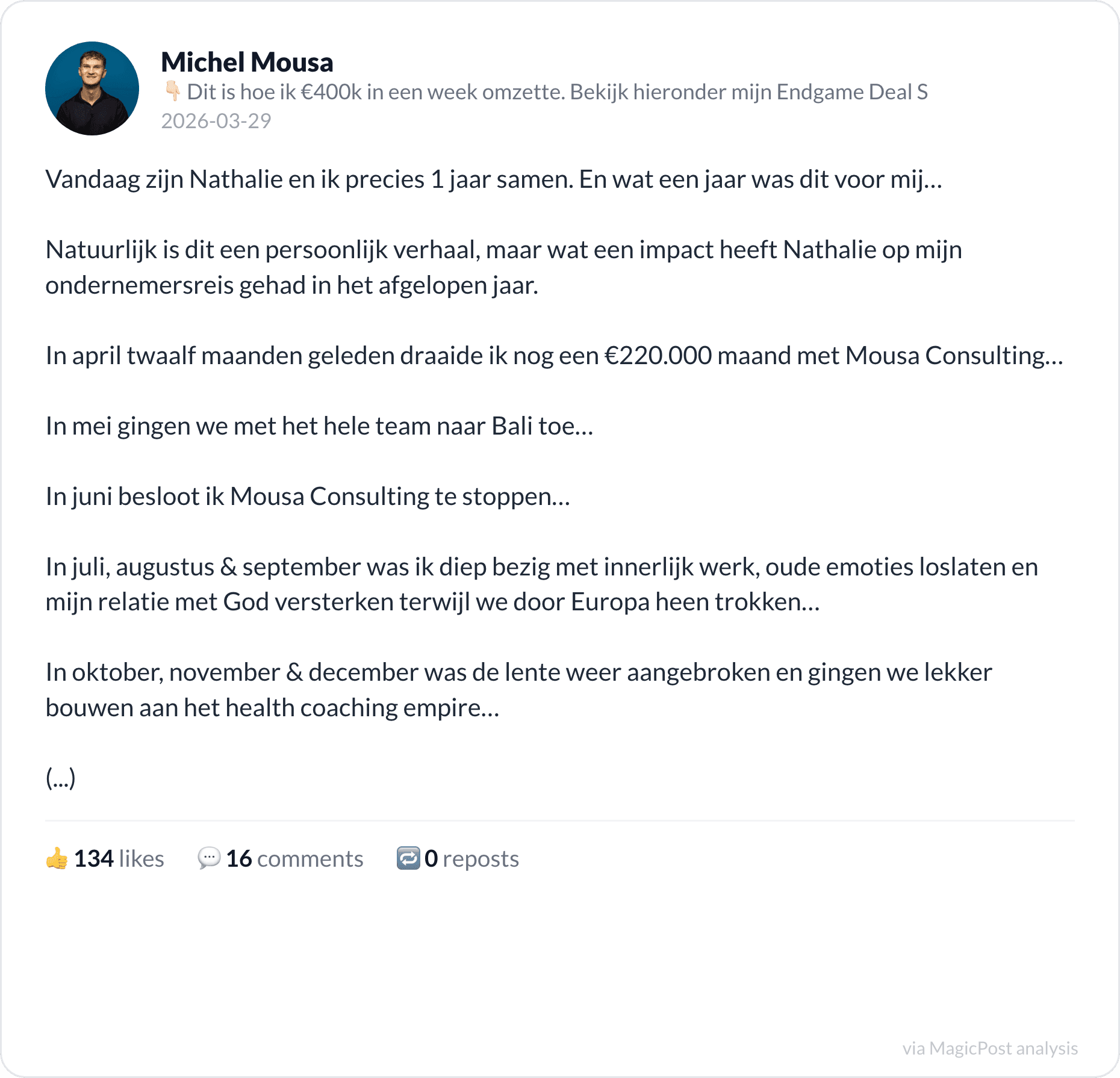
134 likes. A month-by-month account of a year with his partner, threaded through the business timeline (the 220,000-euro month, Bali, stopping Mousa Consulting, the 477,000-euro month). Pure personal narrative, zero ask, and it still lands: the confessional side of the machine.
Is Michel Mousa still growing on LinkedIn?
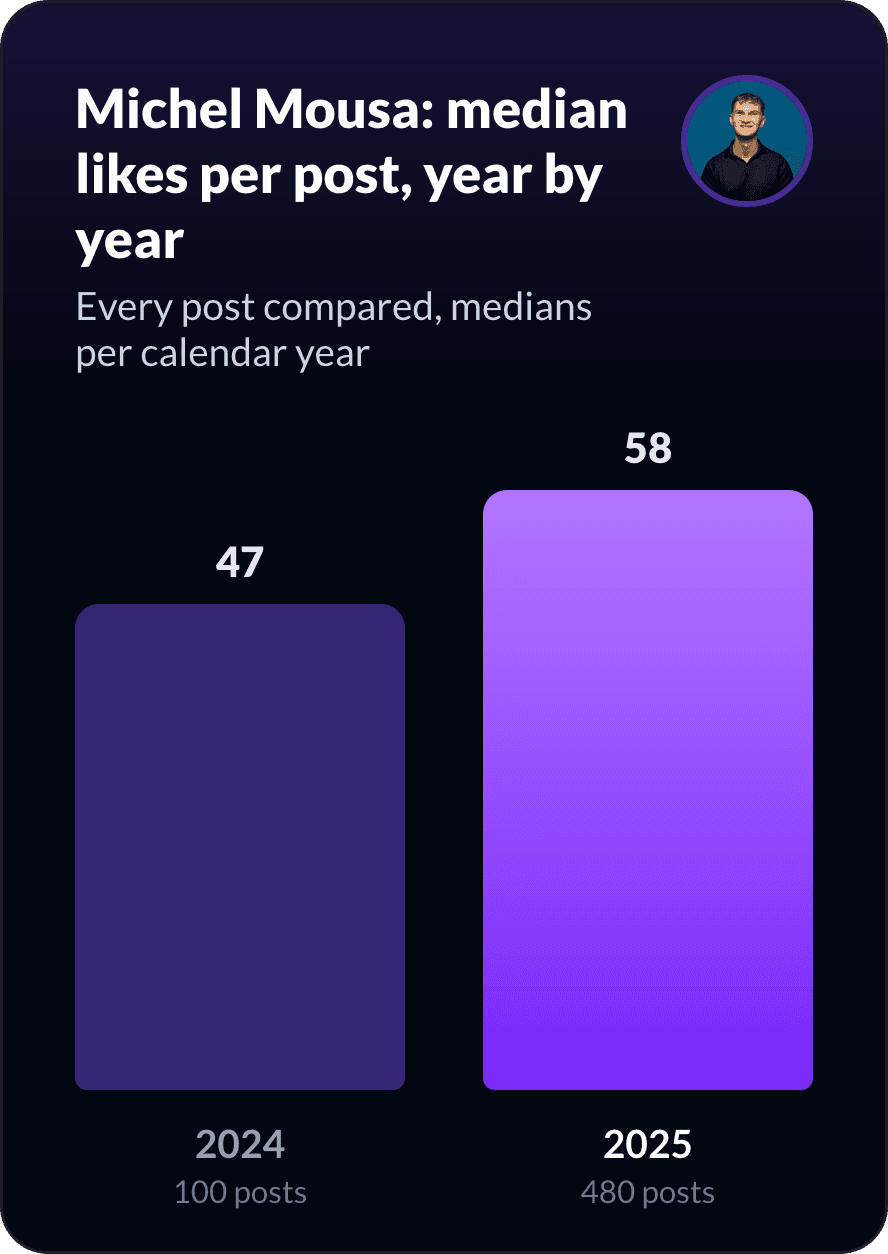
Yes, modestly and steadily. His median post went from about 47 likes in 2024 to about 58 in 2025, a roughly 23% lift, while his posting volume jumped from 100 to 480 measured posts. For a creator scaling output that hard, holding (and slightly raising) the median is quiet proof the machine compounds.
One caveat: we measure engagement, not followers over time, so this is the trajectory of how hard his posts hit, not of his audience size. And with Mousa, likes badly understate the story, because his real currency is comments.
Where do these charts come from? Everything on this page runs on MagicPost's LinkedIn analytics, and it works on your profile too: your best posts, your audience, your benchmark, even a side-by-side with creators like Michel Mousa.
How he writes
Here is Mousa measured against the average creator, and the headline is not "short":
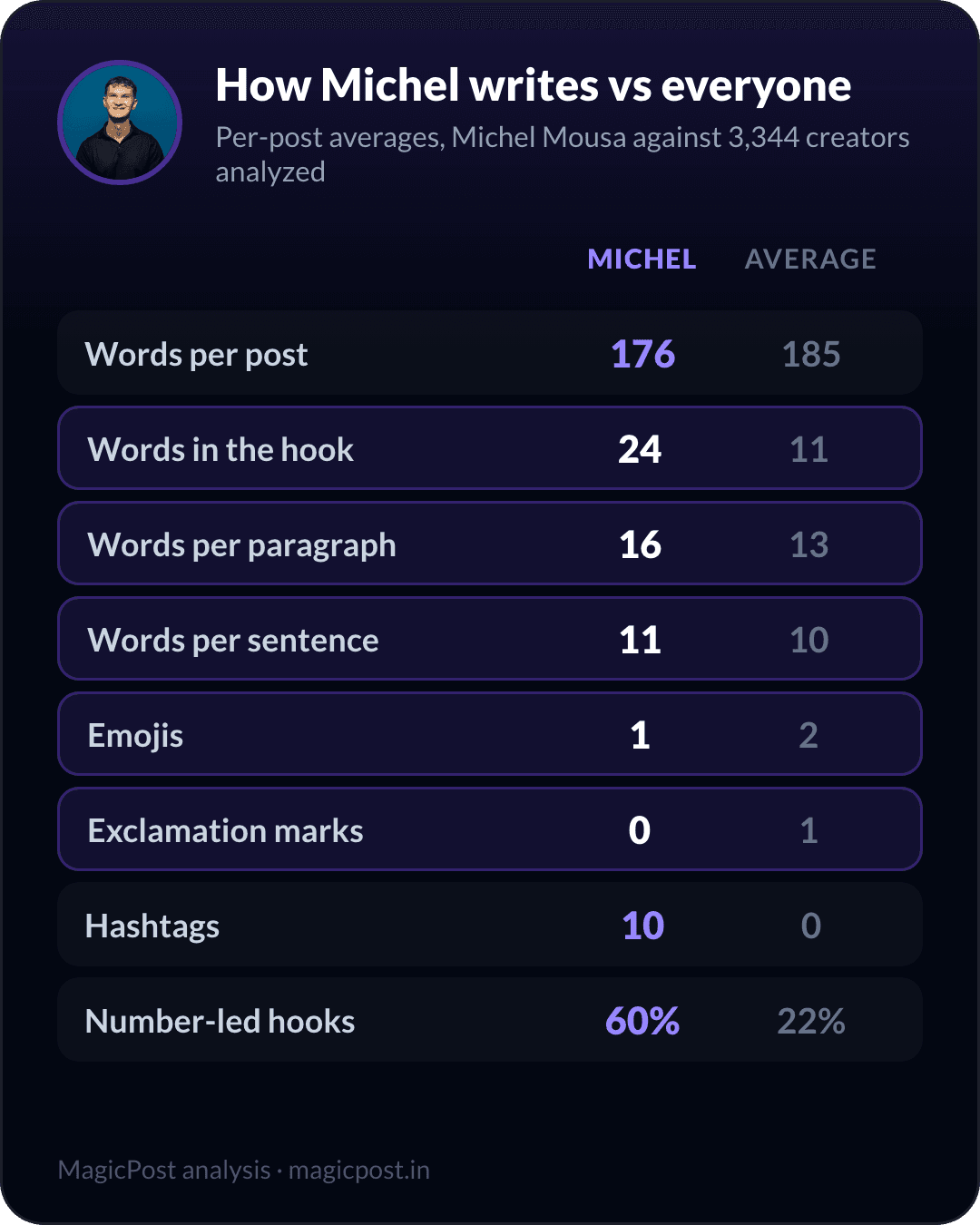
Metric (per post) | Michel Mousa | Average creator* |
Words | ~176 | 185 |
Words in the hook | 24 | 11 |
Words per paragraph | 16 | 13 |
Words per sentence | 11 | 10 |
Emojis | 1 | 2 |
Hashtags | 10 | 0 |
Exclamation marks | 0 | 1 |
Hooks built on numbers | 60% | 22% |
*Median across the 3,344 creators we analyzed with 20+ posts each.
Two numbers jump off this table. His hook runs 24 words, more than double the 11-word average: he opens with a full, loaded scene-setter rather than a punchy fragment. And 60% of his hooks are built on a number, nearly three times the benchmark: a workweek cut from 45 to 20, a 477,000-euro month, a 100,000-euro loss, 1% a day compounding.
The rest is conventional Dutch LinkedIn: paragraph and sentence lengths near the average, a light single emoji, no exclamation marks, and 10 hashtags per post (where the median creator now uses zero). The signature is the long, numbered, confession-style opener.
The "AI tells" in his style (read this the right way)
Run Mousa's writing through the patterns people now call "AI tells," and something useful shows up:
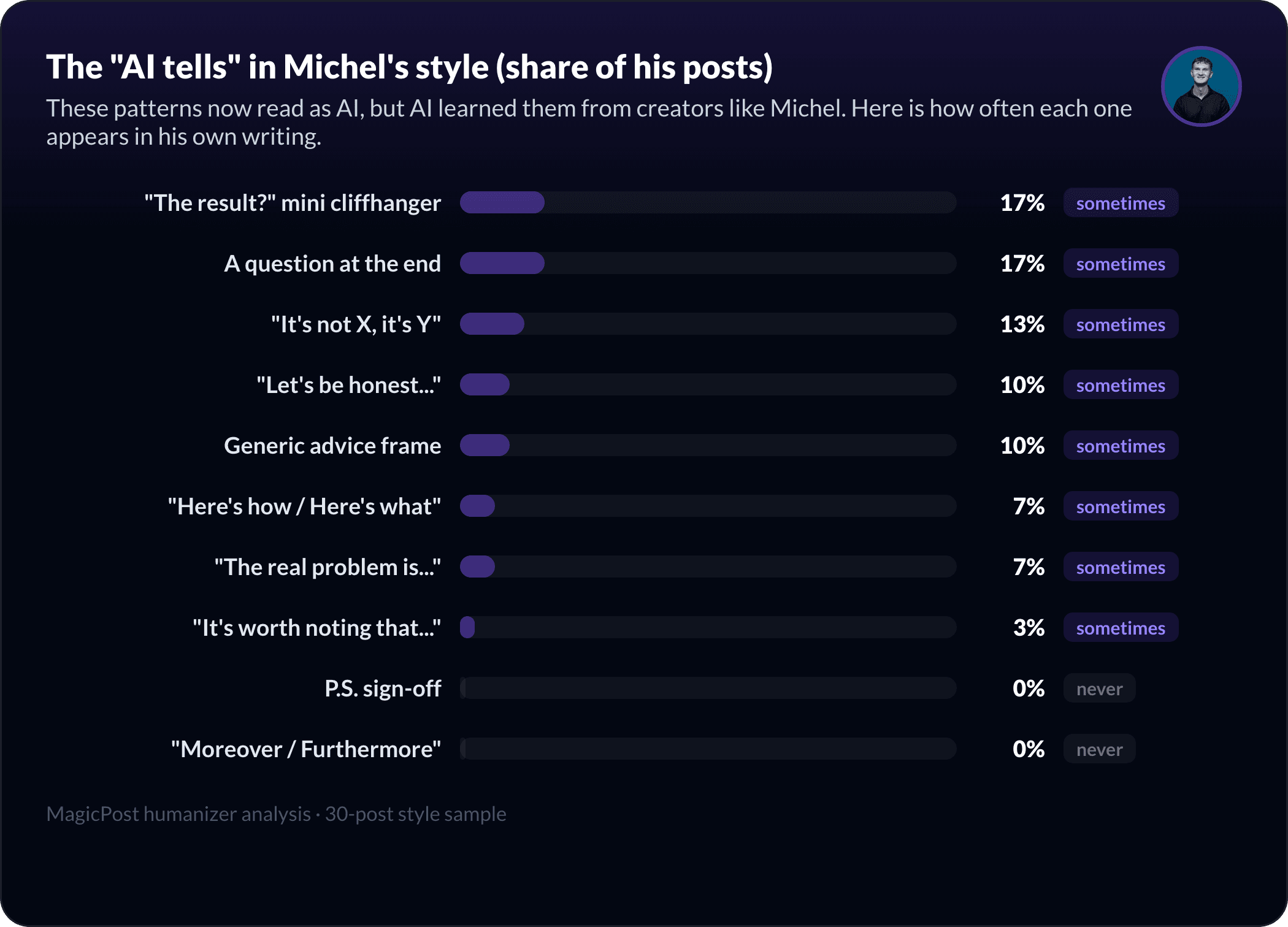
His most frequent devices are mild. About one post in six uses a reveal bridge ("wat bleek?", what turned out?) or closes on a question, and about one in seven leans on the "It's not X, it's Y" contrast formula, the pattern that tops most readers' list of AI tells. None of these is a tic for him; they all sit in the occasional band.
Do not read it backwards. Mousa does not write like an AI; AI writes like Mousa. These patterns read as robotic today because the models trained on creators like him and then stacked every move at once, in every post. He uses one where it lands.
And what really separates him from a model is what he refuses to bolt on: he never opens with a generic transition, and never tacks on an automatic "P.S." as filler. When his "P.S." appears, it carries the proof (the tax statement, the punchline), not a call to action.
When does Michel Mousa post on LinkedIn?
Mousa publishes about 8.6 times a week, favorite slot 9 AM Amsterdam time, with a quarter of his posts on weekends. That 9am habit is exactly what our Netherlands timing data flags him for: in the Dutch market we name him among the 9am posters, a notch earlier than the 10am crowd.
His volume sits high on what our posting-frequency study measured, and the best-day picture fits too, his most frequent day landing midweek.
One more thing the data makes obvious: his bangers tip the like-to-comment ratio completely, with comments outrunning likes five to one. If part of your own playbook is being first in his comments, an engagement feed handles it: his posts, every day, without hunting the timeline.
What to steal from Michel Mousa
Build the comment, not the like. His biggest 2026 posts earn 1,000+ comments on a few hundred likes, because the ask is a single keyword and the payoff is delivered in the replies. Engineer the conversation, not the applause.
Show the receipt. Most founders keep revenue vague. Mousa posts the tax statement and the bank screenshot. Specific proof out-converts a round number.
Open with a loaded scene, not a fragment. His 24-word hooks break the "keep it short" rule on purpose: a full, numbered first line earns the read.
Lead with a number. Six in ten of his hooks carry one, the cheapest way to make a vague reflection feel concrete.
Re-run your signature story. The "I quit the million-euro business" arc earned strong engagement at least six times in a year, each from a fresh angle. Your turning point is an asset, not a one-off.
Study him, then study yourself. With MagicPost you can dig into Michel Mousa's numbers the way we just did, analyze your own LinkedIn analytics with the same depth, and learn to write in the spirit of his style, in your own voice. The data on this page is the product.
The posts behind this profile
Every quote above comes from one of Michel Mousa's own public LinkedIn posts. The ones that carry the story:
Where this data comes from
Everything in this article is MagicPost's own research. MagicPost analyzed 600 Michel Mousa posts, including 53 introspective ones: timing (converted to Amsterdam time), engagement, topics, writing metrics, and the AI-pattern profile from a 30-post style sample.
Every biographical claim is quoted verbatim from one of his own public LinkedIn posts, listed in the sources above. Mousa is not affiliated with MagicPost; his is one of the Dutch styles we track most closely.
FAQ
Who is Michel Mousa?
A Dutch LinkedIn consultant from Eibergen, Gelderland, with about 37,000 followers, founder of Mousa Consulting. In 2025 he publicly announced he was shutting that business down, one he says cleared hundreds of thousands a year in profit, to pivot toward an international coaching project. He documents the whole reinvention on LinkedIn.
How does Michel Mousa make money?
By his own public account: LinkedIn consulting and coaching (1:1 sessions he priced at 1,500 euros) and high-ticket launches. He reports a single launch he calls the "Endgame Deal" generating 477,000 euros, and shares tax documents as proof.
How often does Michel Mousa post on LinkedIn?
About 8.6 posts a week in our data, most often at 9 AM Amsterdam time, with roughly a quarter of his posts on weekends.
Does Michel Mousa write with AI?
No model writes long confessional hooks, posts its own tax screenshots, or files faith-and-fear reflections like his. The catch is that AI tools learned from creators like him, which is why about one post in seven contains the "It's not X, it's Y" pattern people now treat as a tell of automation. He uses it sparingly and skips the filler.
Is Michel Mousa still growing on LinkedIn?
His median engagement rose from about 47 likes per post in 2024 to about 58 in 2025, while his output more than quadrupled, and his real strength is comments: his top posts draw over a thousand each.
Can I write like Michel Mousa?
You can learn the mechanics: MagicPost learns a creator's writing style (hook length, number-led openers, signature stories, the comment-driven ask) and helps you write in that spirit, in your own voice.