" height="26.80529977783203px" id="tymKb8bqC" width="128.00300311279295px"/><path d="M 0 2.417 L 0 0 L 12.909 0 L 12.909 2.417 Z" fill="rgb(126, 78, 253)" height="2.417099999999998px" id="aYr4em6zK" transform="translate(128.341 22.325)" width="12.908999999999992px"/></svg>)

"/><stop offset="1" stop-color="rgb(118, 37, 250)"/></linearGradient></defs><g d="M 19.242 21.22 L 19.362 6.204 L 19.272 6.204 L 13.757 21.22 L 10.161 21.22 L 4.796 6.204 L 4.706 6.204 L 4.825 21.22 L 0 21.22 L 0 0 L 7.283 0 L 12.109 13.607 L 12.229 13.607 L 16.844 0 L 24.247 0 L 24.247 21.22 Z M 26.421 26.113 L 26.421 23.445 L 41.407 23.445 L 41.407 26.113 Z" fill="transparent" height="26.112508199679183px" id="DvfaAIHYn" width="41.40731898311435px"><path d="M 19.242 21.22 L 19.362 6.204 L 19.272 6.204 L 13.757 21.22 L 10.161 21.22 L 4.796 6.204 L 4.706 6.204 L 4.825 21.22 L 0 21.22 L 0 0 L 7.283 0 L 12.109 13.607 L 12.229 13.607 L 16.844 0 L 24.247 0 L 24.247 21.22 Z" fill="rgb(46, 46, 46)" height="21.220180016149442px" id="pLsxRCobd" width="24.247352589074694px"/><path d="M 0 2.668 L 0 0 L 14.986 0 L 14.986 2.668 Z" fill="url(%23yD9d4I5GR-3279285344-linear-gradient)" height="2.6675085048549647px" id="yD9d4I5GR" transform="translate(26.421 23.445)" width="14.986002836263765px"/></g></svg>)

Naïlé Titah
Every list of "top LinkedIn creators" tells you who to follow. Almost none can tell you what, precisely, each one does that works, because almost nobody has the data.
At MagicPost, we do. We analyzed the full posting history of 62 of the platform's most studied creators, across six languages and 27 countries (about 32,000 posts: their timing, engagement, topics, writing fingerprints and signature moves), and wrote a data biography of each. This page is the map: twenty in depth, grouped by the lesson their numbers actually teach, then the wider league, every one linked to their full profile.
One honest note before the list: these are creators we track closely because their styles repay study. There is no paid placement here, and no ranking, because "best" depends on what you need to learn.
The story engineers
The single most consistent finding across all sixty-two: the best creators never retire a story that works, they re-run it. These five built franchises out of their own lives.
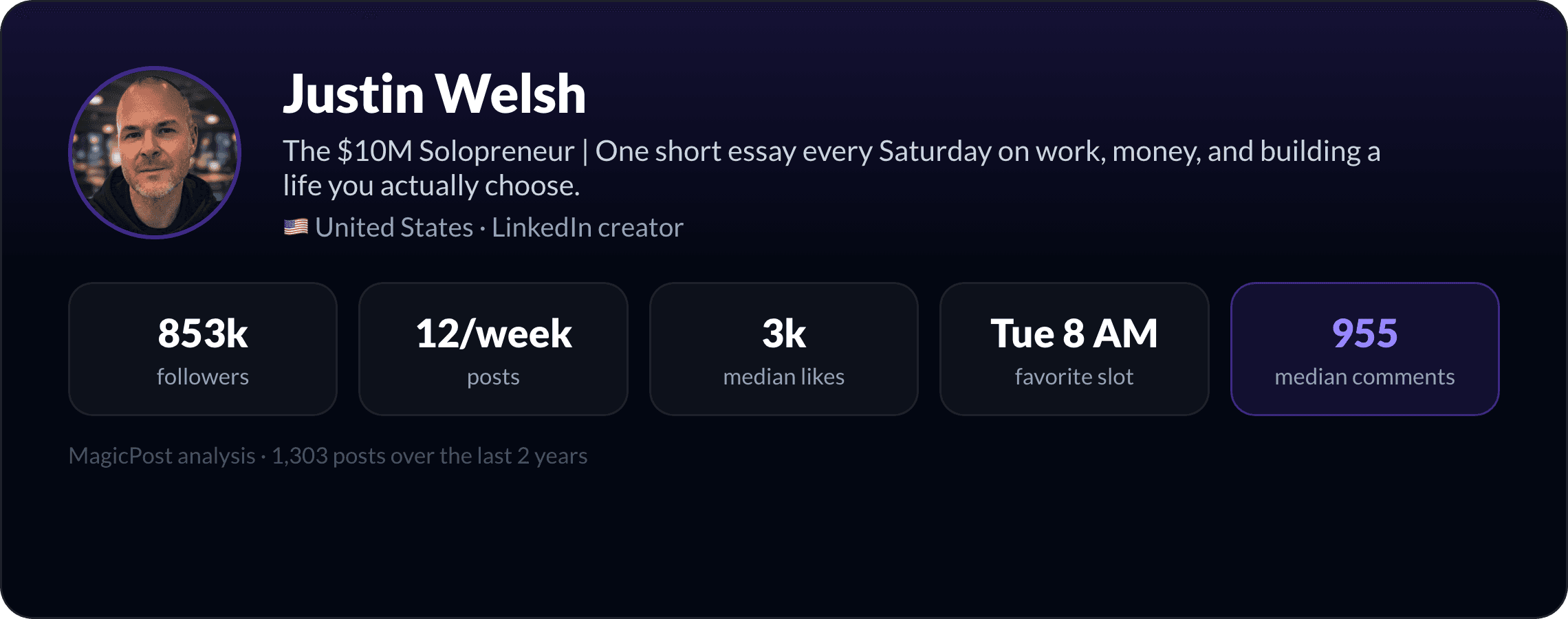
Justin Welsh (853k followers, US): republished his career-timeline post at least six times in two years; it pulls 2,000 to 3,400 likes every single time. Median post: ~2,800 likes on a style with zero emojis, zero hashtags, zero exclamation marks.
Alex Hormozi (949k, US): his "lost everything twice" arc is a six-version franchise, and two of his four biggest 2026 posts are one-word captions.
Sirine Bozetine (82k, France): recycled her "I lost my school after failing to find a work-study contract" origin at least six times; rejection is her most reliable engine.
Amandine Bart (121k, France): the SEO expert whose best-performing theme is not SEO; her "hypersensibilité" essay re-runs reliably at 900 to 3,400 likes.
Maud Alavès (106k, France): turned the introvert's manifesto ("personne n'aurait parié sur moi", nobody would have bet on me) into a 19,317-like signature she keeps re-running.
The lesson: your origin story is an asset, not a one-off. Schedule its reruns.



The conversation engines
A normal LinkedIn post gets one comment for every ten likes. These five rebuilt their content so the audience talks back, and their ratios are unlike anything else we measured.
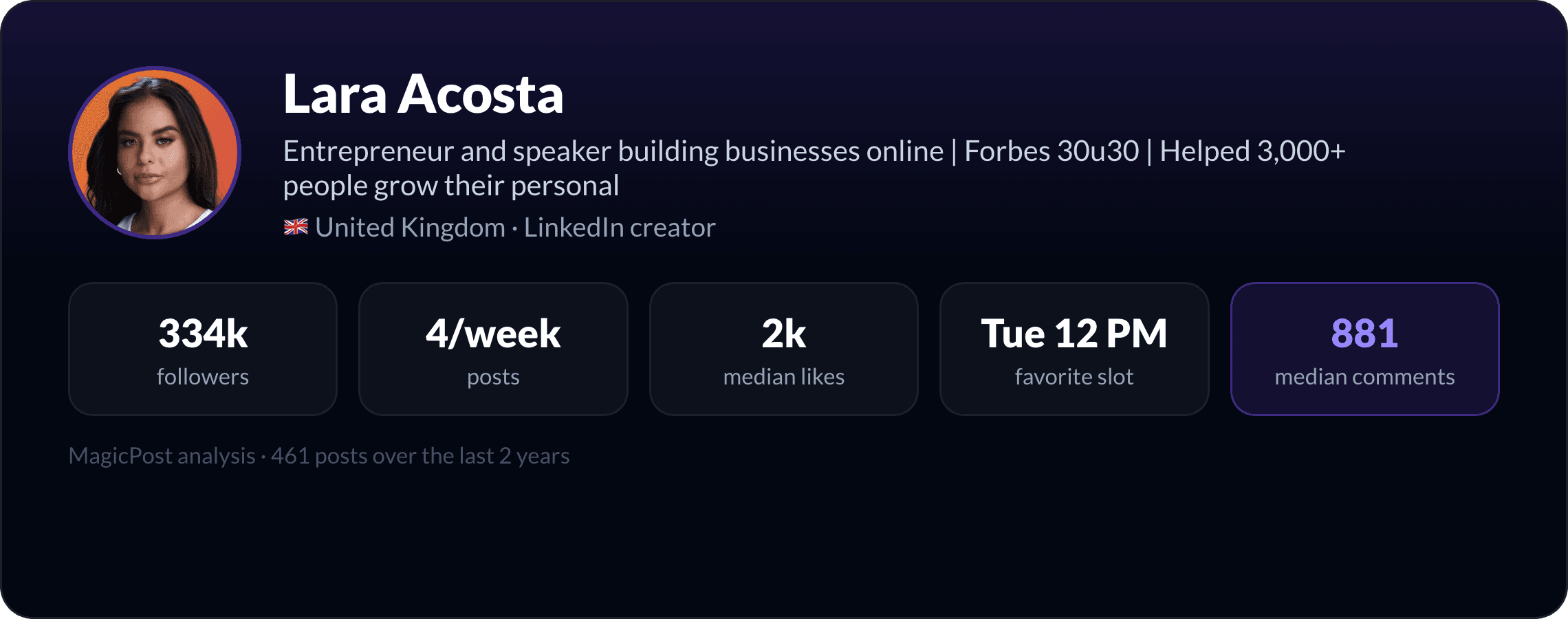
Lara Acosta (334k, UK): ~881 median comments against ~1,531 median likes, driven by the "PS" question that closes 73% of her posts.
Jasmin Alić (365k, Bosnia): a near one-to-one comment-to-like ratio, and LinkedIn restricted him five times for "suspicion of automated activity"; the algorithm flagged a human for replying too much.
Juliette Cadot (49k, France): almost four comments for every five likes at a scale where that is unheard of.
Nick Broekema (89k, Spain): one comment for every two likes, on visual-first content.
Nicolas Cole (125k, US): his biggest 2026 posts pull a few hundred likes and ~2,000 comments each, an audience typing keywords for DMs rather than reacting.
The lesson: comments compound harder than likes, and they are engineered, not wished for.
The sellers who give first
Half of what some of these creators publish is selling something, and their audiences stay, because the sale is wrapped in something usable.
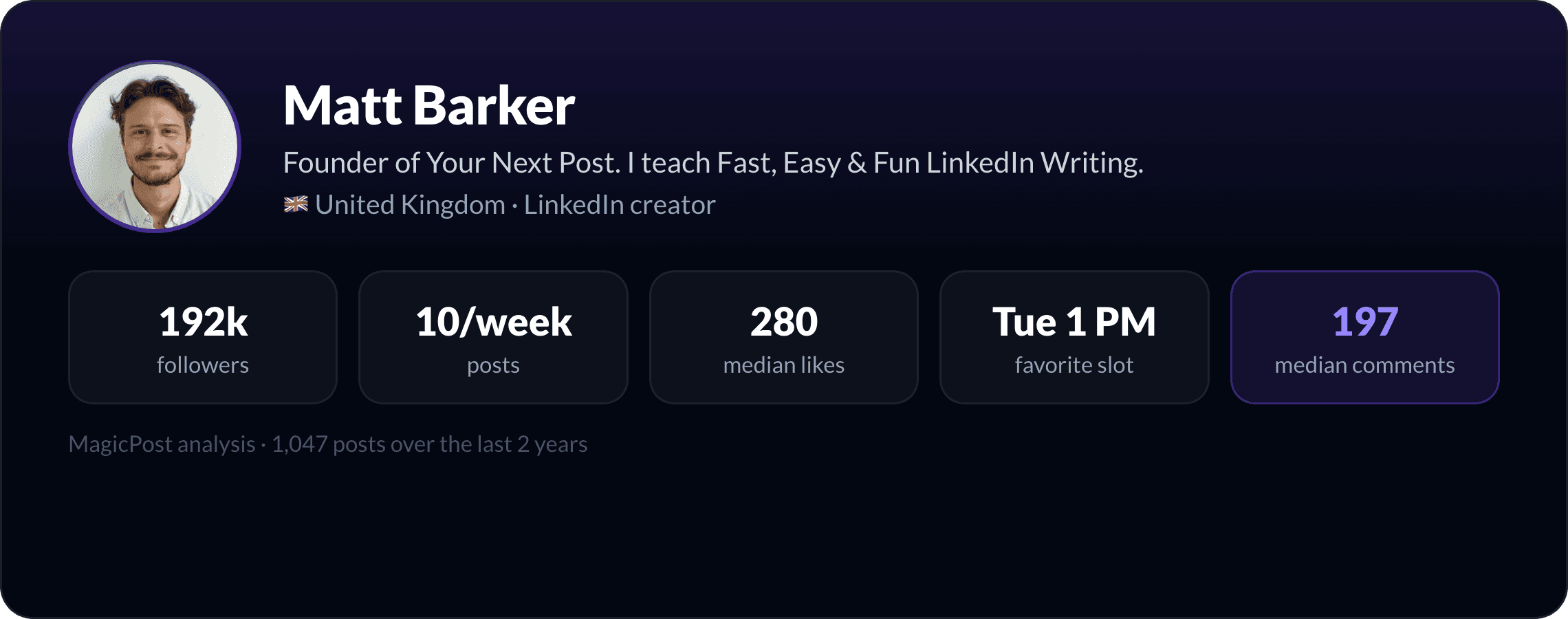
Matt Barker (192k, UK): from "$70 in my bank account" to a reported $1M teaching LinkedIn writing, with a hook so effective he says the whole platform copied it. (Disclosure: Barker is publicly an advisor to MagicPost.)
Benoît Dubos (134k, France): headlined his own "÷4 vs 2023" engagement drop in the same post as his best-ever lead month. Likes down, business up, and he shows you both.
Matt Lakajev (112k, Australia): about 145 of his 951 analyzed posts are "comment a keyword" lead magnets; the funnel is the format.
Ruben Taieb (111k, France): the LinkedIn teacher whose most-repeated teaching, in roughly a third of his posts, is "il n'y a aucune règle sur LinkedIn" (there is no rule on LinkedIn).
Pierre Herubel (171k, Thailand): 56% of his hooks open on a number, two and a half times the average; B2B marketing taught by frameworks.
The lesson: an audience does not punish selling. It punishes selling that teaches nothing.
The contrarians
Proof that the "rules" are defaults, not laws. Each of these five wins by breaking one deliberately.
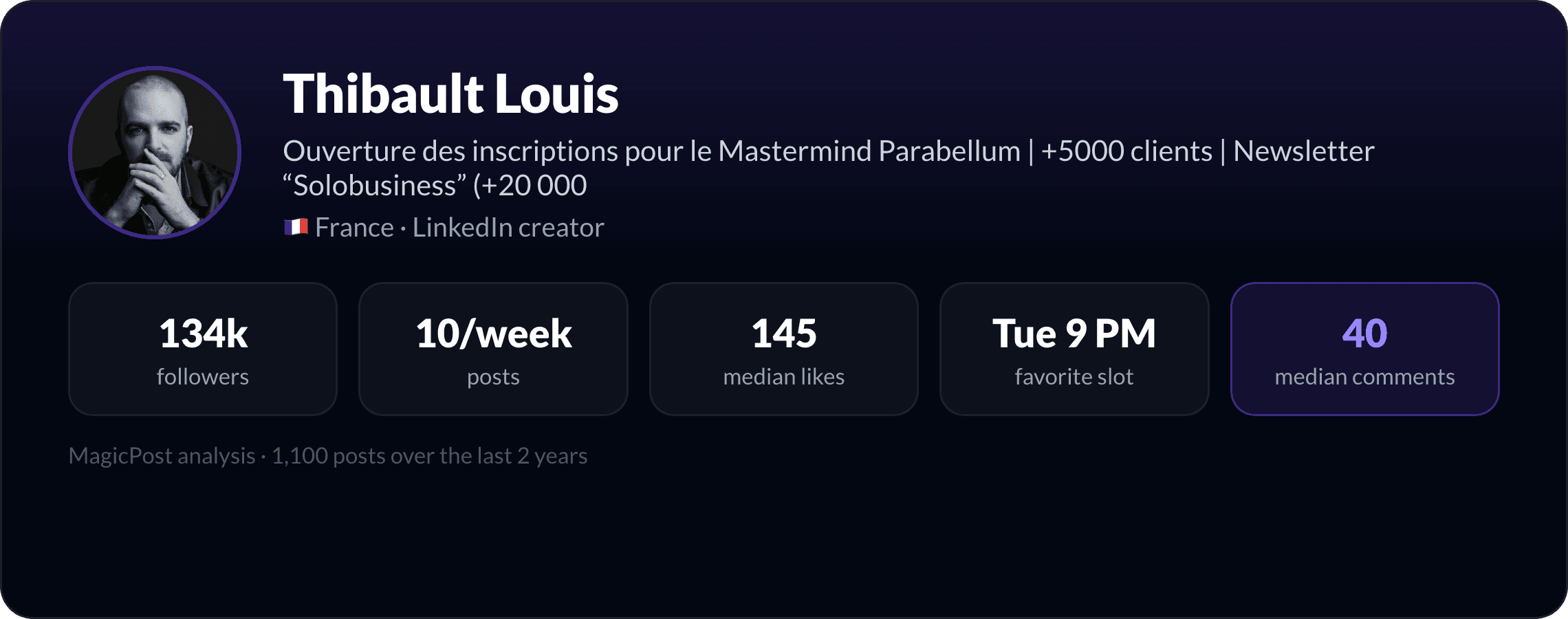
Thibault Louis (134k, France): posts at 9pm in the country of the 7am rule, with only 4% of his posts in the morning. His biggest post ever is a "Bravo pour avoir essayé" (well done for trying) template he re-runs for every French startup that dies.
Luke Matthews (190k): narrates his own retreat, "quit the hyper-growth game," posting less on purpose, and his "days sober" series (108, 276, 394, 577 days) is the franchise.
Ruben Hassid (832k, Israel): LinkedIn's loudest AI-writing advocate, whose own fingerprint is more disciplined than the average human's. He once posted "This post was entirely written by ChatGPT" with the proof attached.
Orane Janvier (38k, France): the smallest account on this page and one of the most studied styles we track: copied for the craft, not the fame. 52% of her hooks open on a number.
Caroline Mignaux (174k, France): her top posts are confessions (half-deaf, fired at 23, dismissed while fundraising), not victory laps. One comment for every two likes says it works.
The lesson: pick which rule you break, and break it every time. That is a brand.
The wider league, language by language
The patterns above are not an anglophone quirk. We ran the same analysis on forty-two more creators across six languages and twenty more countries, and the same mechanics show up everywhere, each with its own data biography:
More English-speaking creators: Gary Vaynerchuk (5.9M, his most recycled idea is kindness), Chris Donnelly (1.2M, the rigid 1pm clock), Matt Gray (912k, yearly "lessons for younger Matt" re-runs), Tobi Oluwole (386k, his old world out-engages his new one 4x), Charlie Hills (233k, the serialized follower-count story), Ayesha Ameer (78k, eight versions of one origin post), Jacob Pegs (53k, narrates his own reach decline as content).
France: Nina Ramen (133k, politics before product), Anthony Bourbon (581k, the 27x viral swing), Kevin Dufraisse (more comments than likes on his best post ever), Laurine Bemer (wounds outperform wins), Hugo Gedio (one Mario Bros CV, six re-runs), Iryna Desmarchelier (her best posts dissect other brands), Ulysse Lubin (publicly retired his own franchise).
Germany: Johannes Kliesch (126k, SNOCKS), Nils Grammerstorf (60% of posts end on a question), Tim Jaschke (the anti-flex, 58-word posts), Nadine Rippler (her follower count lives inside her own recycled posts).
Brazil: Junior Borneli (263k, a one-man business news desk), Léo Kaufmann (a 70:1 gap between his median and his best one-liner), Ivan Cordeiro Junior ("a barata virou Fênix"), Andre Oliveira (his shortest posts travel furthest).
Italy: Francesco Agostinis (long essays, 30 hashtags, 1:5 comments), Luca Altimani (parodies the success-post genre itself), Fabio Banzato (the smallest account here, winning on craft).
Spanish-speaking creators: Daniel Bilbao (Rappi co-founder's identical twin, 68-word posts), Maria Begue (lead magnets "in the comments"), Ismael Briasco (the heaviest "It's not X, it's Y" user we track: 60% of his posts).
Netherlands & Belgium: Lotte de Man (publishes strangers' uncomfortable truths about her), Michel Mousa (shut down a million-euro firm in public, tax statements attached), Magali De Reu (Belgium, "weaponize your weird": her median tripled in a year).
Singapore, Switzerland & Austria: Shulin Lee (268k, bigger and quieter at once), Alec Henry (the security-guard-uniform origin franchise), Stephan Park (gratitude over pitching, hashtags as punchlines), Marina Panova (North Macedonia, the Paris-nanny origin re-shipped 6+ times).
More of Latin America, plus Portugal: Christian Patiño (Argentina, his origin story is his format), Constanza Ibieta (Chile, a 40% comment-to-like ratio), Fernando Cortés (Mexico, the cautionary 30-hashtag arc), Pepe Villatoro (Mexico, the failure-brand CEO who posts wins), Diana Orozco Gollaz (Mexico, "Cuéntame..." as a signature), Pedro Pinto de Almeida (Portugal, self-implication as the engine), Tocha (Portugal, off-topic reflections at 57x his median).
Where do these numbers come from? Every stat on this page runs on MagicPost's LinkedIn analytics, the same engine that can analyze your own profile: your best posts, your audience, your benchmark, even a side-by-side with any of these creators.
The country rankings (by real impact, not followers)
We also rank entire countries: the top 20 creators by median likes per post over the last 12 months, not by followers, with a data card, an engagement rate and their best post for each. Fifteen countries, refreshed quarterly:
France: Hugo Clément at 73 times the national median; the 1.3M-follower giant ranks ninth.
United States: Sundar Pichai on top; Bill Gates and his 40M followers rank #13.
United Kingdom: Rob Dance leads a top 20 half-full of the creators profiled above.
India: Anupam Mittal heads a list of founders and investors.
Germany: Carsten Maschmeyer tops the highest national median of the fifteen.
Netherlands: a top 20 where nobody posts evenings or Sundays.
Brazil: Victor Wendt, 135k followers, out-ranks two 3M-follower accounts.
Spain: Rafael Juan, nearly four times the median likes of the runner-up.
Canada: Colby Kultgen leads an all-weekday top 20.
Australia: Liz Nova on top; the 1.1M-follower account lands sixth.
Pakistan: the rare country where the biggest account is also #1.
UAE: Juhi Bhatia leads the most creator-heavy top 20 of the series.
Denmark: a philosophy professor at triple the runner-up's median.
Switzerland: the CEO of Novartis on top.
Singapore: a former Prime Minister tops the list.
How to actually study a creator
Following is not studying. The pattern that works, visible across all sixty-two profiles:
Read their data biography first (each link above): what they talk about, what over-performs for them, their writing fingerprint, when they post.
Find their one repeatable move (the PS question, the number hook, the recycled origin story) rather than copying their surface style.
Show up in their comments daily: half these creators built their early audience in other people's comment sections, and an engagement feed makes that a five-minute habit.
Steal the mechanic, keep your voice. The fastest way to read as a copy is to borrow someone's words instead of their structure. (This is exactly the trap with "It's not X, it's Y": AI borrowed everyone's words at once.)
A reminder from our timing data and our frequency study: these creators post a lot (often daily, sometimes more), but every one of them built the rhythm gradually. Start with the move, not the volume.
Study them, then study yourself. With MagicPost you can dig into any of these creators' numbers the way we did, analyze your own LinkedIn with the same depth, and write in the spirit of the styles you admire, in your own voice. The data on this page is the product.
Where this data comes from
Everything in this article is MagicPost's own research, not a roundup of other people's lists. MagicPost analyzed the full available posting history of the 62 creators above (about 32,000 posts: timing in local time, engagement against each creator's own baseline, topics, writing metrics, and AI-pattern profiles), and published a sourced data biography of each. No creator paid to be here; one (Matt Barker) is publicly an advisor to MagicPost, disclosed on his page and here.
SSS
Who are the top LinkedIn creators in 2026?
It depends on what you want to learn. For solopreneur content, Justin Welsh and Alex Hormozi; for comment-driven growth, Lara Acosta and Jasmin Alić; for selling through value, Matt Barker and Benoît Dubos; for breaking the rules profitably, Thibault Louis and Ruben Hassid. The sixty-two profiles above cover the spectrum, each with its data.
How were these creators selected?
They are the creators MagicPost tracks most closely, across 27 countries and six languages, with enough posting history for the numbers to mean something (hundreds to thousands of analyzed posts each). No paid placements.
Who is the best LinkedIn creator to learn writing from?
For pure mechanics, Justin Welsh (five-word sentences, one idea per post) and Nicolas Cole (a professional writing teacher) are the most studied. The honest answer is to pick someone whose audience looks like yours and steal their structure, not their words.
Do these creators use AI to write?
Their styles mostly predate AI, and that is the twist: AI learned from them. The patterns people now call "AI tells" (like "It's not X, it's Y") appear in a quarter to half of top creators' own posts. See how to spot actual AI writing.
How can I analyze a creator like this myself?
The charts on these pages come from MagicPost's LinkedIn analytics, which can run the same analysis on any profile, including yours.
Who Is Justin Welsh? The $10M Solopreneur, Explained by Data (2026)
Who is Justin Welsh? MagicPost analyzed 1,303 of their LinkedIn posts: topics, timing, signature moves and the writing fingerprint behind their growth, with rea
Who Is Matt Barker? The Hook Writer on LinkedIn, by Data (2026)
Who is Matt Barker? MagicPost analyzed 1,047 of their LinkedIn posts: topics, timing, signature moves and the writing fingerprint behind their growth, with real
Who Is Lara Acosta? The Forbes 30 Under 30 Comment Machine, Explained by Data (2026)
Who is Lara Acosta? MagicPost analyzed 461 of their LinkedIn posts: topics, timing, signature moves and the writing fingerprint behind their growth, with real n
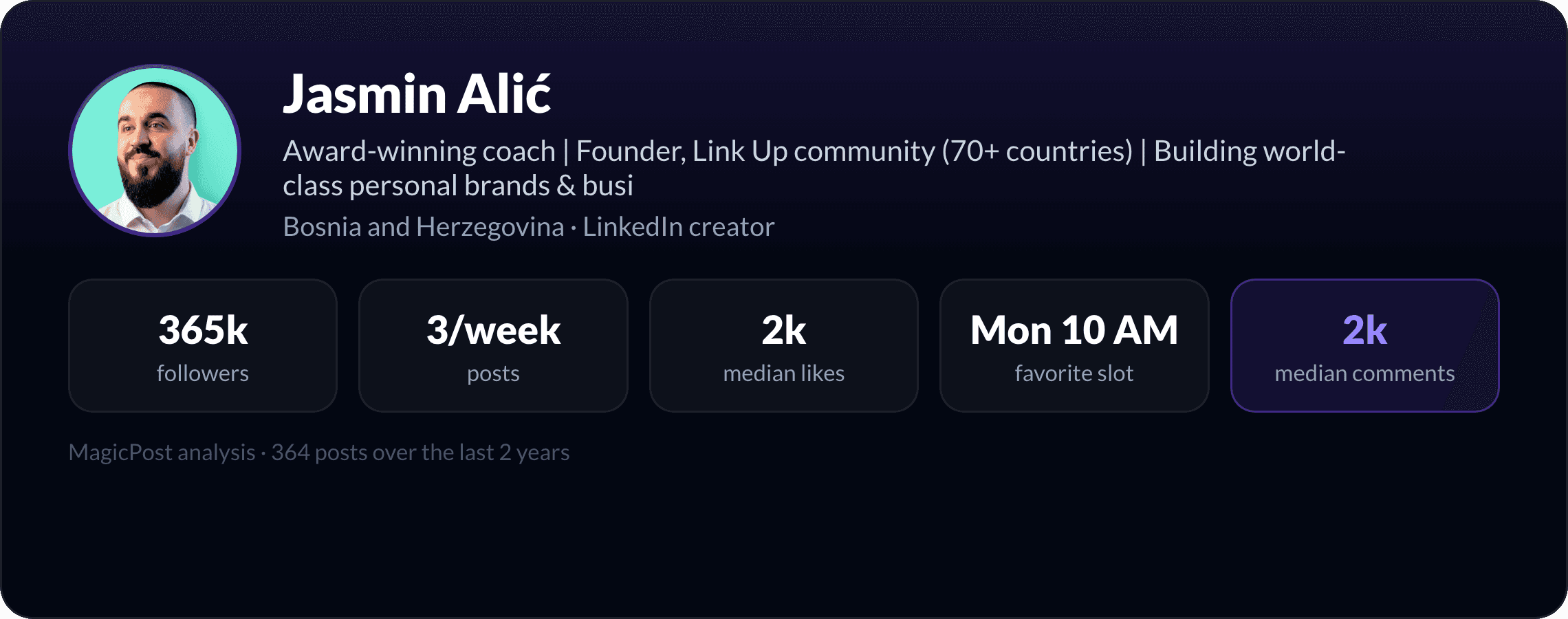
Who Is Jasmin Alić? The Bosnian Coach LinkedIn Mistook for a Bot (2026)
Who is Jasmin Alić? MagicPost analyzed 364 of their LinkedIn posts: topics, timing, signature moves and the writing fingerprint behind their growth, with real n
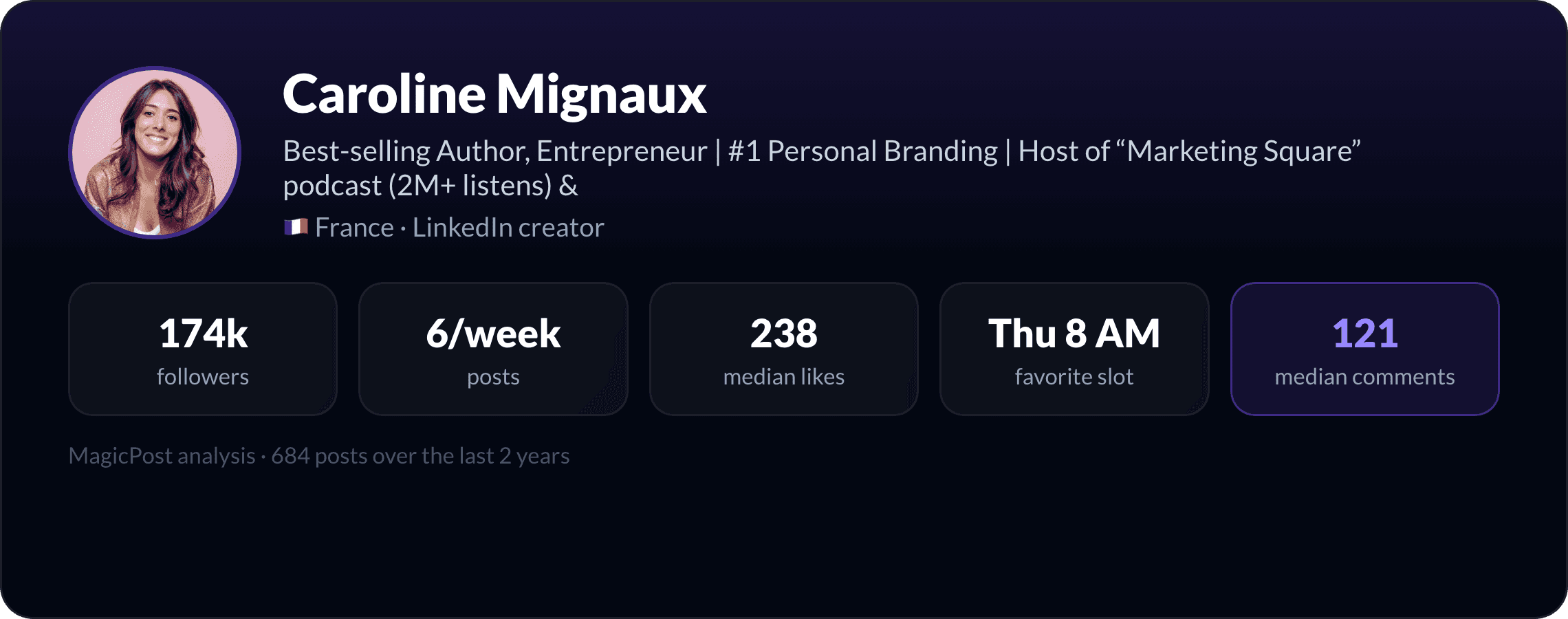
Who Is Caroline Mignaux? France's LinkedIn Top Voice Who Turned Shame Into a Following (2026)
Who is Caroline Mignaux? MagicPost analyzed 684 of their LinkedIn posts: topics, timing, signature moves and the writing fingerprint behind their growth, with r
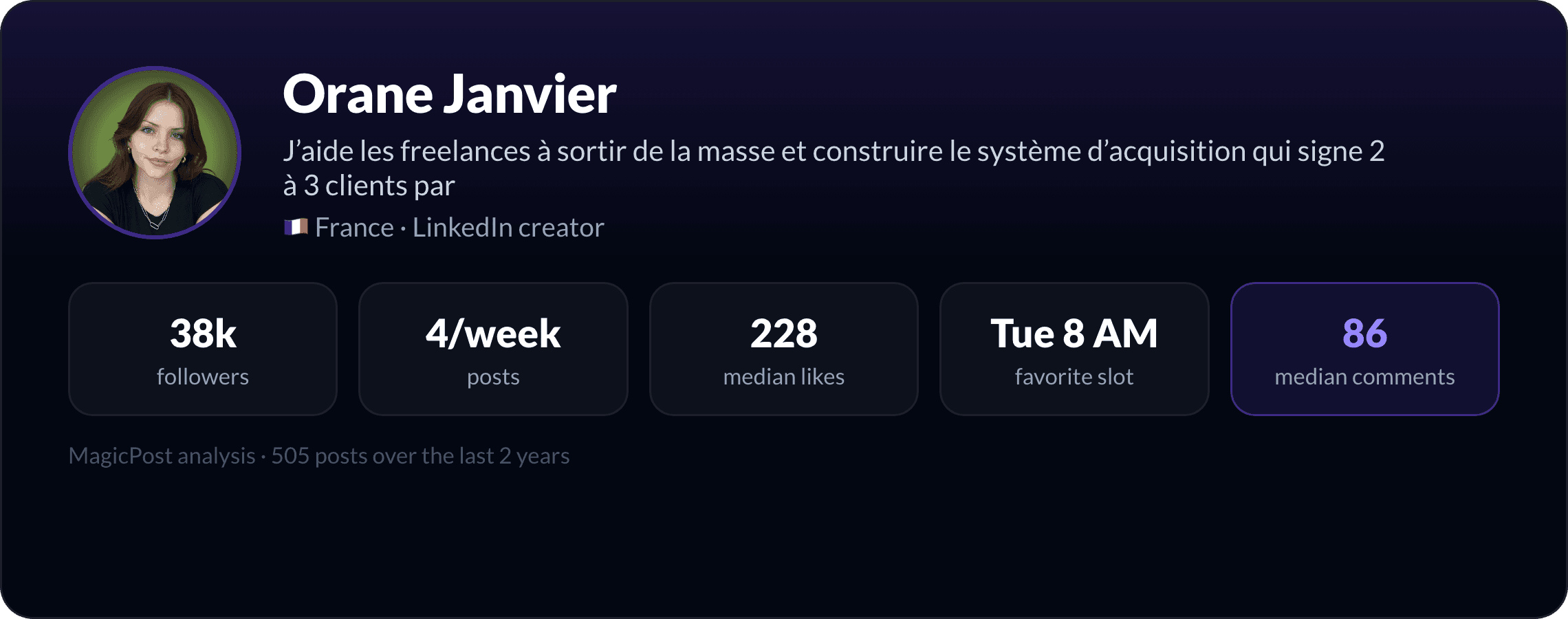
Who Is Orane Janvier? The Freelance Coach LinkedIn Quietly Copies (2026)
Who is Orane Janvier? MagicPost analyzed 505 of their LinkedIn posts: topics, timing, signature moves and the writing fingerprint behind their growth, with real
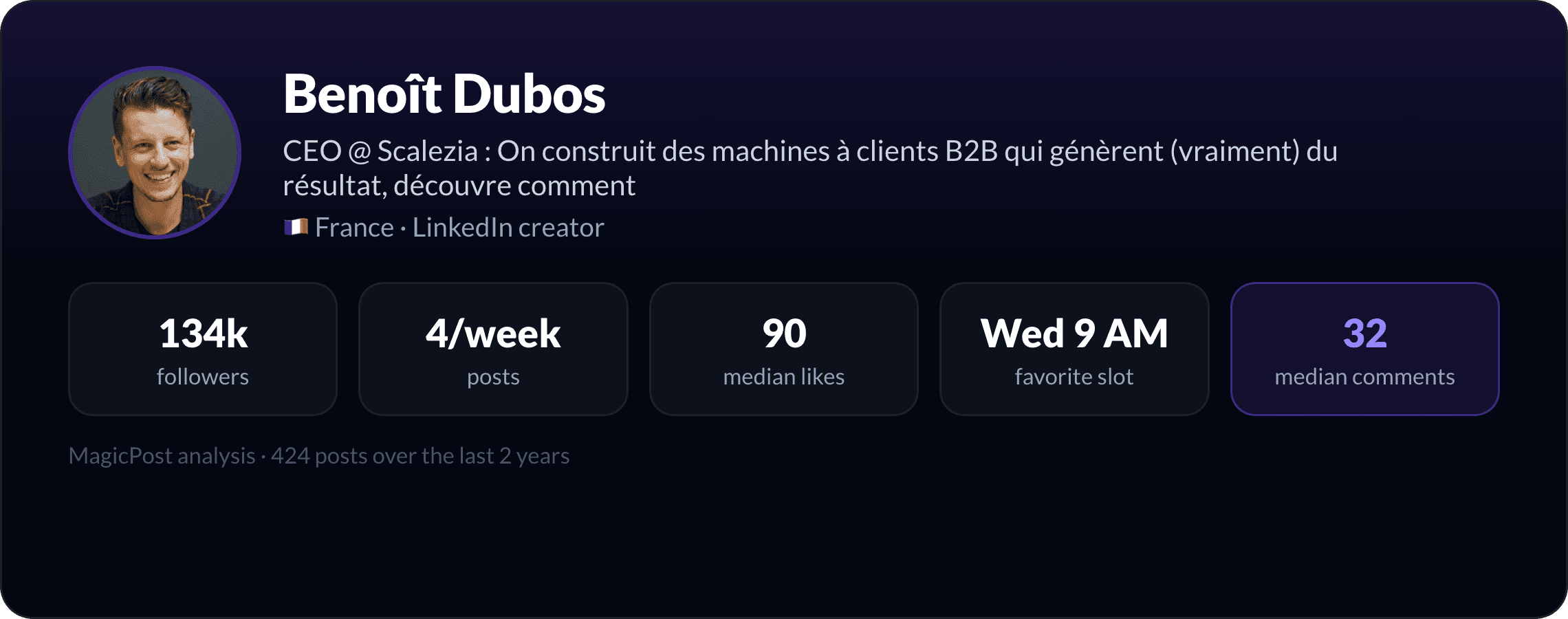
Who Is Benoît Dubos? The Growth Operator Who Turned a Falling Reach Into a Lead Machine (2026)
Who is Benoît Dubos? MagicPost analyzed 424 of their LinkedIn posts: topics, timing, signature moves and the writing fingerprint behind their growth, with real
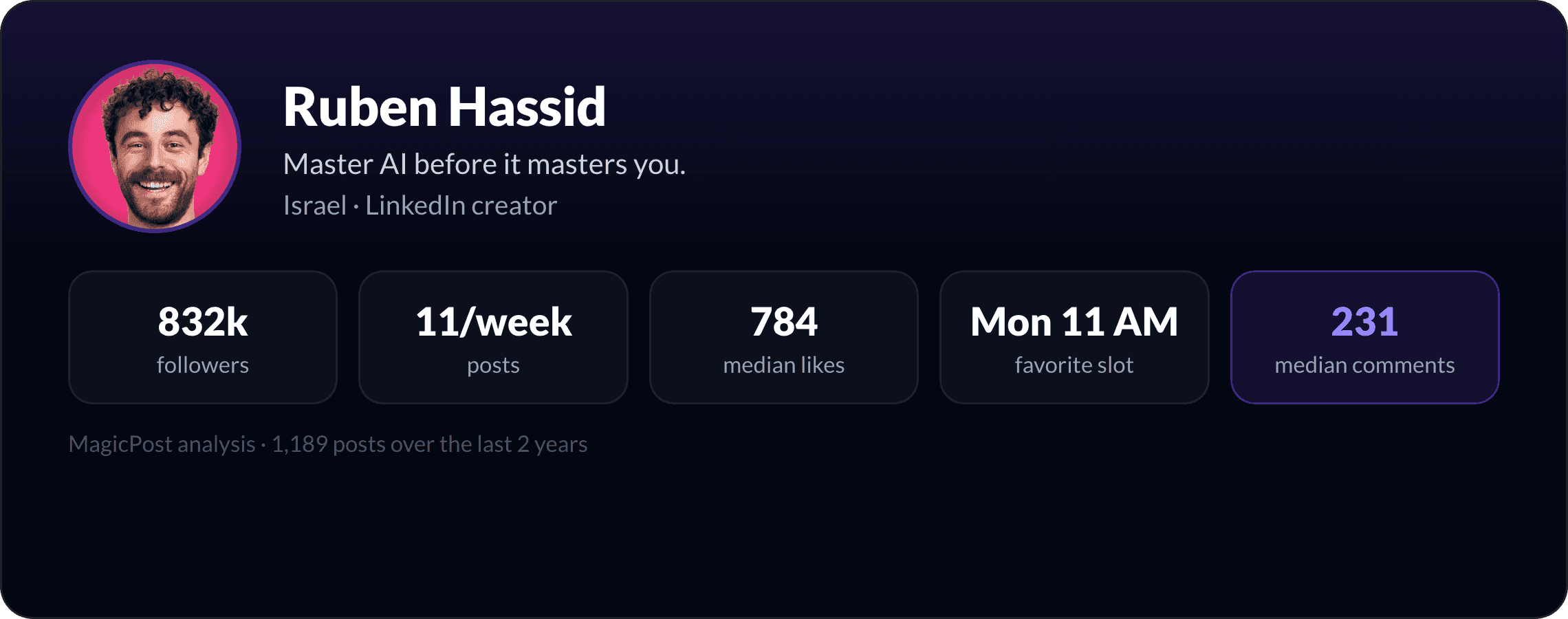
Who Is Ruben Hassid? The "Master AI Before It Masters You" Creator, Explained by Data (2026)
Who is Ruben Hassid? MagicPost analyzed 1,189 of their LinkedIn posts: topics, timing, signature moves and the writing fingerprint behind their growth, with rea
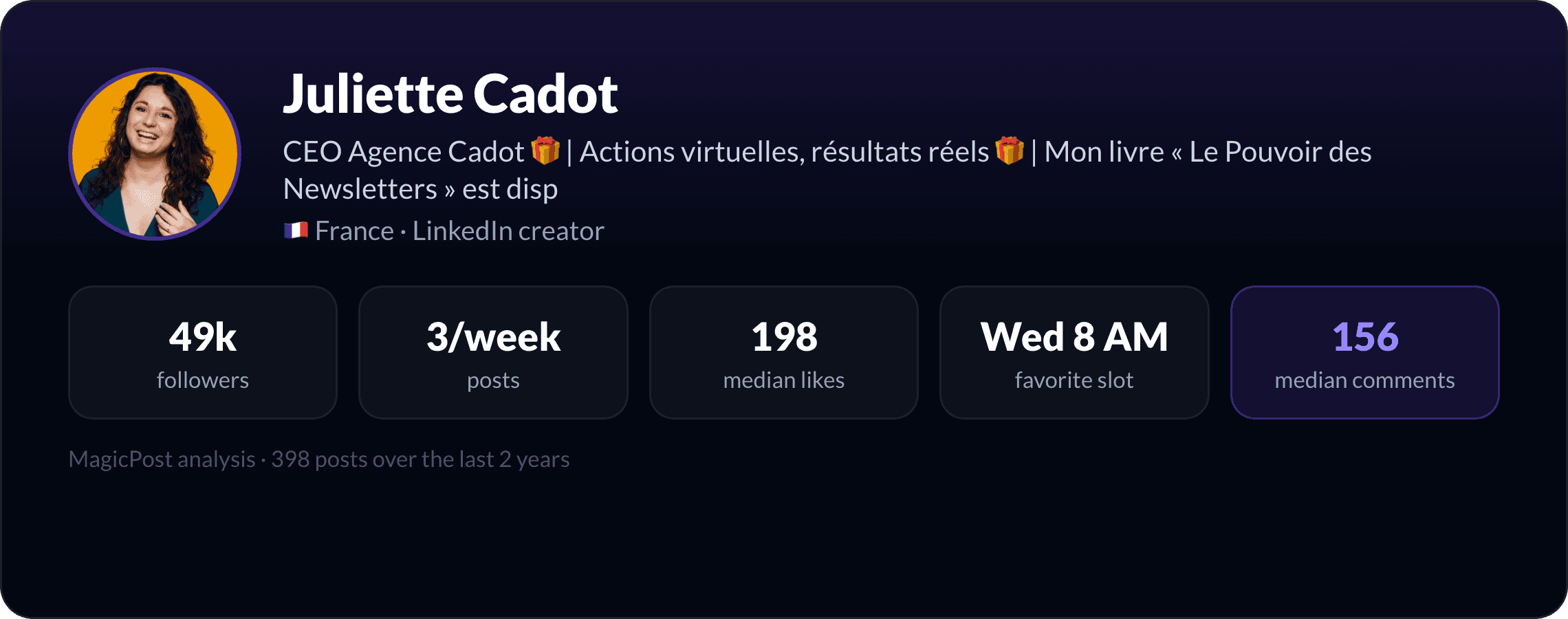
Who Is Juliette Cadot? The Agency Founder Whose Audience Talks Back (2026)
Who is Juliette Cadot? MagicPost analyzed 398 of their LinkedIn posts: topics, timing, signature moves and the writing fingerprint behind their growth, with rea
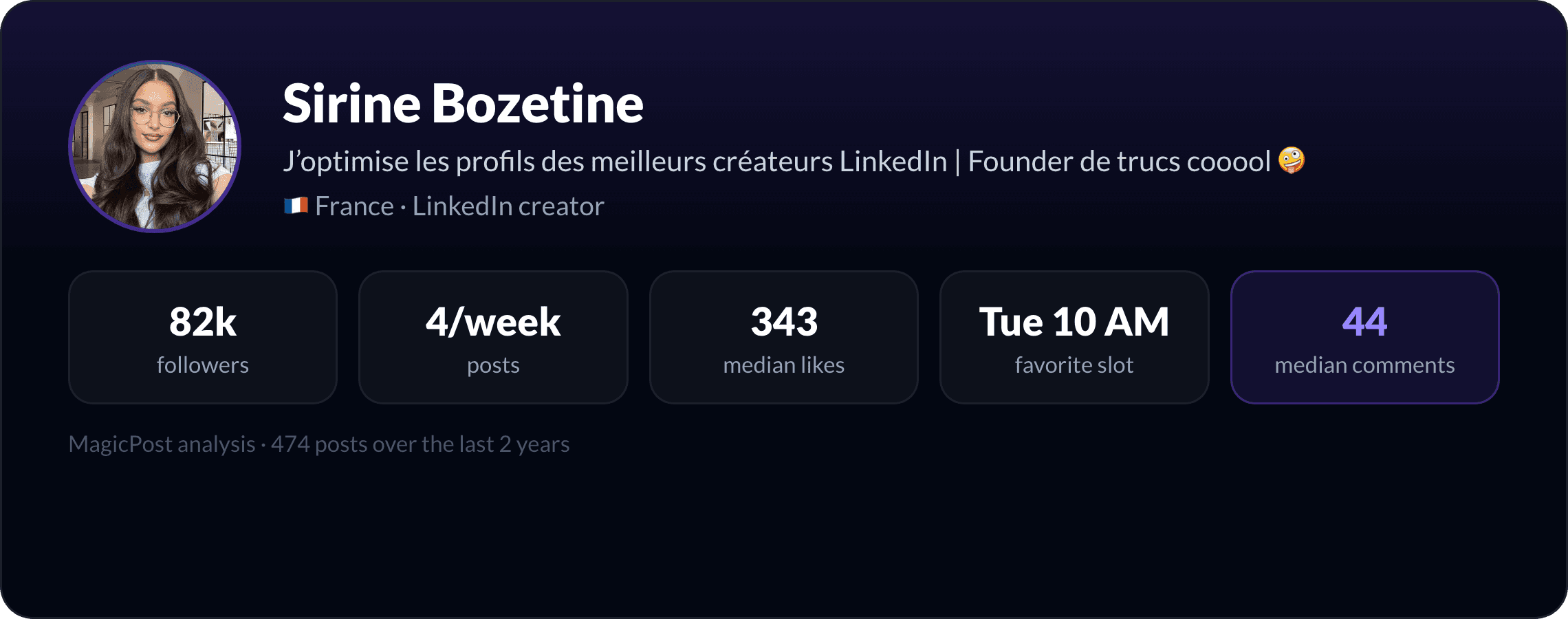
Who Is Sirine Bozetine? The Creator Who Turned Getting Rejected Into 82k Followers (2026)
Who is Sirine Bozetine? MagicPost analyzed 474 of their LinkedIn posts: topics, timing, signature moves and the writing fingerprint behind their growth, with re