Employee advocacy software helps you get your employees to show up consistently on LinkedIn without it feeling like a second job.
When it works, the returns are real: employee content earns far more reach than the same content on a company page, and candidates trust what your employees say about working somewhere far more than what the brand says.
When it doesn't work, and most programs don't, the tool is rarely the problem. Below we cover what kills advocacy programs (with data), what to look for, and how the leading employee advocacy platforms and tools actually compare, prices included.
How MagicPost runs your employee advocacy program
What Is Employee Advocacy Software?
Employee advocacy software helps companies activate their employees to share content and build a presence on professional networks, primarily LinkedIn. It typically includes content creation or curation tools, scheduling, analytics to track team-wide performance, and admin controls for brand consistency. The key distinction in 2026 is the model:
In distribution-first platforms, admins push pre-approved content and employees click "share."
In creation-first platforms, employees generate original LinkedIn posts in their own voice, supported by AI.
The two models produce very different adoption, and very different results, which is the thread running through every review below.
Why Do Most Employee Advocacy Programs Fail?
Most programs follow the same arc: big launch, a decent first month thanks to novelty and a gift-card incentive, then a slow decline into a Slack channel nobody checks. By month three, the HR manager is personally chasing people to post. By month six, the program is shelved.
The causes are always the same: employees are asked to share content that doesn't sound like them, the inauthenticity resonates with no one, and LinkedIn's algorithm notices the pattern (identical posts from multiple profiles) and suppresses the reach.
It is worth being concrete about that last point: in our benchmark of millions of posts, content that could have been written by anyone, generic and interchangeable, reaches 10 to 14% fewer people.
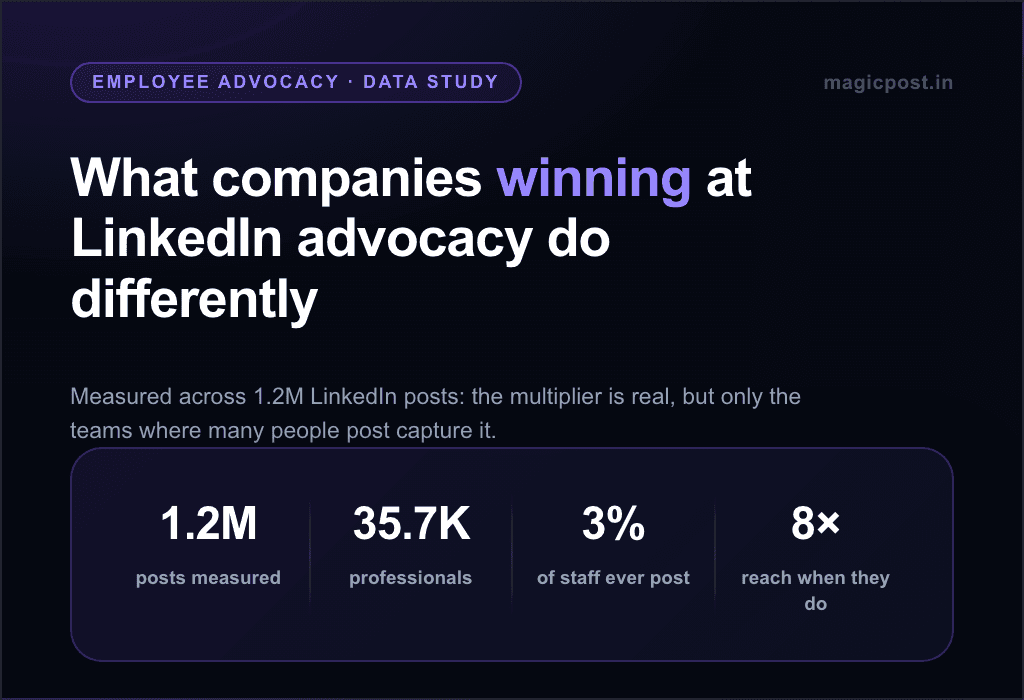
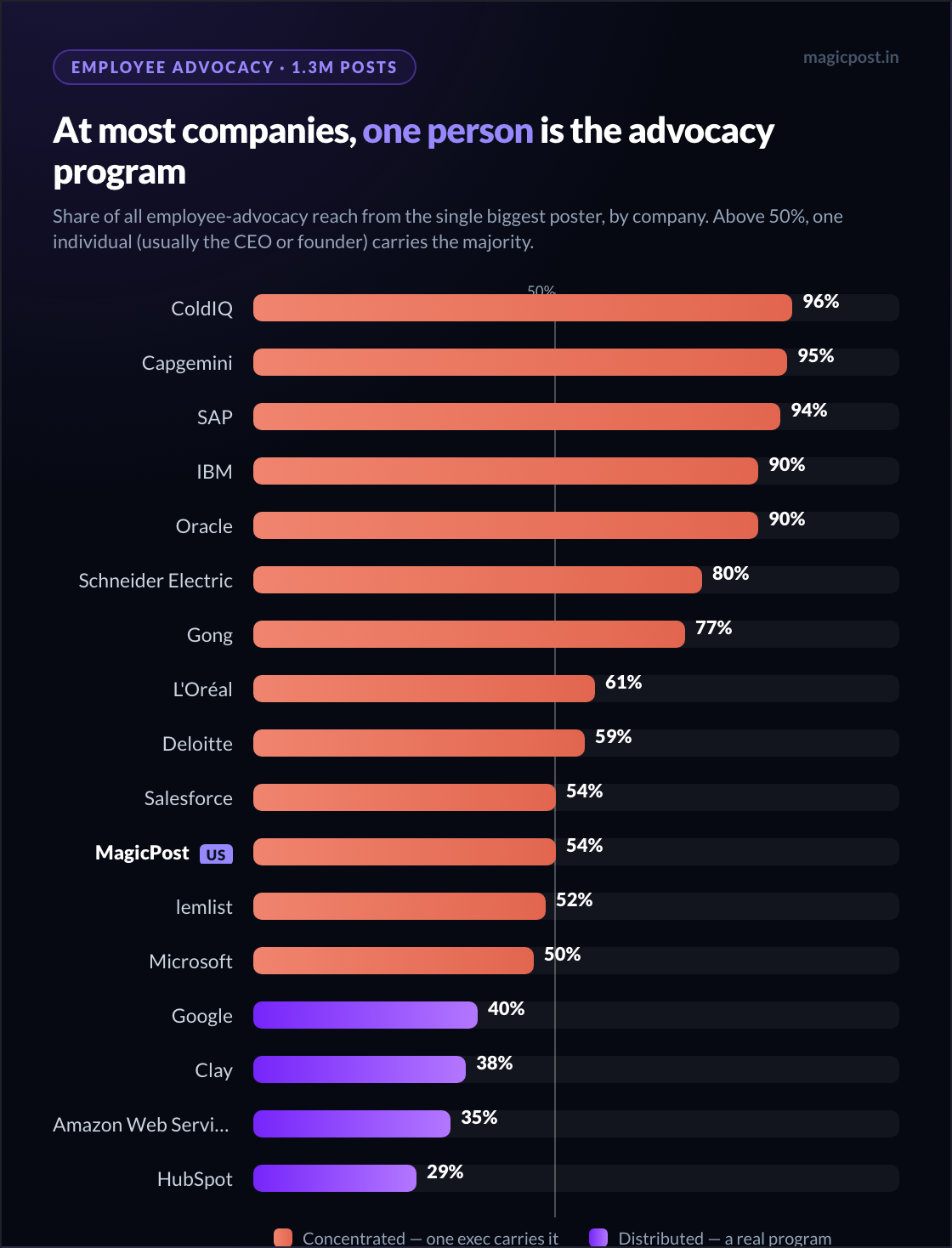
This is not just anecdote. We measured what "most programs fail" actually looks like across 1.3M LinkedIn posts by 39,729 professionals, and the failure has a signature: concentration. The two models produce very different adoption, visible program by program in our employee advocacy case studies.
At most companies, a single person, usually the founder or one executive, generates 70% to 96% of all the company's advocacy reach, while the rest of the team stays silent (industry-wide, only about 3% of employees ever post).
The programs that stick treat employees as content creators, not content distributors. When an engineer posts something that genuinely sounds like them, specific, opinionated, grounded in their actual work, their network engages.
When they share a branded link with a caption nobody wrote for them, it lands like a press release. The full data on who escapes the one-person trap is in our study of employee advocacy across 1.3M posts.
✅ Pro tip: before evaluating any software, ask one question: does this tool help employees create original content in their own voice, or does it help admins push approved content to employees? The answer determines whether you are solving an activation problem or a distribution problem.
What Should You Look for in Employee Advocacy Software?
Not all tools are built for the same use case. Here are the five criteria worth evaluating.
Criteria | What to check |
Voice authenticity | Does the AI generate posts in each employee's individual style, or produce generic captions from approved content? Individual voice matching drives adoption; corporate templates kill it. |
LinkedIn-specific vs generic social | LinkedIn has its own algorithm, formats and engagement mechanics. Tools built specifically for LinkedIn outperform general social schedulers here. |
Employee experience (not just admin) | Most platforms are designed for the admin. The employee-facing interface decides whether people actually use it. If posting takes more than 5 minutes, adoption drops sharply. |
Analytics that show real ROI | Impressions and shares are table stakes. Look for follower growth per employee, engagement trends, and ideally recruitment or pipeline metrics. |
Account safety | Any tool that uses browser extensions or session cookies to publish on employees' behalf violates LinkedIn's Terms of Service. Stick to OAuth, API-verified platforms only. |
On the analytics criterion, the formula is in how to measure employee advocacy ROI.
The 6 Best Employee Advocacy Software in 2026
We evaluated six platforms on content-creation quality, LinkedIn focus, employee experience, analytics and pricing transparency.
Tool | Model | LinkedIn-native? | Best for | Pricing |
MagicPost | Creation-first (voice AI) | Yes | LinkedIn teams wanting authentic content | $59/mo. per seat, from 2 seats; no-card trial |
Sociabble | Intranet + distribution | Multi-platform | Enterprises needing internal comms and advocacy in one | Custom quote (demo only) |
DSMN8 | Distribution + caption AI | Multi-platform | Enterprise, regulated industries | Custom quote, annual contract |
EveryoneSocial | Distribution-first | Multi-platform | Financial services, compliance-heavy | Custom quote, priced by registered users |
GaggleAMP | Distribution + gamification | Multi-platform | Large teams, adoption challenges | Not published; not re-verified |
Hootsuite Amplify | Distribution-first | Multi-platform | Existing Hootsuite customers | No public price (demo); now sold as Parliament |
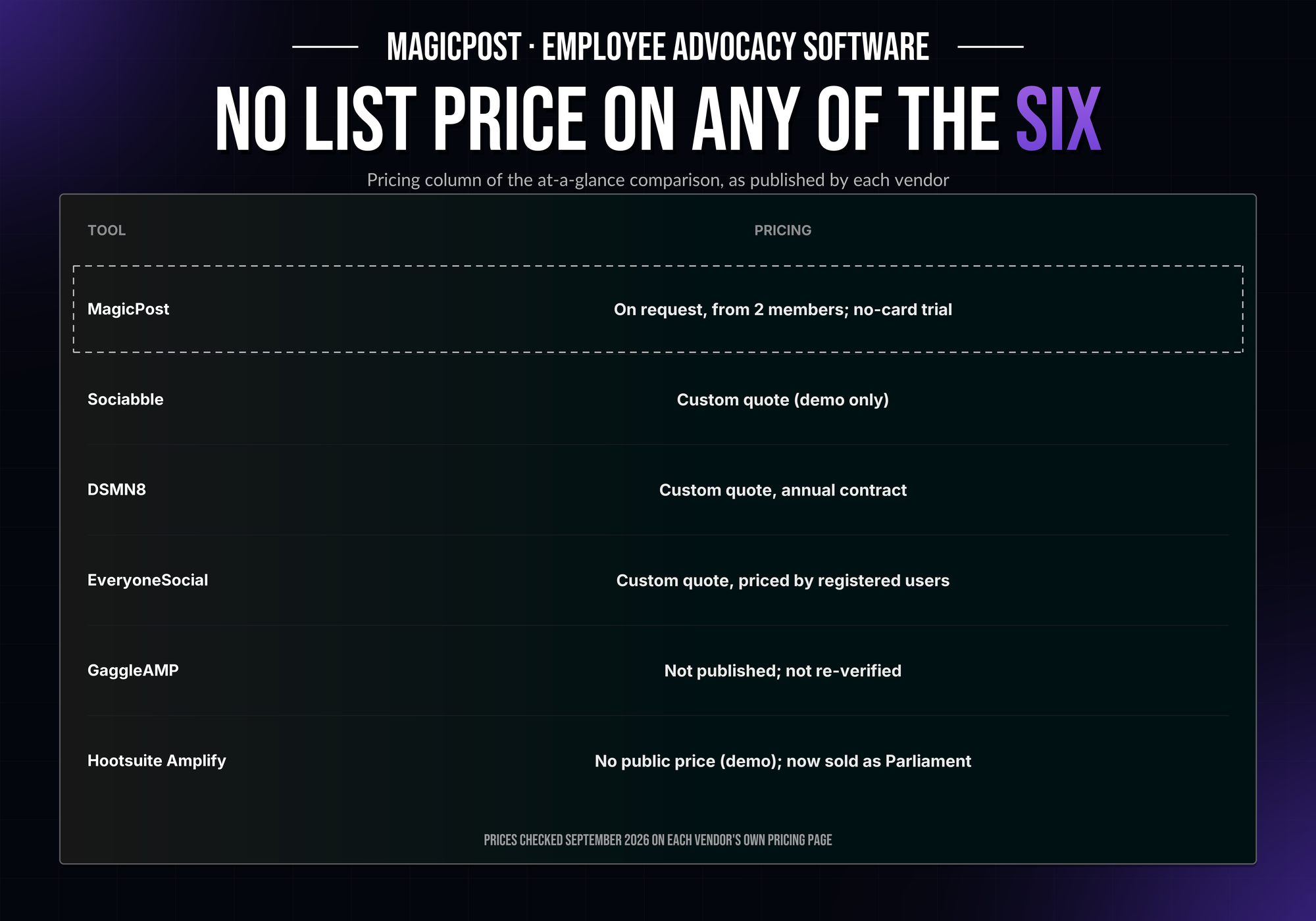
🏷️ Note on pricing: prices checked on each vendor's own pricing page. Four of these six publish no figure at all: the quote depends on headcount, modules and contract length.
Where a vendor does publish a number, it sits in its block below and in the five extra platforms further down. The full employee advocacy software pricing guide covers 12 platforms and what 25, 100 and 500 employees cost.
1. MagicPost: Best for LinkedIn-Focused Teams
MagicPost is built specifically for LinkedIn content creation, not content distribution. Its Teams plan works differently from every other tool here: instead of an admin creating content for employees to share, each team member generates their own posts using AI trained on their individual LinkedIn profile and writing style.
The AI learns their tone, vocabulary and post structure, so drafts come out sounding like the employee, not the marketing team, and a humanizer built on our published research keeps them from reading as AI (which, as noted above, the algorithm penalizes).
Admins get full visibility: a team calendar of all scheduled and published posts, adoption dashboards per member (who's posting, who's gone quiet, what's performing), and white-label performance reports for leadership.
Publishing goes through LinkedIn's official API as a verified application, with working @mentions of people and companies that survive scheduling, so there are no browser extensions and no account risk.
📊 Saint-Gobain equipped 30+ HR team members on this model and saw 3x more content and 15% more applicants within 30 days.
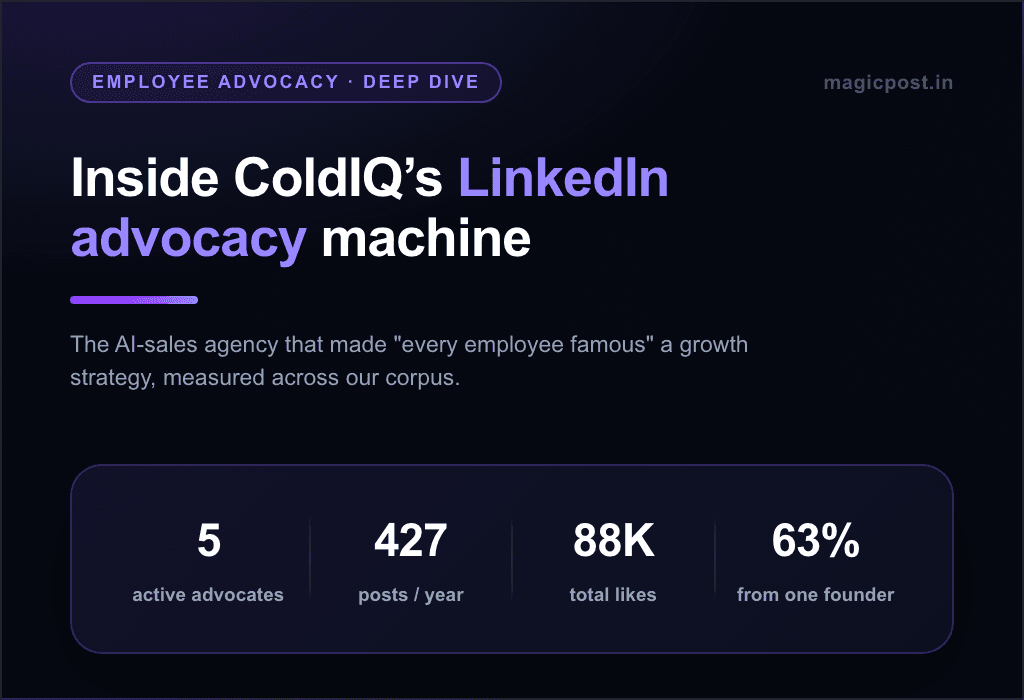
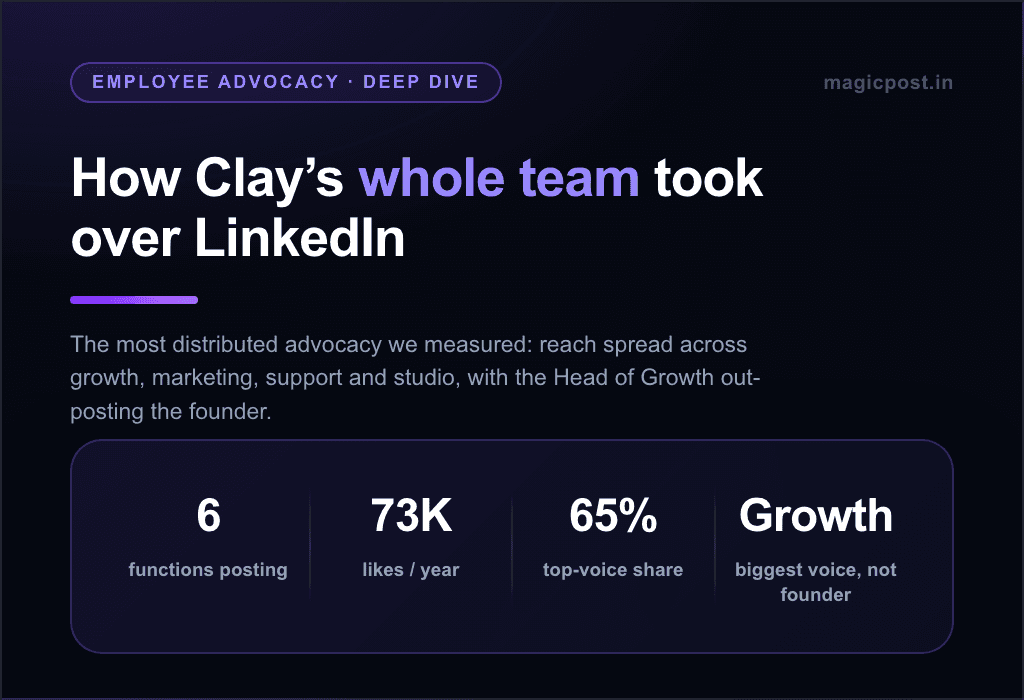
For a sense of what the creation-first model looks like at lean, high-output teams, see how ColdIQ (five people, 88k likes in the year to June 2026) and Clay run it, measured in our roundup of the companies winning at advocacy.
Notable features
AI post generation per employee in their individual voice and tone, with a research-backed humanizer.
Admin-set brand guidelines that keep content consistent without sounding corporate.
Team calendar across all members; scheduled and published posts in one place.
Activity dashboard: who's posting, who's gone quiet, what's performing.
White-label reports, exportable for leadership or clients.
Official LinkedIn API publishing with working @mentions; fully compliant.
Pros
✅ One of only two tools here built from scratch for LinkedIn.
✅ Voice-matched AI per employee, not generic captions.
✅ Fast adoption, because employees create content rather than just share it.
Cons
❌ LinkedIn-only (not a multi-platform tool).
❌ Smaller enterprise feature set than DSMN8 or EveryoneSocial.
💰 Pricing: Teams plan at $59/mo. per seat ($47/mo. billed yearly), from 2 seats, one seat per member and admin seats free; the trial is free with no credit card.
📌 MagicPost is the strongest choice for companies whose primary advocacy goal is LinkedIn, especially those who want employees creating original content rather than resharing approved posts.
It punches above its weight on adoption because posting takes employees a couple of minutes, with no extra tools or steps. See the employee advocacy platform for LinkedIn teams, or estimate your team's reach first.
2. Sociabble: Best for Internal Comms and Advocacy Combined
Sociabble is the only tool in this list that pairs employee advocacy with a full internal-communications platform: intranet, newsletters, frontline chat and video in one place.
The advocacy module lets admins publish content across types (news, social posts, newsletters, events) and employees share or schedule in one click, with AI for optimal timing and an "Ask AI" assistant for content aligned to your tone and templates. Analytics surface top content and your most active advocates.
Where Sociabble stands apart is the intranet layer: a branded mobile app for deskless workers, targeted newsletters with 60-language auto-translation, adaptive-streaming video and Microsoft 365 integration. For HR and comms teams managing both internal engagement and external visibility from one platform, that breadth is the whole argument.
The limitation is the same as the strength: if you only need advocacy, you are paying for a lot of internal-comms infrastructure you may not use.
Notable features
"Ask AI" content creation aligned to company tone, values and templates.
Targeted employee newsletters with 60-language auto-translation.
Branded mobile app for frontline and deskless workers.
Badges, leaderboards, rewards and an Idea Box for engagement.
Microsoft 365 integration, enterprise-grade security and compliance.
Pros
✅ Multi-format content (text, video, PDF, GIF, audio).
✅ Internal comms and advocacy in one platform.
✅ Strong for frontline and deskless workforces.
Cons
❌ Not LinkedIn-specific, advocacy is one module among many.
❌ Significant feature overhead if advocacy is your only need.
❌ No voice-matched AI per employee.
💰 Pricing: custom only, sized to company size, user count and modules; demo first, no trial mentioned.
📌 Sociabble is the right choice for larger organizations that need to solve internal communications and employee advocacy together. If your only goal is getting employees posting on LinkedIn, it is more than you need. (See our Sociabble review for the full breakdown, or Sociabble alternatives for the lighter field.)
3. DSMN8: Best for Enterprise Teams Needing Segmentation
DSMN8 is a mature, enterprise-grade platform with strong content segmentation, gamification and a growing AI layer. Content is curated centrally and pushed to employees by role, location, language or team, so the right content reaches the right people without flooding everyone.
Its Personal Voice AI generates multiple caption options per post, giving employees some personalization without creating from scratch. Where DSMN8 excels is the enterprise operational layer: ISO 27001 security, SSO, a Salesforce integration, custom newsletters and an Executive Influence module for C-suite activation.
It is built for regulated industries and global teams where compliance and brand control matter as much as reach.
Notable features
Content segmentation by role, location, language and team.
Personal Voice AI generating multiple caption options per post.
Executive Influencer Platform as a separate module for C-suite management.
Enterprise security: ISO 27001, SSO, GDPR.
Native Slack, Teams and Salesforce integrations.
UTM tracking and ROI attribution back to individual employee shares.
Pros
✅ Best segmentation of any tool here.
✅ Strong compliance and enterprise security credentials.
✅ Analytics down to earned media value per share.
Cons
❌ Personal Voice AI generates captions, not original posts.
❌ Annual contract minimum.
❌ Distribution-first model: employees share, not create.
💰 Pricing: quote only. The one public wording is "from a few dollars per employee per month", on an annual contract, with onboarding and unlimited admin seats included.
📌 DSMN8 is the right choice for large enterprises in regulated industries that need compliance, multi-region segmentation and deep CRM integrations. It is not the best fit for companies whose primary goal is authentic, employee-generated content. Smaller teams that want a published price can start with our DSMN8 alternatives for small teams.
4. EveryoneSocial: Best for Compliance-Heavy Industries
EveryoneSocial is the veteran of the space, in the market since 2012, and its compliance module sets it apart. Banks, brokerages and insurers can run full advocacy programs with simultaneous social-media capture, review and archiving, integrated with Global Relay and other regulatory archives.
For everyone else it is a solid distribution platform with strong analytics. What makes it interesting at scale is the audience-insight layer: it shows whether your content is reaching customers, prospects or hiring candidates, not just raw impressions.
Employees can also surface their own user-generated content (photos, videos, stories) for admins to amplify.
Notable features
Compliance module with social-event capture and archiving (financial-services focus).
Audience-level analytics (customers vs candidates vs prospects).
Employee story capture and amplification of user-generated content.
One plan priced by registered users, no admin-seat fees.
Microsoft Teams, Slack, SharePoint and email integrations; SOC 2 Type 2, GDPR, SCIM, SSO.
Pros
✅ The only tool here with a full compliance + advocacy solution.
✅ Implementation, integrations and a dedicated CSM bundled in the quote.
✅ Audience segmentation analytics.
Cons
❌ No creation-first AI for individual voice matching.
❌ Overkill for companies not in regulated industries.
❌ Distribution-first: employees share admin-approved content.
💰 Pricing: quote only, a single plan priced by registered users; pilots start around 500 people, annual term, implementation and a dedicated CSM bundled.
📌 EveryoneSocial is the right call specifically for financial services, healthcare or other regulated industries that need compliant social-media management alongside advocacy. For everyone else, the compliance overhead is unnecessary and the distribution-first model limits authentic engagement.
5. GaggleAMP: Best for Gamification-Driven Programs
GaggleAMP pioneered the activity-based advocacy model: admins create activities (share this, comment on that, like this), employees earn points, and points redeem for rewards. It is a proven way to get initial participation up, particularly in larger organizations where a bit of friendly competition helps.
Its AI Paraphrase feature addresses the identical-post problem by generating alternative versions of approved content, so fifty people aren't sharing the exact same caption. It is not voice matching from scratch, but it is a meaningful step above pure copy-paste.
Notable features
Activity-based engagement: points for sharing, commenting and liking.
AI Paraphrase generates caption variants so posts aren't identical.
Leaderboards, competitions and reward redemption.
Drag-and-drop content calendars for self-scheduling.
Real-time reporting and analytics.
Pros
✅ Gamification works well for initial adoption in large teams.
✅ AI Paraphrase reduces the identical-post problem.
✅ Flexible activity types beyond social sharing.
Cons
❌ Less LinkedIn-specific than MagicPost.
❌ Distribution-first, no individual voice creation.
❌ Gamification can incentivize quantity over quality.
💰 Pricing: not published on a page we could verify; treat it as quote-based until you ask.
📌 GaggleAMP fits large organizations where adoption is the main challenge and a reward-based system resonates culturally. It is less suited to companies whose goal is authentic, employee-generated thought leadership.
6. Hootsuite Amplify: Best for Existing Hootsuite Customers
Hootsuite Amplify, now sold as Parliament inside Hootsuite's Social OS line-up, isn't a standalone product; it is an advocacy module on top of a Hootsuite enterprise subscription. If your team already manages multi-channel social through Hootsuite, Amplify is a natural extension: admins create pre-approved content in the main dashboard and employees share it in one click.
The limitation is structural, Amplify is a distribution tool, not a creation tool. Employees share what the admin publishes, with an AI assistant for captions; there is no individual voice matching and no original content per employee.
It also inherits Hootsuite's enterprise pricing, with no accessible entry point for smaller teams.
Notable features
Built-in integration with existing Hootsuite workflows.
Pre-approved content library for one-click sharing.
Slack and Microsoft Teams integrations.
Performance tracking per employee and per post.
AI content writer for caption generation.
Pros
✅ Zero friction to add if you are already a Hootsuite customer.
✅ Strong case studies at enterprise scale.
✅ Integrates with the broader Hootsuite analytics suite.
Cons
❌ Not standalone, requires Hootsuite enterprise.
❌ Distribution-only: no individual voice creation.
❌ Enterprise pricing plus add-on, no accessible entry point for smaller teams; not LinkedIn-specific.
💰 Pricing: Parliament has no public price (request a demo) and is not sold self-serve; base Hootsuite seats start at $99/user/mo billed annually (Standard).
📌 Hootsuite Amplify is worth considering only if you are already on Hootsuite at enterprise level. For everyone else, the extra infrastructure cost and distribution-only model are hard to justify against purpose-built alternatives.
Our full take on the suite is in the Hootsuite review; the lighter field is in Hootsuite alternatives.
How Do You Roll Out an Employee Advocacy Program That Gets Adoption?
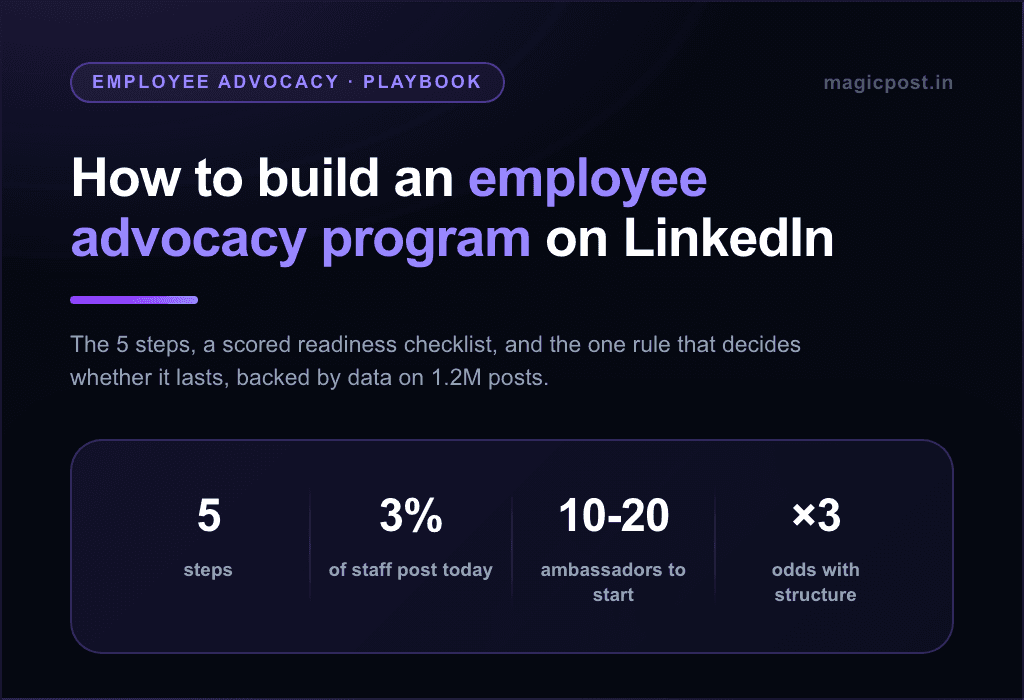
Choosing the right software isn't enough. What separates programs that run for years from ones that die in month three is how you roll them out. The full operating playbook is in our guide to building an employee advocacy program on LinkedIn; the essentials:
Start with volunteers, not mandates. The employees who genuinely want to build their LinkedIn presence are your best advocates and your internal proof of concept. One enthusiastic engineer with 3,000 followers beats twenty reluctant participants posting once under pressure.
Solve the blank page before launch day. Run a short onboarding where employees generate and publish their first post during the session. The hardest part is always the first one; once they've seen their own post live with real engagement, the second is easy.
Show employees what's in it for them. A strong LinkedIn presence is a career asset. Frame the program around personal brand and professional visibility, not corporate distribution, and adoption becomes self-sustaining. What high-adoption programs do differently is in our employee advocacy adoption guide.
Make it a routine, not a one-off. Adoption sticks when posting and replying becomes a weekly habit each member can run in minutes; building that posting and engagement routine into the workflow matters more than any single launch push.
Track the right things. Measure inbound application volume, impressions per employee per week and engagement rate, not vanity totals like raw shares.
✅ Pro tip: the teams with the highest long-term adoption are the ones where the admin checks in with individuals personally in the first two weeks, not with a reminder, but with a specific observation about their content. That feedback loop is what keeps people going.
Which Employee Advocacy Software Should You Pick?
Most employee advocacy programs fail because they are built around distribution, not activation.
The software choice matters, but it matters less than whether employees feel like they are posting as themselves or on behalf of a corporate PR machine.
The data is clear that the companies capturing the multiplier are the ones where many people post in their own voice, not one executive.
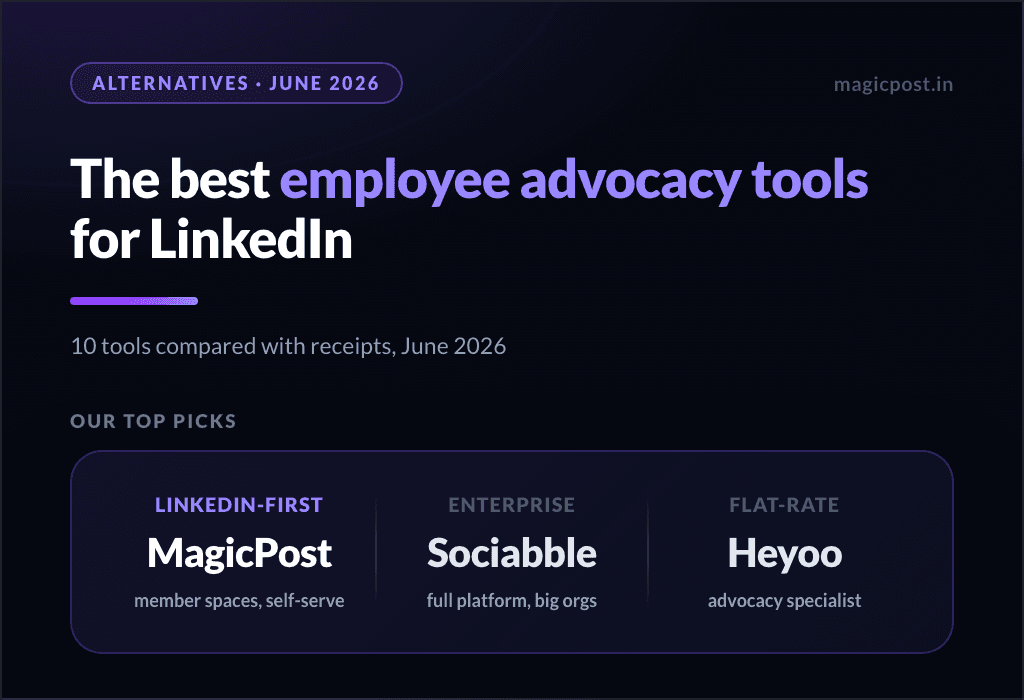
If your team is primarily on LinkedIn and your goal is authentic employee content, MagicPost is the best fit.
If you are a large enterprise running a multi-platform program across thousands of employees in regulated industries, DSMN8 or EveryoneSocial are the mature options.
If you already pay for Hootsuite at enterprise level, Hootsuite Amplify is a logical add-on.
If you need internal communications and advocacy from a single platform, Sociabble covers both.
Start with whatever makes it easiest for your employees to engage. That is the variable that decides whether you are having this same conversation again in six months.
Other employee advocacy platforms we evaluated: Supergrow, Oktopost, Haiilo, PostBeyond, Sprout Social
Five more employee advocacy platforms and tools show up on most shortlists. They sit outside the six above because advocacy is one module of a wider suite, or because we could not verify enough. Same registry for each: model, price, fit.
Supergrow is a creation-first LinkedIn content tool sold to teams as advocacy software: AI interviews and a "Content DNA" voice model per member, calendar and queue scheduling, approval workflows and per-member analytics on the Teams plan. Teams costs $199/mo for 5 accounts, with a 7-day trial and no free plan; bigger teams get a custom quote.
Its official-API publishing is a vendor claim, not a LinkedIn-verified-application receipt. G2 reviewers repeatedly flag thin analytics and an approval flow that needs a separate account per LinkedIn profile. Fit: teams of 2 to 5 that want cheap voice AI and can live without deep reporting.
Oktopost is a B2B social media management suite with advocacy as one module: company-page publishing across networks, social listening, analytics and attribution, unlimited social profiles. Professional starts from $499/mo and Advanced from $799/mo, both billed annually and finalised by quote; no trial, a demo instead. Our Oktopost alternatives guide scores its replacements on publishing, advocacy and CRM attribution.
Fit: B2B marketing teams that want employee sharing inside the same tool as their company pages. LinkedIn is one network among several, and there is no per-employee voice AI.
Haiilo is an employee communications platform (formerly Smarp) with an advocacy module. Its site refused our automated checks, so we list no price, no rating and no feature claim for it.
Fit: internal comms teams that already shortlist Haiilo for the intranet. Ask for a quote and confirm the LinkedIn publishing method before you sign.
PostBeyond is Influitive's distribution-first advocacy product: content library, one-click sharing, Slack and Teams notifications, gamification, newsletters and campaign analytics. Growth costs $1,125/mo for a minimum of 100 enrolled employees (billing period not stated), Enterprise is custom from 250 employees.
It is one of the few enterprise vendors with a published price, plus a 30-day trial capped at 30 employees and no free plan. Fit: programs of 100 employees or more that want a number before the demo.
Employee Advocacy by Sprout Social is an add-on to the Sprout suite: curated content library, Slack, Teams and mobile distribution, gamification and earned-media-value reporting. The add-on has no public price and needs the Standard plan or higher; Sprout seats start at $79/seat/mo billed annually, so the total stays opaque until you ask.
Fit: teams already running their company pages on Sprout Social. Everyone else pays for a full social suite to get a sharing module.
If you want a wider shortlist before you commit, our roundup of the best employee advocacy tools for LinkedIn maps the broader field beyond these six.
Struggling to get your team active on LinkedIn? See how MagicPost fixes it for teams, book a 30-minute demo, or manage all your LinkedIn content in one place.
Where these facts come from
Tool capabilities, models and security claims were checked on each vendor's own site and documentation in 2026. Prices come from each vendor's pricing page and appear only where the vendor publishes one; Haiilo's site could not be read, so it carries none.
The data on program failure, the concentration of reach and the engagement penalty for AI-sounding posts, is measured from our research corpus of 3.2M LinkedIn posts (1.3M in the twelve months to September 2026, 39,729 professionals), with the method and its limits detailed in our employee advocacy study.
The Saint-Gobain figures are from that deployment. Corrections land at the next quarterly refresh.
FAQ
What is an employee advocacy platform (or software)?
An employee advocacy platform (also sold as employee advocacy software or tools) helps companies activate employees to share content and build a presence on LinkedIn, with content tools, scheduling, team analytics and admin controls.
The decisive 2026 distinction is the model: distribution-first tools push approved content for employees to reshare, while creation-first tools help each employee generate original posts in their own voice. The latter drives far better adoption.
What is the best employee advocacy software for LinkedIn?
For LinkedIn specifically, MagicPost is the strongest pick because it is built only for LinkedIn and is creation-first: each employee's posts are generated in their own voice and published through LinkedIn's official API.
Sociabble, DSMN8, EveryoneSocial, GaggleAMP and Hootsuite Amplify are multi-platform and distribution-first, better suited to large or regulated enterprises that need compliance and internal comms.
How much does employee advocacy software cost?
Employee advocacy software costs anywhere from $118/mo to well over $1,000/mo, and most enterprise vendors publish no price at all. Three models exist. Published monthly plans: MagicPost Team $59/mo per seat from 2 seats, Supergrow Teams $199/mo for 5 accounts, Clearview Social $425/mo for 50 employees billed annually, Oktopost from $499/mo billed annually, PostBeyond $1,125/mo for 100 employees minimum.
Per-seat suites where advocacy is an unpriced add-on: Sprout Social, seats from $79/seat/mo billed annually. Custom quotes with no public figure: DSMN8, EveryoneSocial, Sociabble and Hootsuite Parliament. The full employee advocacy software pricing guide breaks down all 12 platforms and what 25, 100 and 500 employees cost.
Why do employee advocacy programs fail?
Employee advocacy programs fail because they are built around distribution, not activation. Employees are asked to reshare content that doesn't sound like them, the inauthenticity gets little engagement, and LinkedIn suppresses identical posts.
In our data on 1.3M posts, this shows up as concentration: one person generates most of the company's reach, while LinkedIn's own figure puts the share of employees who ever share at about 3%. Programs that succeed help many employees create original content in their own voice.
Is employee advocacy software safe for LinkedIn accounts?
Employee advocacy software is safe for LinkedIn accounts only if it publishes through LinkedIn's official API (OAuth). Tools that rely on browser extensions or session cookies to post on employees' behalf violate LinkedIn's Terms of Service and put accounts at risk. MagicPost is API-verified; confirm the publishing method of any tool before rolling it out across a team.
Is there a free employee advocacy tool?
No employee advocacy tool we verified (MagicPost, Sociabble, DSMN8, EveryoneSocial, Hootsuite Parliament, Supergrow, Oktopost, PostBeyond, Sprout Social, Clearview Social) offers a permanent free plan, and LinkedIn retired its own My Company tab and employee advocacy tab in November 2024 without replacing them.
What exists is trials: MagicPost's is free with no credit card, PostBeyond gives 30 days for up to 30 employees, Supergrow 7 days. Everything else starts with a demo.