Ken Cheng writes from London to about 230,000 followers under a headline that gives the game away: "I want to connect with you, emotionally :)". His profile job title reads "Boyfriend of Company," at FullEnrich.
At MagicPost, we analyzed 296 of his LinkedIn posts from the last two years (492 back to 2023).
The posts are satire: each one mimics a sincere CEO post (the hiring hack, the hustle lesson, the vulnerable confession) and collapses in its last line.
In our data, 49 of his posts have the exact shape of a sincere life-story post, the kind sorted as "hardship lived through" or "success celebration." The joke is in the content, never in the form.

Ken Cheng's story, in his own posts (do not believe a word)
With Cheng, the biography belongs to a character: a self-adoring boss who has "conquered the business world" and learned nothing from it. Every chapter of that life is built like a real LinkedIn origin story.
The birth. "I should not be alive. I was 3 months overdue at my own birth." The doctors wanted to intervene, the mother overruled them: "No, let him cook." The lesson, delivered straight: "I was no average baby. I was exceptional."
The gifted child. At seven, the character insists on writing four-digit years on his schoolwork, gets mocked for it, and later claims credit for avoiding the Millennium bug. The sign-off: "You're welcome, computer scientists."
The awards. The trophy cabinet is a running gag. In one post he trips over his "Tech Entrepreneur of the Year Award" because the cabinet is full, and concludes: "No. I just need a bigger trophy cabinet."
In another, a Forbes 30 Under 30 invitation becomes an insult because he was 35. The same Forbes joke appears in two separate posts.
The milestone. The one chapter that is also a real number: "Ladies and gentlemen, I hit 200k followers." It flashes back to everyone who doubted him and ends: "anyone can reach 200k followers if they're as skilled and talented as I am."
A month earlier, the same goal drove a darker gag: a post written as his own obituary, asking readers to follow the account in his memory. Two posts, 8,836 likes between them.
His signature story is the job interview, and he has re-run it at least six times: the worm costume interview, the posture test, the abandoned Tamagotchi, the candidate who gets gaslit, the jogger, the 964-round interview process.
Most open like a sincere recruiting tip ("I only look for one thing when hiring."), and all six land between 1,814 and 6,463 likes. When a frame works, he does not retire it.
What does Ken Cheng post about?
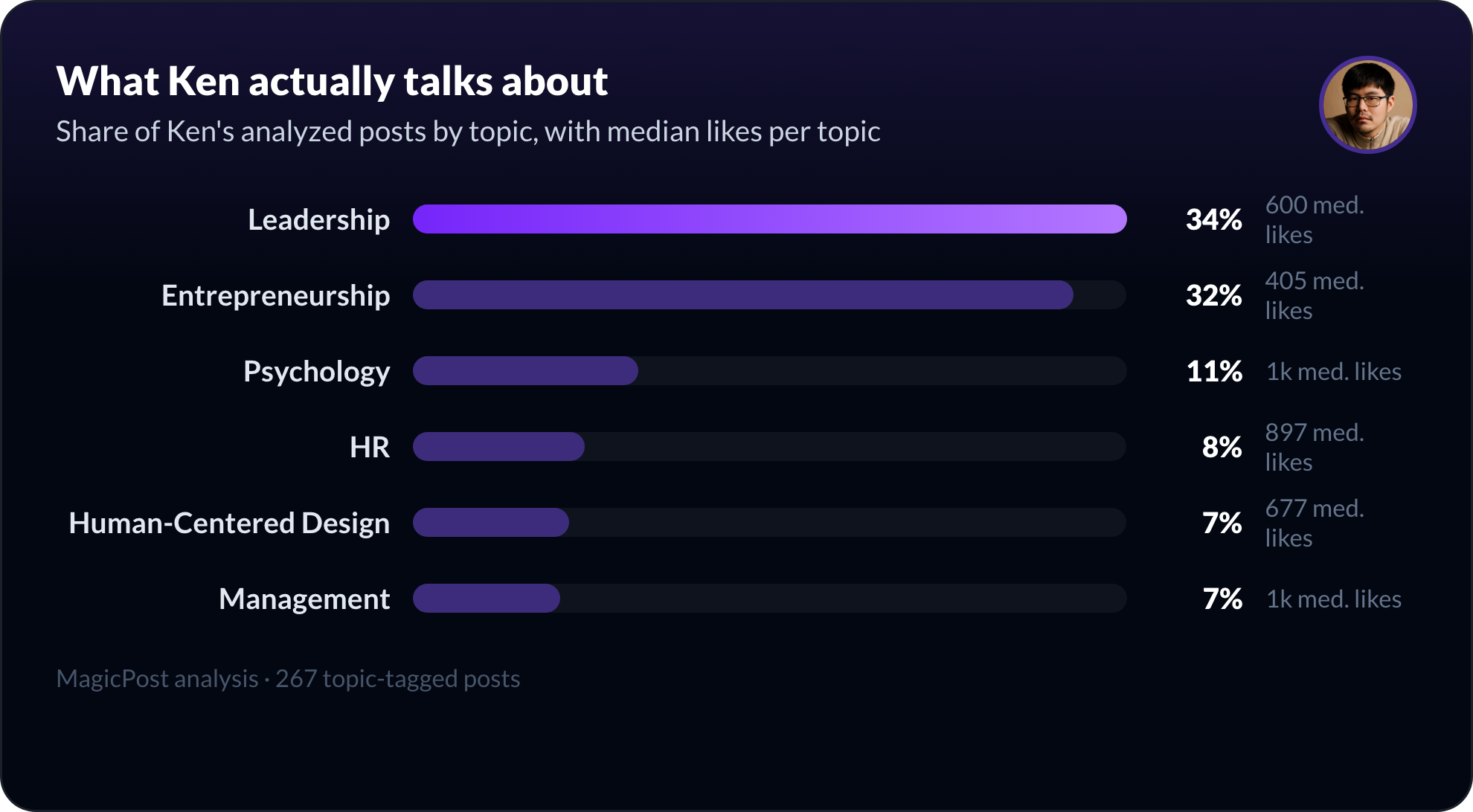
Leadership (92 posts) and entrepreneurship (85) lead his topic tags by far. Those are the genres he parodies, so the tags name his targets. The medians split them:
Management and psychology lead the themes: 1,499 and 1,057 median likes. Bad bosses are his richest material.
Entrepreneurship trails at 405, despite the volume. Social media (292) and diversity and inclusion (73) sit at the bottom.
By register, the classifier puts 145 posts under "provocative take," and 121 under "other." Then come the sincere labels: 15 posts filed as a "hardship lived through," 13 as "challenges overcome," 13 as "lessons learned," 8 as "success celebration."
The car crash survived while taking a Teams call has the shape of a hardship post. The worm-costume interview has the shape of a lesson learned. The parody copies the template so closely that only the content gives it away.
Who Ken Cheng writes for
His reader is anyone who has scrolled past one too many guru posts, addressed the way the genre does it, earnestly. The lonely-boss post ends with an appeal: "So, next time you're watching TV with your family, maybe spare a thought for your boss and give them a call."
Nothing in our sample sells a course or a program. Even the product-thank-you post gets the treatment: an app builder, Lovable, is thanked for an AI replacement son ("We're closer than ever before.").
Ken Cheng's best posts of 2026
His top three posts of 2026 so far, each linked to the original (browse 2M+ posts like these in MagicPost for more):
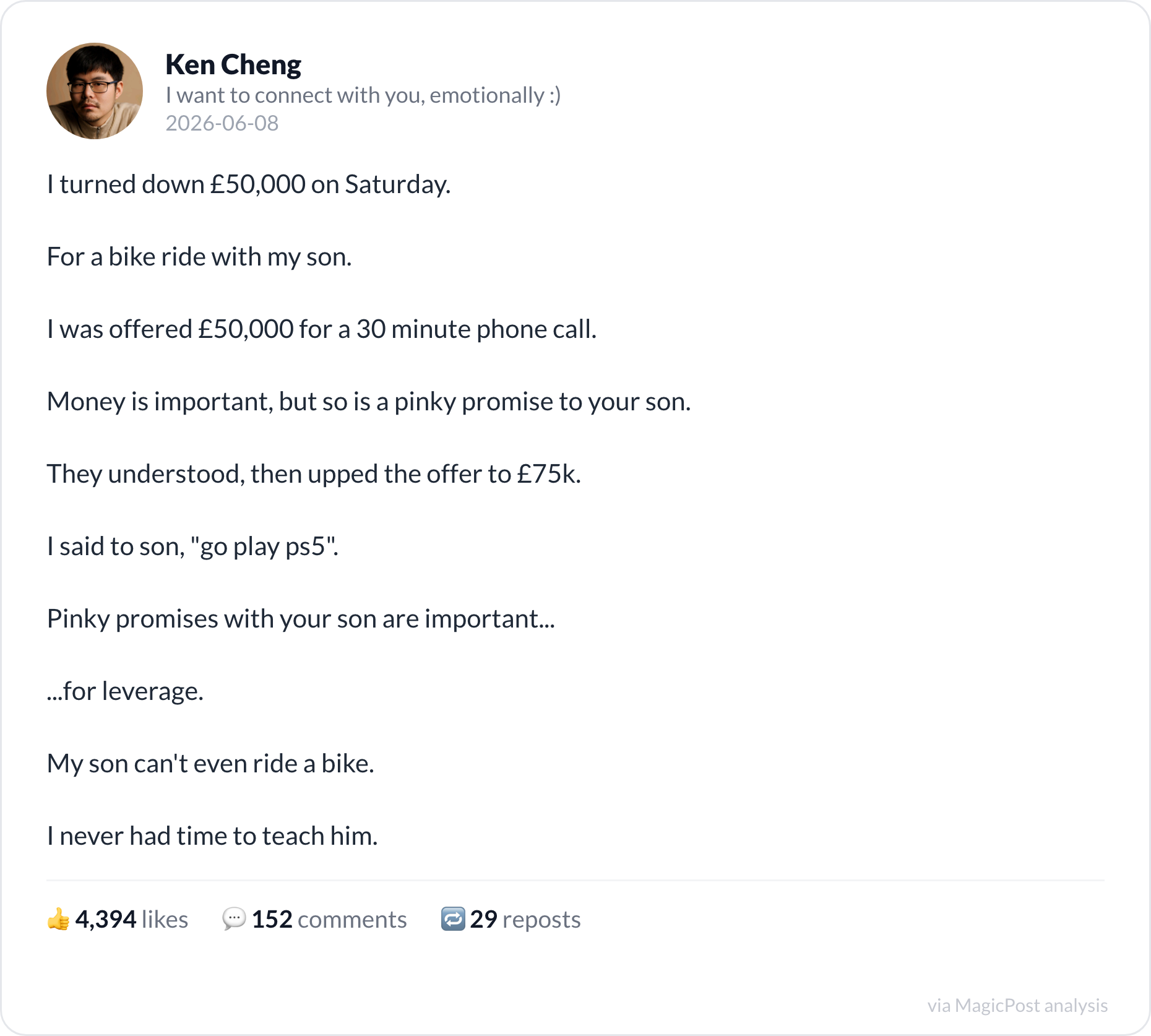
4,394 likes. A two-line hook in the "I turned down money for family" genre, an escalation (£50,000, then £75k), then two reversals in the final three lines. The son never gets the bike ride, and never learned to ride one.
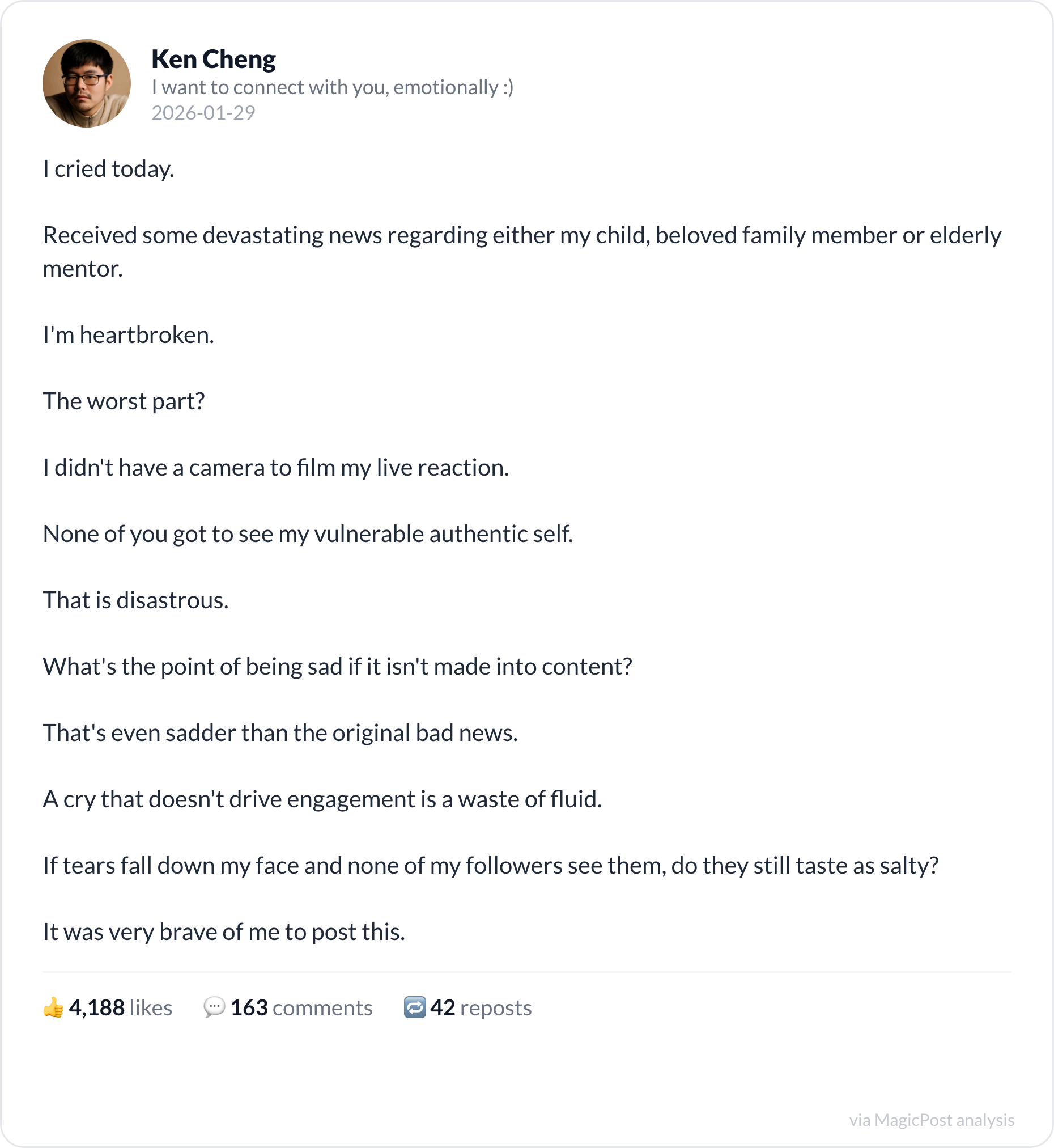
4,188 likes. A send-up of the vulnerability post. The bad news stays deliberately vague, and the grief is aimed at the habit of turning every emotion into content. It drew 163 comments.
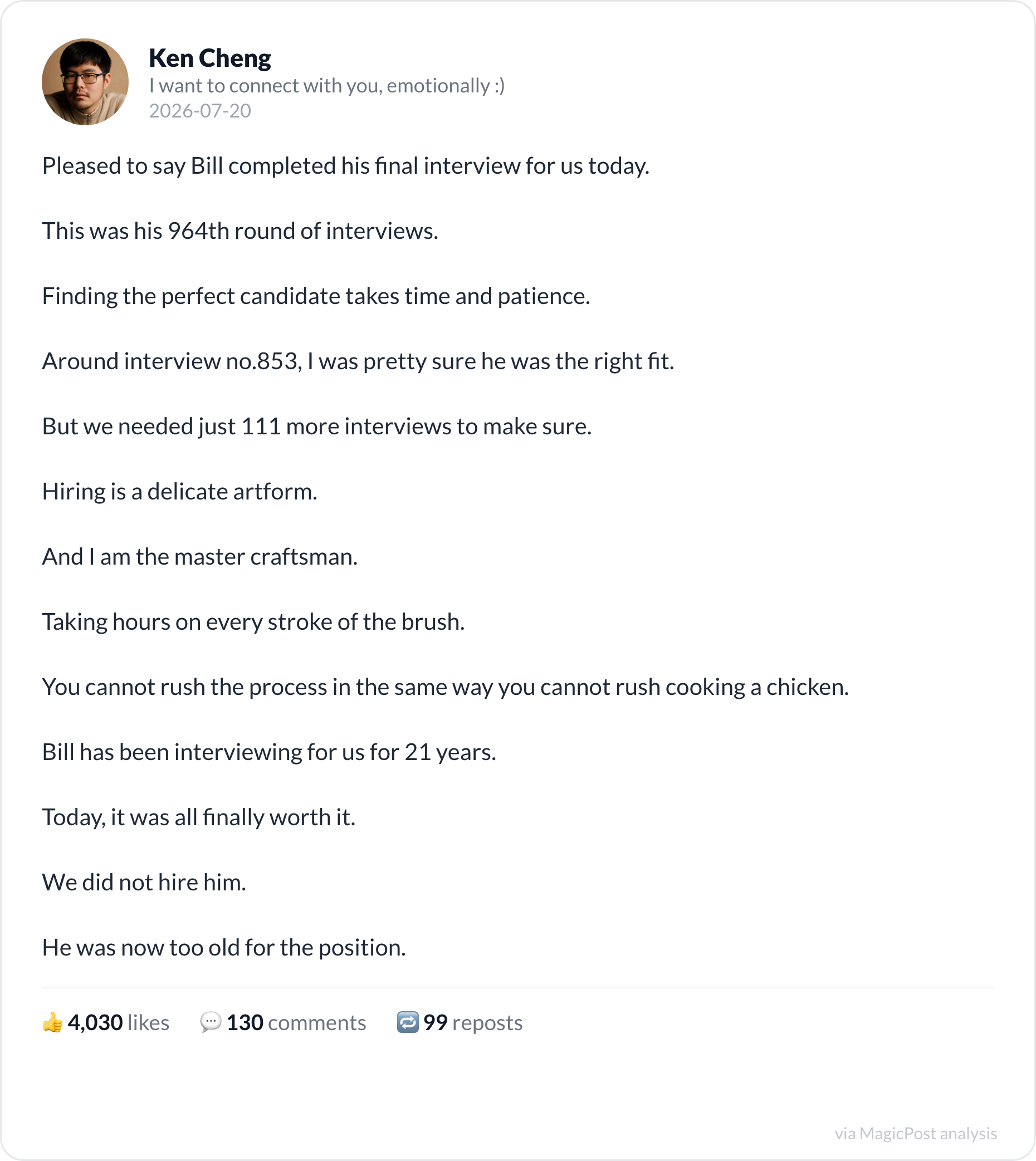
4,030 likes. The hiring franchise again, powered by absurd precision: the 964th round, 111 more interviews "to make sure," 21 years. Its 99 reposts are the most of his 2026 top four.
The fourth, the boss who invents a server outage on a Saturday night because he is lonely, earned 3,687 likes and the most comments of the four (192).
Is Ken Cheng still growing on LinkedIn?
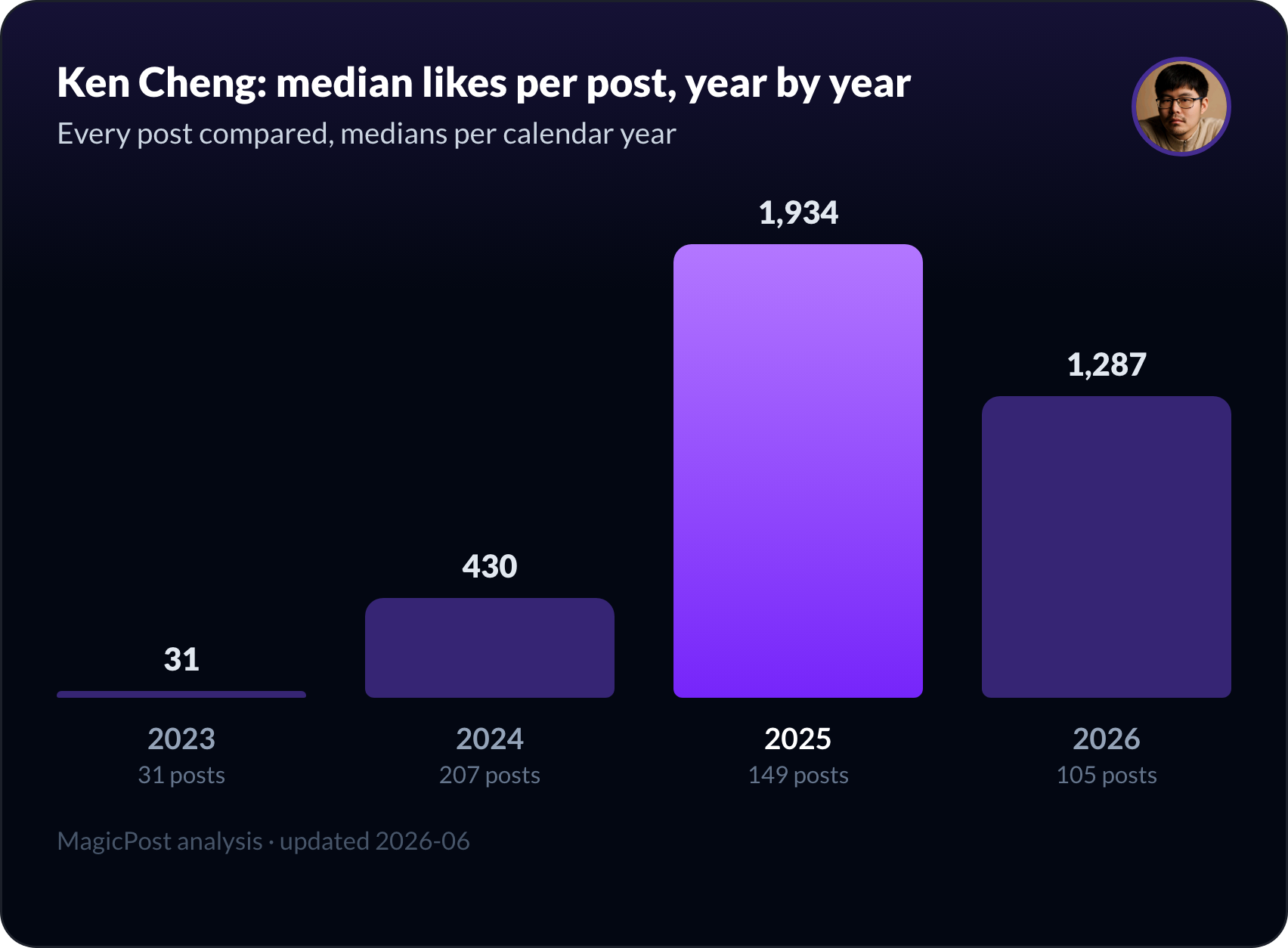
Yes, and the curve is one of the steepest we track. His median post went from 31 likes in 2023 to 430 in 2024 and 1,934 in 2025, a 62-fold rise in two years. 2026 is running at 1,287 so far: below the 2025 peak, still three times 2024.
The breakout is easy to date. In December 2024, the "Plausible Deniability Typo" post (he rounds down every money transfer to a friend, "£22.19" instead of "£22.91") reached 65,146 likes and 5,741 comments, about 40 times his current median.
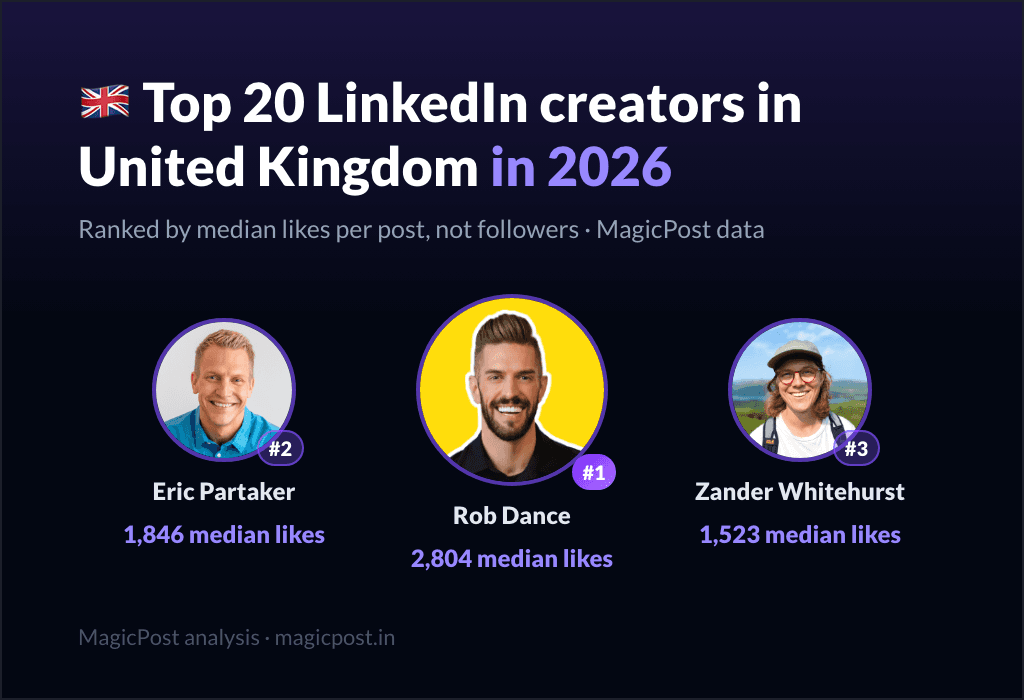
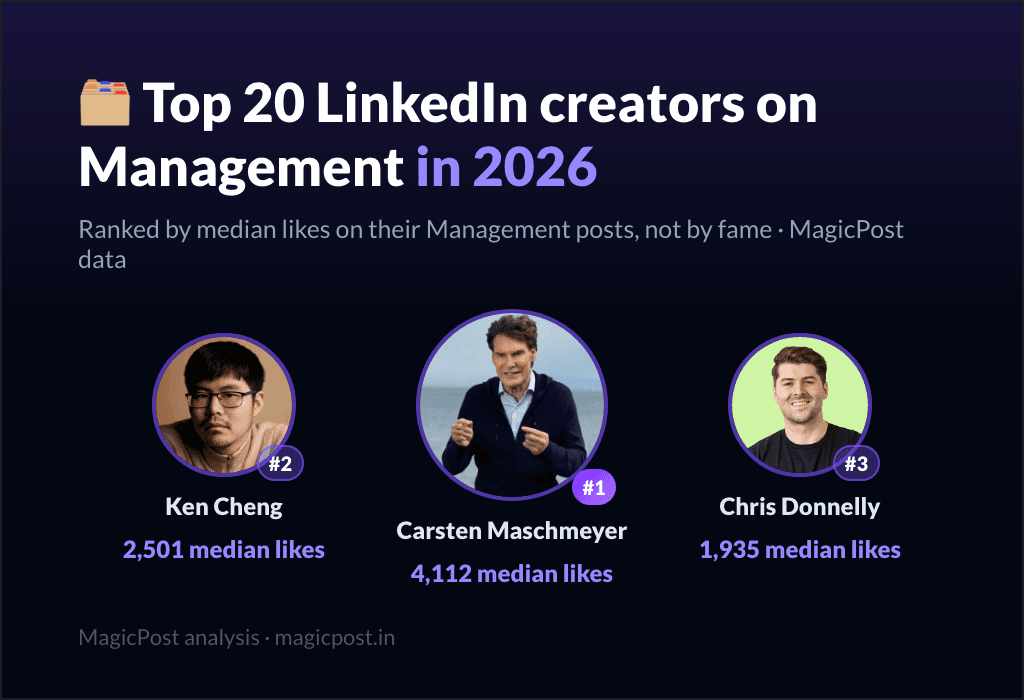
Our 2026 rankings measure the standing: Cheng is #7 among the top LinkedIn creators in the UK and #2 among the top LinkedIn creators on management. A satirist of bad bosses ranks second on management.
The medians track engagement per post; how fast his audience grew is outside our data.
Where do these charts come from? Everything on this page runs on MagicPost's LinkedIn analytics, and it works on your profile too: your best posts, your audience, your benchmark, even a side-by-side with creators like Ken Cheng.
How Ken Cheng writes
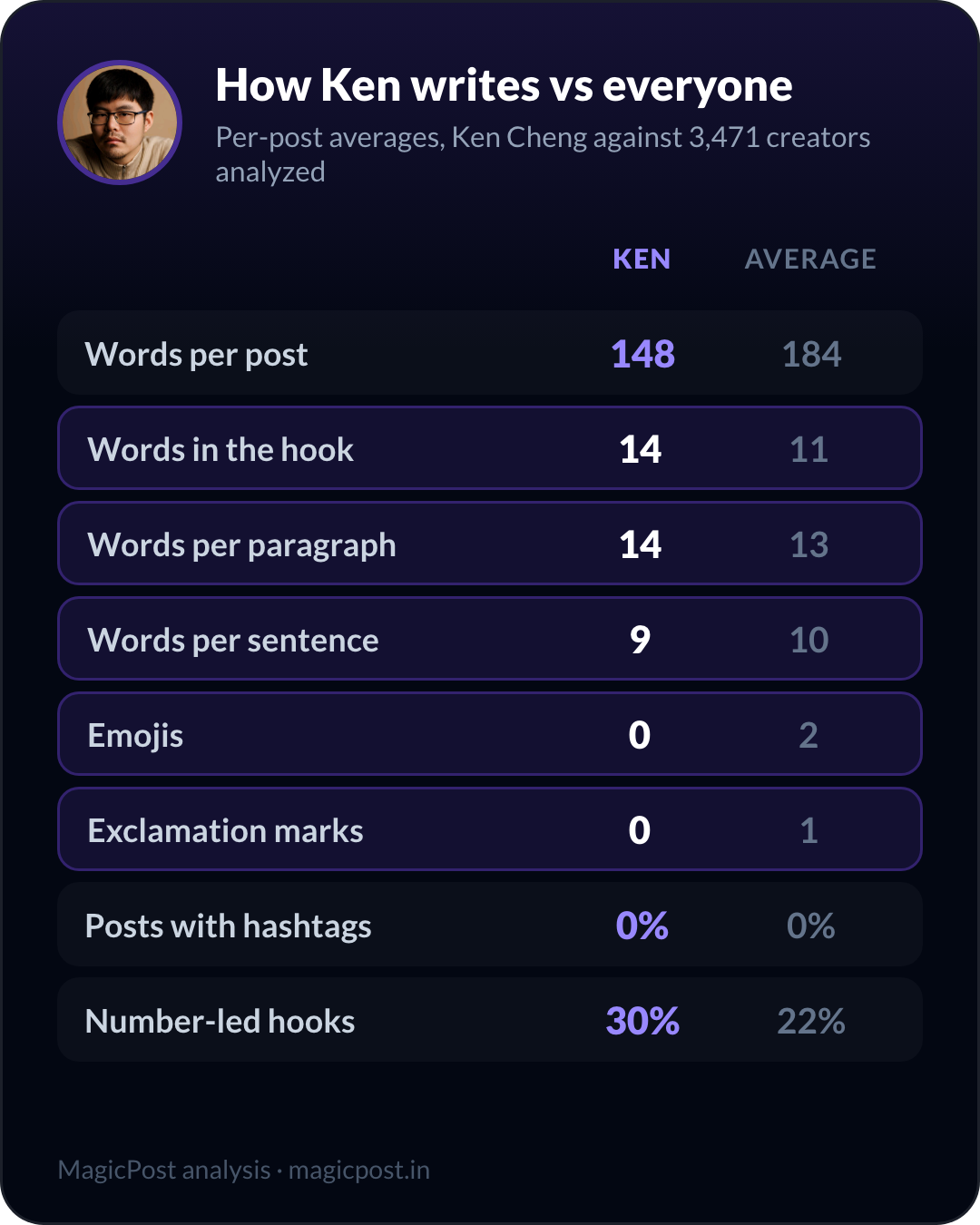
Metric (per post) | Ken Cheng | Average creator* |
Words | 148 | 184 |
Words in the hook | 14 | 11 |
Words per paragraph | 14 | 13 |
Words per sentence | 9 | 10 |
Emojis | 0 | 2 |
Exclamation marks | 0 | 1 |
Posts with hashtags | 0% | 0% |
Hooks built on numbers | 30% | 22% |
*Median across the 3,471 creators in our benchmark.
Paragraphs at 14 words and sentences at 9 sit almost exactly on the average. That is the point: parody only works if the form is a perfect copy of the thing it mocks. Cheng writes the standard LinkedIn post, one sentence per line, and changes only what it says.
Two numbers break from the norm. His hooks run 14 words against 11, because the first line carries the whole premise ("I owed a friend £22.91 for an Uber."). And 30% of hooks open on a number, usually an oddly exact one: £50,000, the 964th round, 57.6-minute hours.
Then the four zeros: no emojis, no hashtags, no bold, no exclamation marks. A deadpan voice needs no volume. Our style classifier labels the voice narrative, with a humorous tone.
The "AI tells" in Ken Cheng's style (read this the right way)
Checked against the usual "AI tells," Cheng's fingerprint comes back almost clean:
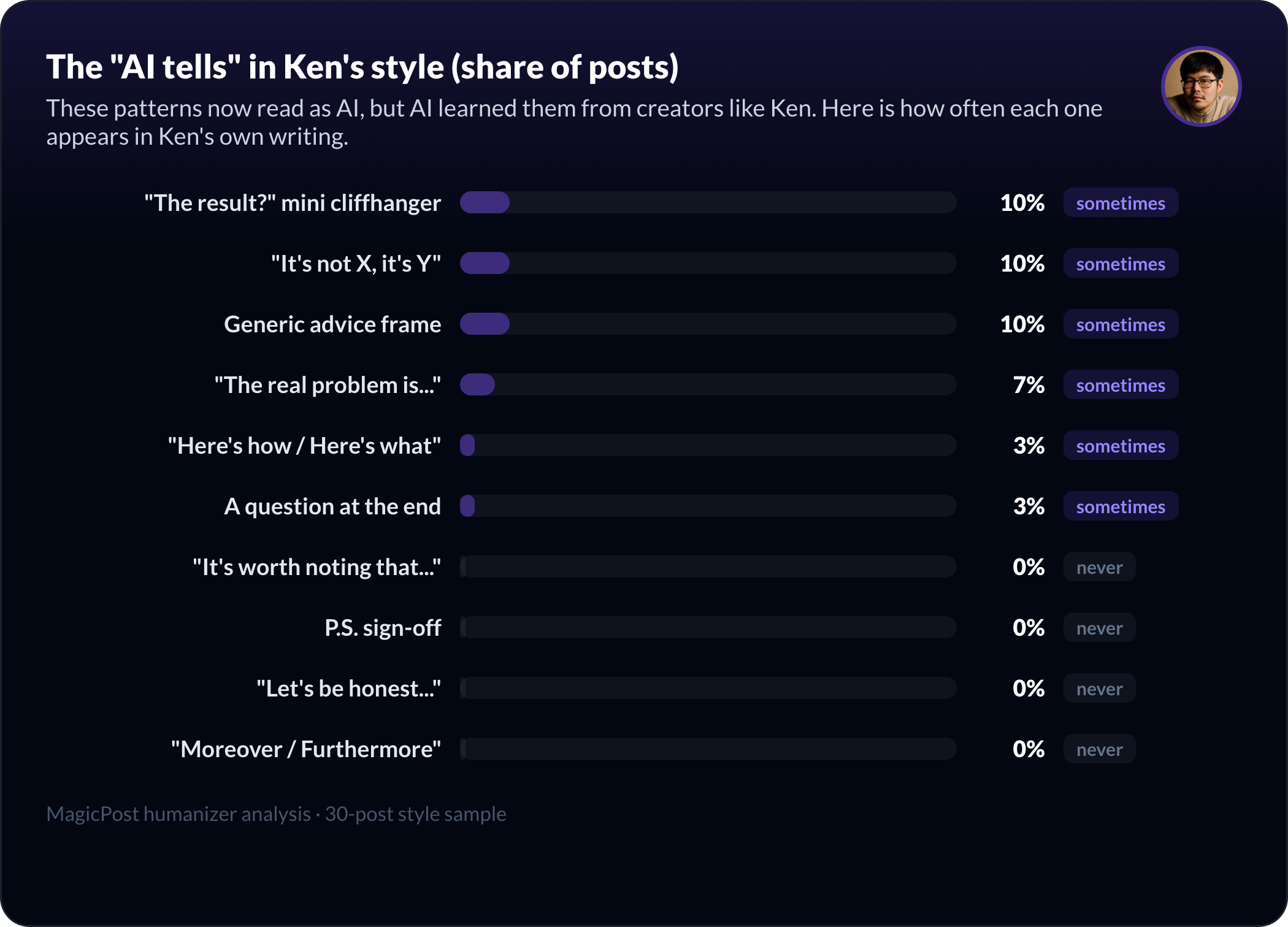
No device reaches "characteristic" level. The most frequent, at one post in ten each, are the contrast formula, the reveal bridge and the generic advice frame. A here-is announcement shows up in 3% of posts.
When he uses them, they are props. The posture post runs the contrast formula straight-faced, and the reveal is where the punchline lives ("Why? Because I was lonely."). AI learned these moves from LinkedIn's creators; Cheng borrows them to show how they sound.
Four devices never appear: hedging, the "Moreover" transition, the automatic postscript, and fake sincerity. That last zero is the best one: his whole material is fake sincerity, yet he never uses its vocabulary. The sincerity sits in the situation. (More: how to spot AI writing on LinkedIn.)
He has also written about AI directly. "AI will never be able to write like me," a 2025 post begins, "Because I am now inserting random sentences into every post to throw off their language learning models." It earned 18,738 likes and 912 reposts.
When does Ken Cheng post on LinkedIn?
Cheng publishes just under 3 times a week, favorite slot Monday at 10 AM London time. Only 11% of posts go out between 6 and 9 AM, and 13% land on weekends.
That mid-morning slot fits the working-hours pattern in our UK timing data, at a pace our posting-frequency study rates sustainable. A median of 89 comments per post shows readers playing along.
To reply while the joke is fresh, an engagement feed brings each new Cheng post to you as it goes out.
What to steal from Ken Cheng
Load the premise into line one. 14-word hooks, three above average.
Make the number do the joke. 30% of hooks open on a precise figure.
Turn a format into a franchise. Six job-interview posts, 1,814 to 6,463 likes.
Save the reversal for the last line. "He was now too old for the position."
Copy the form exactly. 9-word sentences against a 10-word norm, zero emojis, then the twist.
Study the satirist, then study yourself. With MagicPost you can dig into Ken Cheng's numbers the way we just did, analyze your own LinkedIn analytics with the same depth, and write in the spirit of his style, in your own voice. The data on this page is the product.
The posts behind this profile
Every quote above comes from one of Ken Cheng's own public LinkedIn posts. The ones that carry the story:
His biggest posts of 2026:
Where this data comes from
Everything in this article is MagicPost's own research. MagicPost analyzed 296 Ken Cheng posts from the last two years (492 back to 2023): timing, engagement, topics, register, writing metrics, and the AI-pattern profile from a 30-post style sample. The benchmark is the median of 3,471 creator profiles.
Every biographical claim is quoted from one of his own public LinkedIn posts, listed above, or from his public profile. Ken Cheng is not affiliated with MagicPost; his style is one of those MagicPost tracks most closely.
FAQ
Who is Ken Cheng?
Ken Cheng is a London-based LinkedIn creator with about 230,000 followers who satirizes the LinkedIn thought-leader genre in the voice of a self-adoring CEO. His headline reads "I want to connect with you, emotionally :)"
Are Ken Cheng's LinkedIn posts real stories?
No. Ken Cheng's posts are satire, and that is the craft: each post copies the shape of a sincere LinkedIn story and turns it inside out in the final lines.
The one hard number he celebrates, 200,000 followers, is consistent with the 230,000 we measure today.
How often does Ken Cheng post on LinkedIn?
Ken Cheng posts just under 3 times a week in our data, most often on Monday at 10 AM London time, with 13% of posts on weekends.
Does Ken Cheng write with AI?
Ken Cheng's fingerprint is one of the cleanest we measure: no device at characteristic level, and zero hedging or fake sincerity. He even wrote a post, 18,738 likes, about scrambling his sentences so that "AI will never be able to write like me."
Is Ken Cheng still growing on LinkedIn?
Ken Cheng's median likes per post rose from 31 (2023) to 430 (2024) to 1,934 (2025), one of the steepest climbs we track. 2026 runs at 1,287 so far, below the peak and three times 2024.
Can I write like Ken Cheng?
You can learn the mechanics: MagicPost learns a creator's writing style (length, rhythm, hooks, signature moves) and helps you write in that spirit, in your own voice.