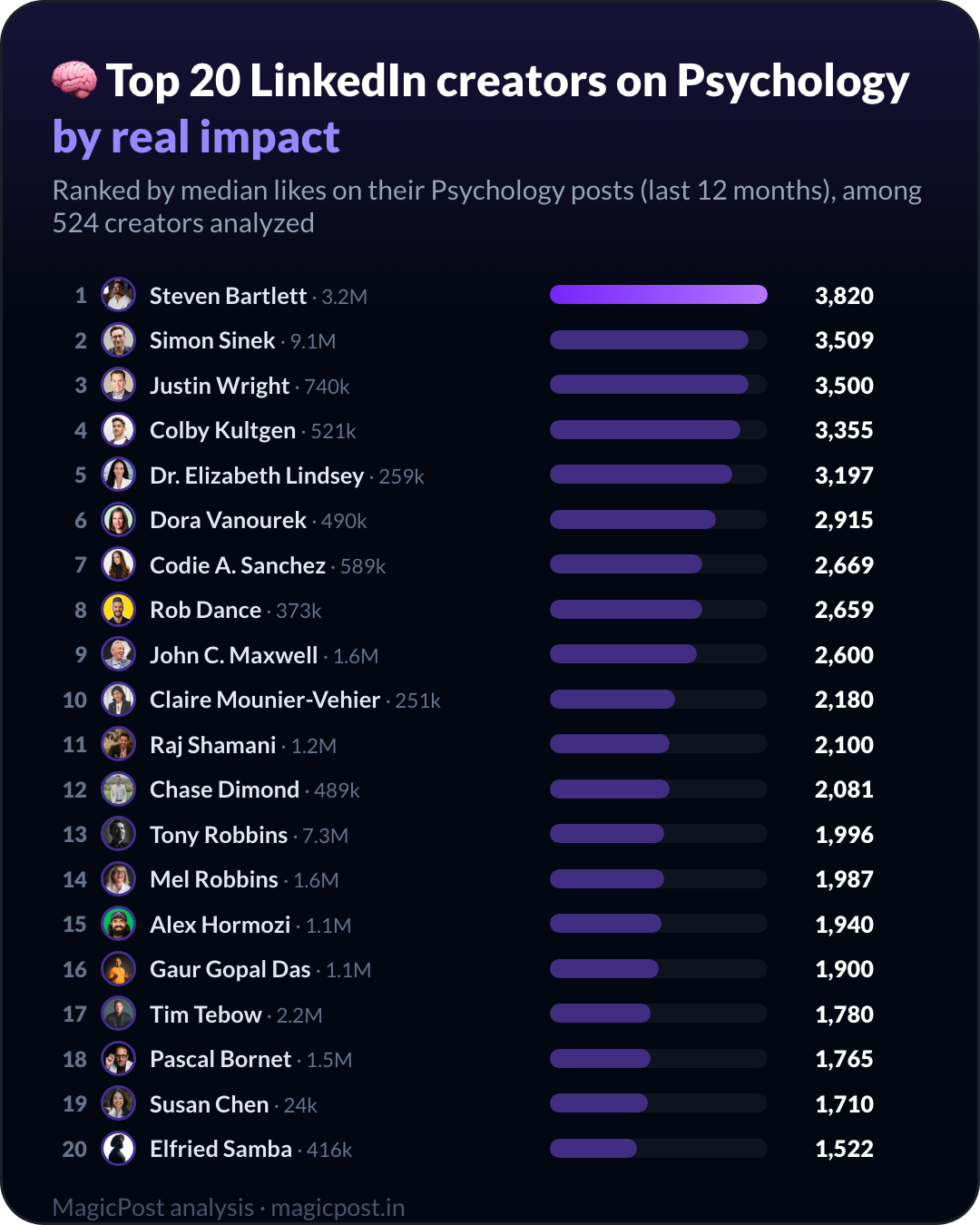
Most lists of "top psychology influencers on LinkedIn" sort people by follower count. Followers tell you who subscribed once, not who still gets read. The biggest account in this ranking, Simon Sinek, holds 9.1 million followers and finishes second, behind a creator with about a third of his audience.
So we ranked psychology by a working measure instead. At MagicPost we took the 524 active creators in our dataset who post about psychology consistently (at least 10 psychology posts in the last 12 months, 5,000 followers minimum) and sorted them on median likes on their psychology posts alone.
Only creators with at least one post in the last 60 days are ranked, a rule new in this edition.
Our dataset holds 25,482 psychology posts from the last 12 months, and the typical one earns 83 likes. Number twenty here earns 18 times that. Steven Bartlett, at number one, earns 46 times that.
Two figures in each entry belong to theme rankings. The share of feed says whether psychology is their whole identity or a sideline. The vs overall median says whether their psychology posts beat their own usual median.
On this subject the second figure leans positive: 15 of the 20 earn more on psychology than on their usual post, led by an ecommerce email marketer, Chase Dimond (+1,201%).
Each entry carries a data card, a note on what stands out and the creator's most liked psychology post of the last 12 months. For a steady supply of posts like these, see MagicPost's post inspiration library.
The full board first, then the countdown:
What changed in the top 20 LinkedIn psychology creators since our last ranking
The pool is larger this time: 524 active psychology creators, against 394 in our previous edition.
Six names are new in this top 20, led by Steven Bartlett, who enters at #1, and Dora Vanourek at #6. Gaur Gopal Das (#16), Tim Tebow (#17), Susan Chen (#19) and Elfried Samba (#20) complete the list.
Simon Sinek holds #2. Among the climbers, Justin Wright moves from #9 to #3 and Rob Dance from #14 to #8. Raj Shamani goes the other way, from #3 to #11.
Six creators from our previous top 20 are no longer in it.
#20 · Elfried Samba, 1,522 median likes per psychology post
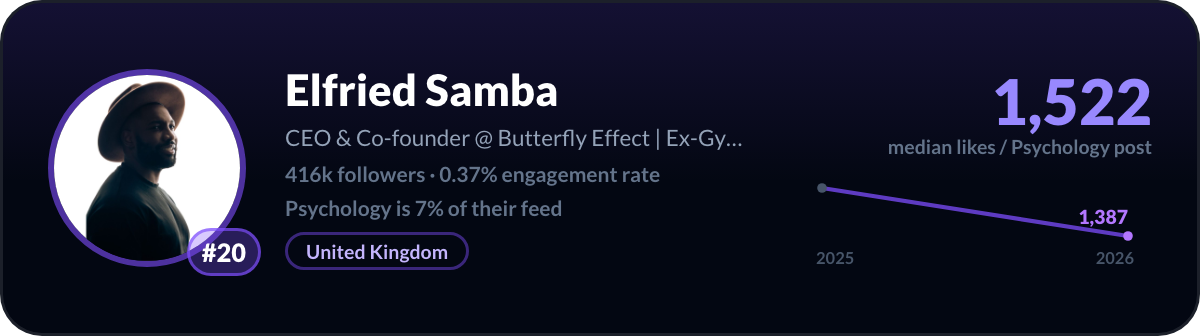
Followers | Median likes (psychology posts) | Psychology posts analyzed | Share of feed | vs overall median | Engagement rate |
416k | 1,522 | 26 | 7% | +176% | 0.37% |
Elfried Samba, chief executive and co-founder of Butterfly Effect and a former global head of social at Gymshark, is new in this edition. Psychology is 7% of his feed, yet those posts earn 176% more than his overall median, the second-largest premium in the top 20.
His psychology median fell from 2,532 in 2025 to 1,387 so far in 2026, the steepest drop from 2025 to 2026 in the top 20.
"Your mindset is either your greatest architect or your loudest critic." His most liked psychology post of the year, a two-sided metaphor in its first line: 4,789 likes, 3.1 times his median. Read it
#19 · Susan Chen, 1,710 median likes per psychology post
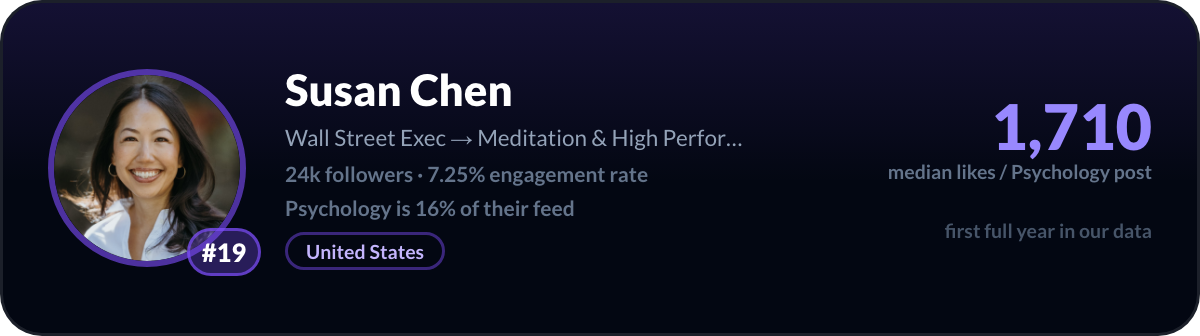
Followers | Median likes (psychology posts) | Psychology posts analyzed | Share of feed | vs overall median | Engagement rate |
24k | 1,710 | 31 | 16% | -16% | 7.25% |
Susan Chen, a former Wall Street executive who now teaches meditation and high performance, is new in this edition and the smallest account in the top 20, at 24k followers. Her 7.25% engagement rate is the highest on this page, and she leads the efficiency table below.
Her psychology posts earn 16% less than her overall median of 2,043 likes: the rest of her feed does even better.
"Most dreams die in inaction." Her most liked psychology post of the year: 5,576 likes and 572 comments, 3.3 times her median. Read it
#18 · Pascal Bornet, 1,765 median likes per psychology post
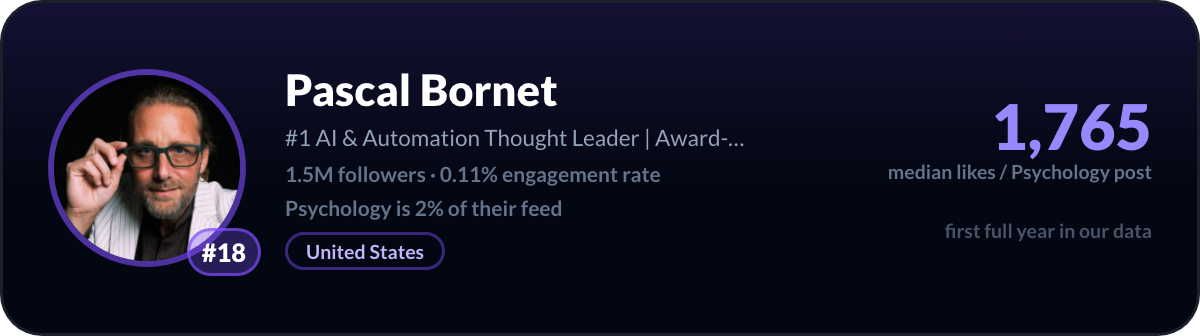
Followers | Median likes (psychology posts) | Psychology posts analyzed | Share of feed | vs overall median | Engagement rate |
1.5M | 1,765 | 12 | 2% | +31% | 0.11% |
Pascal Bornet, an author and keynote speaker on AI and automation, holds #18, the same rank as in our previous edition. He published 749 posts in 12 months, so his 12 psychology posts are 2% of his feed, the smallest share in the top 20.
They earn 31% more than his overall median. His best post earned 1.9 times his median, the second-smallest gap here after Dora Vanourek's.
"For years, I thought the answer to stress was elimination." His most liked psychology post of the year, below a first line set in bold Unicode letters: 3,412 likes, the smallest best post in the top 20. Read it
#17 · Tim Tebow, 1,780 median likes per psychology post
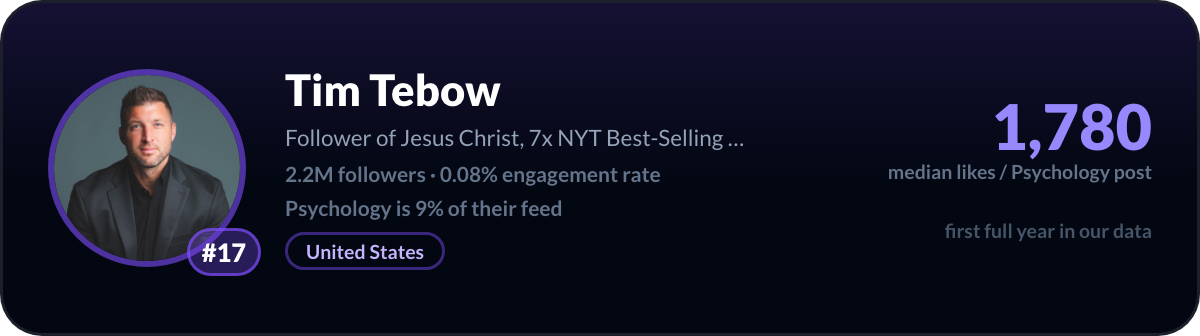
Followers | Median likes (psychology posts) | Psychology posts analyzed | Share of feed | vs overall median | Engagement rate |
2.2M | 1,780 | 16 | 9% | +3% | 0.08% |
Tim Tebow, a Heisman Trophy winner, ESPN analyst and founder of the Tim Tebow Foundation, is new in this edition. At 2.2 million followers he is the fourth-biggest account in the top 20, on a 0.08% engagement rate, the third-lowest here.
He gives psychology 9% of his feed, and it lands 3% above his overall median. His audience comments little: a median of 71, second-lowest in the top 20.
"I've come back to Romans 8:28 more times than I can count." His most liked post tagged psychology by our classifier, which introduces one day of his new devotional: 7,703 likes, 4.3 times his median. Read it
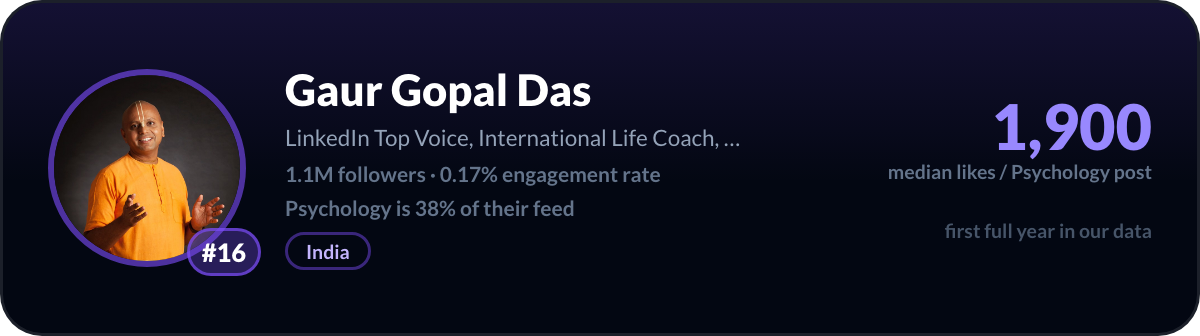
#16 · Gaur Gopal Das, 1,900 median likes per psychology post
Followers | Median likes (psychology posts) | Psychology posts analyzed | Share of feed | vs overall median | Engagement rate |
1.1M | 1,900 | 23 | 38% | +7% | 0.17% |
Gaur Gopal Das, a life coach, wellness adviser and author based in India, is new in this edition. He posted 61 times in 12 months, the smallest feed in the top 20, and 38% of it is psychology, the second-highest share here after Mel Robbins.
His psychology posts beat his overall median by 7%. His audience likes far more than it replies: a median of 67 comments, the lowest in the top 20.
"This gentleman spent two solid hours peacefully staring at what he thought was a lake. It was a fence." His most liked psychology post of the year, a joke that turns into a point about attention: 8,869 likes, 4.7 times his median. Read it
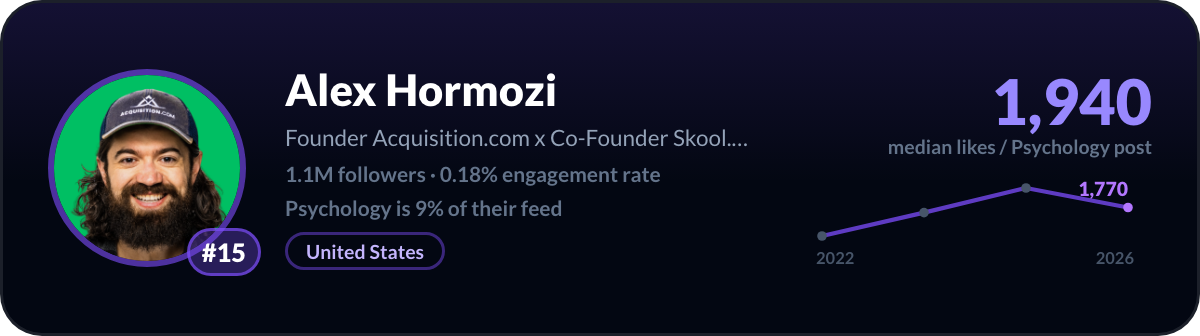
#15 · Alex Hormozi, 1,940 median likes per psychology post
Followers | Median likes (psychology posts) | Psychology posts analyzed | Share of feed | vs overall median | Engagement rate |
1.1M | 1,940 | 56 | 9% | -18% | 0.18% |
Alex Hormozi, founder of Acquisition.com and co-founder of Skool (see his data biography), is down from #12 in our previous edition. His 56 psychology posts are 9% of a 619-post year, and they earn 18% less than his overall median.
His posts average 22 words, tied with Raj Shamani for the shortest in the top 20. His psychology median was 2,650 in 2025 and is 1,770 so far in 2026.
"Pain tolerance > IQ" His most liked psychology post of the year, three words and a symbol: 5,971 likes and 587 comments. Read it
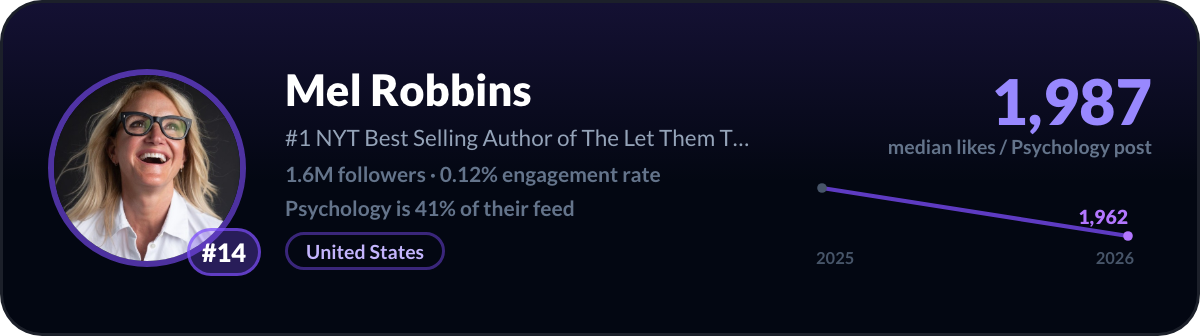
#14 · Mel Robbins, 1,987 median likes per psychology post
Followers | Median likes (psychology posts) | Psychology posts analyzed | Share of feed | vs overall median | Engagement rate |
1.6M | 1,987 | 155 | 41% | +14% | 0.12% |
Mel Robbins, author of The Let Them Theory and host of The Mel Robbins Podcast, is down from #11 in our previous edition. She is the volume record of this ranking: 155 psychology posts in 12 months, 41% of her feed, both the highest in the top 20.
They earn 14% more than her overall median. Her psychology median went from 2,366 in 2025 to 1,962 so far in 2026, on 125 posts this year alone.
The volume adds up: 463,824 likes on psychology, the most in our pool.
"Let this be your permission slip today." Her most liked psychology post of the year, written as an instruction to the reader: 18,749 likes, 9.4 times her median. Read it
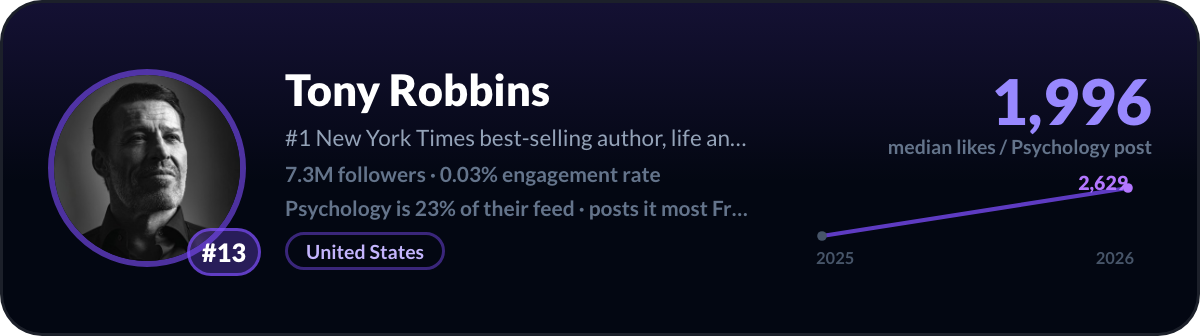
#13 · Tony Robbins, 1,996 median likes per psychology post
Followers | Median likes (psychology posts) | Psychology posts analyzed | Share of feed | vs overall median | Engagement rate |
7.3M | 1,996 | 51 | 23% | +65% | 0.03% |
Tony Robbins, the author and life and business strategist, holds #13, the same rank as in our previous edition. His 7.3 million followers make him the second-biggest account in the top 20, on a 0.03% engagement rate, the lowest here.
At 23% of his feed, psychology earns him 65% more than his overall median. His psychology median rose from 1,443 in 2025 to 2,629 so far in 2026, the steepest rise from 2025 to 2026 in the top 20.
"Reminder: class is in session. It’s called LIFE. Don’t waste a minute." His most liked psychology post of the year, signed from Saint-Tropez: 13,407 likes, 6.7 times his median. Read it
#12 · Chase Dimond, 2,081 median likes per psychology post
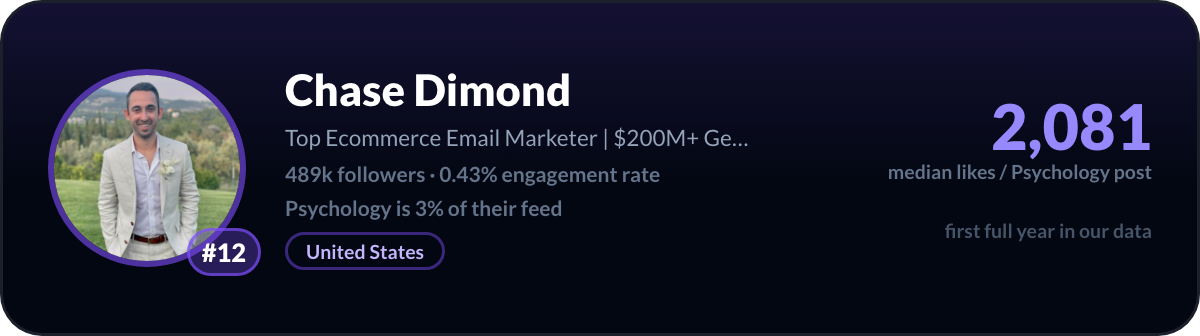
Followers | Median likes (psychology posts) | Psychology posts analyzed | Share of feed | vs overall median | Engagement rate |
489k | 2,081 | 24 | 3% | +1201% | 0.43% |
Chase Dimond, an ecommerce email marketer, is down from #10 in our previous edition. He published 925 posts in 12 months, the most in the top 20, and psychology is only 3% of them.
Those 24 posts carry his rank. His overall median is 160 likes, so his psychology posts earn 1,201% more than his usual post, by far the largest premium on this page. So far in 2026 his psychology median is 2,508.
"The older I get, the more I realize: Starting again is a skill." His most liked psychology post of the year, one short line per thought: 6,637 likes, 3.2 times his median. Read it
#11 · Raj Shamani, 2,100 median likes per psychology post
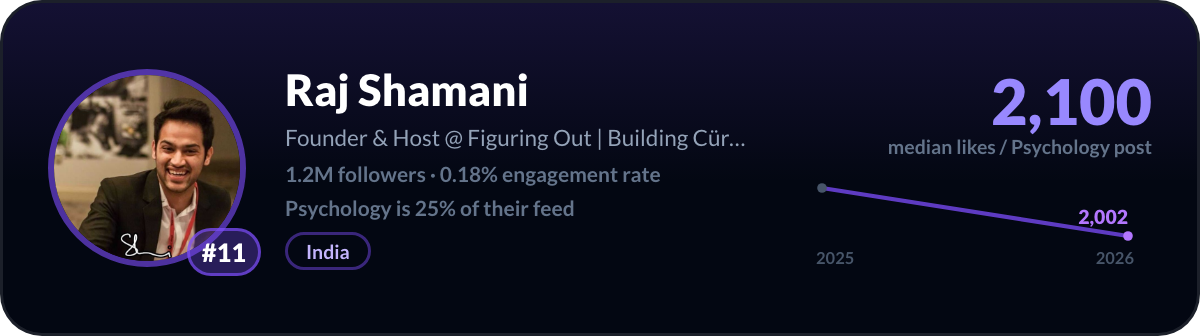
Followers | Median likes (psychology posts) | Psychology posts analyzed | Share of feed | vs overall median | Engagement rate |
1.2M | 2,100 | 59 | 25% | -32% | 0.18% |
Raj Shamani, founder and host of Figuring Out and a bestselling author, is down from #3 in our previous edition. Psychology takes 25% of his feed, 59 posts, yet they earn 32% less than his overall median, the steepest discount in the top 20.
He still leads our India ranking on everything he posts. His psychology median held near 2,000: 2,051 in 2025, 2,002 so far in 2026.
"There is a point where self-awareness stops healing you and starts numbing you." His most liked psychology post of the year, and the most recent best post in this top 20: 11,316 likes, 5.4 times his median. Read it
#10 · Claire Mounier-Vehier, 2,180 median likes per psychology post
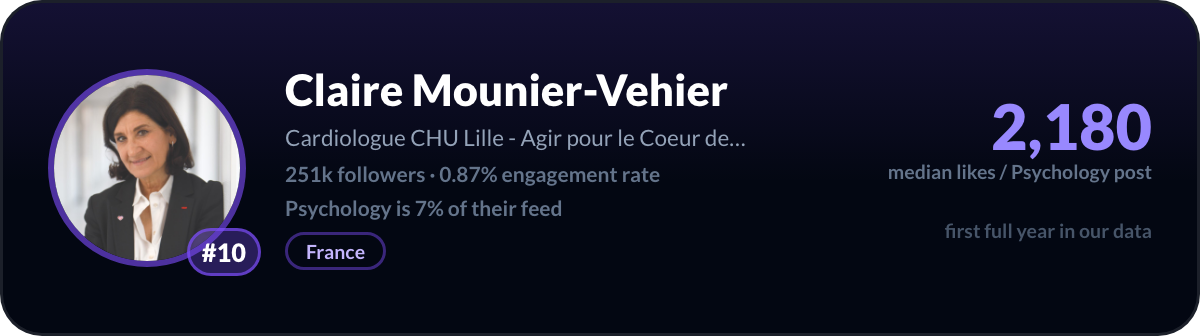
Followers | Median likes (psychology posts) | Psychology posts analyzed | Share of feed | vs overall median | Engagement rate |
251k | 2,180 | 18 | 7% | +43% | 0.87% |
Claire Mounier-Vehier, a cardiologist at Lille University Hospital and professor of vascular medicine, is down from #6 in our previous edition. She is the only France-based creator in the top 20.
She also leads our ranking of the top LinkedIn mental health creators, where five other names from this page appear.
Psychology is 7% of her feed and earns 43% more than her overall median. Her 0.87% engagement rate is the third-highest in the top 20, while her audience comments little: a median of 77, third-lowest here.
"C'est aussi un entrainement ! A nous de cultiver notre attention au positif." Her most liked psychology post of the year, in French, with an emoji after each of its first two key words: 6,288 likes, 2.9 times her median. Read it
#9 · John C. Maxwell, 2,600 median likes per psychology post
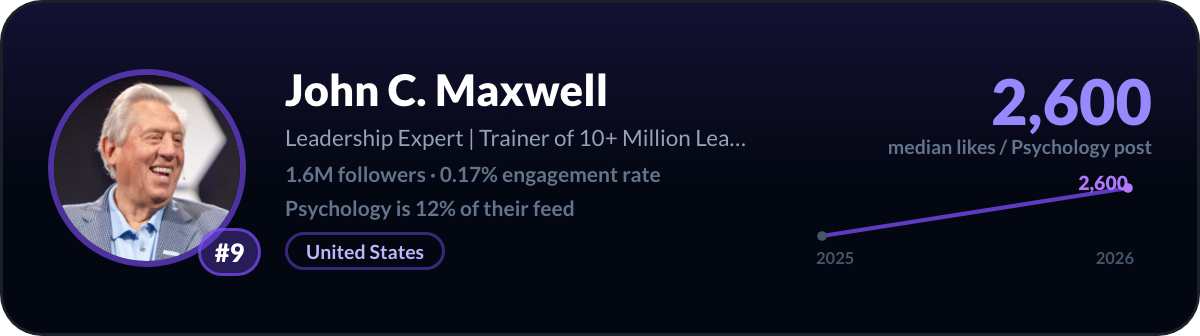
Followers | Median likes (psychology posts) | Psychology posts analyzed | Share of feed | vs overall median | Engagement rate |
1.6M | 2,600 | 16 | 12% | +7% | 0.17% |
John C. Maxwell, a leadership expert and trainer whose headline counts more than 10 million leaders trained, is down from #8 in our previous edition. His psychology posts, 12% of his feed, earn 7% more than his overall median.
His posts average 38 words, and none of his hooks we measured opens on a number, the only 0% among the top-20 creators we hold writing data for. His psychology median rose from 2,493 in 2025 to 2,600 so far in 2026.
"Are we going to take responsibility and make adjustments?" His most liked psychology post of the year, which lists setbacks before it asks this: 5,657 likes. Read it
#8 · Rob Dance, 2,659 median likes per psychology post
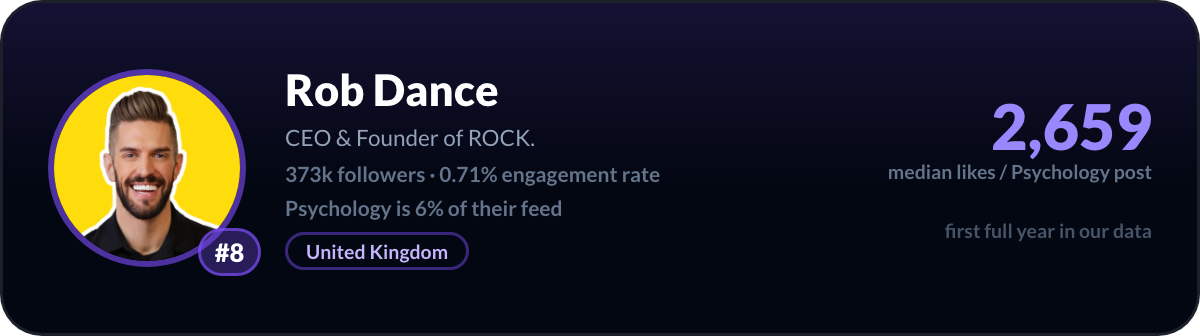
Followers | Median likes (psychology posts) | Psychology posts analyzed | Share of feed | vs overall median | Engagement rate |
373k | 2,659 | 18 | 6% | +33% | 0.71% |
Rob Dance, chief executive and founder of ROCK, is up from #14 in our previous edition. His audience comments more than anyone's in the top 20: a median of 761 comments per psychology post.
On 6% of his feed, psychology earns 33% more than his overall median. Our psychology median for him covers 2026 only, with 2,402 so far.
"People talk themselves out of things before they even have a chance to begin." His most liked psychology post of the year, followed by a list of small events read as verdicts: 5,951 likes and 924 comments. Read it
#7 · Codie A. Sanchez, 2,669 median likes per psychology post
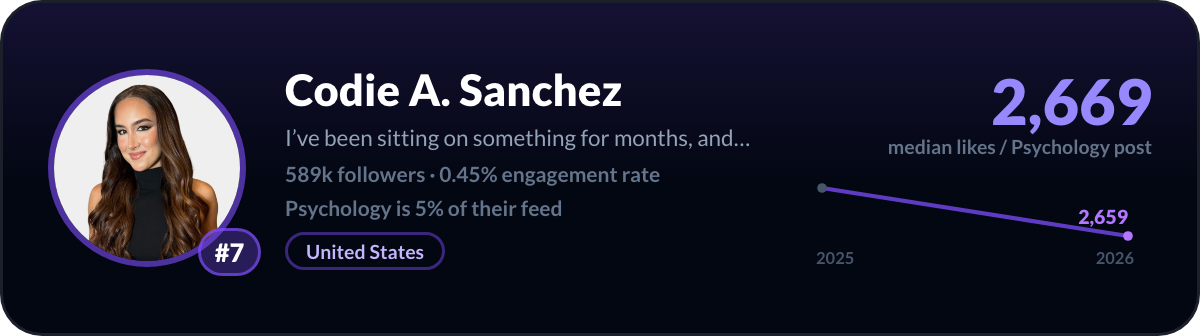
Followers | Median likes (psychology posts) | Psychology posts analyzed | Share of feed | vs overall median | Engagement rate |
589k | 2,669 | 18 | 5% | +99% | 0.45% |
Codie A. Sanchez invests in Main Street businesses and teaches people how to buy them. She is down from #4 in our previous edition, on 18 psychology posts, 5% of a 386-post year.
Those posts earn 99% more than her overall median, nearly twice her usual figure. Her psychology median has barely moved: 2,665 in 2025, 2,659 so far in 2026.
"Never too late." Her most liked post tagged psychology by our classifier, three words of text: 7,048 likes, 2.6 times her median. Read it
#6 · Dora Vanourek, 2,915 median likes per psychology post
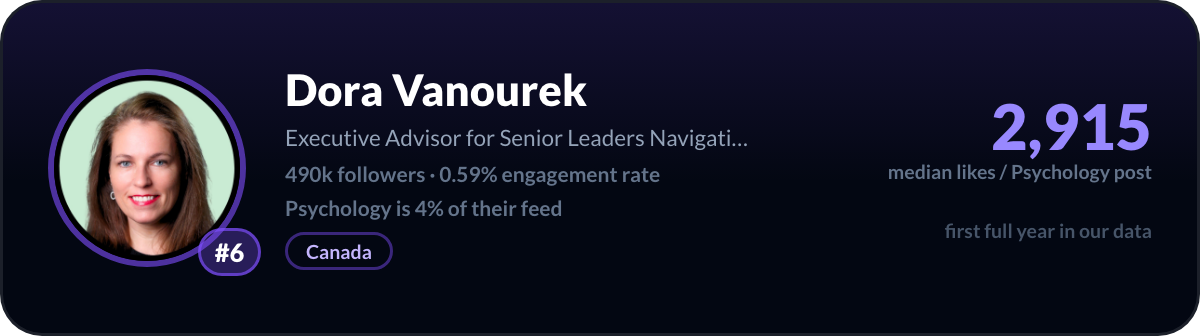
Followers | Median likes (psychology posts) | Psychology posts analyzed | Share of feed | vs overall median | Engagement rate |
490k | 2,915 | 13 | 4% | +118% | 0.59% |
Dora Vanourek, a Canada-based adviser to senior leaders moving into a new role, formerly at IBM and PwC, is new in this edition, and the highest new entry after our number one.
Her place rests on 13 psychology posts, 4% of her feed, and they earn 118% more than her overall median of 1,338 likes. Her best post earned 1.7 times her median, the smallest gap in the top 20: the rank rests on consistency.
"Self-doubt kills more careers than bad bosses ever could." Her most liked psychology post of the year, followed by a list of traps marked with crosses: 5,063 likes and 816 comments. Read it
#5 · Dr. Elizabeth Lindsey, 3,197 median likes per psychology post
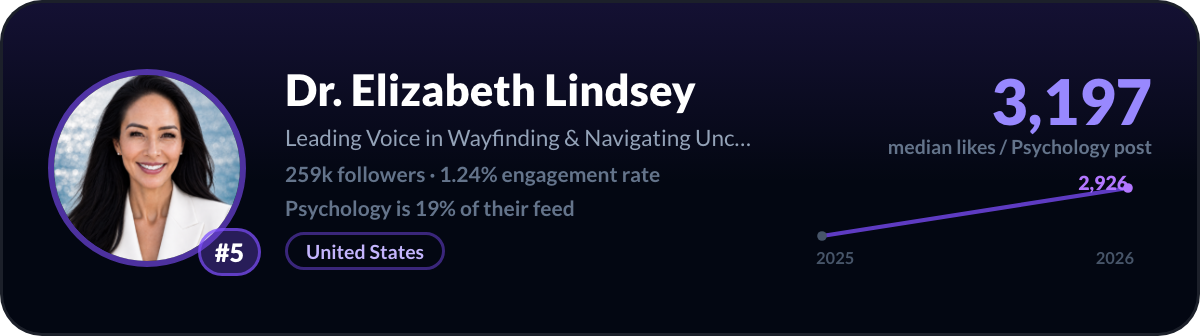
Followers | Median likes (psychology posts) | Psychology posts analyzed | Share of feed | vs overall median | Engagement rate |
259k | 3,197 | 65 | 19% | +15% | 1.24% |
Dr. Elizabeth Lindsey, a National Geographic Explorer who advises chief executives on navigating uncertainty, is up from #7 in our previous edition. Her 65 psychology posts are the second-most in the top 20, after Mel Robbins.
Her 1.24% engagement rate is the highest among the top-20 creators over 100k followers. Her psychology median held steady, 2,885 in 2025 and 2,926 so far in 2026, and she ranks sixth in total psychology likes (202,770).
"'I can't' is a lie. 'I'll learn' is freedom." Her most liked psychology post of the year, two quoted phrases set against each other: 8,687 likes and 681 comments. Read it
#4 · Colby Kultgen, 3,355 median likes per psychology post
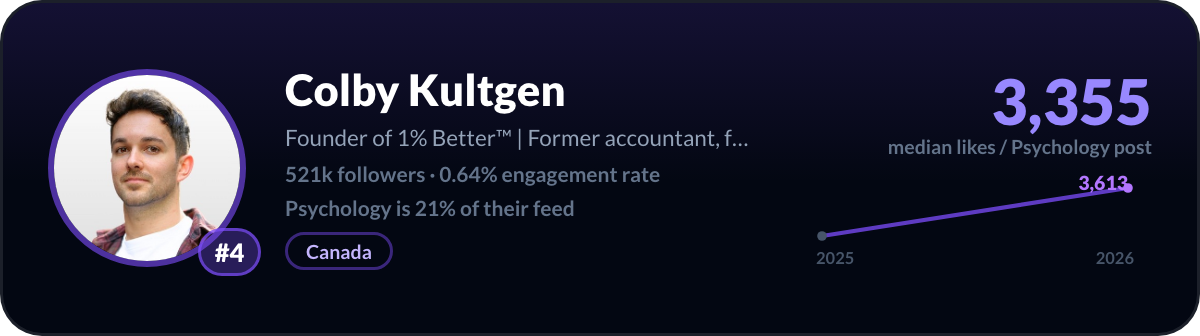
Followers | Median likes (psychology posts) | Psychology posts analyzed | Share of feed | vs overall median | Engagement rate |
521k | 3,355 | 56 | 21% | +62% | 0.64% |
Colby Kultgen, a former accountant who founded 1% Better and is based in Canada, is up from #5 in our previous edition. Psychology is 21% of his feed, 56 posts, and they earn 62% more than his overall median.
His psychology median rose from 2,558 in 2025 to 3,613 so far in 2026, above his 12-month figure. He ranks fifth in total psychology likes (222,345).
"As humans, we're hardwired to focus on what we lack. Our brains have literally evolved to notice problems." His most liked psychology post of the year, which opens on an admission before any argument: 20,367 likes, the second-biggest post on this page. Read it
#3 · Justin Wright, 3,500 median likes per psychology post
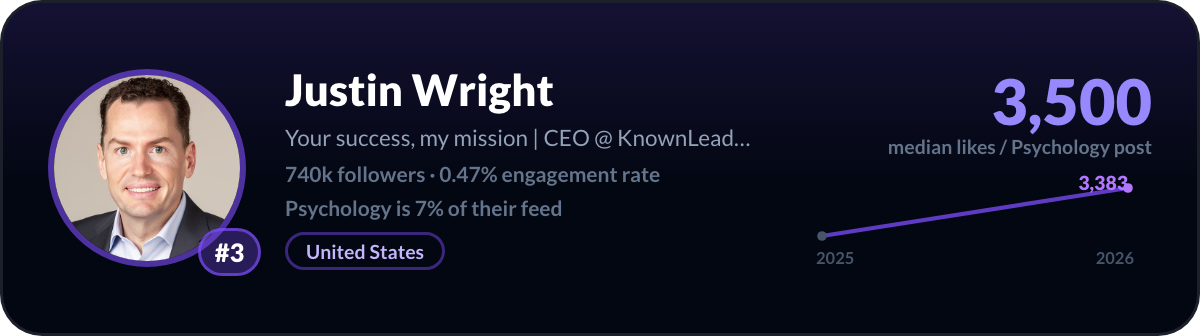
Followers | Median likes (psychology posts) | Psychology posts analyzed | Share of feed | vs overall median | Engagement rate |
740k | 3,500 | 23 | 7% | -1% | 0.47% |
Justin Wright, chief executive of KnownLeaders and Polished Carbon and a former CIO of a $4B company, is up from #9 in our previous edition, a six-place climb matched only by Rob Dance.
His 23 psychology posts, 7% of his feed, land 1% below his overall median. His audience talks back: a median of 587 comments, second only to Rob Dance here. His psychology median rose from 2,602 in 2025 to 3,383 so far in 2026.
"Growing up, my dad always said, 'Empathy is the highest form of intelligence.'" His most liked psychology post of the year, a lesson told through his father: 6,949 likes, only twice his median. Read it
#2 · Simon Sinek, 3,509 median likes per psychology post
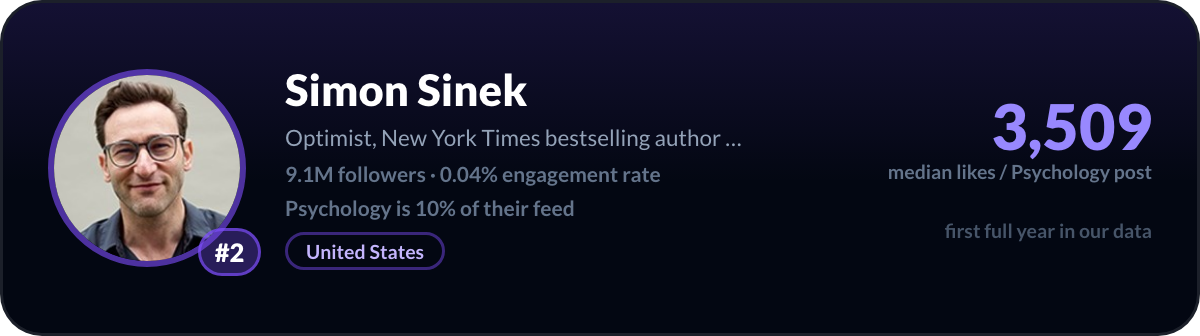
Followers | Median likes (psychology posts) | Psychology posts analyzed | Share of feed | vs overall median | Engagement rate |
9.1M | 3,509 | 24 | 10% | +5% | 0.04% |
Simon Sinek, author of Start with Why and The Infinite Game and founder of The Optimism Company, holds #2, as in our previous edition. He has the biggest audience in the ranking, 9.1 million followers, on a 0.04% engagement rate, second-lowest here.
Psychology is 10% of his feed and earns 5% more than his overall median. His posts average 34 words. Our psychology median for him covers 2026 only: 3,542 so far, above his 12-month figure.
"Kindness and niceness aren’t the same thing." His most liked psychology post of the year, which then gives each word its own definition: 33,818 likes, 9.6 times his median and the single biggest post on this page. Read it
#1 · Steven Bartlett, 3,820 median likes per psychology post
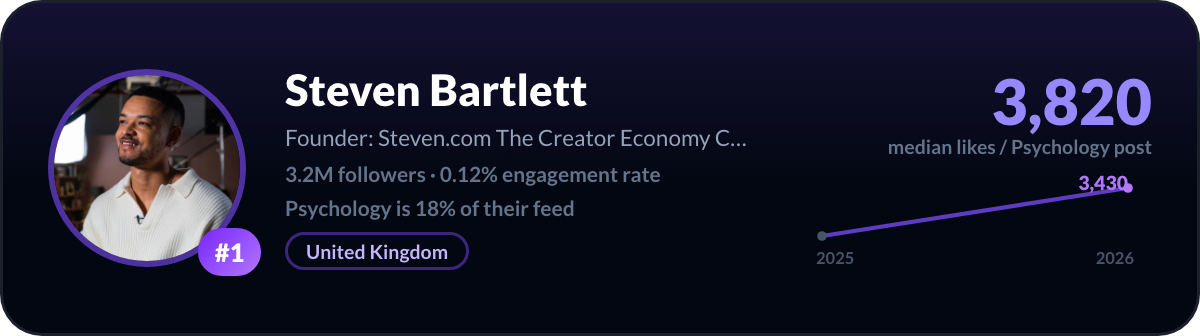
Followers | Median likes (psychology posts) | Psychology posts analyzed | Share of feed | vs overall median | Engagement rate |
3.2M | 3,820 | 47 | 18% | -4% | 0.12% |
Steven Bartlett (see the data biography), founder of Steven.com, the creator economy company behind FlightStory and FlightCast, is new in this edition and holds #1 with 3,820 median likes per psychology post, 46 times the typical psychology post we measured and 311 likes ahead of number two.
Psychology is 18% of his feed and lands 4% below his overall median. His psychology median rose from 2,959 in 2025 to 3,430 so far in 2026.
He writes the longest posts among the top-20 creators we hold writing data for, 237 words on average. He also leads our wellness ranking and ranks third in total psychology likes (257,938), on 47 posts.
"Several years ago I was working in a call centre in Manchester on Christmas Day for a company called LateRooms.com" His most liked psychology post of the year, which opens with a line to readers having a hard Christmas: 19,278 likes and 1,254 comments, the most on any best post here. Read it
Where do these cards come from? We computed every figure on this page from public posts with MagicPost's LinkedIn analytics: median engagement per theme, share of feed, theme premiums and trajectories, across 524 creators and 25,482 psychology posts. It works on your profile too, including a side-by-side with anyone on this list.
Which psychology creators just missed the top 20?
Five names sit right behind the cut, all within 202 likes of number twenty:
Rank | Creator | Median likes (psychology) | Followers | Share of feed |
#21 | 1,519 | 981k | 12% | |
#22 | 1,495 | 384k | 13% | |
#23 | 1,360 | 431k | 4% | |
#24 | 1,330 | 715k | 32% | |
#25 | 1,320 | 137k | 6% |
Rachel Mitchell, at #21, misses the cut by 3 likes, on 44 psychology posts. Patrick Bet-David, at #22, earns 17% more on psychology than on his usual post, on 11 posts.
Sahil Bloom, at #24, posted 143 psychology posts in 12 months, a count only Mel Robbins beats in the top 20, and ranks fourth in total psychology likes (224,477). Leonardo Freixas, at #25, draws the most comments of the five, a median of 663.
Which LinkedIn psychology creators have the highest engagement rate?
Raw likes flatter the largest followings, so divide by reach: engagement rate on psychology posts, median likes divided by followers (20k followers and over):
Creator | Followers | Engagement rate | Median likes (psychology) |
24k | 7.25% | 1,710 | |
41k | 2.66% | 1,089 | |
34k | 2.57% | 868 | |
33k | 2.50% | 827 | |
42k | 2.50% | 1,052 |
Susan Chen (#19) is the only one of the five inside the top 20, and her 7.25% is nearly three times the next figure. Joshua Freedman, chief executive of Six Seconds, who trains leaders in emotional intelligence, comes second.
James Ware, a UK-based flow state performance coach, gives psychology 52% of his feed. Dr. Selina Hehl, an Austria-based psychologist, and Anoushka Jena, a marketing storyteller based in India, tie at 2.50%.
The top 20 itself runs from Susan Chen's 7.25% down to Tony Robbins's 0.03%, about a 240-fold spread. For how psychology compares with other subjects, see our study of LinkedIn engagement rate by topic.
Which psychology creators get the most total likes on LinkedIn?
One more cut counts the total likes on psychology posts over 12 months, where frequent posters gain ground:
Creator | Total likes on psychology (12 mo) | Psychology posts |
463,824 | 155 | |
272,839 | 333 | |
257,938 | 47 | |
224,477 | 143 | |
222,345 | 56 | |
202,770 | 65 | |
189,687 | 59 | |
165,367 | 51 |
Mel Robbins leads with 463,824 likes, 1.7 times Gary Vaynerchuk in second place, on 155 posts. Steven Bartlett takes third on 47, the fewest in the table.
Six of the eight come from the top 20. Gary Vaynerchuk (see his data biography) gets in without a place in it, on 333 psychology posts, the most in the table, and so does Sahil Bloom (#24 above), on 143.
Which LinkedIn psychology creator gets the most comments per post?
This cut divides comments by likes. The record in our psychology pool belongs to Fatima Khan, co-founder and chief marketing officer of Takivo, with 7k followers: 158 median comments against 121 median likes, about 1.3 comments for every like.
The typical top-20 creator gets one comment for every 10 likes. Okeowo Temiloluwa Emmanuel, at 1.26 comments per like, and Melina Panetta, at 1.23, complete the podium (counting creators with 100+ median likes).
Are the top LinkedIn psychology creators full-time psychology voices?
None of them is. Of the 524 creators who post about psychology consistently, 13 give it at least half their feed, and none of them reaches this top 20. The highest share here is Mel Robbins's 41%, ahead of Gaur Gopal Das (38%) and Raj Shamani (25%).
At the other end sit Pascal Bornet (2%), Chase Dimond (3%) and Dora Vanourek (4%).
Focus does not decide the premium. The four biggest premiums all go to creators who give psychology 7% of their feed or less:
Chase Dimond: +1,201%
Elfried Samba: +176%
Dora Vanourek: +118%
Codie A. Sanchez: +99%
The four creators who give psychology the highest share of their feed land between -32% (Raj Shamani) and +65% (Tony Robbins). In all, 15 of the 20 earn more on psychology than on their other posts and 5 earn less.
The top 20 is mostly American: 12 creators are based in the United States, 3 in the United Kingdom, 2 each in Canada and India, and one in France.
Country by country rankings: the United States, the UK, Canada, India, France, the full series.
For a neighboring theme, see the top LinkedIn leadership creators, where nine of these twenty also rank, Steven Bartlett third.
And if showing up in these creators' comment sections is part of your plan, an engagement feed keeps it to a five-minute daily habit.
How we ranked the top LinkedIn psychology creators
All of this is MagicPost's own research. We went through 25,482 psychology posts from the last 12 months and ranked 524 creators by median likes on their psychology posts.
Only creators with at least one post in the last 60 days are ranked. The method:
Floors: at least 5,000 followers and 10 psychology posts in the window; deleted posts excluded.
Median rather than average: no single viral post can buy a place.
Psychology posts only: each post gets a theme from our own classification, and only those posts count.
Psychology posts analyzed: the posts our dataset holds per creator, sometimes fewer than they published.
Per creator: share of feed, premium over their own median, psychology median by year, engagement rate and comment ratio.
Thirteen of the twenty medians rest on 12 to 31 psychology posts, so a few posts can move those ranks. Rankings refresh as the data does. No placement here was sponsored; every rank comes straight from the median.
Study them, then study yourself. With MagicPost you can analyze any psychology creator the way we just did (median engagement by theme, share of feed, premiums, trajectory) and benchmark your own profile against the pool. The data on this page is the product.
FAQ
Who is the top psychology creator on LinkedIn in 2026?
Steven Bartlett, founder of Steven.com, is #1 in MagicPost's 2026 ranking of 524 active psychology creators, with 3,820 median likes per psychology post over 12 months, 46 times the typical psychology post we measured. Simon Sinek (3,509) and Justin Wright (3,500) follow.
How is this ranking calculated?
MagicPost ranks creators by median likes per psychology post over 12 months, among 524 creators with 5,000+ followers, 10+ psychology posts and a post in the last 60 days. Median, not average, so one viral post cannot buy a spot.
Why isn't the most-followed psychology creator number one?
Because followers measure accumulated audience, not current engagement. Simon Sinek has the largest audience in this ranking, with 9.1 million followers, and ranks second, 311 likes behind Steven Bartlett, who has about a third of his audience. Sinek's engagement rate on psychology posts is 0.04%.
Does posting about psychology boost engagement on LinkedIn?
For 15 of this top 20, psychology posts beat their overall median, by up to 1,201% (Chase Dimond, whose usual post earns 160 likes). Raj Shamani sits at the other end, 32% below his own median. The typical psychology post we measured earns 83 likes.
Who are the most efficient psychology creators on LinkedIn?
Susan Chen is the most efficient creator in our psychology pool by engagement rate (median likes / followers, minimum 20k followers), at 7.25%, ahead of Joshua Freedman (2.66%), James Ware (2.57%), Dr. Selina Hehl and Anoushka Jena (2.50% each).
Are the top psychology voices full-time psychology creators?
No. Only 13 of the 524 eligible creators give psychology at least half their feed, and none of them is in this top 20. Mel Robbins's 41% is the highest share here; for most others, Steven Bartlett and Simon Sinek included, it is one topic among several.
Which countries lead psychology content on LinkedIn?
In this ranking, the United States: 12 of the top 20 psychology creators are based in the US, ahead of the United Kingdom (3), Canada and India (2 each) and France (1). Country rankings are in our country series.