Most employee advocacy case studies are written by the vendor that sold the program, with the numbers the client agreed to share. These six are measured instead.
We matched 1.3M LinkedIn posts from 39,729 professionals to their authors' current company and computed how much of each company's reach depends on one person. Then we compared each program with its own June figures. Two of the six moved a lot in three months.
What 6 employee advocacy case studies show at a glance
Employee advocacy case studies measured by MagicPost on 1.3M LinkedIn posts show that the programs which last keep any single person under about 40% of the company's reach. HubSpot (29%), Clay (38%) and Saint-Gobain (33%) sit in that band within the companies in our research corpus.
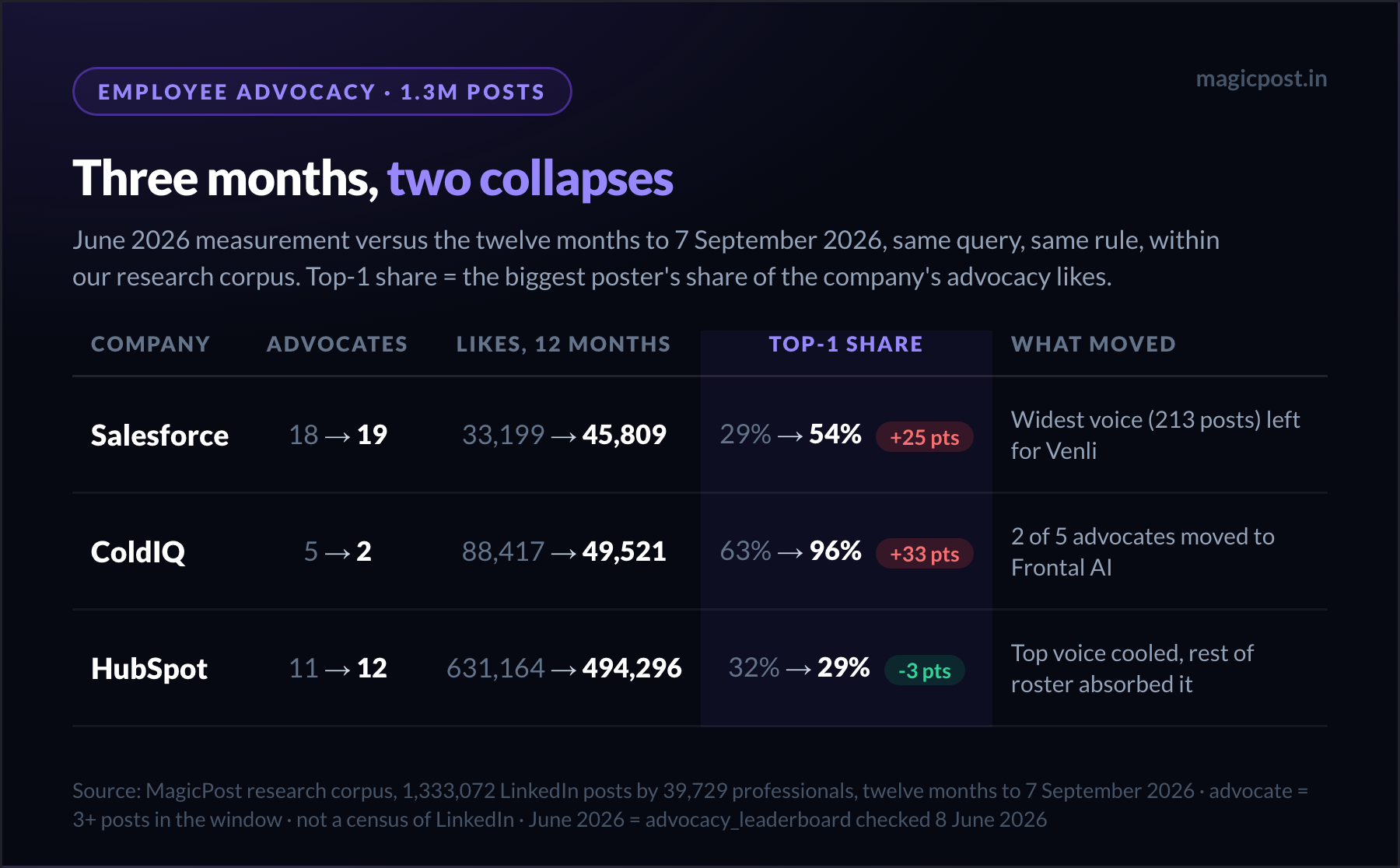
Salesforce and ColdIQ were in or near it in June. Both concentrated sharply after one or two people changed jobs.
Company | Advocates | Posts (12 mo) | Likes (12 mo) | Top-1 share | Since June 2026 |
HubSpot | 12 | 2,061 | 494,296 | 29% | 32% → 29% |
Saint-Gobain | 5 | 47 | 4,055 | 33% | no June baseline |
Salesforce | 19 | 420 | 45,809 | 54% | 29% → 54% |
Clay | 10 | 278 | 115,144 | 38% | no June baseline |
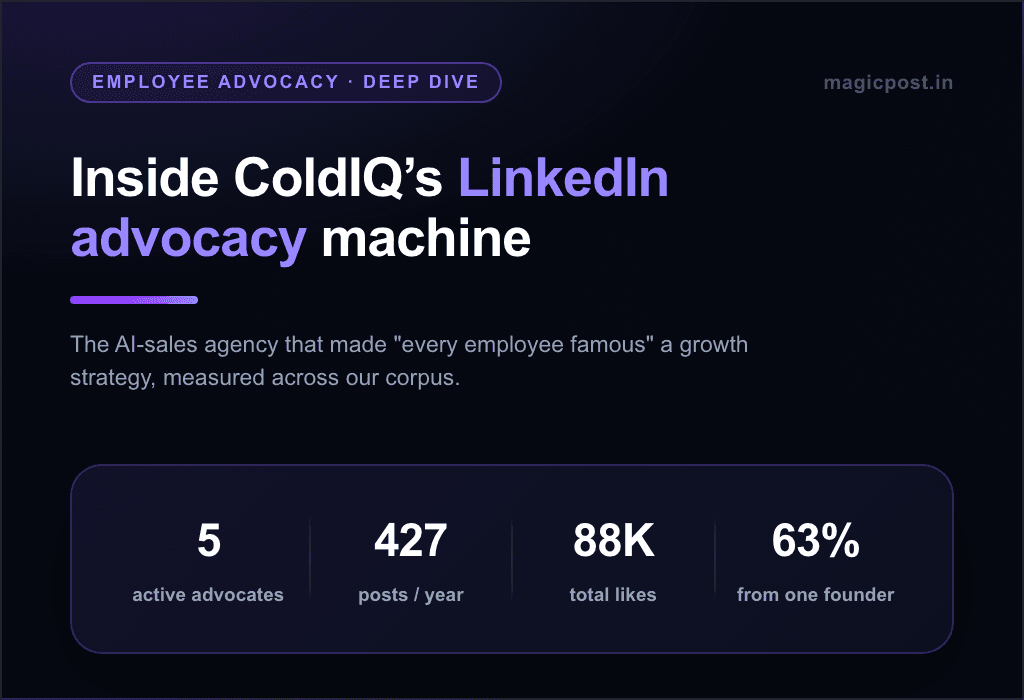
ColdIQ | 2 | 199 | 49,521 | 96% | 63% → 96% (5 → 2 advocates) |
MagicPost | 9 | 320 | 18,240 | 54% | 41% → 54% |
"Top-1 share" is the share of the company's advocate likes produced by its single biggest poster. Low means distributed. High means the program is one exec or founder with a supporting cast.
All six rows are measured within the companies in our research corpus, which over-indexes B2B, sales-tech and big tech.
HubSpot case study: employee advocacy distributed at enterprise scale
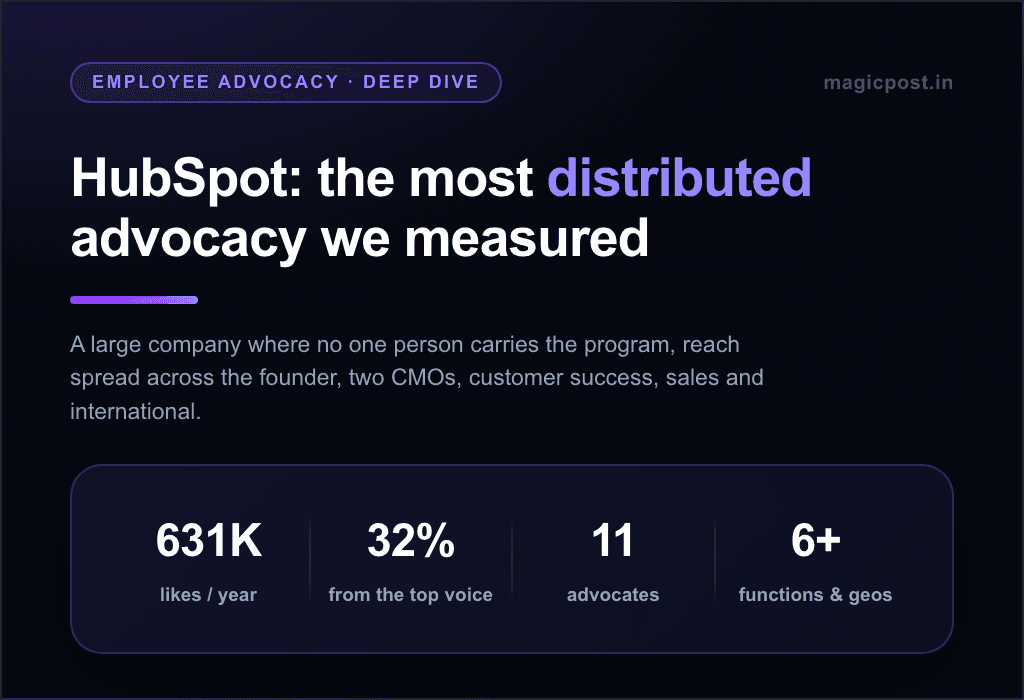
HubSpot is the only large company in this set whose reach got more distributed between June and September. Twelve advocates, 2,061 posts and 494,296 likes in the year, and the biggest voice, founder and CTO Dharmesh Shah, carries 29% of it, down from 32%.
Total likes fell from 631,164 in the June window. Concentration fell with them.
That combination is what a program looks like when it does not depend on one person's output: the top voice cooled off and the rest of the roster absorbed the change.
Two of the twelve advocates came in through the Mindstream acquisition and, between them, account for roughly half of the likes.
Strip them out and Dharmesh Shah's share rises to 57%: the acquisition bought part of the spread, so the top-1 share alone would flatter HubSpot.
The median is what makes it a case study rather than a lucky roster: 160 likes per post across twelve people in marketing, customer success, partnerships and regional roles. The full HubSpot advocacy breakdown profiles each of those voices; this page keeps to the shape.
Saint-Gobain case study: employee advocacy in HR, before and after 30 days
Saint-Gobain is the one case study here with a documented before-and-after, because it is a MagicPost deployment. The HR and employer-brand team equipped more than 30 people. Within 30 days the group was producing 3x more content, and applications rose by 15%.
Those two figures are the customer's, not a corpus measurement, and they answer a different question from the other five: what changes in the first month, rather than how distributed the reach is.
The corpus view is a smaller sample: within the companies in our research corpus, five Saint-Gobain advocates published 47 posts for 4,055 likes, with a top-1 share of 33%.
The lead is a communication and digital manager rather than an executive. The other four are an employer-brand lead, a deputy HR director, an internal-communications manager and a cloud FinOps head.
Five profiles is a small sample, and the corpus only sees the people it has imported, so the 30-plus figure and the five-advocate figure describe the same program at different resolutions.
What the two agree on is the shape: a program run by HR, spread across HR, with no executive at the top of it.
That shape matters because it is the opposite of the founder-led pattern. Recruiting content posted by the people who recruit reaches candidates that a CEO's feed does not, and it does not depend on one person's calendar.
Salesforce case study: what happens to employee advocacy when the widest voice leaves
In June, Salesforce was the distributed reference of the whole corpus: 18 advocates, a top-1 share of 29%, led by a salesperson, Marcus Chan, who had published 213 posts in the window. Then he left for Venli.
Three months later the same company reads 19 advocates and a top-1 share of 54%. Nobody switched the program off. Headcount in the data went up by one. Total likes went up too, from 33,199 to 45,809.
The distribution simply collapsed onto the next most active person, Maha Alaoui, whose 114 posts now produce 24,871 of those likes. The Salesforce employee advocacy breakdown profiles the five voices that remain and what each one covers.
This is the clearest evidence in the six case studies that a low top-1 share can be an accident of who happens to be posting. Salesforce's 29% was one prolific rep making the roster look evenly spread, with no system behind it.
The metric to watch is what the share does when your top poster changes jobs.
A program that survives that event is distributed. One that halves its spread overnight was relying on a single person all along.
Clay case study: employee advocacy where the biggest voice is not a founder
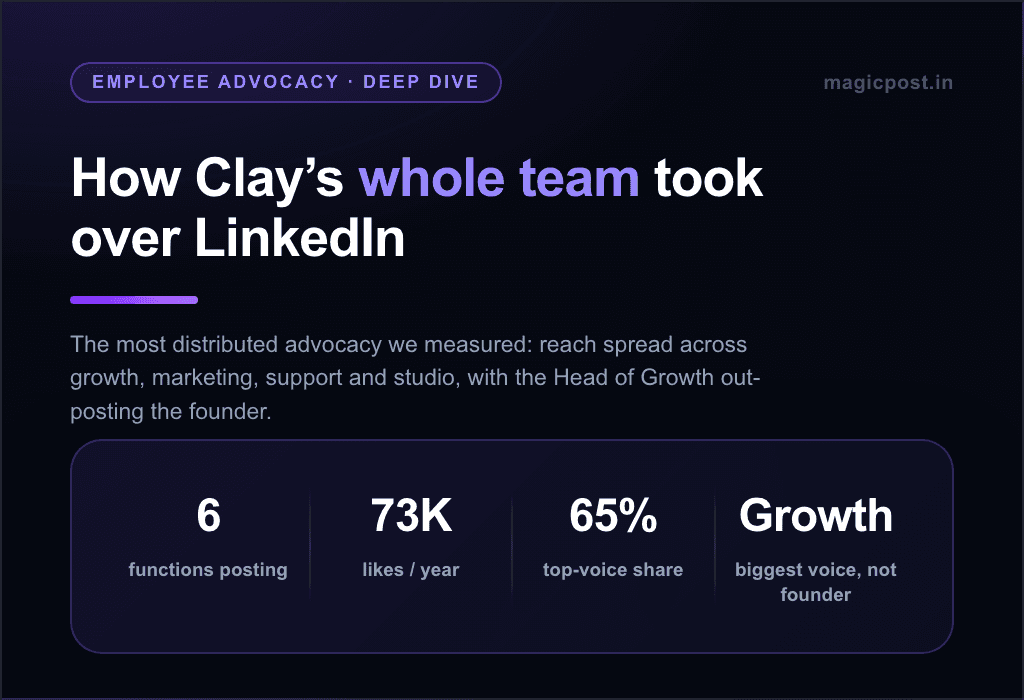
Clay is the specialist counterpart to HubSpot: ten advocates, 278 posts, 115,144 likes, and a top-1 share of 38% within the companies in our research corpus.
The biggest voice is Jahnavi Shah, a content creator on the team, with 43,941 likes. Co-founder Varun Anand is second, with 33,024.
That ordering is unusual. Across the curated set, the top voice is the CEO or a founder at almost every company. At Clay, the founder is a strong second, and the third, fourth and fifth voices (growth, marketing, systems engineering) each clear 3,000 likes on their own.
Two things stand out in comparison with the other five. First, Clay reaches its 115,144 likes on only 278 posts, a median of 248 likes per post, the highest of the four programs with a measured median.
Second, its advocates post from very different seats, so no single departure would repeat the Salesforce swing.
The people and their formats are in the Clay advocacy breakdown. The comparative lesson is that a program built on several mid-sized voices is harder to break than one built on a founder and a chorus.
ColdIQ case study: a small-team employee advocacy program and its fragility
ColdIQ was, in June, the small-company showcase: five advocates, 88,417 likes in the year, a top-1 share of 63% that looked healthy for a team that size. It now reads two advocates, 199 posts, 49,521 likes and a top-1 share of 96%.
Nothing about the founder changed. Michel Lieben still published 158 posts and collected 47,302 likes.
What changed is the roster: Alex Vacca and Ivan Falco moved to Frontal AI, and a third team member no longer clears the three-post bar. The second tier left, and the number reverted to what a founder alone produces.
This is the "small team" case study in both directions. A five-person company can post at the weight of a corporate communications department. It can also lose most of that weight in a single quarter, because two people are 40% of the roster.
The June program is documented in the ColdIQ advocacy breakdown, which now reads as a historical snapshot. For comparison purposes, the useful number is 63% → 96%: the size of the swing a small program should plan for.
MagicPost case study: our own employee advocacy, measured with the same rule
We run the same query on ourselves, and the current answer is nine advocates, 320 posts, 18,240 likes and a top-1 share of 54%. In June it was ten advocates and 41%. The biggest voice is our CEO, Naïlé Titah, with 9,883 of those likes.
At 54% across nine advocates, MagicPost sits above the 40% band this quarter; the other eight advocates still produce 46% of the reach, the opposite of the 90%-plus pattern. We publish our own row like the others.
The number also illustrates something the other case studies show from the outside: a founder-led company's concentration tracks who is posting this quarter. Between June and September the roster went from ten to nine, total likes fell from 25,179 to 18,240, and the share moved 13 points.
What we take from our own row is the same thing we take from Salesforce: watch the metric quarter to quarter, not once.
The cadence that keeps a roster of nine posting is the product we sell, and our own top-1 share is the number we track on ourselves every quarter.
What these 6 employee advocacy case studies have in common
The method fits in two sentences. Every post in a 1,333,072-post, 365-day corpus was matched to its author's current company, and anyone with three or more posts in the window counted as an advocate (company pages and freelance labels stripped).
Concentration is the biggest advocate's likes divided by the company's total. The complete design is in our employee advocacy study.
Concentration is the employee advocacy metric nobody publishes
Vendor case studies report shares, clicks, and sometimes "reach". None of the ones we have read report how much of that reach came from one person. Yet it is the only figure in this set that predicted what happened next.
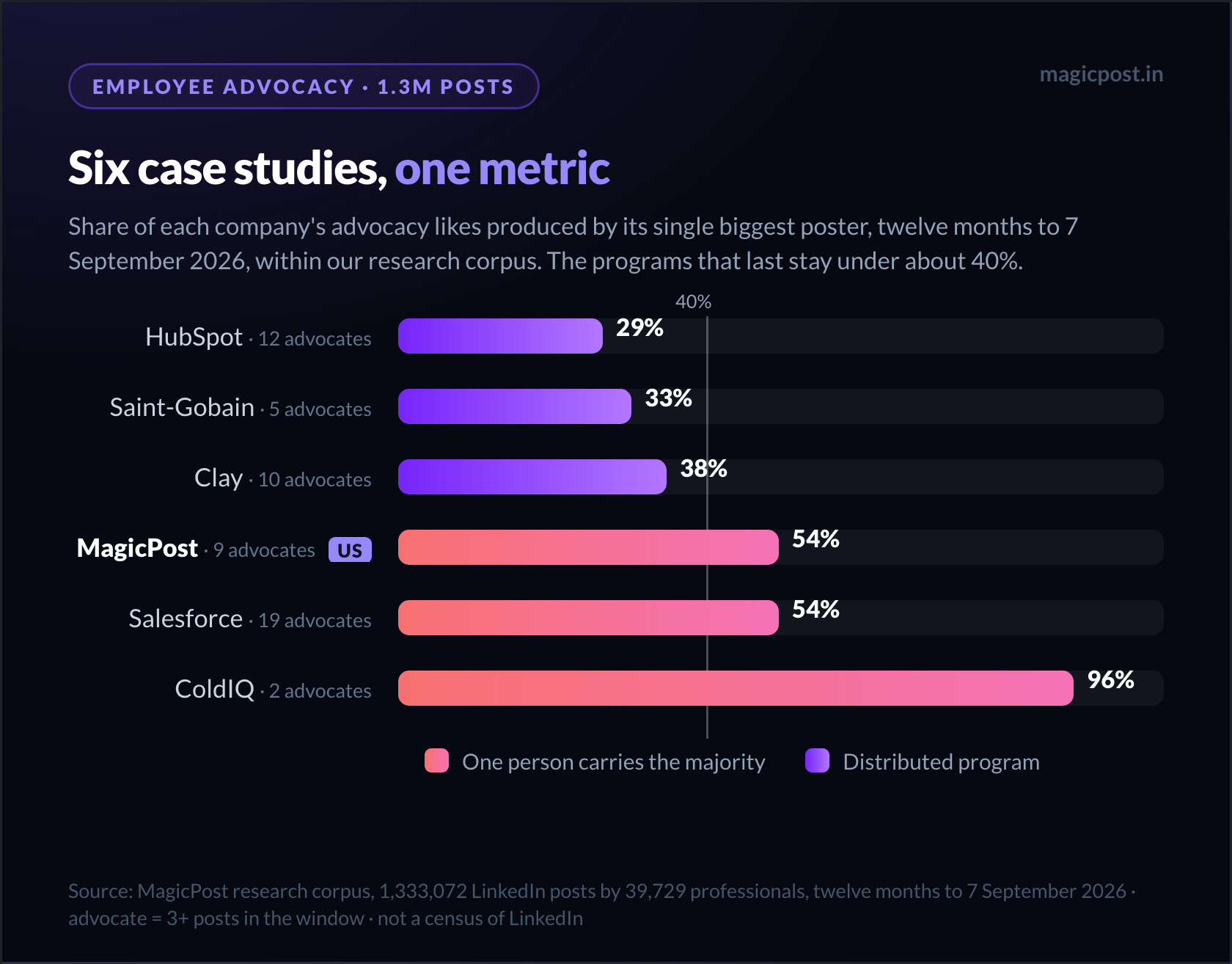
The two programs that concentrated (Salesforce, ColdIQ) both had a single departure or two behind the move. The two that stayed distributed (HubSpot, Clay) had several mid-sized voices under the top one. The number was visible in June, before either departure.
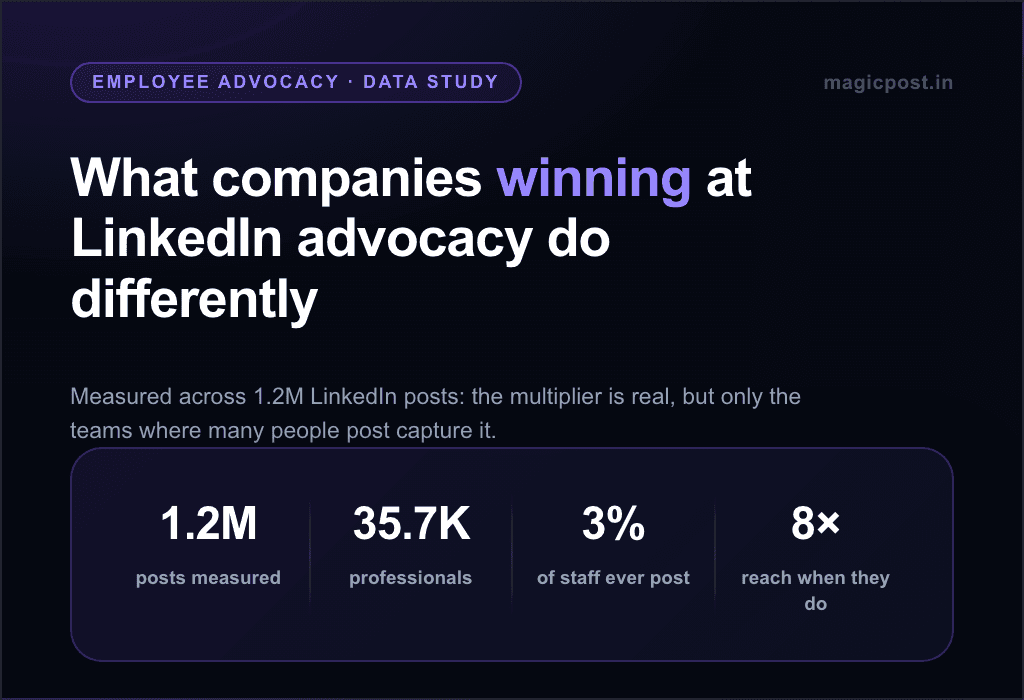
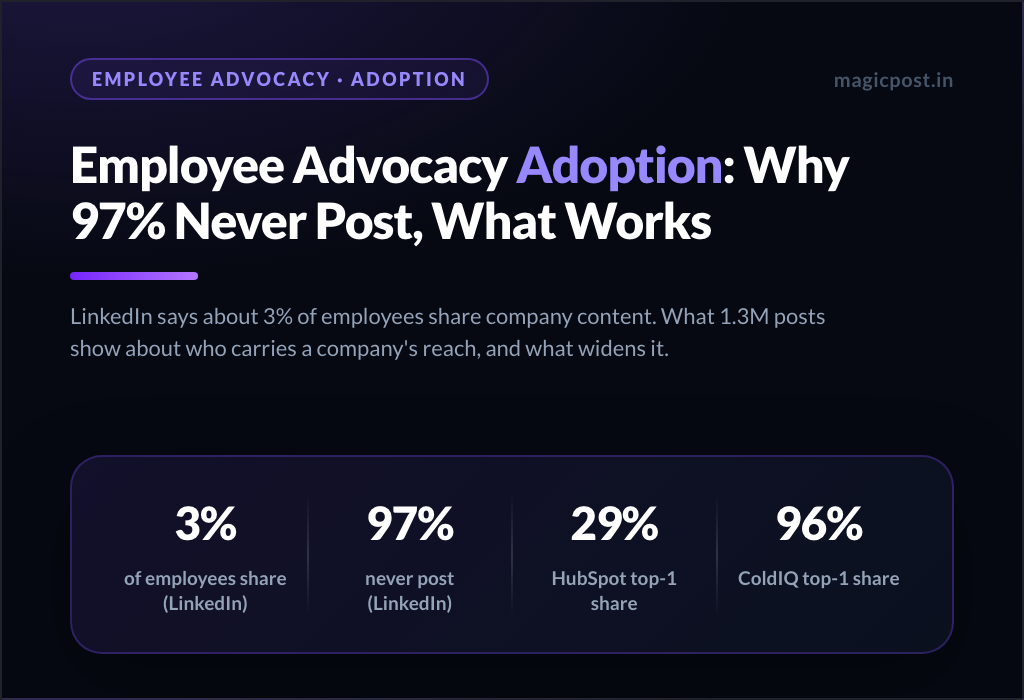
LinkedIn's own guide reports that only about 3% of employees ever share company content, a figure from the Official Guide to Employee Advocacy, not from our corpus.
Concentration is what that 3% looks like from the outside: if three people post and one of them is the CEO, the CEO is the program.
If you evaluate employee advocacy software on this basis, the question to ask a vendor is whether the admin view shows who is carrying the reach, not just who has logged in.
The admin view of LinkedIn analytics per team member is what makes the top-1 share visible month by month.
Headcount is not the lever in these employee advocacy case studies
Across the research corpus, enrolling more advocates does not lower concentration or lift engagement per post.
Microsoft has 63 advocates in our research corpus and posts at a median of 81 likes, a spread the Microsoft employee advocacy page takes voice by voice. EY has 34 and posts at a median of 44.
L'Oréal, with 12 advocates, posts at a median of 310. Sanofi, with 8, at 293. Novo Nordisk, with 13, at 285. Clay, with 10, at 248. The smaller rosters in this list out-engage the large ones per post by a factor of three to seven.
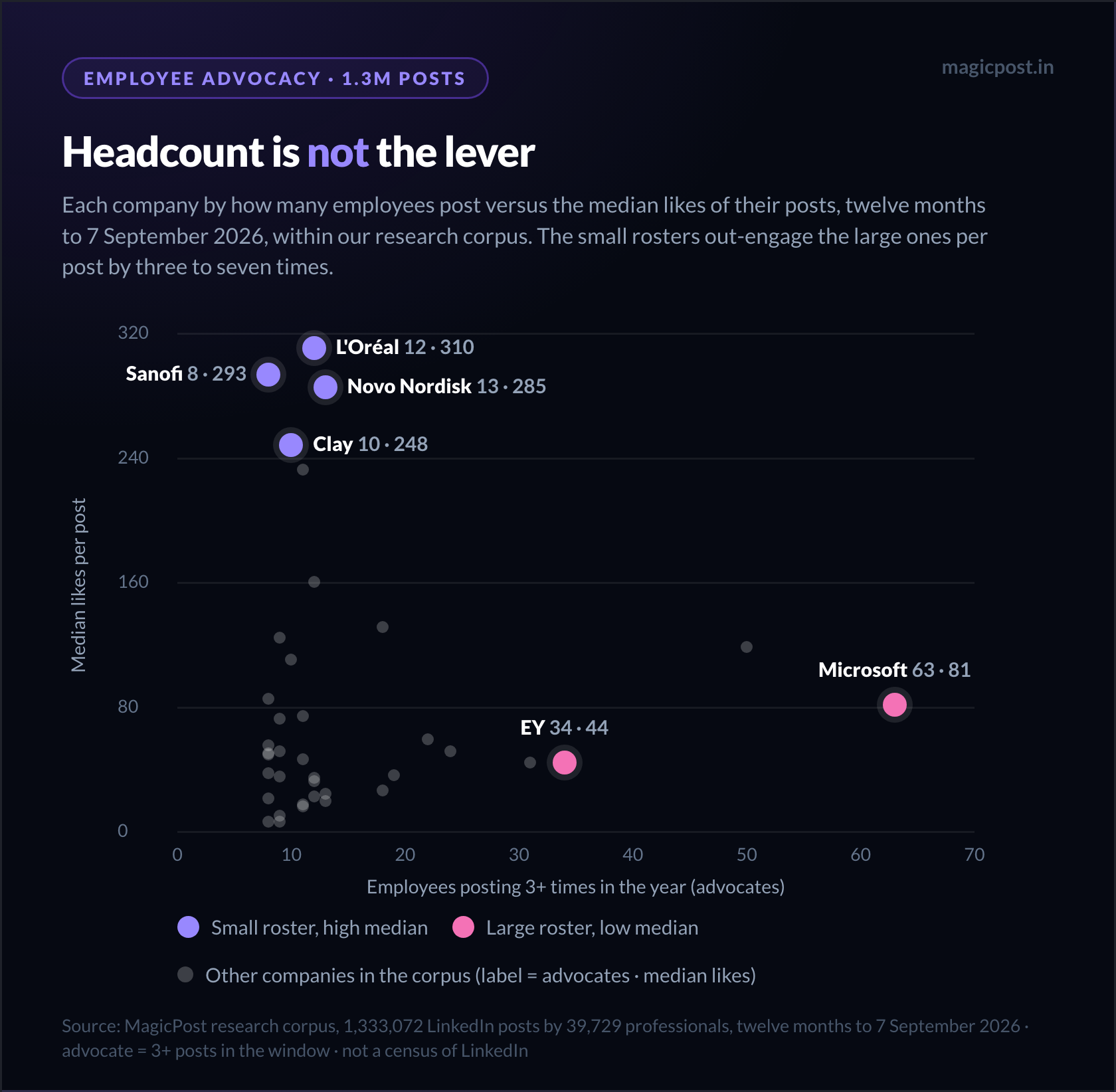
The pattern across the six case studies is the same. HubSpot's 12 and Clay's 10 beat Salesforce's 19 on both spread and median. Saint-Gobain's five HR voices are evenly distributed.
What predicts a durable program is the number of people who post well and often, which is a much smaller number than the number enrolled.
Generic content loses reach in every employee advocacy case study
The last common thread is what the distributed programs post. HubSpot's customer-success director posts operating cadences. Clay's growth lead posts contrarian essays. Saint-Gobain's HR team posts about recruiting. None of it is reshared corporate content.
That matters because our monthly engagement benchmark, measured on millions of posts, finds that content which could have been written by anyone in the field reaches 10 to 14% fewer people than the author's own specific material. The figure and its method are in our employee advocacy statistics.
A program that hands every employee the same caption is paying that penalty on every post, which is one reason the 97% LinkedIn counts as never sharing stays silent: nobody wants to be the tenth person posting the same thing.
Build the next employee advocacy case study with MagicPost
The programs that held their shape had several people posting in their own voice, and someone watching who carried the reach. MagicPost is the employee advocacy platform built for that: each member drafts in their own tone, publishes through LinkedIn's official API, and admins see adoption and concentration per member.
FAQ
What is an employee advocacy case study?
An employee advocacy case study is a documented account of one company's program: who posted, how often, what reach it produced, and what changed as a result. The useful ones report a baseline and a follow-up rather than a single snapshot, and include how concentrated the reach was, because a program carried by one executive behaves very differently from one spread across a team.
Which employee advocacy case studies show a distributed program?
Successful employee advocacy programs measured in our research corpus include HubSpot (top-1 share 29% across 12 advocates), Clay (38% across 10) and Saint-Gobain (33% across an HR-led group). Our roundup of ten measured and documented programs covers each one, including lemlist, Gong, Microsoft and L'Oréal.
How do you measure an employee advocacy program?
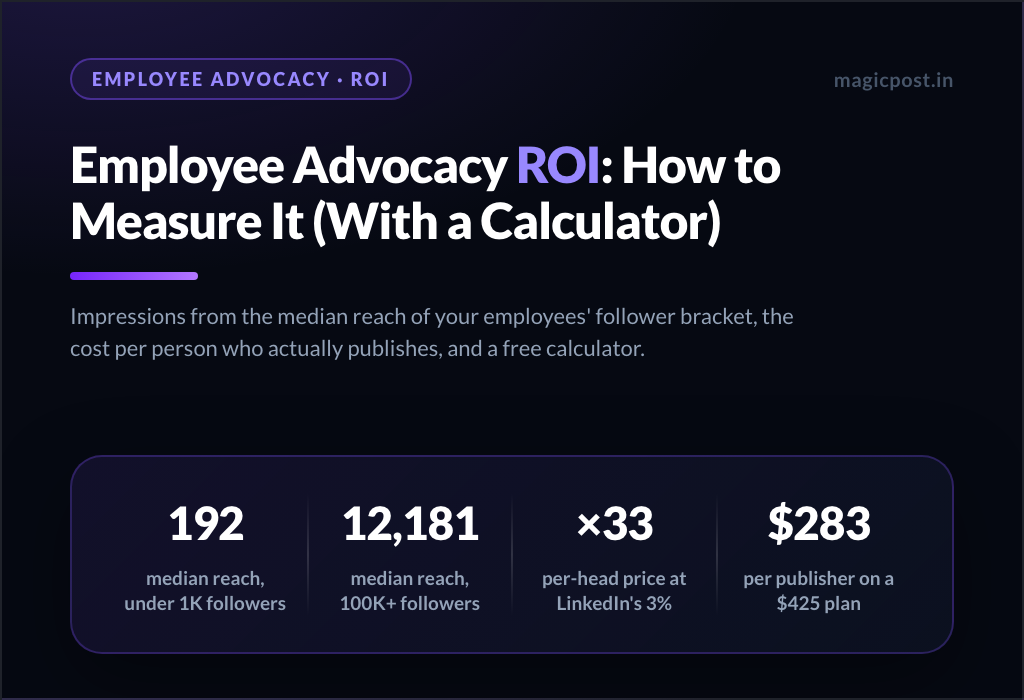
An employee advocacy program is measured on three numbers: how many employees post at least three times in the period, how much reach they produce together, and what share of that reach comes from the single biggest poster. Track them quarter to quarter. The employee advocacy ROI guide turns those into a cost per active poster and a reach multiplier.
Which employee advocacy programs achieve high adoption without making participation mandatory?
HubSpot, Clay and Saint-Gobain achieve broad participation without mandated posting: each person publishes their own expertise in their own format, leadership posts first, and no one shares a common caption. Saint-Gobain's HR team runs on MagicPost, one seat per publishing member, adoption tracked per person. In each case the top voice carries under 40% of reach in our research corpus; the mechanisms are in our guide to employee advocacy adoption.
How long does an employee advocacy program take to show results?
An employee advocacy program shows its first measurable results within about 30 days when it removes per-person friction: Saint-Gobain's HR team, equipped with MagicPost, produced 3x more content and saw 15% more applicants in that window. Reach concentration takes a quarter to read reliably, which is why the program guide recommends a 90-day review.
Does employee advocacy work for a small company?
Employee advocacy works for a small company, and the ColdIQ case study shows both sides: five people produced 88,417 likes in a year, then two departures took the top-1 share from 63% to 96%. Small programs win on median engagement and lose on resilience. You can estimate what your team's reach would be before deciding how many people to enroll.