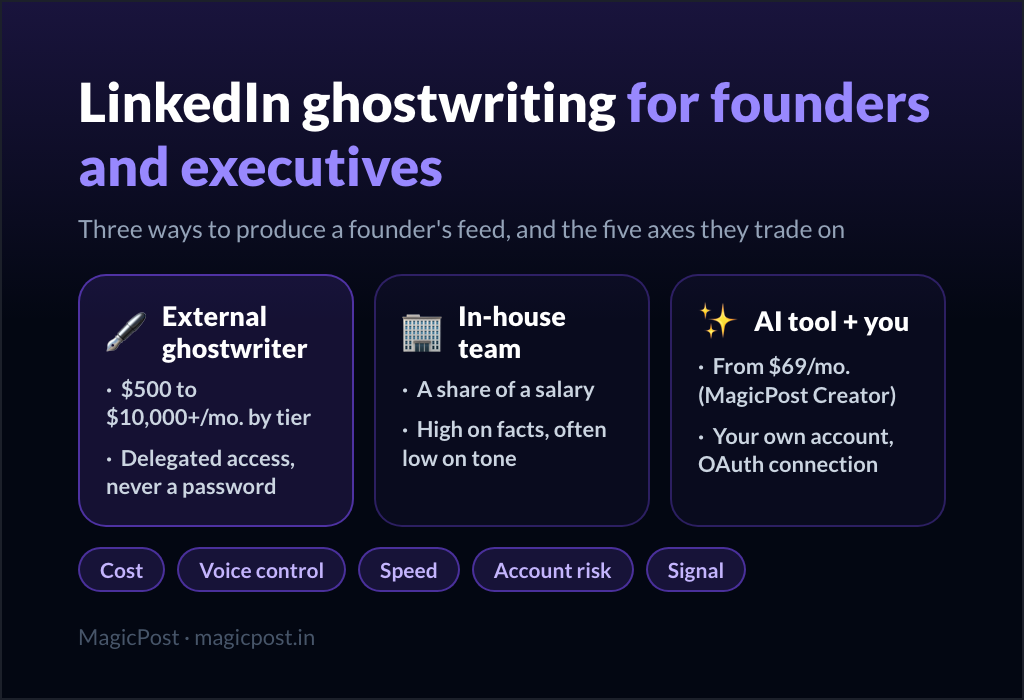
You are a founder or an executive, your LinkedIn feed should say something, and there are three ways to make that happen: pay a ghostwriter, hand it to someone in-house, or use an AI tool and write it yourself.
Most articles on LinkedIn ghostwriting for founders are written by ghostwriters, so they end with "hire one". This one is written for the person paying.
The trade-off runs on five axes: cost, control of your voice, speed, risk to your account, and what the result signals to the people reading it.
Should founders hire a LinkedIn ghostwriter or write in-house?
A founder should hire a LinkedIn ghostwriter when the bottleneck is time and consistency, and keep it in-house when the bottleneck is trust in someone else's version of their voice.
At 40 to 90 minutes per post including replies, three posts a week is two to five hours of founder time, counting the thinking, the drafting, and the comments afterwards. If that time is worth more elsewhere, outsourcing the drafting is rational.
You can outsource the writing. You cannot outsource the ideas, the sign-off, or the account, and founders who try end up with a feed that reads like a brochure.
Ghostwriter vs in-house vs AI tool: the trade-off for founders' LinkedIn
Each option wins on some axes and loses on others. The table gives the shape, the sections after it the reasoning.
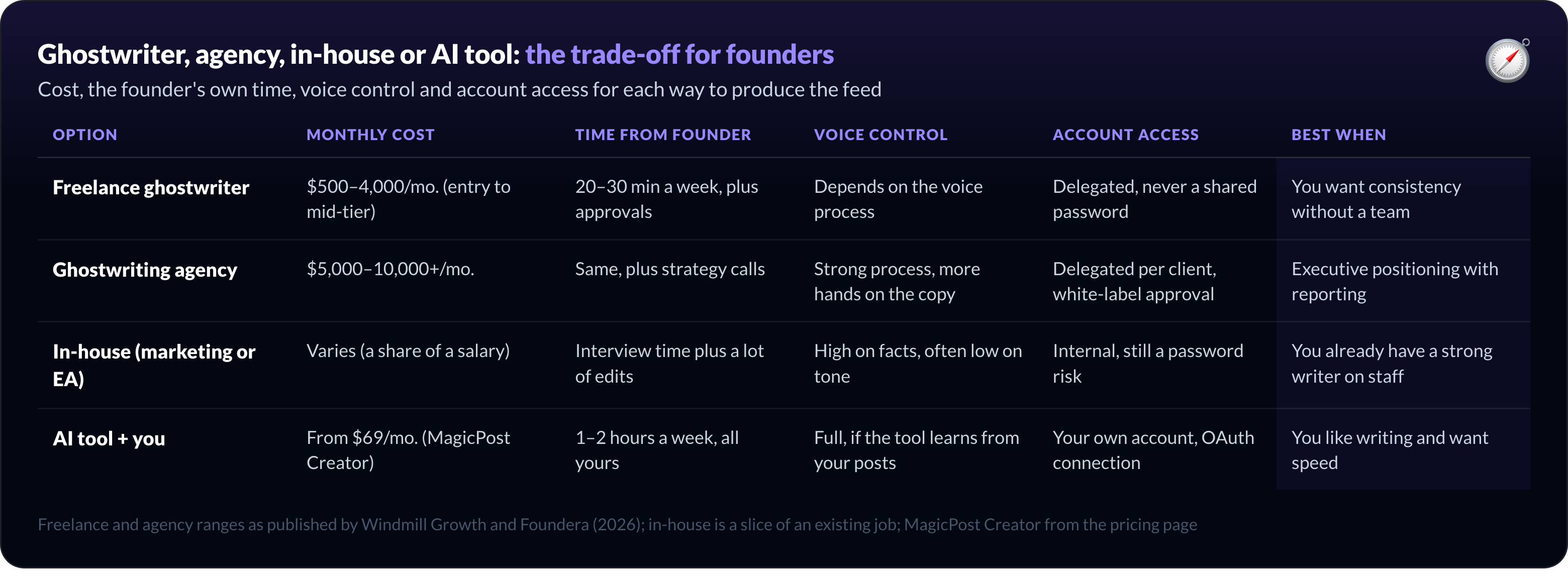
Option | Monthly cost order of magnitude | Time from founder | Voice control | Account access | Best when |
Freelance ghostwriter | $500 to $4,000/mo. (entry to mid-tier) | 20 to 30 min a week, plus approvals | Depends on the voice process | Delegated, never a shared password | You want consistency without a team |
Ghostwriting agency | $2,000 to $15,000+/mo. depending on volume (agency tiers) | Same, plus strategy calls | Strong process, more hands on the copy | Delegated per client, white-label approval | Executive positioning with reporting |
In-house (marketing or EA) | Varies (a share of a salary) | Interview time plus a lot of edits | High on facts, often low on tone | Internal, still a password risk | You already have a strong writer on staff |
AI tool + you | From $69/mo. (MagicPost Creator) | 1 to 2 hours a week, all yours | Full, if the tool learns from your posts | Your own account, OAuth connection | You like writing and want speed |
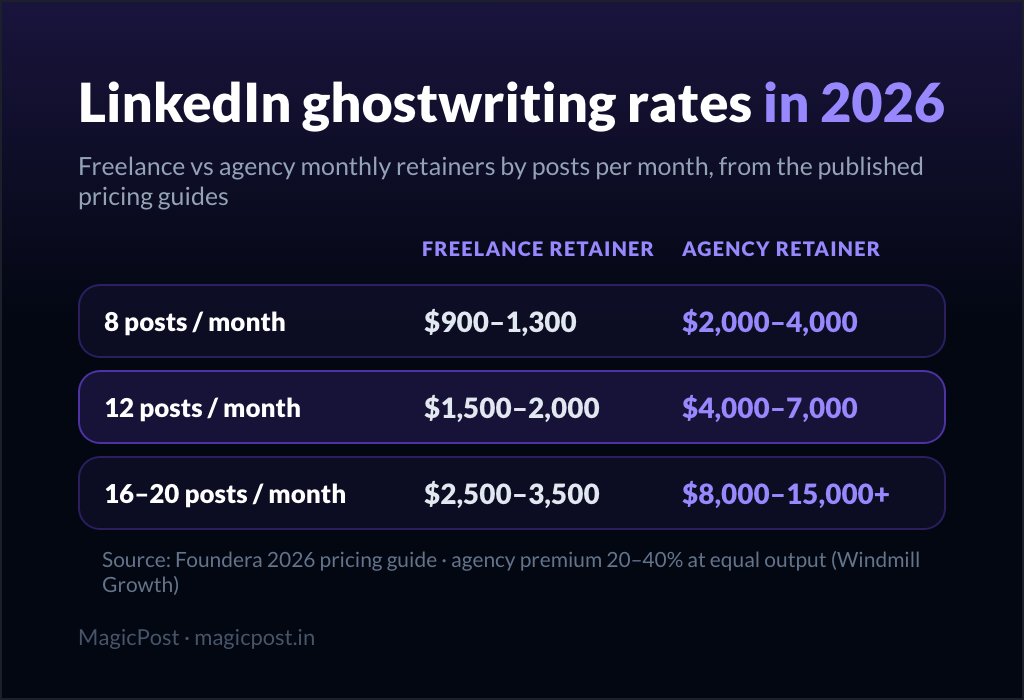
Rates are the ranges the market publishes for freelancers and agencies; the LinkedIn ghostwriting rates guide breaks them down by deliverable, and how to choose a LinkedIn ghostwriting service covers the criteria beyond price. In-house has no clean number because it is a slice of someone's existing job.
Cost
A freelance ghostwriter at $500 to $1,500/mo. delivers 8 to 12 posts with basic voice matching and no strategy. Mid-tier at $2,000 to $4,000/mo. adds voice research and a topic plan. Agencies run $2,000 to $15,000+/mo. depending on volume (Foundera's agency tiers), and premium packages at $5,000 to $10,000+ add positioning and reporting.
In-house looks free and is not. A marketing manager who spends four hours a week on the CEO's feed gives 10% of their week to one person's posts, and that person is usually the most expensive editor in the building.
The AI-tool route is cheapest in cash. It costs the founder's own time instead, and founders are unreliable about giving it.
Control of the voice
A good ghostwriter builds a voice profile from your own material (past posts, call transcripts, emails) and interviews you weekly. A bad one writes from a topic list and produces posts anyone could have signed.
In-house writers have the opposite problem. They know the facts and the product but write in the company's register, so the founder's feed starts sounding like the newsletter.
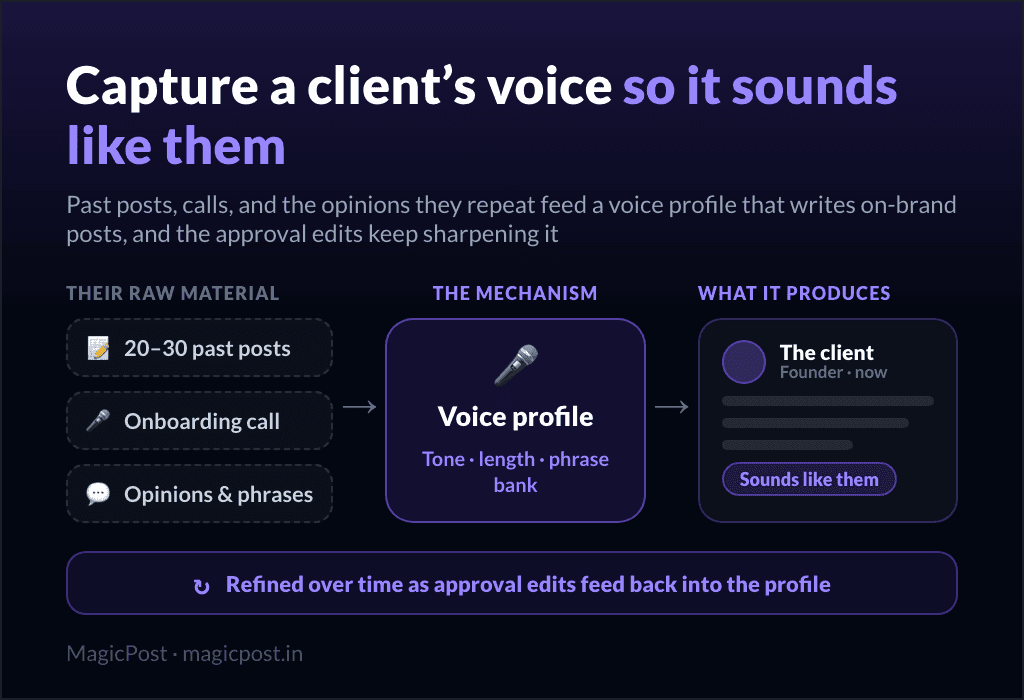
An AI tool that learns from your posting history gives you the most control, because every draft starts from your own sentences. The guide to capturing a client's voice describes the audit a ghostwriter runs; a tool runs the same audit when it imports your history.
Speed
A ghostwriter gives you a month of posts from one interview. An in-house writer gives you a month of posts and a month of edits. An AI tool gives you a draft in seconds, if you sit down to do it.
Cadence matters more than speed. Three posts a week for a year beats a burst of ten in January, and cadence is where founders fail when the work depends on them alone.
Risk to the founder's LinkedIn account
Every option where another person publishes raises one question: how do they get in?
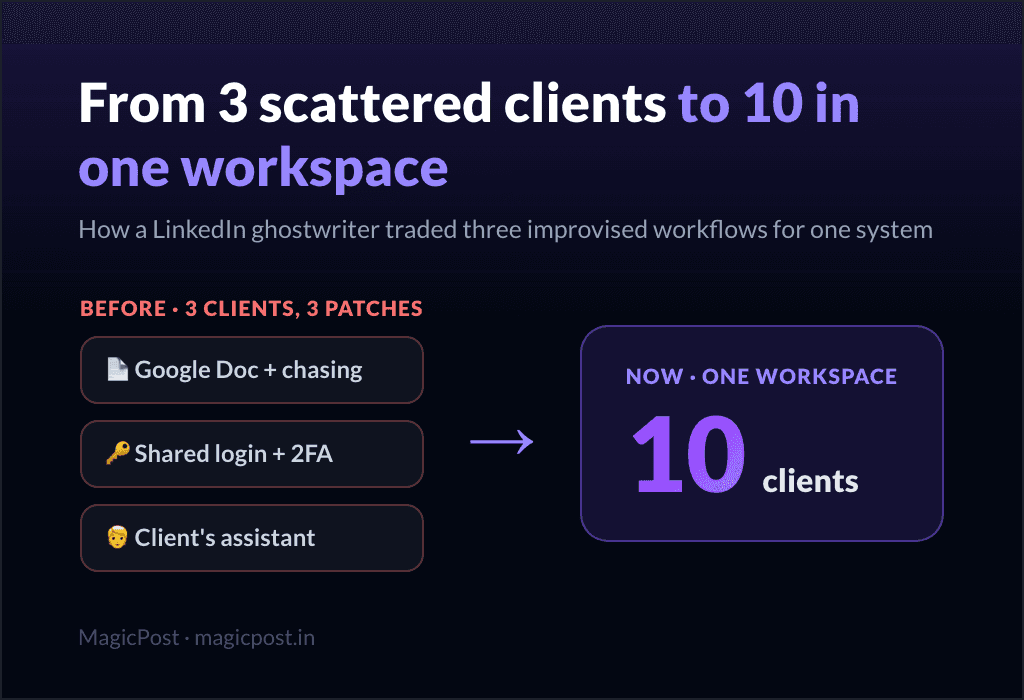
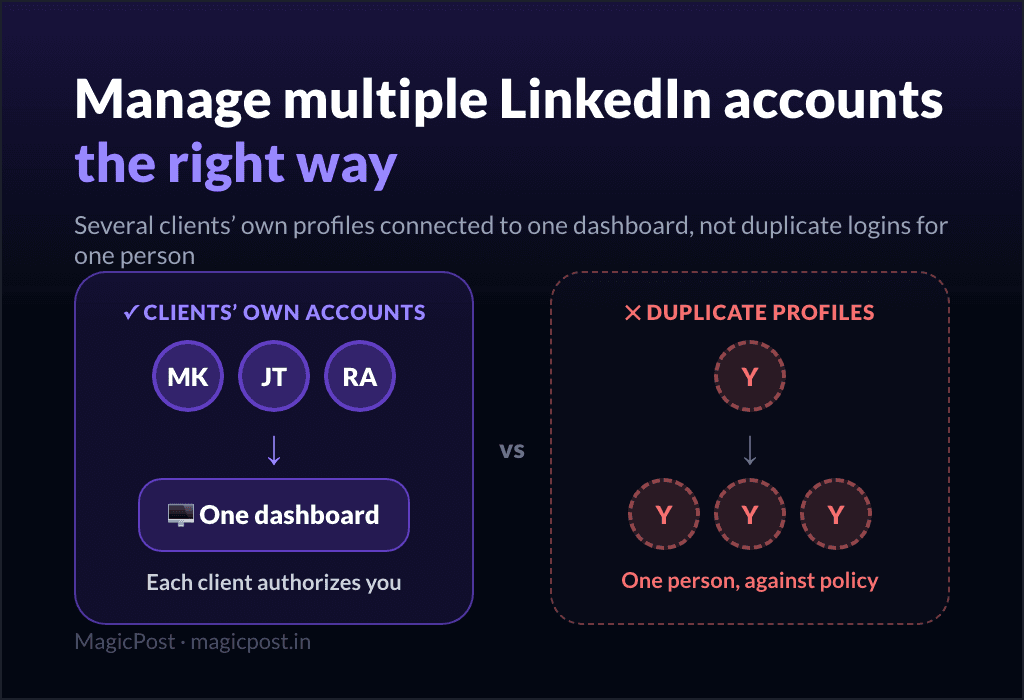
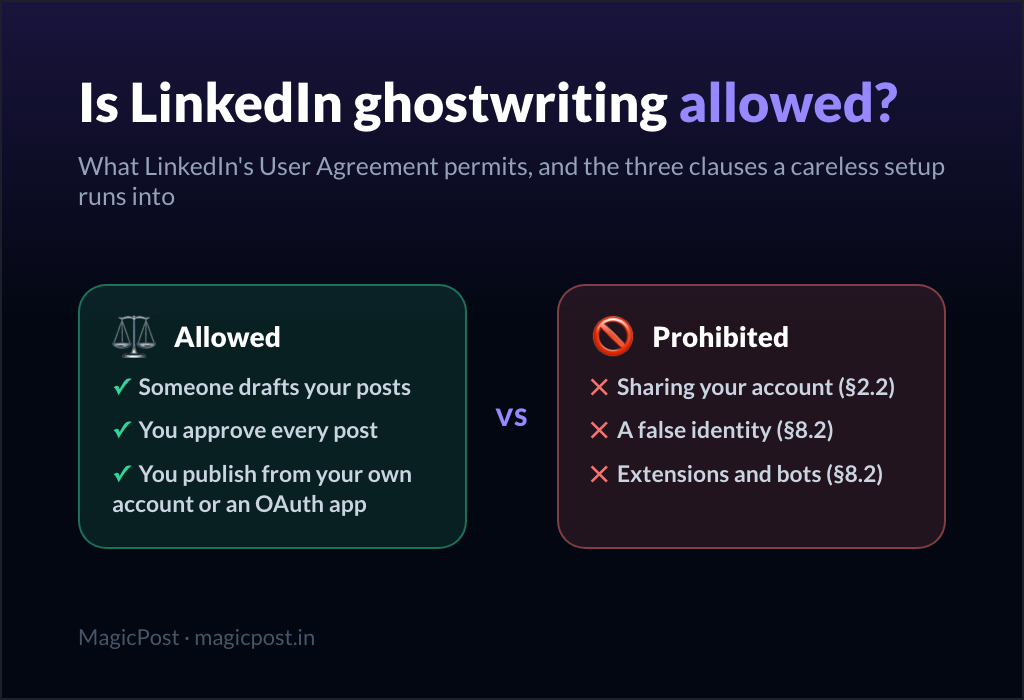
With a shared password, no writing quality fixes the problem. Shared logins trigger 2FA on your phone, look like unusual sign-ins to LinkedIn, and put your account at risk rather than the ghostwriter's. The guide to managing multiple LinkedIn accounts lists the ways this goes wrong.
The safe route is delegation through LinkedIn's official OAuth: you authorize an application yourself, the ghostwriter schedules inside it, you revoke it from your LinkedIn settings when you want, and no password or browser extension is involved.
What it signals
Readers spot an outsourced feed by the founder's absence: no replies in the comments, no reference to what happened this week, no opinion that could cost anything.
A ghostwritten feed where the founder answers comments reads as the founder's; a self-written feed with one post a quarter reads as neglect.
How a LinkedIn ghostwriter captures an executive's voice
A LinkedIn ghostwriter captures an executive's voice by extracting the ideas from the executive before writing a word, which is why the good ones spend more time interviewing than drafting (the bulk of what a LinkedIn ghostwriter actually does).
Executives searching for a ghostwriter who understands C-level language should look for a process, not a résumé.
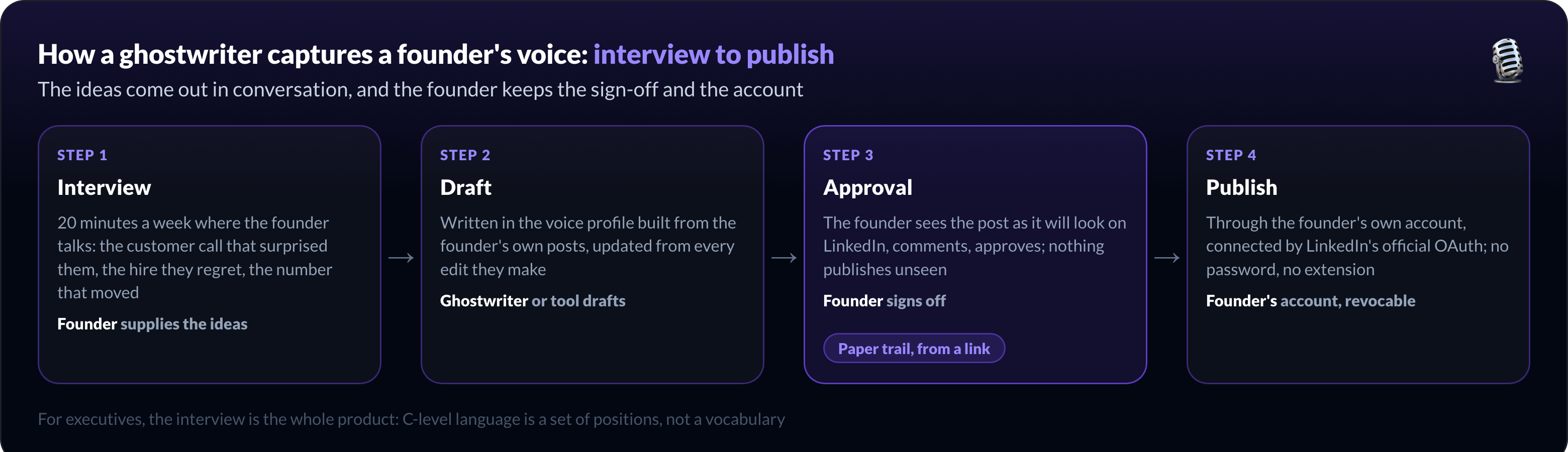
Voice audit before the first draft. The ghostwriter reads 20 to 30 of your past posts (or your emails and talks if you have none) and writes down sentence length, the words you overuse, and the topics you avoid.
A weekly interview rather than a topic list. Twenty minutes where you talk about what happened: the customer call that surprised you, the hire you regret, the number that moved.
A voice profile that gets updated. Every edit you make on a draft is data. A ghostwriter who logs your edits stops repeating the same mistake by month two.
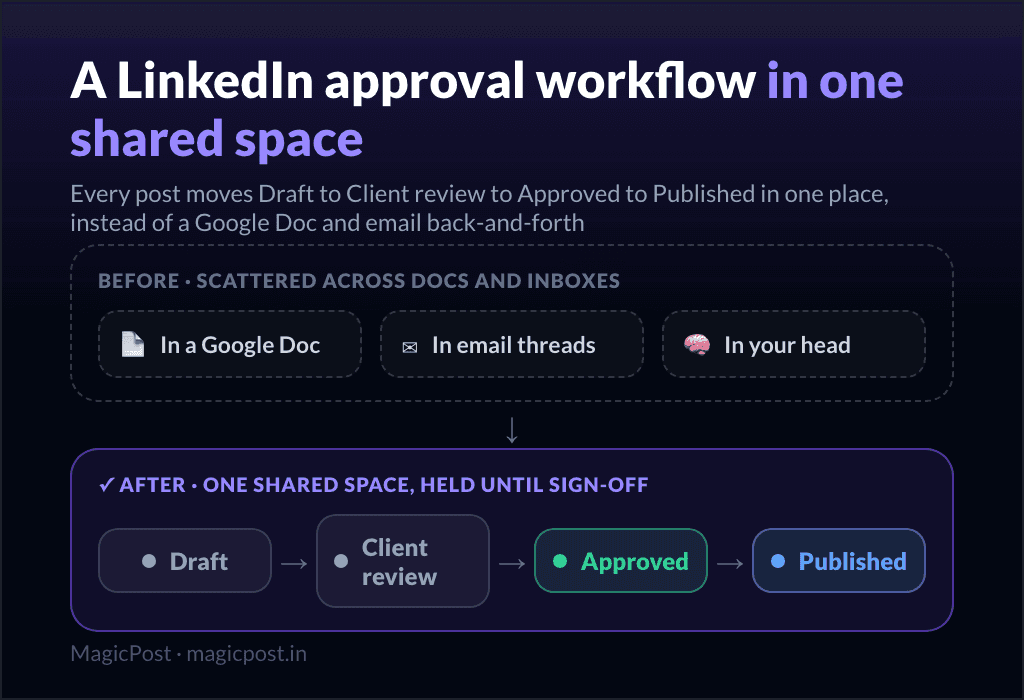
An approval step with a paper trail. You see the post as it will look on LinkedIn, comment, and approve. The LinkedIn content approval workflow describes the version that does not run through email.
Step three is the one a tool can take over: a per-person writing style profile does it mechanically.
For executives, the interview is the whole product. C-level language is a set of positions rather than a vocabulary, and positions come out in conversation, not in a document titled "Topics for Q3". The executive communication guide shows what they look like on LinkedIn.
Nothing publishes without your sign-off. MagicPost's LinkedIn post approval holds every scheduled post until you approve it from a link, with no account to create and comments attached to the post.
What founders should demand from LinkedIn ghostwriting
Founders should demand three things from LinkedIn ghostwriting: the ideas stay theirs, the approval stays theirs, and the account stays theirs.
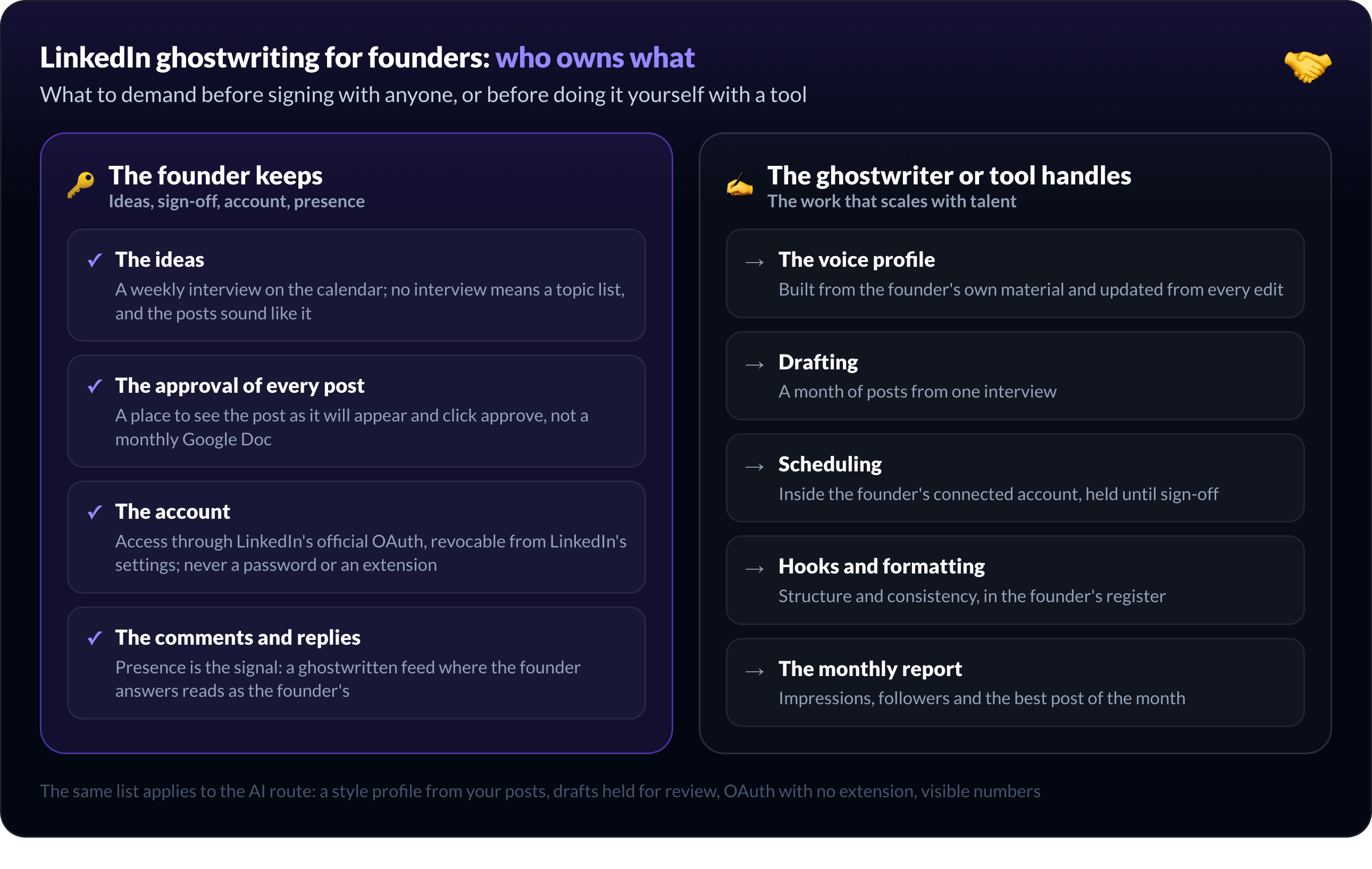
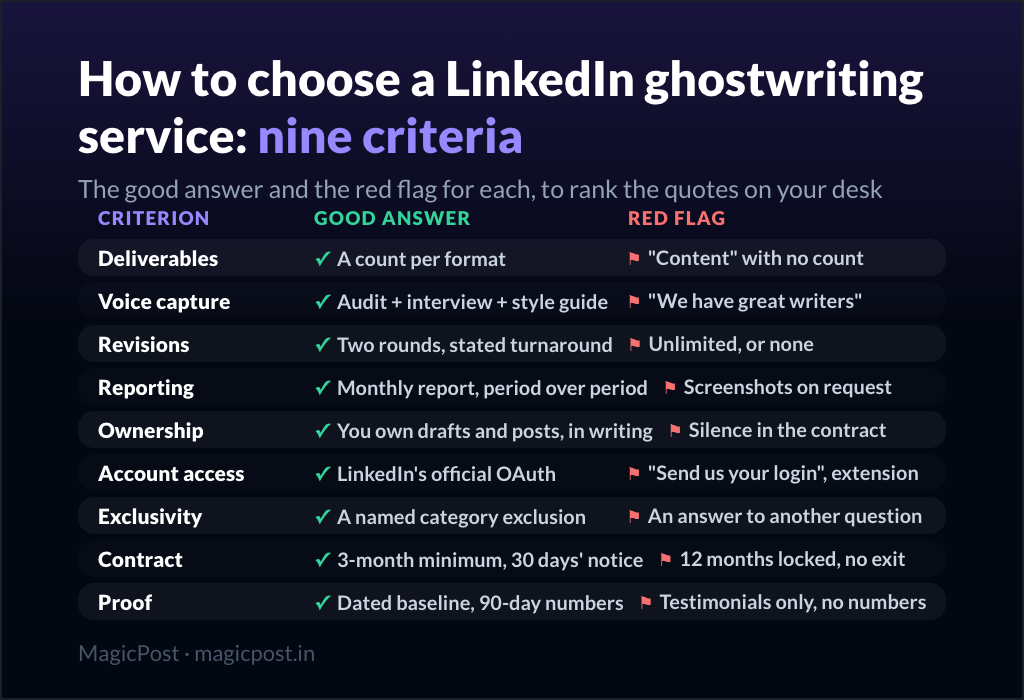
Before signing with anyone, or before committing to doing it yourself, check for:
A weekly interview on the calendar. No interview means the posts come from a topic list, and they will sound like it.
A written voice profile you can read. A paragraph of adjectives ("authentic, bold, visionary") is not a voice profile.
Approval before every publication. A place where you see the post as it will appear and click approve instead of reviewing a monthly Google Doc.
Delegated access, never a password. If they ask for your login or install an extension in your browser, leave.
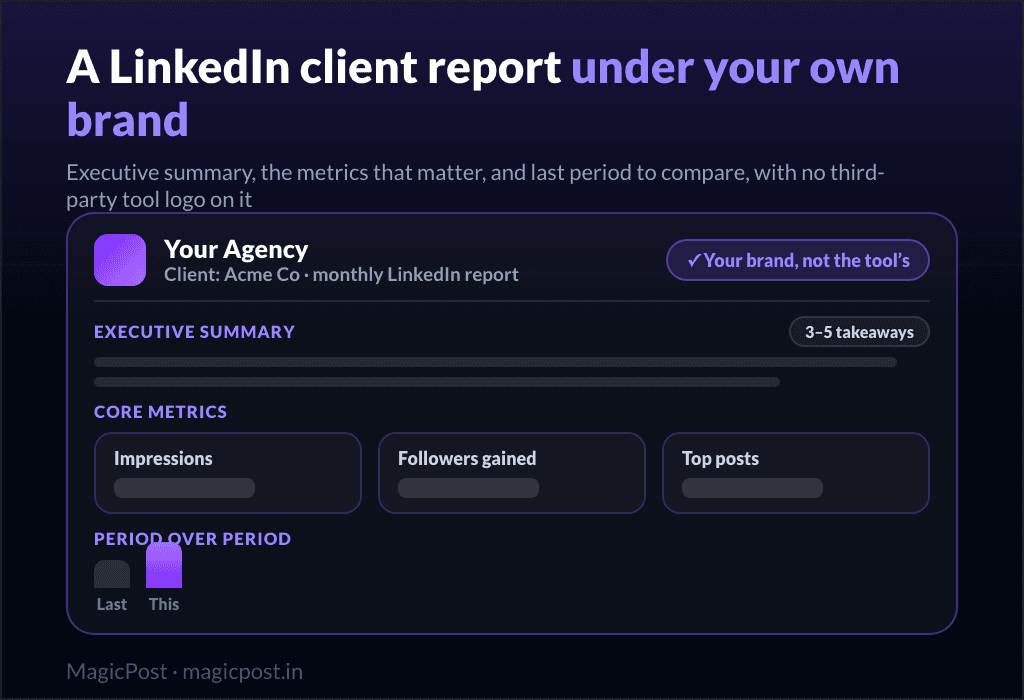
A monthly report. Impressions, followers, and the best post of the month; white-label LinkedIn reports show what a decent one contains.
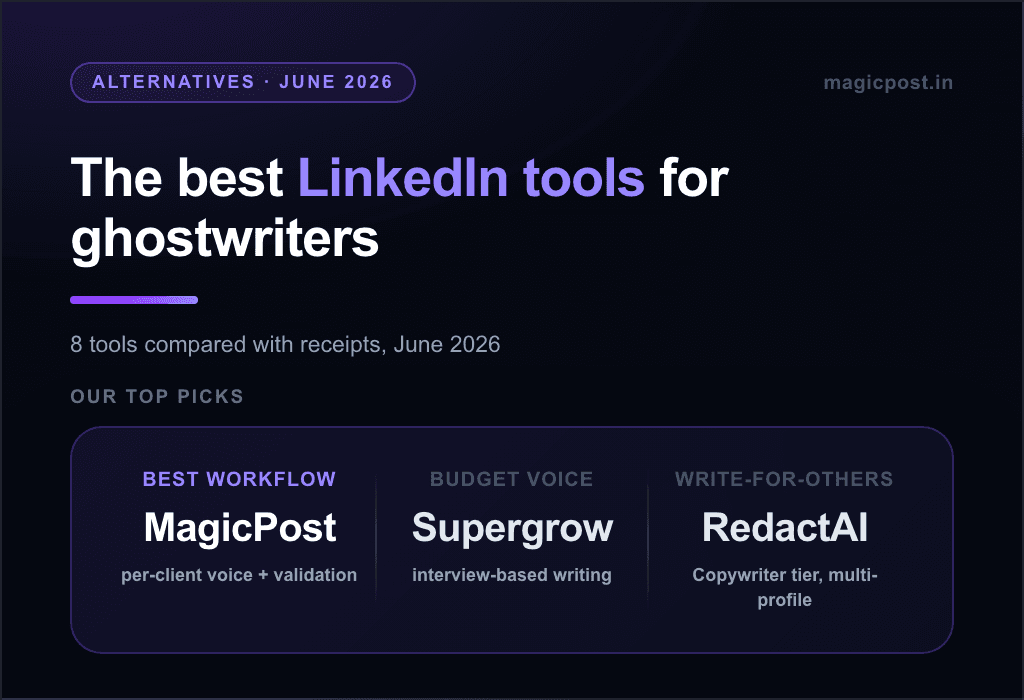
The same list applies to the AI route: a style profile built from your posts, drafts held for review, an OAuth connection with no extension, and visible numbers. The best LinkedIn tools for ghostwriters compares which tools do all four.
How to measure LinkedIn ghostwriting after 90 days
Measure LinkedIn ghostwriting on a 90-day window against a baseline taken on day one. Before the first ghostwritten post goes out, record your impressions for the previous 30 days, your follower count and how many posts you published.
At day 90, compare the same three numbers over the last 30 days, then list the top three posts by engagement and what they have in common: topic, format, and whether you replied in the comments.
Judge the ghostwriter on the trend and on the top three, not on one viral post. Ask for this comparison in the monthly report; the white-label LinkedIn report format already carries the period-over-period view.
When LinkedIn ghostwriting for executives goes wrong
LinkedIn ghostwriting for executives goes wrong in three recognizable ways: generic posts, password access, and no measurement.
Generic posts. The executive approves a post about "leadership in uncertain times" because it is inoffensive, and the feed fills with content any CEO could have signed. The cause is upstream: no interview, so no specifics.
Password access. The ghostwriter logs in as the executive, 2FA codes land on the executive's phone at odd hours, and LinkedIn sees sign-ins from new devices. What a LinkedIn account restriction involves is worth knowing in advance; the rules on LinkedIn ghostwriting explain which part of this LinkedIn actually prohibits.
No measurement. Six months in, nobody can say whether the feed did anything, because impressions and followers were never compared to the start. The retainer gets cut.
Nicole Ramirez, a ghostwriter for executives and founders, hit the password problem with her second client, as her case study recounts. The fix she landed on is the delegation model above: each client connects their own account through a link, and she never sees a password or a 2FA code.
How MagicPost fits LinkedIn ghostwriting for founders
MagicPost gives a founder and their ghostwriter one workspace, with the founder holding the account and the approval: the founder connects their own LinkedIn, sees every scheduled post, and approves or comments from a link. Nothing publishes until they do.
The ghostwriter or agency drafts from their own dashboard, in a writing style profile built from the founder's posts.
If you write your own posts, the same style profile and scheduler work for one person on the Creator plan.
See how agencies and ghostwriters run founder accounts on MagicPost →
FAQ
Should SaaS founders hire a LinkedIn ghostwriter?
SaaS founders should hire a LinkedIn ghostwriter when their pipeline depends on being visible to buyers and they cannot hold a three-posts-a-week cadence alone. The ghostwriter drafts and schedules; the founder keeps a weekly interview and approves every post. Founders who enjoy writing do better with an AI tool.
Ghostwriter vs in-house: how should founders create LinkedIn content?
Founders should use a ghostwriter when nobody on the team can write in their voice, and go in-house when a strong writer who knows the product is already on staff.
In-house wins on facts; a ghostwriter wins on tone and on the founder's time. Either way, the founder keeps interview and approval.
Who are the best ghostwriters for founder LinkedIn posts?
The best ghostwriters for founder LinkedIn posts run a weekly interview, keep a written voice profile, hold every post for approval, and connect through LinkedIn's official OAuth rather than a shared password. Judge them on that process and on a portfolio where the clients sound different from each other.
How do I find a LinkedIn ghostwriter who understands C-level language?
A LinkedIn ghostwriter who understands C-level language is one who interviews executives instead of writing from topic lists. Ask how the first month works: a voice audit plus a recurring call means they extract positions from conversation. "Send us your topics" means the posts will sound like everyone else's.
How much does LinkedIn ghostwriting for executives cost?
LinkedIn ghostwriting for executives costs $2,000 to $4,000/mo. for a mid-tier ghostwriter with voice research, and $2,000 to $15,000+/mo. for an agency depending on volume (agency tiers), with premium packages at $5,000 to $10,000+ handling full positioning and reporting. Entry-level freelancers start at $500/mo. with no strategy layer.
Does my ghostwriter need my LinkedIn password?
No, a ghostwriter does not need your LinkedIn password. You connect your account to a scheduling application through LinkedIn's official OAuth, the ghostwriter works inside it, and you can revoke the access from your LinkedIn settings. Sharing a password goes against LinkedIn's User Agreement and puts your account at risk.