Choosing a LinkedIn ghostwriting service is mostly a question of what you cannot see in the sales call: how the writer will learn your voice, who approves a post before it goes live, and how they get into your account.
This guide gives you the criteria, the questions and the red flags, so you can rank the three quotes on your desk yourself.
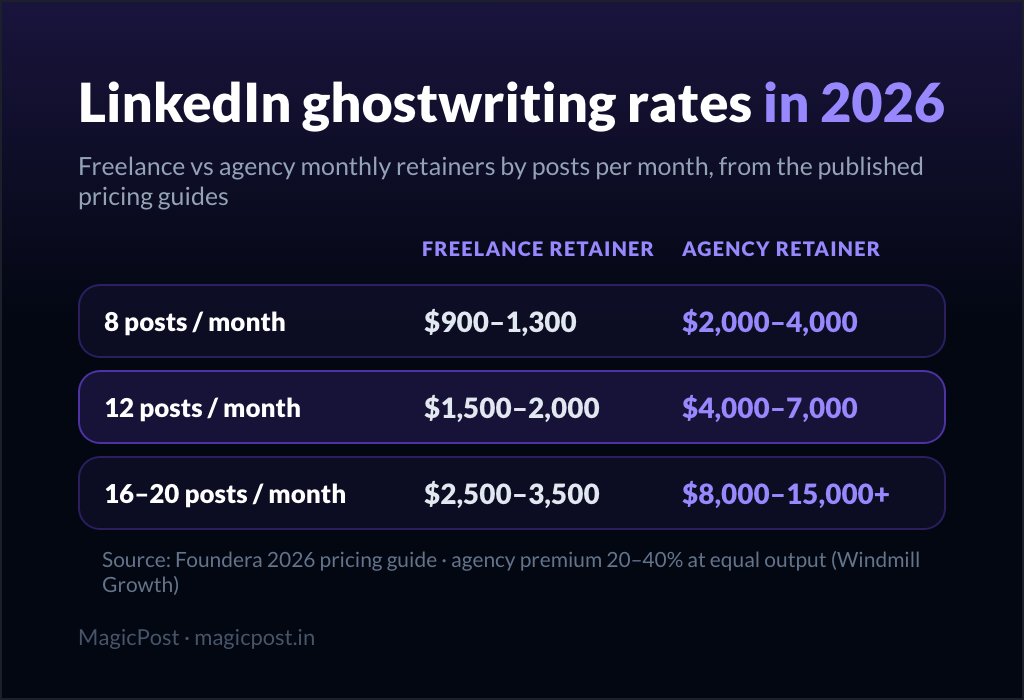
For what the service should cost, the LinkedIn ghostwriting rates page has the sourced ranges. This one is about how to pick.
What do LinkedIn ghostwriting services include?
A LinkedIn ghostwriting service writes, edits and usually publishes posts under a client's name, based on the client's ideas, interviews and past writing. The LinkedIn ghostwriting guide describes the job from the writer's side; from the buyer's side, a full service has five parts.
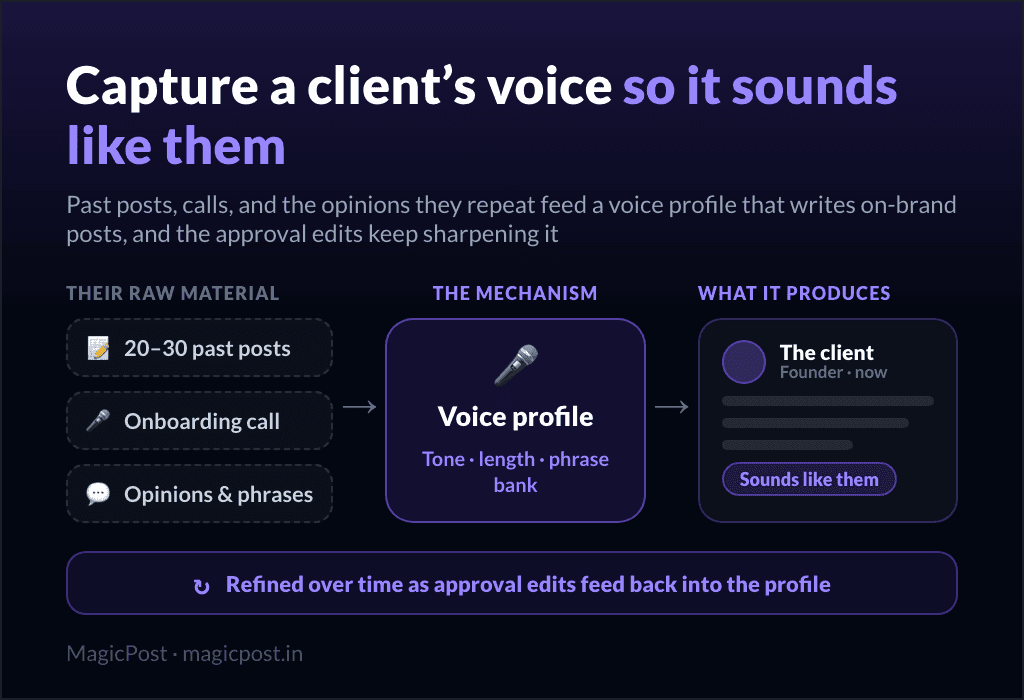
Voice capture. A voice audit of your past posts, an onboarding interview, and a style guide the writer keeps updating.
Strategy. Content pillars, a monthly calendar, and a point of view on what you should be known for.
Writing and design. Text posts, plus carousels, articles or a newsletter if the package includes them.
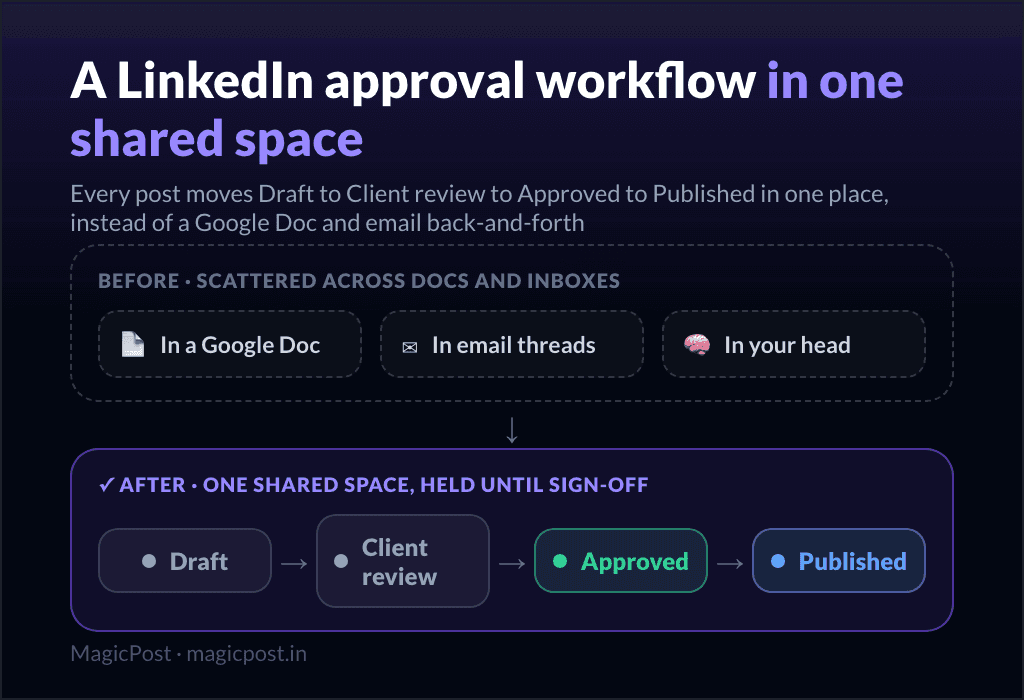
Approval and publishing. You review each post before it goes out, then the service schedules it to your profile.
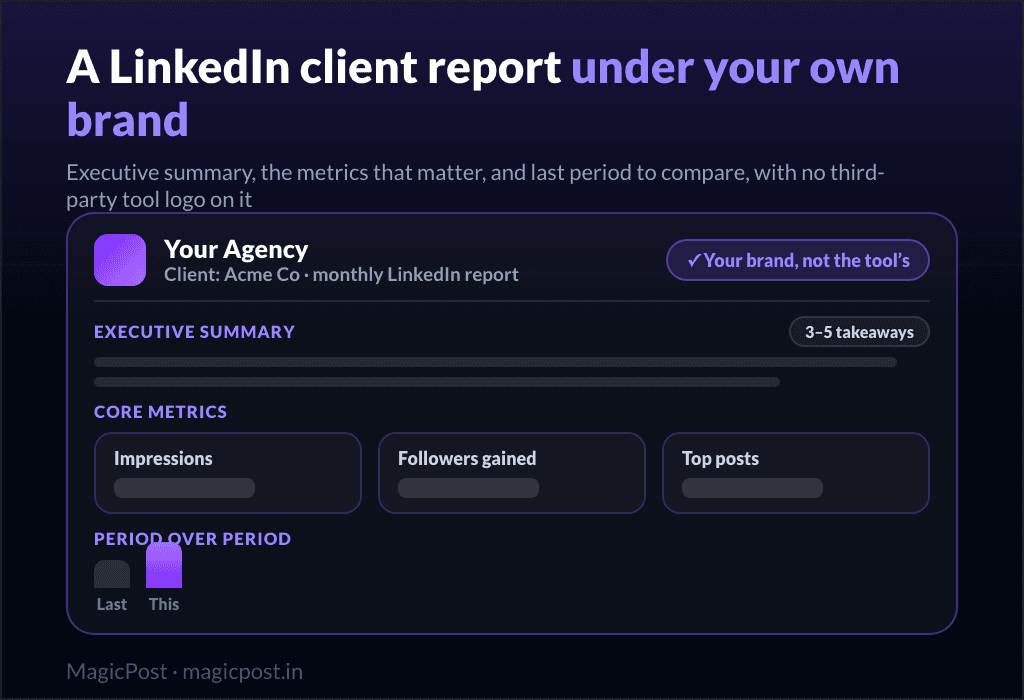
Engagement and reporting. Comment replies on your behalf, and a monthly report on impressions, followers and top posts.
Cheaper services drop strategy and engagement and sell writing only. That is a legitimate offer, as long as you know that is what you are buying. The rates by deliverable show how each part is priced.
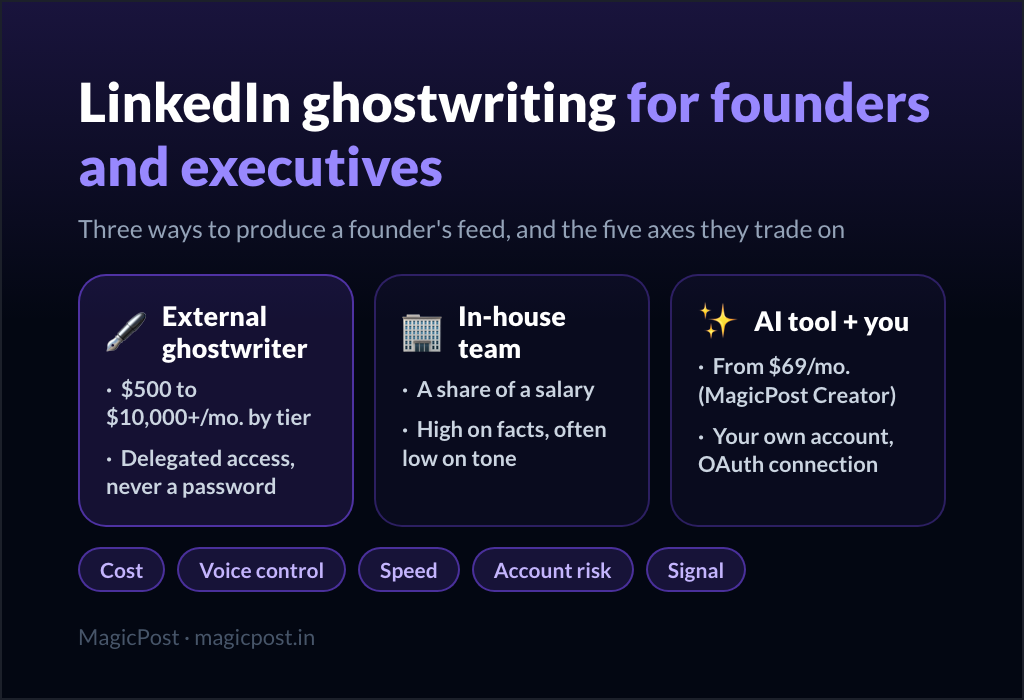
Agency, freelancer, in-house or a tool: which LinkedIn ghostwriting service fits?
The right model depends on how much process you need and how much of the writer's attention you want.
Model | Strength | Weakness | Fits best |
Freelancer | One accountable writer who learns your voice deeply | Single point of failure; capacity caps around a handful of clients | Founders and executives who want one voice and are available for interviews |
Agency | Process, backup writers, design and reporting built in | 20% to 40% more expensive at equal output (Windmill Growth); your writer may change | Executives with PR sensitivity, companies buying for several leaders |
In-house | Full control, daily access to the executive | A salary for one channel; hard to keep the skill sharp | Companies where LinkedIn is a primary pipeline channel |
Tool-assisted | Lowest cost; AI trained on your past posts drafts, you edit | You still do the thinking and the editing | Founders who like writing and lack time, not skill |
The agency premium comes from Windmill Growth's 2026 pricing guide. What it buys is redundancy: if a freelancer is sick in launch week, your calendar stops; an agency reassigns.
For executives specifically, the deciding factor is usually exposure. A CEO whose posts can move a stock or a funding round wants a second editor and a formal approval step, which pushes toward an agency or an in-house pair.
A founder building a personal pipeline is often better served by one freelancer who interviews them weekly. LinkedIn ghostwriting for founders goes deeper on that case.
The line between these models is blurrier than it looks. The best freelancers run on the same tooling agencies do (per-client voice, approval links, white-label reports), and the tools ghostwriters use are what let a solo writer offer agency-grade process.
How to evaluate a LinkedIn ghostwriting service
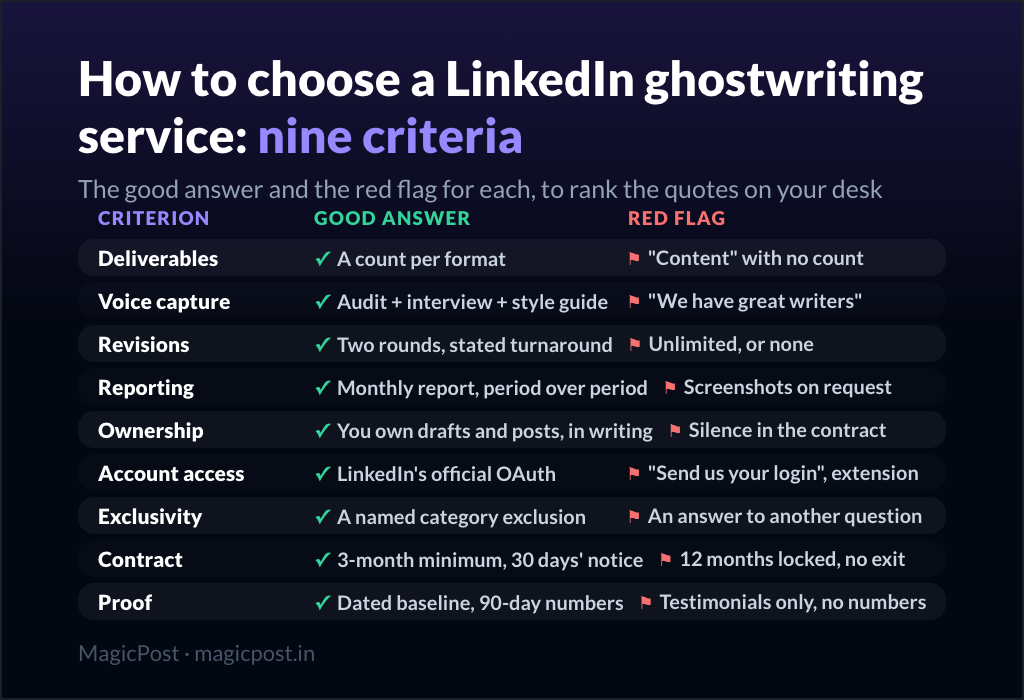
Ask every provider the same nine questions and write the answers in one grid. The good answers below are what a service with a real process gives without hesitation; the red flags are what you hear when the process does not exist.
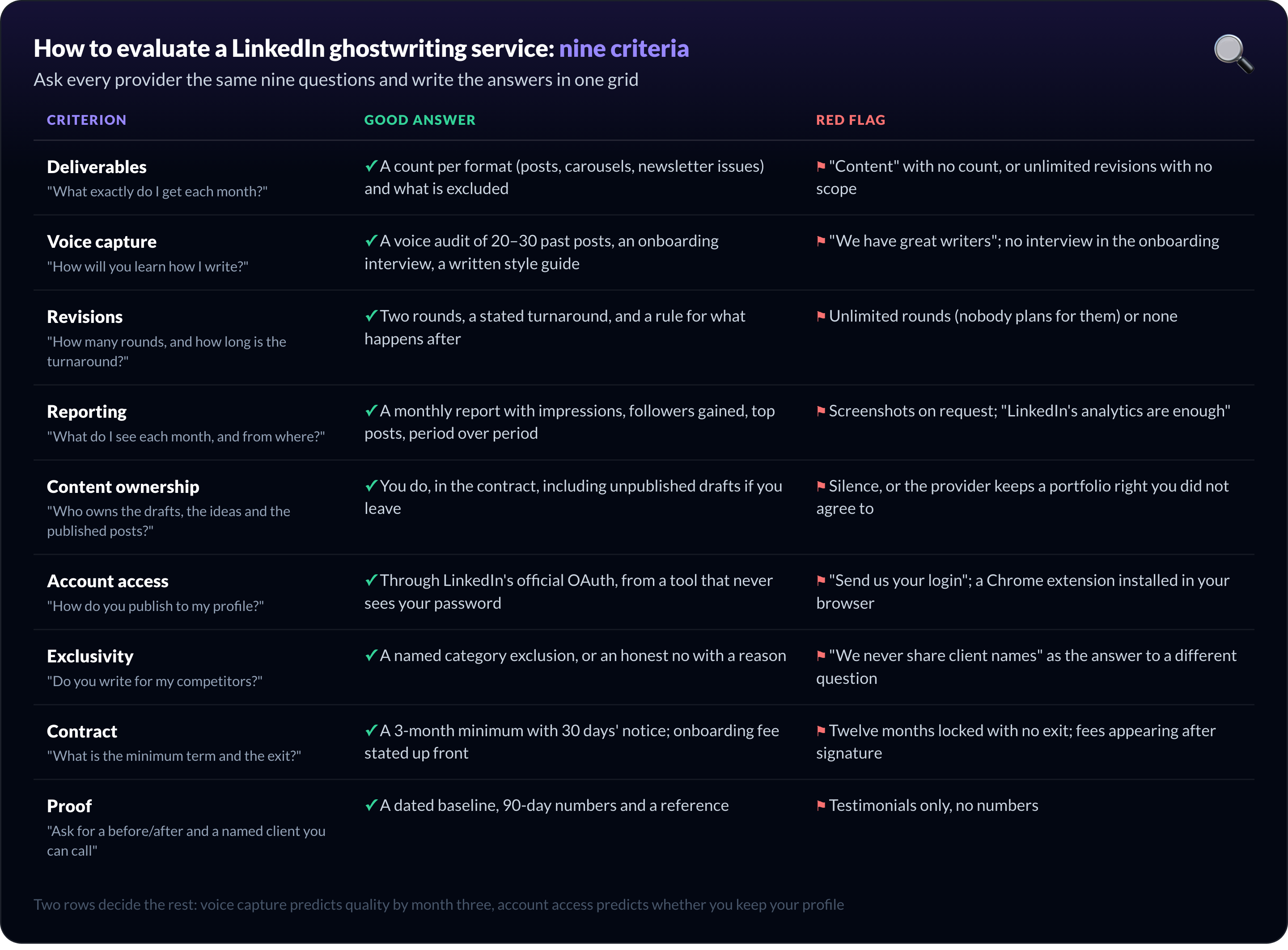
Criterion | What to ask | Good answer | Red flag |
Deliverables | "What exactly do I get each month?" | A count per format (posts, carousels, newsletter issues) and what is excluded | "Content" with no count, or unlimited revisions with no scope |
Voice capture | "How will you learn how I write?" | A voice audit of 20 to 30 past posts, an onboarding interview, a written style guide | "We have great writers"; no interview in the onboarding |
Revisions | "How many rounds, and how long is the turnaround?" | Two rounds, a stated turnaround, and a rule for what happens after | Unlimited rounds (nobody plans for them) or none |
Reporting | "What do I see each month, and from where?" | A monthly report with impressions, followers gained, top posts, period over period | Screenshots on request; "LinkedIn's analytics are enough" |
Content ownership | "Who owns the drafts, the ideas and the published posts?" | You do, in the contract, including unpublished drafts if you leave | Silence, or the provider keeps a portfolio right you did not agree to |
Account access | "How do you publish to my profile?" | Through LinkedIn's official OAuth, from a tool that never sees your password | "Send us your login"; a browser extension you are asked to install |
Exclusivity | "Do you write for my competitors?" | A named category exclusion, or an honest no with a reason | "We never share client names" as the answer to a different question |
Contract | "What is the minimum term and the exit?" | A 3-month minimum with 30 days' notice; onboarding fee stated up front | Twelve months locked with no exit; fees appearing after signature |
Proof | Ask for a before/after and a named client you can call | A dated baseline, 90-day numbers and a reference | Testimonials only, no numbers |
Two of those rows decide the rest. Voice capture predicts whether the posts will sound like you by month three, and the voice-capture method a service can describe is the best predictor of quality you will get before signing. Account access predicts whether you keep your profile.
Who owns the content and account access in a LinkedIn ghostwriting service?
Ownership is the clause buyers skip and regret. The posts carry your name, but unless the contract says so, the drafts, the idea bank and the style guide belong to whoever wrote them, and leaving the service can mean starting from zero.
Ask for three things in writing: you own every draft and published post, you receive the style guide and idea backlog on exit, and the provider may only cite you as a client with your consent.
Account access is a safety question, not a convenience question. There are three ways a service can publish for you.
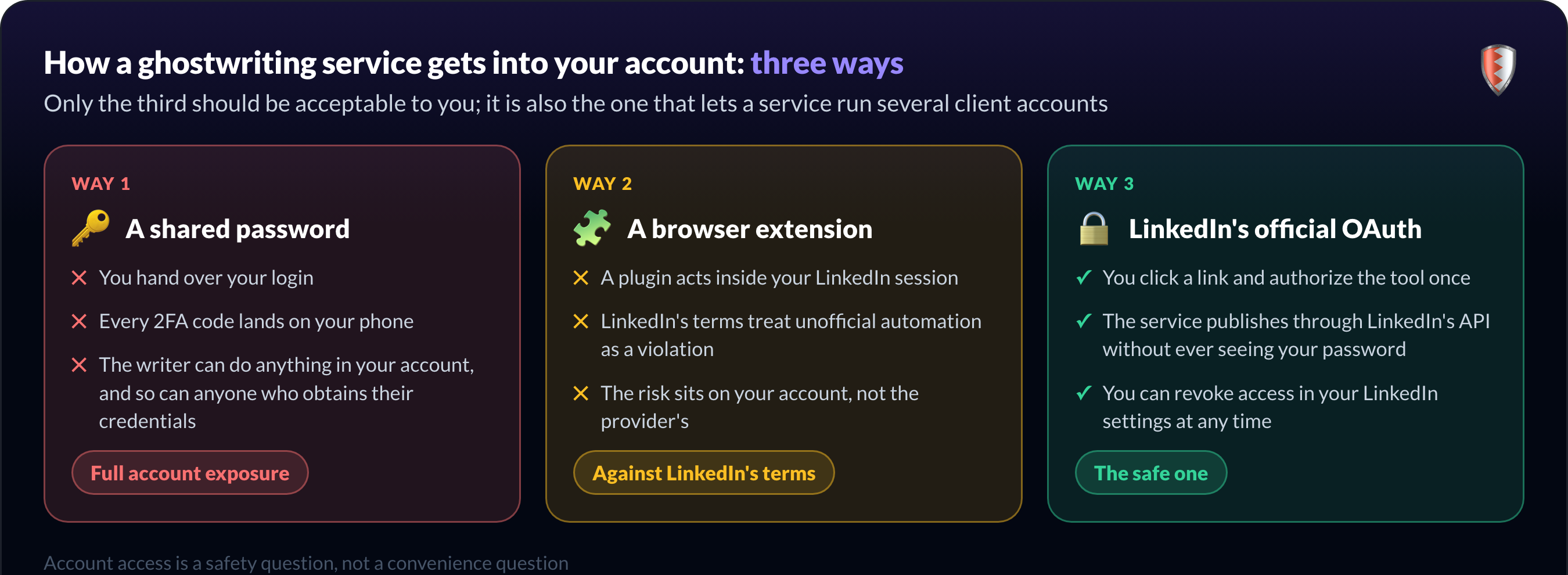
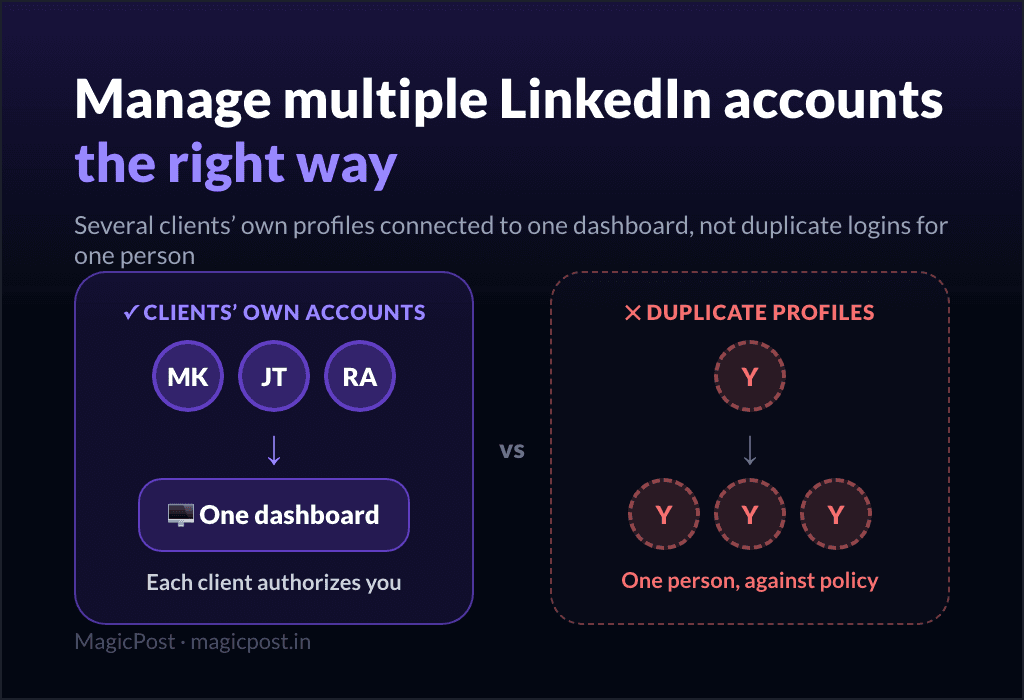
A shared password. You hand over your login; every 2FA code lands on your phone; the writer can do anything in your account, and so can anyone who obtains their credentials.
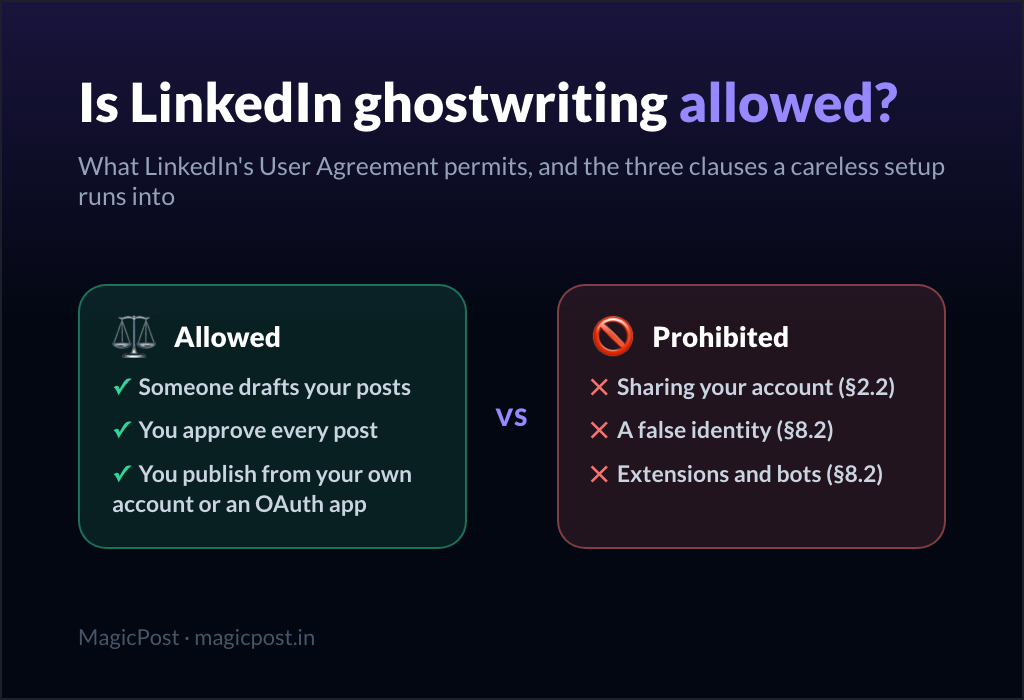
A browser extension. The writer installs a plugin that acts inside your LinkedIn session. LinkedIn's terms treat unofficial automation as a violation, and the risk sits on your account, not the provider's.
LinkedIn's official OAuth. You authorize the tool once from a link, the service publishes through LinkedIn's API without ever seeing your password, and you can revoke it from your LinkedIn settings.
Only the third option should be acceptable to you. It is the only one of the three that shares no credential at all and stays inside LinkedIn's User Agreement; it also lets a service run several client accounts from one workspace.
Whether ghostwriting itself is allowed under LinkedIn's rules is a separate question, covered in is LinkedIn ghostwriting allowed.
Ask to see the approval step before you sign. With MagicPost's LinkedIn post approval, a service shares a link where you review each post as it will look on LinkedIn, comment, and approve, with no account to create and no password to share; nothing publishes until you say yes.
What LinkedIn ghostwriting services should report
A service that cannot show you numbers is asking you to pay on faith. The monthly report should answer one question: is this working, and what changes next month?
Impressions and reach per post and per month, with the trend.
Followers gained, because the audience is the asset that outlives any single post.
Top posts by engagement, and what they have in common.
Period over period, so a good month is measured against the last one, not against nothing.
Next month's plan, based on the above.
What the report looks like matters less than that it exists on a fixed date. The white-label LinkedIn report format is what agencies send when they have this in place; if a freelancer sends the same thing under their own name, that is just as good.
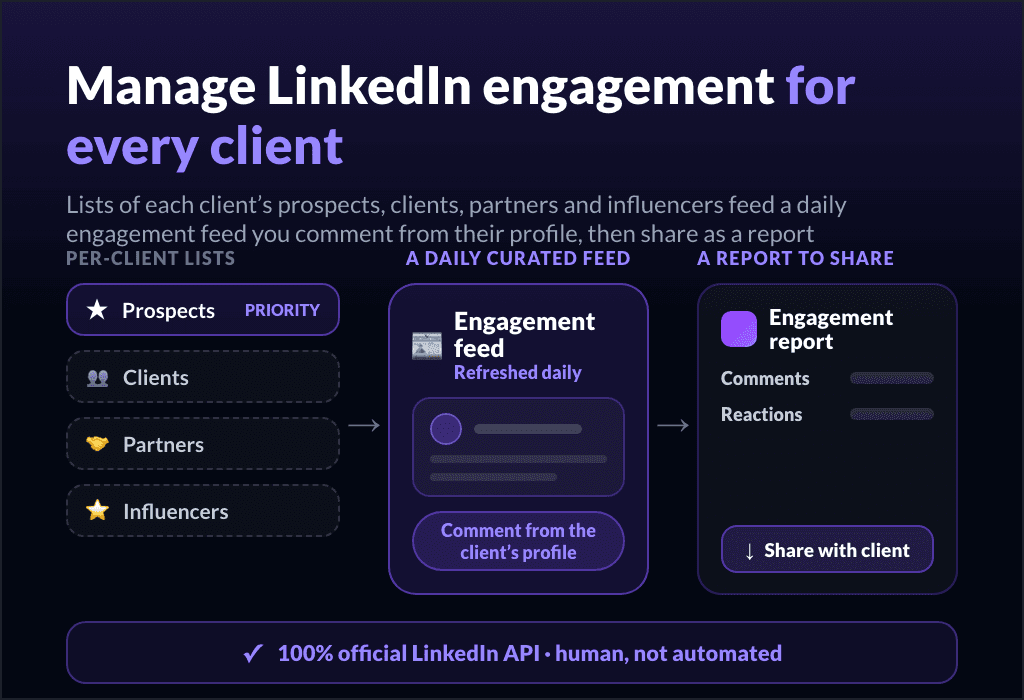
If comment engagement is part of the package, ask how it is reported too: how many comments, on whose posts, from which list of accounts. How agencies manage LinkedIn engagement for clients describes what a defined engagement scope looks like.
Red flags in a LinkedIn ghostwriting service
Four of the red flags already sit in the grid above: the password request, the browser extension, the missing report, the voice-capture method nobody can name. None has a safe version; the account or the voice at risk is yours, not theirs.
Two are not in the grid. No approval step means posts go out without your sign-off, and you will eventually explain one to your board. A promise of numbers (followers, viral posts, leads) is the second: nobody controls the LinkedIn feed, so a guarantee means the metric will be gamed.
What a serious LinkedIn ghostwriting service looks like
A serious service shows you its process before you ask: the onboarding interview, the approval link, the report, the OAuth connection. It can also show you a client who scaled with it.
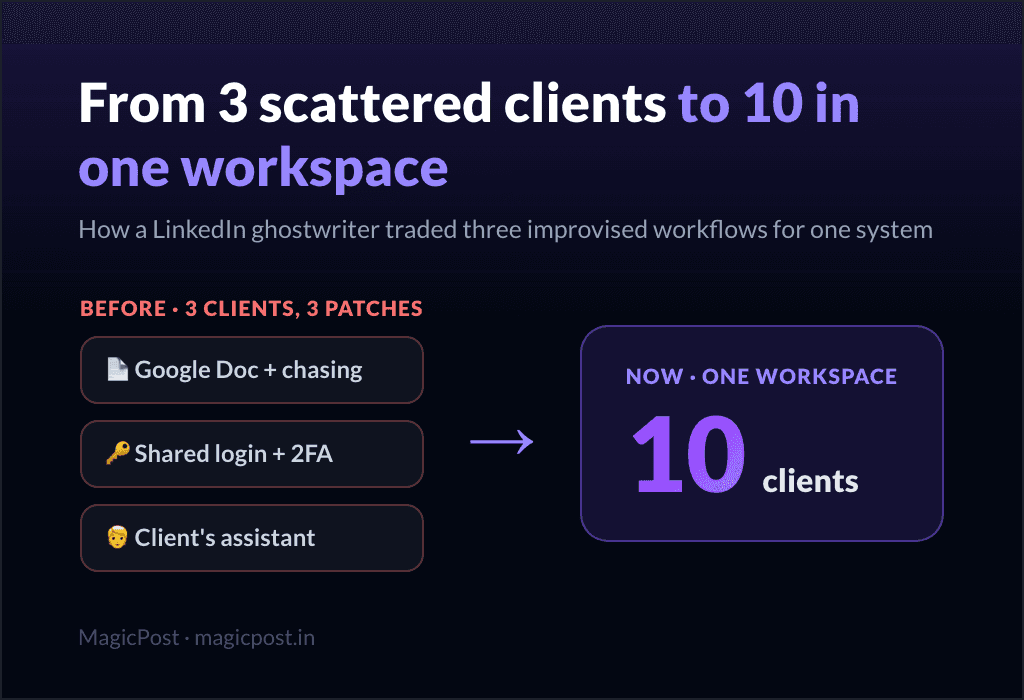
The Nicole Ramirez case study is the shape to look for. At three clients she was running three different workarounds, and one of them was the shared-login-plus-2FA setup from the red flags above.
What changed when she went to ten clients was not the writing. Every client got the same process: a connect link instead of a password, validation switched on or off per client, and a report pulled from one place. Same process, ten times, is what a service means by scale.
The test for any service you are evaluating is whether it could tell that story about its own clients: which step of the process it removed, and what the client did with the time.
How MagicPost supports LinkedIn ghostwriting services
MagicPost is built for LinkedIn ghostwriting services, and the part a buyer meets first is the approval step: the service sends you a link, and you approve each post from it without creating an account or sharing a password.
Per-client workspaces, the OAuth connection, the saved writing style and the monthly white-label report run behind that link. It is the setup Nicole Ramirez used to go from three to ten ghostwriting clients.
If you are the buyer, ask your shortlisted providers what they run on and whether you will approve posts from a link. If you are the provider, the agencies page shows the multi-client setup.
FAQ
What is the best LinkedIn ghostwriting service?
The best LinkedIn ghostwriting service is the one that can show you its voice-capture method, an approval step, a monthly report and an official OAuth connection to your account before you sign.
No public ranking of providers publishes its audit criteria, so rank your shortlist on the nine criteria above rather than on a list.
Should an executive hire a LinkedIn ghostwriting agency or a freelancer?
An executive whose posts carry PR or investor risk should hire a LinkedIn ghostwriting agency or an in-house pair, for the second editor and the formal approval step.
A founder building a personal pipeline is usually better served by one freelancer who interviews them weekly. Agencies cost 20% to 40% more at equal output, according to Windmill Growth.
Which LinkedIn ghostwriting service is best for SaaS founders?
A SaaS founder is best served by a LinkedIn ghostwriting service that interviews them regularly (product opinions do not survive a questionnaire), publishes through official OAuth, and reports followers gained and top posts monthly. Whether that is a freelancer or an agency matters less than whether those three parts exist.
Who provides LinkedIn ghostwriting with content strategy for companies?
LinkedIn ghostwriting with content strategy for companies is typically an agency or senior-freelancer offering, priced above writing-only packages: strategy, content pillars and a monthly call separate the entry band from the mid band in the 2026 pricing guides.
Ask for the strategy deliverable by name (a written plan, a calendar, a monthly review), not as a word in the proposal.
How do LinkedIn ghostwriting services access my account?
A safe LinkedIn ghostwriting service accesses your account through LinkedIn's official OAuth: you authorize a tool once from a link, it publishes through LinkedIn's API, and you can revoke it at any time.
Services that ask for your password or install a browser extension expose your account to a suspension you would bear alone.
What should a LinkedIn ghostwriting service report every month?
A LinkedIn ghostwriting service should report impressions, followers gained, top posts, a period-over-period comparison and next month's plan, on a fixed date. If engagement is included, the report should also count comments made and on whose posts.